
Quick Summary:
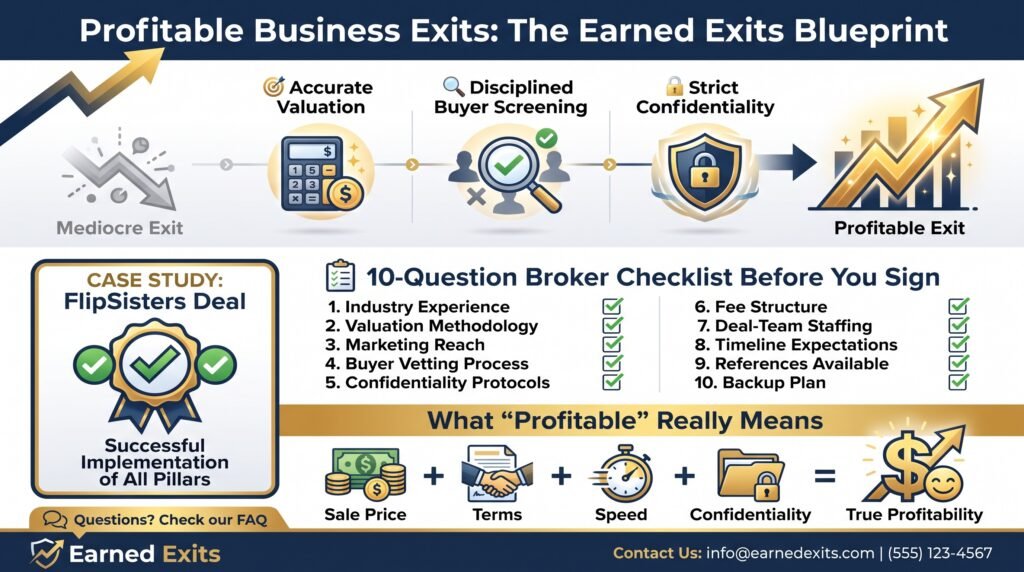
This article breaks down what separates profitable business exits from mediocre ones — accurate valuation, disciplined buyer screening, and strict confidentiality, and uses Earned Exits’ approach (including the FlipSisters deal) as the model. The second half is a 10-question checklist owners should run through with any business broker before signing, covering industry experience, valuation methodology, marketing reach, buyer vetting, confidentiality protocols, fee structure, deal-team staffing, timelines, references, and backup plans if a buyer doesn’t materialize. A closing FAQ section reinforces these points and explains what “profitable” really means beyond just the sale price.
Table of Contents
- Quick Summary:
- What Sets Profitable Exits Apart from Average Ones
- 10 Critical Questions to Ask a Business Broker Before Signing
- Frequently Asked Questions
What Sets Profitable Exits Apart from Average Ones
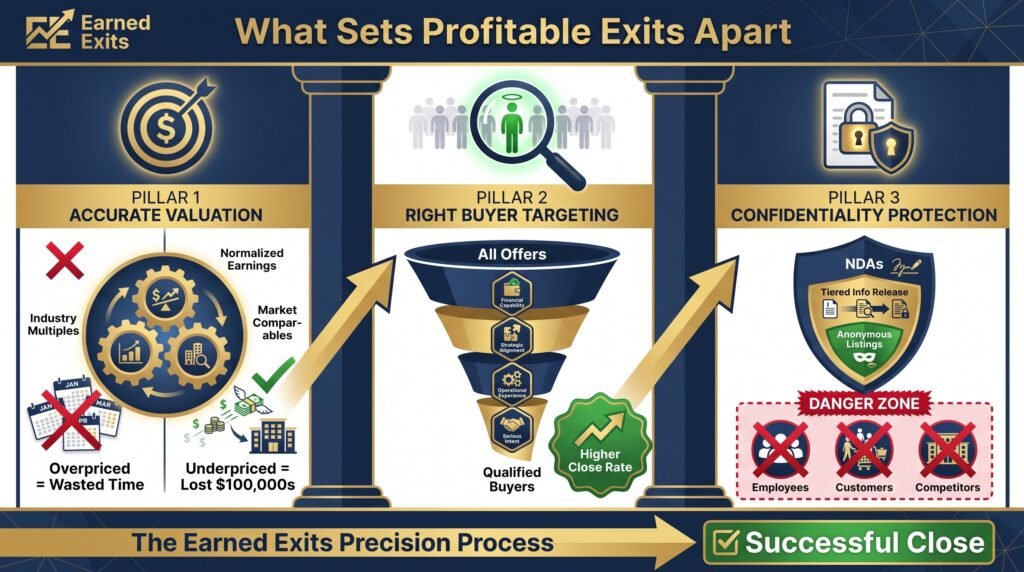
Walk through enough business sale case studies and a clear pattern emerges. The exits that produce the best outcomes share three things: an accurate starting valuation, a disciplined buyer targeting process, and airtight confidentiality management throughout the sale. Get any one of these wrong and the deal either falls apart or closes at a fraction of what it should have.
Earned Exits has built its entire process around executing all three with precision.
Accurate Valuation From the Start
Overpricing a business drives away serious buyers and creates months of wasted time. Underpricing it costs the seller hundreds of thousands of dollars in a single transaction. Earned Exits uses a combination of industry-specific multiples, normalized earnings analysis, and market comparables to arrive at valuations that attract qualified buyers and hold up through due diligence.
Targeting the Right Buyers, Not Just the Highest Bidders
The highest offer isn’t always the best offer. A buyer who lacks the financing, operational experience, or strategic fit to close the deal is a liability, not an asset. Earned Exits screens buyers rigorously before introducing them to sellers, filtering for financial capability, industry background, and genuine intent to close.
- Financial qualification: Buyers must demonstrate they have the capital or financing to complete the transaction
- Strategic alignment: The buyer’s goals must align with the business’s existing model and growth trajectory
- Operational capability: Buyers are evaluated on whether they can realistically run and grow the business post-sale
- Serious intent: Tire-kickers are filtered out early to protect the seller’s time and confidentiality
This screening process is one of the key reasons Earned Exits transactions reach the closing table at a higher rate than industry averages. Sellers aren’t burned by unqualified buyers who fall through at the last moment after months of negotiation.
It also protects the seller’s leverage. When multiple qualified buyers are competing for a business, the seller is in the driver’s seat, and Earned Exits structures the process to create exactly that dynamic wherever possible.
Protecting Confidentiality During the Sale Process
One of the fastest ways to damage a business during a sale is for word to leak to employees, customers, or competitors before the deal is signed. Earned Exits uses non-disclosure agreements, tiered information release protocols, and anonymous listing strategies to ensure confidentiality is maintained from the first conversation to the final closing document.
10 Critical Questions to Ask a Business Broker Before Signing
Choosing the wrong broker is one of the most expensive mistakes a business owner can make. A bad fit doesn’t just mean a lower sale price, it can mean a deal that falls apart entirely, confidentiality breaches that damage the business, or months of wasted time pursuing buyers who were never qualified to close.
Before you sign any engagement agreement, ask these ten questions. The answers will tell you everything you need to know about whether a broker has the experience, resources, and integrity to represent your business properly.
1. How Many Businesses Have You Successfully Sold in My Industry?
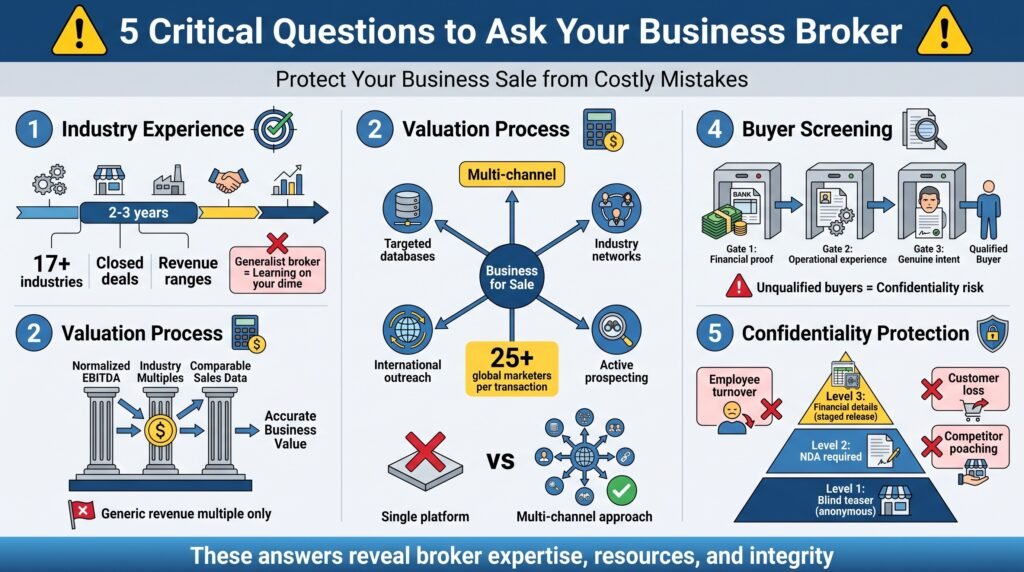
Industry-specific experience is not optional, it’s essential. A broker who has sold dozens of e-commerce businesses understands the buyer pool, the valuation multiples, the typical deal structures, and the red flags that kill deals in that space. A generalist broker working in an unfamiliar industry is essentially learning on your time and your dime.
Ask for specific examples. How many businesses in your sector have they sold in the last two to three years? What were the approximate revenue ranges? Did those deals close at or above the original asking price? These questions separate brokers with genuine expertise from those who will claim familiarity with any industry to win the listing.
Earned Exits brings transactional experience across 17+ industries, which means they can draw on real deal data, not educated guesses, when positioning your business in the market.
2. How Do You Value a Business Like Mine?
Valuation methodology matters enormously. A broker who simply applies a generic revenue multiple without accounting for your specific earnings, customer concentration, growth trajectory, and market conditions is likely to either overprice or underprice your business, both of which are damaging outcomes.
The right answer involves a combination of normalized EBITDA analysis, industry-specific multiples, and a detailed review of what comparable businesses have actually sold for in the current market. If a broker can’t walk you through their valuation process in specific terms, that’s a serious red flag.
3. What Does Your Marketing Strategy Actually Look Like?
Listing your business on a single platform and waiting for inquiries is not a marketing strategy, it’s a passive approach that leaves money on the table. A serious broker should be able to describe a multi-channel outreach plan that includes targeted buyer databases, industry-specific networks, international buyer outreach, and active prospecting. Earned Exits deploys 25+ global marketers and analysts per transaction specifically because passive listing strategies consistently underperform.
4. How Do You Screen Buyers Before Introducing Them to Me?
Every unqualified buyer who gets access to your financials is a confidentiality risk and a time drain. A rigorous broker screens for financial capability through proof of funds or financing pre-approval, evaluates the buyer’s relevant operational experience, and assesses genuine intent before any sensitive information changes hands. If a broker can’t explain their buyer screening process in detail, assume it doesn’t exist.
5. How Do You Protect Confidentiality During the Sale?
Why Confidentiality Is Non-Negotiable During a Business Sale
When employees find out a business is for sale before a deal is finalized, turnover risk spikes immediately. Key staff members, often the very people a buyer is counting on being there post-sale, begin exploring other opportunities. Customers who learn of a pending sale may reduce orders or seek alternative suppliers. Competitors can use the information to poach clients or recruit your team. A broker without a rigorous confidentiality protocol doesn’t just risk your deal, they risk your business.
The confidentiality question should produce a detailed, specific answer. Look for brokers who use blind teasers, anonymous marketing documents that describe the business without identifying it, as the first step in buyer outreach. NDAs should be required and signed before any identifying information is shared, and the release of financial details should happen in stages, only as buyer qualification is confirmed.
Ask specifically how they handle inquiries from competitors who express interest in acquiring the business. This is a scenario that comes up more often than sellers expect, and it requires a broker with both legal awareness and situational judgment to navigate correctly.
Earned Exits manages confidentiality through tiered information protocols, requiring signed NDAs before any business-identifying details are disclosed and screening buyers before financials are shared. For sellers, this means the business continues operating normally, without disruption to staff, customers, or vendor relationships, throughout the entire sale process.
6. What Is Your Fee Structure and When Do You Get Paid?
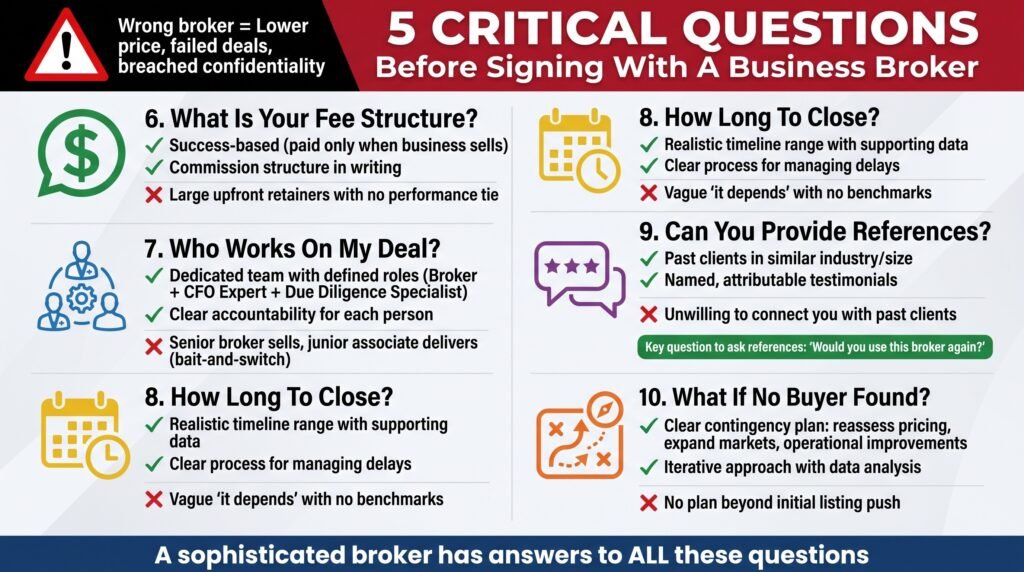
Reputable business brokers, including Earned Exits, work on a success-based fee structure, meaning the broker only gets paid when your business sells. This alignment of incentives is fundamental. A broker charging large upfront retainers with no performance obligation has no financial motivation to close your deal. Always confirm the fee is contingent on a successful transaction, and get the full commission structure in writing before signing anything.
7. Who Specifically Will Be Working on My Deal?
Some brokerages win your listing with their most experienced senior broker, then hand your deal off to a junior associate once the paperwork is signed. This bait-and-switch is unfortunately common, and it directly affects your outcome. You need to know exactly who will be managing your transaction, who will be handling buyer communications, and who is responsible for your due diligence process.
Earned Exits answers this question through their Trifecta Team model, a dedicated broker, a CFO-level financial expert, and a due diligence specialist assigned to each transaction. You know exactly who is working your deal, and each person has a defined role and accountability.
8. How Long Does It Typically Take You to Close a Sale?
Timeline varies based on business complexity, market conditions, and buyer availability, but a broker should be able to give you a realistic range based on their recent transaction history. Vague answers like “it depends” without any supporting data suggest a broker who either hasn’t closed enough deals to have meaningful benchmarks or is managing your expectations down from the start.
More important than the timeline itself is understanding what drives delays and how the broker actively manages the process to keep deals moving. Due diligence is where most transactions slow down, which is precisely why Earned Exits includes a dedicated due diligence specialist in every deal team.
9. Can You Provide References from Past Clients?
References are non-negotiable. Any broker unwilling to connect you with past clients is hiding something, whether it’s a thin transaction history, unhappy sellers, or deals that didn’t close as promised. Ask for references from clients whose businesses were similar in size and industry to yours, not just the broker’s most impressive success stories.
When you speak with references, ask specific questions: Did the business sell for what the broker initially estimated? Were there any surprises during due diligence, and how did the broker handle them? Would you use this broker again? That last question is the most revealing, it cuts through polished testimonials and gets to the truth of the experience.
Earned Exits publishes client testimonials directly on their website, including the FlipSisters feedback noting that the team was “incredibly thorough and efficient.” Real, attributable testimonials from named clients carry far more weight than anonymous five-star reviews.
10. What Happens if They Cannot Find a Buyer?
This question makes brokers uncomfortable, which is exactly why you need to ask it. What is their contingency plan if the first round of buyer outreach doesn’t produce qualified offers? Will they reassess the pricing? Expand the buyer search to new markets? Recommend operational improvements before relisting?
A broker without a clear answer to this question has no plan beyond the initial listing push. That’s a significant risk for a seller who has committed months to the process. A strong broker will walk you through their iterative approach, how they analyze buyer feedback, adjust strategy, and continue active outreach until the right buyer is identified.
The ability to course-correct mid-process is one of the clearest indicators of broker sophistication. It requires data, market awareness, and a buyer network broad enough to pivot when the initial approach isn’t generating the right results.
Learn about how Earned Exits prepares a business for sale and the profitable Flipsters business exit case study here.
Frequently Asked Questions
The questions below cover the most important things business owners ask before deciding to sell, and before choosing who to trust with that process. Read through them carefully. The answers here will help you walk into your first broker conversation fully prepared.
How does Earned Exits find the right buyers for a business?
Earned Exits uses a multi-channel buyer sourcing strategy that combines active outreach with a proprietary network of qualified buyers built over 30+ years of mid-market transactions. Their team of 25+ global marketers and analysts works across domestic and international markets to identify buyers who have both the financial capability and strategic motivation to close a deal at the right price.
The process begins with a targeted outreach campaign built around a detailed buyer profile, not a blanket listing sent to every name in a database. This profiling draws on industry comparables, deal history, and buyer behavioral data to identify the buyers most likely to value the specific business being sold.
Buyer screening happens before any sensitive information is shared. Earned Exits requires financial qualification, signed NDAs, and an assessment of operational fit before a seller ever interacts with a prospective buyer. This protects confidentiality, preserves seller leverage, and dramatically reduces the risk of a deal collapsing due to buyer unpreparedness late in the process.
The result of this approach is a curated pool of serious, qualified buyers competing for the business, rather than a wide-open process that attracts tire-kickers and exposes the seller’s information to people who were never going to close anyway.
Proprietary buyer network built across 30+ years of mid-market transactions
25+ global marketers and analysts conducting active outreach per transaction
Domestic and international buyer sourcing to maximize competitive interest
Targeted buyer profiling based on industry, deal size, and strategic fit
Multi-stage screening process requiring financial qualification and signed NDAs before information is shared
How does Earned Exits maintain confidentiality during a sale?
Confidentiality is managed through a tiered information release protocol. Initial buyer outreach uses blind teasers — marketing documents that describe the business opportunity without identifying the company by name, location, or any detail that could expose it to employees, customers, or competitors. Only after a buyer signs a non-disclosure agreement and passes the initial qualification screen does any identifying information get released.
Financial documentation is shared in stages, with deeper access granted only as buyer qualification is confirmed at each level. This approach means the most sensitive operational and financial details, the information that could cause real damage if it reached the wrong hands, are protected until a buyer has demonstrated both the intent and capability to close the deal.
What does a profitable business exit actually look like beyond the sale price?
A profitable exit means the deal structure works in the seller’s long-term financial interest, whether that’s an all-cash closing, a seller note that generates ongoing income, or an earnout arrangement tied to post-sale performance milestones.
It means the buyer is qualified to sustain and grow the business, so the seller isn’t fielding crisis calls six months after closing. It means the seller’s team is protected, the brand continues under capable ownership, and the transition period is structured so the seller can actually move on. The sale price is the headline, but these factors determine whether the exit was genuinely profitable or just financially large.
How long does it typically take to sell a business with Earned Exits?
Timeline varies based on business complexity, industry, buyer availability, and current market conditions. Simpler businesses with clean financials and strong earnings tend to move faster. Businesses with complex ownership structures, customer concentration issues, or heavily owner-dependent operations typically require more preparation time before going to market, but that upfront investment almost always results in a stronger outcome.
The phase where most deals slow down is due diligence. Buyers and their advisors are thorough, and any gap in documentation becomes a bottleneck. This is precisely why Earned Exits includes a dedicated due diligence specialist in every transaction, their job is to anticipate buyer requests and have documentation organized and ready before the questions are asked, not scrambling to produce records under deadline pressure.
The most important thing to understand about timeline is that rushing a sale almost always costs money. A seller who pushes for a faster close before the right buyer has been identified often accepts a lower offer or worse deal terms just to get to a finish line. Earned Exits is structured to move as efficiently as possible — but always in service of the best outcome for the seller, not the fastest one.
What is a business broker and why do I need one to sell my business?
A business broker is a professional intermediary who manages the entire process of selling a business on behalf of the owner, from valuation and packaging through buyer sourcing, negotiation, due diligence, and closing.
You need one because selling a business is not a single transaction, it’s a complex, multi-stage process involving financial analysis, legal documentation, confidentiality management, and negotiation strategy that most business owners have never encountered before. The cost of getting it wrong is not a minor inconvenience. It’s measured in hundreds of thousands of dollars of value that never makes it to the closing table.

*Disclaimer: This article is written for educational purposes and should not be interpreted as financial advice. We may receive compensation for referrals made through this article.