
Latest posts
-
These 7 States Could Take Half Your Business Sale. Here’s How to Stop Them in 2026
Quick Summary These 7 states: California, New York, New Jersey, Illinois, Massachusetts, Oregon, and Washington, can quietly claim up to half your sale price through capital gains, income, and property taxes. A $5M California sale alone can trigger $650K+ in state taxes before federal obligations. The fix isn’t avoiding these states, it’s planning your exit
-
Selling a Business in Oregon? 10 Little-Known Tax Strategies to Cut Your Bill (2026)
Quick Summary Oregon taxes capital gains as ordinary income up to 9.9%, making tax planning critical before selling a business. This guide covers 10 lesser-known strategies, from qualifying for Oregon’s reduced 5% business sale rate to structuring earnouts, deferred compensation, cost segregation studies, and 1031 exchanges for real estate holdings, that can save sellers tens
-
Selling a Business in Oregon? 10 Tax Strategies to Save Thousands (2026)
Quick Summary Oregon taxes capital gains as ordinary income (up to 9.9%), making business sales in the state expensive without planning. The article outlines 10 tax strategies — from qualifying for Oregon’s reduced 5% business sale rate, to installment sales, stock-vs-asset structuring, QSBS exclusions, Opportunity Zones, charitable remainder trusts, ESOPs, pre-sale relocation to a no-income-tax
-
Selling Your Oregon Business: The Complete Tax and Timing Guide
Quick Summary Selling an Oregon business typically takes 6–10 months and involves specific state requirements: confirming good standing with the Oregon Secretary of State, complying with ORS Chapter 56, and transferring city/county licenses (which can take weeks to months for regulated industries like cannabis, healthcare, or construction). Success depends on aligning three factors — favorable
-
Selling an Oregon Business? Here’s What Capital Gains Tax Really Costs You in 2026
Quick Summary Selling an Oregon business is one of the most financially complex events of your entrepreneurial life, and most sellers don’t realize how much the details matter until it’s too late. Oregon’s business environment is genuinely appealing to buyers, no sales tax, a growing tech and manufacturing sector, and a resilient small business community,
-
Selling a Washington Business? 8 Tax-Saving Strategies for 2026
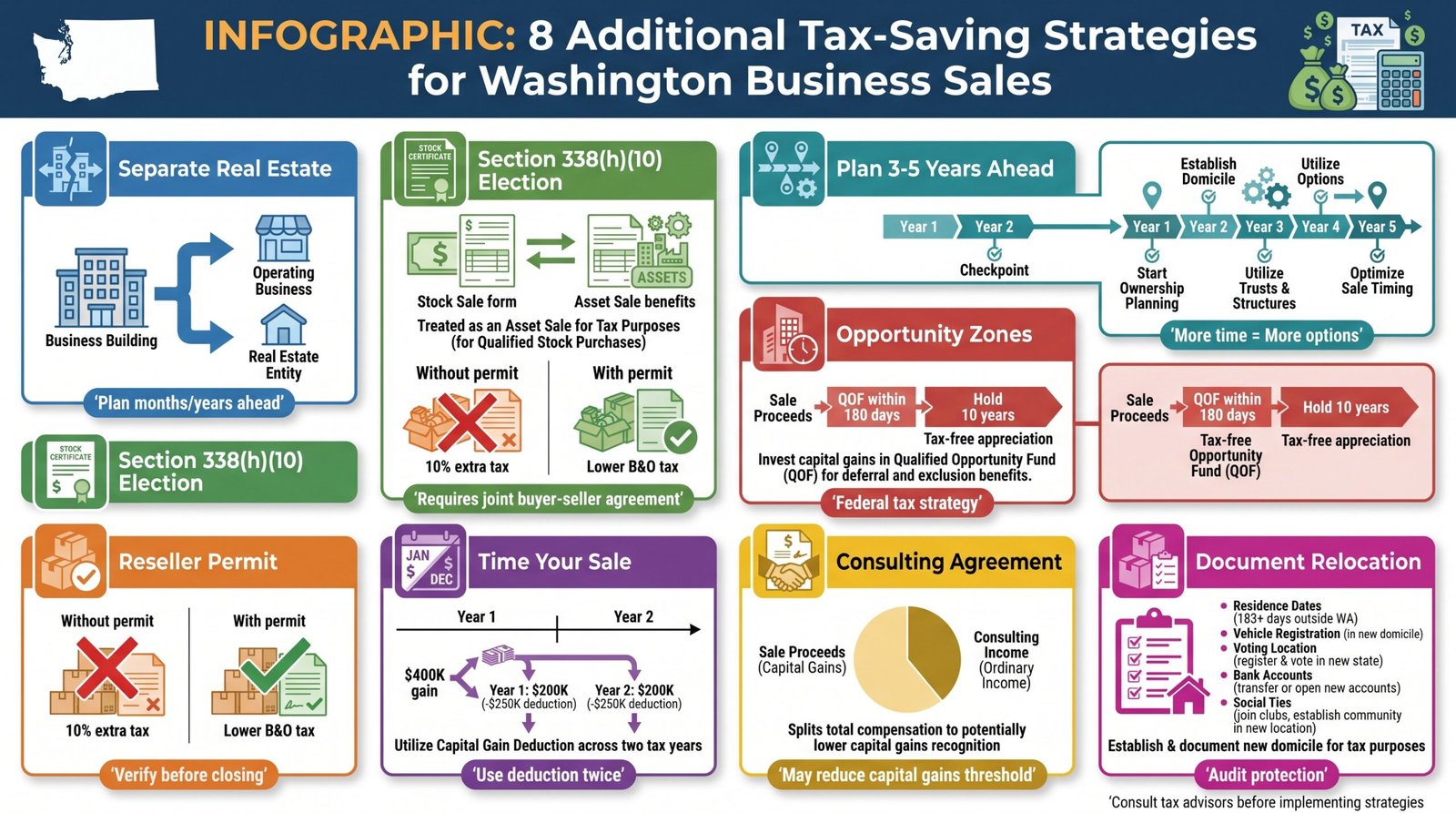
Quick Summary Selling a Washington business? Beyond the first 7 strategies covered earlier, this article adds 8 more ways to cut your tax bill: separating real estate from the operating business, using a Section 338(h)(10) election for C-corps, securing proper reseller permits for inventory sales, timing your sale to capture Washington’s $250,000 annual capital gains
-
7 Tax-Saving Strategies for Selling Your Washington Business (2026 Guide)
Quick Summary Washington business owners selling their companies face a tough tax environment: a state capital gains excise tax (7%, rising to 9.9% on gains over $1M), plus federal capital gains, B&O tax, and possible sales/real estate excise tax. The article outlines 7 strategies to reduce that burden: (1) claim the Qualified Family-Owned Small Business
-
Washington Business Sale Guide 2026: Timeline, Taxes, and Building Your Exit Team
Quick Summary Selling a business in Washington involves several state-specific legal steps: an asset or stock purchase agreement, IRS Form 8594 filing, tax clearance from the Department of Revenue, lien releases, and (for LLCs) following operating agreement transfer provisions. Most sales take 6–12 months (longer for larger deals), broken into prep/valuation, marketing, due diligence, and
-
Washington Business Sale Guide (2026): Find Buyers, Get Valued, and Avoid Costly Mistakes
Quick Summary Selling a business in Washington starts with knowing its real worth — EBITDA, industry multiples, customer concentration, and owner dependency all drive the number, and a professional valuation (BOV, certified CVA/ABV, or QoE report) costs $3,000–$15,000+ and takes 2–10 weeks depending on type. Washington’s buyer pool includes strategic buyers (competitors paying premiums for
-
Selling a Business in Washington State (2026): Tax and Timing Guide
Quick Summary Selling your business in Washington is one of the most financially significant events of your life. Earned Exits is an elite business broker that works directly with business owners navigating these exact transactions. Their full-service approach, from deal structuring to closing, reflects exactly the kind of expert guidance that separates a good exit