
Key Takeaways
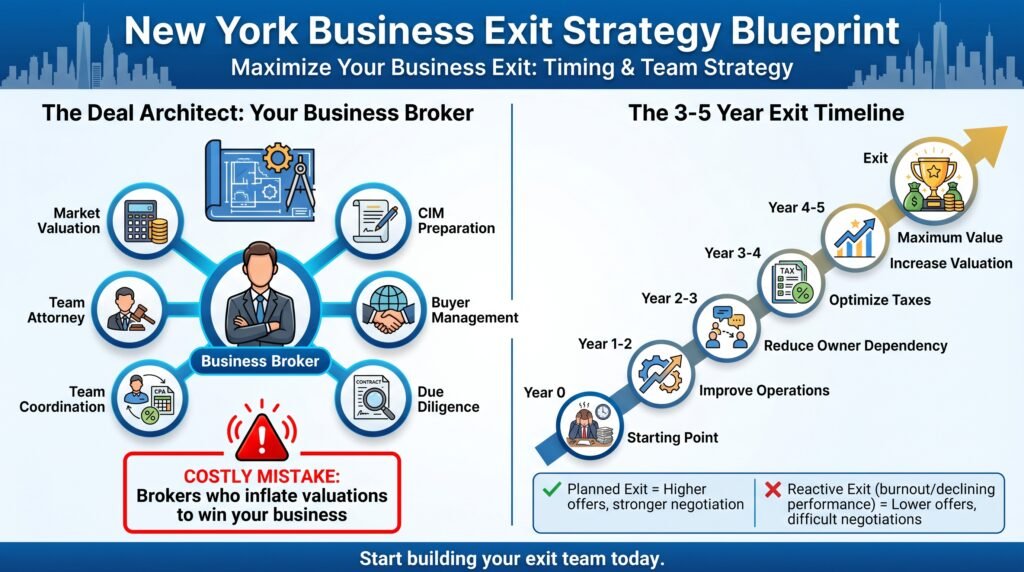
Selling a New York business in 2026 is about far more than finding a buyer — it’s about maximizing after-tax proceeds, protecting confidentiality, and timing the market correctly.
1. The Role of a Business Broker A skilled broker isn’t just a salesperson — they’re a deal architect. They help you understand your realistic market value, prepare your Confidential Information Memorandum (CIM), manage buyer communications, coordinate due diligence, and work alongside your attorney and CPA to keep the transaction moving. Choosing the wrong broker — especially one who inflates their valuation estimate to win your business — is one of the most common and costly mistakes sellers make.
2. Building Your Exit Team Early The sellers who achieve the best outcomes are not the ones who react to the process — they are the ones who built their team before it started. You need four specialists: a transaction-experienced CPA, an M&A attorney, a financial planner, and a business broker — all working in coordination, not in silos.
3. Start Now, Not Later The most successful business exits are typically planned 3–5 years in advance, giving owners time to improve operations, reduce owner dependency, optimize taxes, and increase valuation. Owners who wait until burnout or declining performance tend to get lower offers and face harder negotiations.
The Role of a New York Business Broker in Your Exit
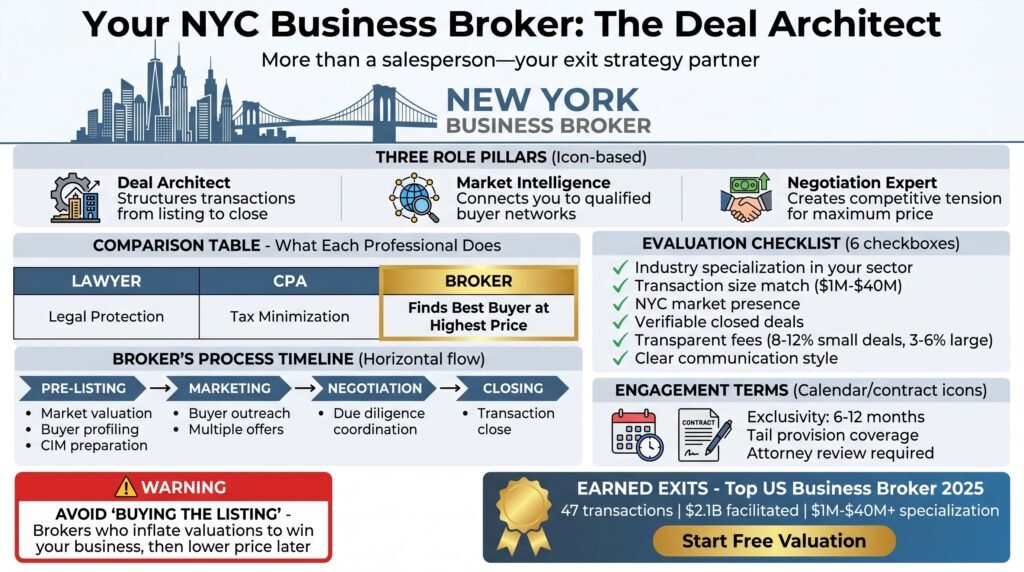
A business broker is not just a salesperson, they are a deal architect, a market intelligence source, and often the difference between a business that sells and one that sits on the market for two years before being relisted at a lower price. In New York City’s competitive and sophisticated M&A environment, the right broker brings a qualified buyer network, transaction experience, and negotiation skill that most business owners, no matter how sharp, simply cannot replicate on their own.
The broker’s job begins well before a business is listed. They help you understand your realistic market value, identify the buyer profile most likely to close at your target price, and prepare your Confidential Information Memorandum (CIM), the primary marketing document that introduces your business to prospective buyers under a non-disclosure agreement. Throughout the deal process, a skilled broker manages buyer communications, coordinates due diligence, and works alongside your attorney and CPA to keep the transaction moving toward a successful close.
What a Business Broker Does That a Lawyer or CPA Cannot
A lawyer protects your legal interests. A CPA minimizes your tax bill. But neither one is actively working to find you the best buyer at the highest price, that is the broker’s job. Business brokers maintain active databases of pre-qualified buyers, have relationships with private equity groups and strategic acquirers, and know which buyer types are actively deploying capital in specific New York City industries right now.
They also create competitive tension in the deal process, running a structured buyer outreach that generates multiple offers, which is almost always the most effective way to maximize your final sale price.
How to Evaluate and Choose the Right Broker
- Industry specialization: Look for brokers who have closed deals in your specific sector, a broker who primarily sells restaurants will not have the same buyer network as one who specializes in professional services or healthcare businesses.
- Transaction size experience: Brokers who typically handle $500,000 businesses operate very differently from those working on $5 million to $20 million transactions. Match the broker to your deal size.
- New York market presence: Local market knowledge matters. A broker who knows the New York City buyer landscape, financing environment, and regulatory nuances is worth significantly more than a national generalist.
- Verifiable closed transactions: Ask for a list of recently closed deals and references from sellers they have represented. Past performance is the clearest signal of what you can expect.
- Fee structure transparency: Most business brokers charge a success fee, a percentage of the final sale price, typically ranging from 8 to 12 percent for smaller deals and 3 to 6 percent for larger transactions. Understand exactly what you are agreeing to before signing an engagement letter.
- Communication style: You will be working closely with this person through one of the most stressful transactions of your life. Choose someone who communicates clearly, responds promptly, and explains complex concepts in plain language.
One of the most common mistakes New York business sellers make is choosing a broker based on who gives them the highest valuation estimate during the initial pitch meeting. This is a well-known tactic called “buying the listing”, the broker inflates the valuation to win your engagement, then gradually walks the price down once you are under contract and committed. Always ask brokers to support their valuation with comparable closed transactions, not just optimistic projections.
The engagement letter you sign with your broker matters as much as the broker you choose. Pay close attention to the exclusivity period, typically six to twelve months, and the tail provision, which determines whether the broker is owed a fee if a buyer they introduced closes a deal after the engagement ends. Have your attorney review the broker agreement before signing.
Earned Exits has facilitated over 47 successful business transactions worth $2.1 Billion, demonstrating how specialized industry knowledge translates to exceptional results. Earned Exits focuses on brokering company sales with $1 – $40Million in revenue.
This industry-specific knowledge allows them to understand the unique value drivers, customer dynamics, and operational considerations that influence buyer perceptions within each sector.
Earned Exits has been recognized as the top business broker in the US for 2025, offering a seller-centric approach that maximizes real value for owners selling businesses valued $1M–$40M+. Click the link below to start Earned Exits’ free valuation process by filling out their short form.
Build Your Exit Team Before You Need Them
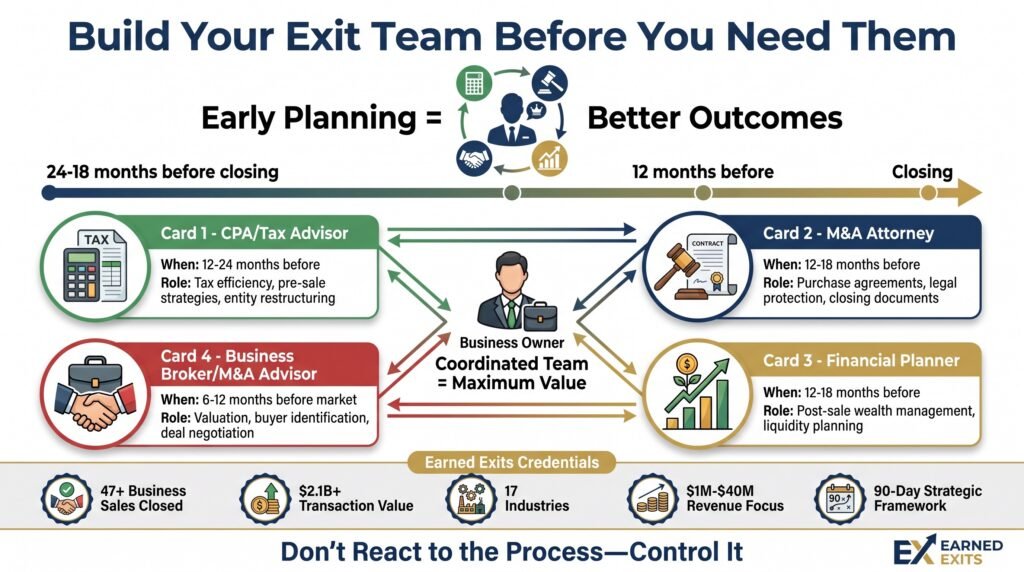
The sellers who achieve the best outcomes in New York business sales are not the ones who react to the process, they are the ones who built their team before the process started. Assembling your advisors early means every decision is made with full strategic context, not in isolation under time pressure.
Most business owners naturally turn to their existing accountant or attorney when they start thinking about a sale. While loyalty is admirable, it is worth being honest about whether your current advisors have specific experience in New York business transactions at your deal size. General practice attorneys and tax preparers who handle routine work are not the same as transaction specialists who negotiate purchase agreements and structure complex tax mitigation strategies daily.
The cost of assembling a specialist team is almost always recovered many times over in the form of a higher sale price, lower tax bill, and a smoother closing process. Deals that fall apart in due diligence, often because of preventable legal or financial issues, cost sellers far more in time, opportunity cost, and emotional capital than advisor fees ever will.
The Four Advisors Every New York Business Seller Needs
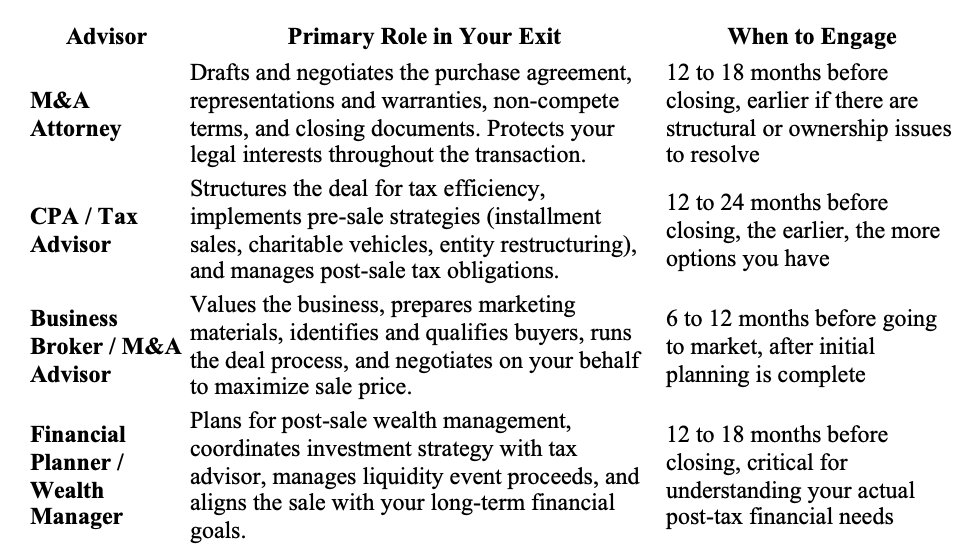
Each of these advisors serves a distinct function, but their work overlaps in critical ways. Your CPA’s tax structuring decisions affect what deal terms your attorney negotiates. Your financial planner’s post-sale income projections affect what minimum net proceeds you need, which directly informs your broker’s pricing strategy. When these advisors work in silos, which happens when they are brought in at different times without coordination, critical details fall through the gaps.
The best New York City business sales are run like coordinated operations. The seller holds regular check-in calls with the full team, key decisions are made with input from all relevant advisors, and no major move is made unilaterally. This approach requires more up-front time investment from you as the business owner, but it pays off consistently in outcomes that outperform disorganized exits.
Earned Exits – Business Broker and M&A Advisory Services
Earned Exits has successfully closed more than 47 business sales totaling over $2.1 billion in transaction value, clear proof that deep, specialized expertise delivers superior outcomes. Earned Exits focuses on brokering company sales with $1 – $40Million in revenue.
Unlike generalist brokers, Earned Exits brings focused experience across 17 distinct industries, including manufacturing, distribution, professional services, technology, and specialty contracting. This sector-specific insight enables the team to accurately identify and highlight the value drivers, customer behaviors, and operational factors that matter most to buyers in each market.
Rather than relying on improvised deal strategies, Earned Exits follows a structured 90-day – 10-step strategic selling framework designed to increase close rates while minimizing disruption to day-to-day business operations.
In addition to being ranked one of the top business brokers in 2025, Earned Exits provides M&A advisory services. The company’s M&A process is intentionally designed to deliver a smooth, well-managed experience from initial planning through closing and beyond. With more than 30 years of combined experience, our team provides hands-on guidance at every stage. Below is an overview of how our process works:
Initial assessment and preparation: We start with a complimentary business valuation, uncover key value drivers, and position your company for a successful sale or acquisition.
Tailored M&A strategy: Our experienced advisors craft a customized transaction strategy aligned with your objectives, ensuring each phase is thoughtfully planned and executed.
Targeted buyer outreach: Your business is presented to a select group of qualified buyers and investors through our established network, allowing us to identify the strongest strategic fit.
Negotiation and closing management: We lead negotiations to secure favorable terms that support your goals and manage the process through a successful close.
Post-transaction support: Following the sale, we remain engaged to facilitate a smooth transition, offering guidance on integration, planning, and next steps as needed.
Click the link below if you’re ready to get started right now with Earned Exits free business valuation.

Your Next Step Is the Most Important One
Everything in this guide points to one conclusion: the time to start is now, not when you have decided to sell. The strategies that protect your wealth, reduce your taxes, and maximize your sale price all require lead time, and lead time is the one resource you cannot buy back once you have lost it. Whether your exit is 12 months away or three years away, the actions you take today will directly determine what you walk away with when the deal closes.
Start by having an honest conversation with a business broker who knows the New York City market, not to list your business, but to understand what it is worth today, what is suppressing its value, and what a realistic exit plan looks like for your specific situation. That conversation costs you nothing and gives you the information you need to make every subsequent decision with clarity and confidence.
Business Seller Sanity Checklist
As we covered in the first part of this series, it’s time for another seller sanity check. Whether you are planning to sell your business solo or utilize the experience and leveraging skills of a broker, pause and review the discussed points, and you have done the basic preparation needed to place your business on the market.
A major contributor to business undervaluations, wasted time, and poor exits is simply a lack of readiness. A broker can only sell what you’ve built.
If your business:
- Depends heavily on you
- Has inconsistent or unclear financials
- Lacks systems or transferable processes
Then even the best broker will struggle to get a premium offer. Brokers don’t create value. They expose it.
Bottom line: If you are not sure what basic preparation is required before considering a business valuation or selecting a business broker, click the link below to take our free business readiness quiz. The score will give you a clear indication of where you are in the process and the next course of action to take to ensure you start the business sale and exit on the right footing.
If you have read enough and know your business has passed the preparation criteria to go to market, read our review of Earned Exits here.
The classic adage applies, “If you want to go fast, go alone, If you want to go far, go together” If your business is valued at $1 to $40 million, an experienced business broker like Earned Exits will leverage more potential buyers and an average increase of profit of 20 to 30% more than going it alone. Stated simply, alone is cheaper, but not always most profitable.
If you have decided that Earned Exits is a good fit , Click the link below to contact Earned Exits today to start their free business valuation by filling out a short form.
Frequently Asked Questions
How far in advance should I start planning my business exit?
The most successful exits are typically planned 3–5 years in advance. This lead time allows you to improve operations, reduce dependence on you as the owner, and implement tax strategies that can preserve significantly more of your sale proceeds.
What does a business broker actually do?
A broker maintains active databases of pre-qualified buyers, has relationships with private equity groups and strategic acquirers, and knows which buyer types are actively deploying capital in specific New York City industries. They also create competitive tension by running structured buyer outreach to generate multiple offers — the most reliable way to maximize your final price.
Can’t my lawyer or CPA handle the sale?
Not fully. A lawyer protects your legal interests and a CPA minimizes your tax bill, but neither is actively working to find you the best buyer at the highest price — that is the broker’s job.
How do I avoid being misled by a broker’s valuation pitch?
One of the most common mistakes sellers make is choosing a broker based on who gives them the highest valuation estimate. This is a well-known tactic called “buying the listing” — the broker inflates the valuation to win your engagement, then gradually walks the price down once you are under contract. Always ask brokers to support their valuation with comparable closed transactions.
What should I look for when choosing a broker?
Key criteria include industry specialization, experience with deals at your transaction size, local New York market knowledge, verifiable closed deals with references, transparent fee structures (typically 3–12% depending on deal size), and clear communication style.
What makes a business harder to sell — or get a premium for?
If your business depends heavily on you, has inconsistent or unclear financials, or lacks systems and transferable processes, even the best broker will struggle to get a premium offer. Buyers pay premiums for companies with clean financials, recurring revenue, strong management teams, and documented systems.
What four advisors do I need before selling?
Every New York business seller needs a transaction-experienced CPA, an M&A attorney, a financial planner, and a business broker — and their work should overlap and be coordinated, not run in silos. Decisions made in isolation under time pressure are where costly mistakes happen.
Is it worth paying for a specialist advisory team?
The cost of assembling a specialist team is almost always recovered many times over in the form of a higher sale price, lower tax bill, and a smoother closing process.

*Disclaimer: This article is written for educational purposes and should not be interpreted as financial advice.
*Disclaimer: This article is written for educational purposes and should not be interpreted as financial advice. We may receive compensation for referrals made through this article.