
Quick Summary
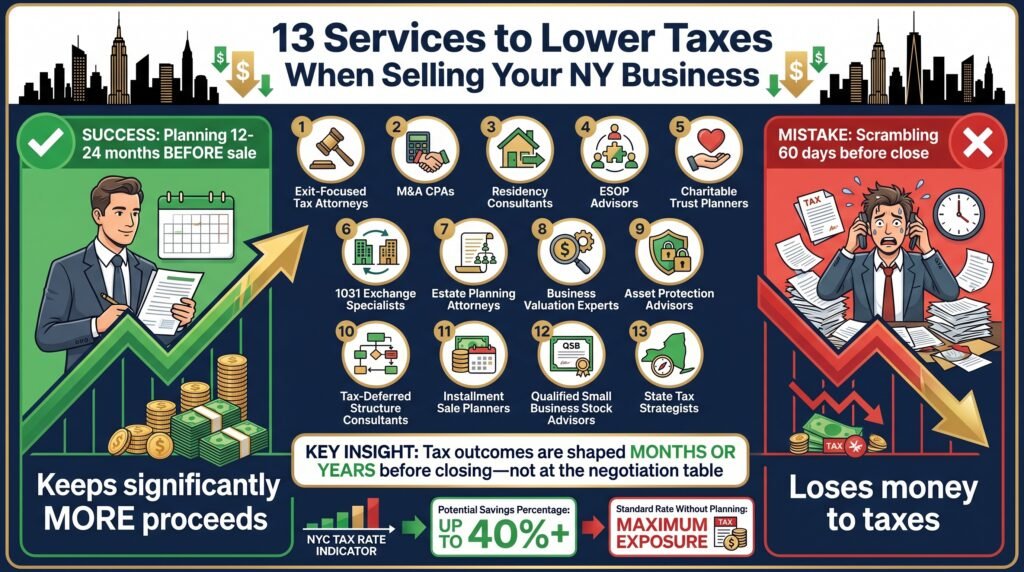
New York business owners can significantly reduce their tax burden when selling, but only with proactive planning. This article outlines 13 professional services to engage well before a sale, including exit-focused tax attorneys, M&A CPAs, residency consultants, ESOP advisors, and charitable trust planners.
The core message: tax outcomes are shaped by decisions made months or years before closing, not at the negotiation table. Owners who build the right advisory team early consistently keep far more of their proceeds than those who start planning 60 days before close.
Table of Contents
- Navigate the exit from one of Americas highest-tax states with expert help and smart planning tools.
- Professional Advisory Services
- 1. New York Exit-Focused Tax Attorneys
- 2. Exit Planning Consultants
- 3. M&A-Specialized CPA Firms
- 4. Qualified Small Business Stock (QSBS) Advisors
- 5. State Tax Residency Consultants
- 6. Trust and Estate Planning Attorneys
- 7. Family Office Services
- 8. Business Valuation Firms
- Specialized Deal Structuring & Planning Services
- 9. Installment Sale Structuring Advisors
- 10. Earnout and Contingent Payment Consultants
- 11. Employee Stock Ownership Plan (ESOP) Advisors
- 12. Charitable Remainder Trust (CRT) Planners
- 13. Donor Advised Fund (DAF) Advisors
- Business Seller Sanity Checklist
- Conclusion: My Top Pick Service & Your Next Step
- Frequently Asked Questions
Navigate the exit from one of Americas highest-tax states with expert help and smart planning tools.
Most New York business owners look at the projected tax bill from selling their company and think the number is fixed. They assume that if the buyer offers $5 million, then after federal, state, and city taxes, whatever is left is what they keep.
This may sound logical, but the final after-tax amount you keep is more flexible than it appears.
Yes, there are always business sales that happen quickly without advanced planning, but not very many actually maximize what the seller keeps. As long as you treat the sale as purely a transaction instead of the culmination of years of wealth strategy, your efforts to preserve value will fall short because tax outcomes depend heavily on decisions made months or years before closing.
But if you shift from reactive deal-making to proactive exit design, you will see that the most effective way to lower your tax burden is to coordinate professional advisors, specialized services, and planning tools long before a term sheet appears.
Developing a relationship with the right advisors and services is one of the highest-leverage steps you can take to keep more of what you built and confirm your next chapter starts with most financial flexibility. And if you are still several years away from a sale, starting now gives you options that simply do not exist in the final six months before closing.
When you work with professionals who understand New York residency rules, deal structuring, and the intersection of state and federal tax law, you create space to legally reduce what you owe. These experts help you time the sale, pick the right entity structure, plan relocation if suitable, and layer in trusts or charitable tools that fit your goals.
If you can gather the right team early, it will allow you to move past the idea that taxes are inevitable at the rates you first calculated, and instead see the sale as a multi-year wealth event you can shape.
Even if your sale timeline is tight, you can still engage specialists who focus on high-tax-state exits and business transitions, which will protect more value than going it alone.
That being said, the owners who start planning three to five years in advance consistently keep significantly more of their sale proceeds than those who call advisors 60 days before close.
Below is a curated list of the types of services, platforms, and professional resources that can help you lower taxes when selling a business in New York. Each entry includes a description of what the service does and how it fits into a business exit strategy focused on reducing state and federal tax liability.
Professional Advisory Services
1. New York Exit-Focused Tax Attorneys
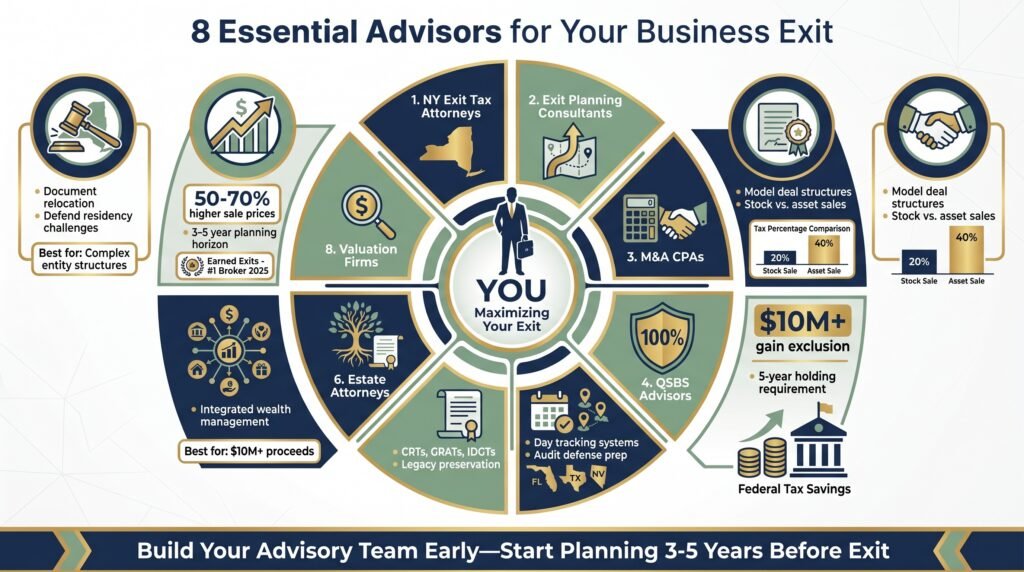
Tax attorneys who specialize in high-net-worth exits from New York understand both residency audits and deal structuring. They help you document a credible move to another state, defend against residency challenges, and structure the transaction to favor capital gains treatment over ordinary income.
This type of attorney is essential if you plan to relocate before the sale or if your deal involves complex entity structures.
What they do: Review residency documentation, advise on state tax sourcing, coordinate with your deal counsel on tax clauses.
Best for: Owners planning to move out of New York before a sale or those with multi-state operations.
2. Exit Planning Consultants
Exit planning firms and business brokers take a holistic view of your business sale. They work with you years in advance to increase company value, prepare financials, identify buyers, and coordinate tax, legal, and wealth advisors.
Many specialize in reducing tax liability by timing the sale, restructuring entities, and layering in estate or charitable strategies.
Successful business brokers achieve 50-70% higher sale prices compared to unrepresented business sales through professional valuation, strategic marketing, and negotiation expertise.
What they do: Develop multi-year roadmaps, model after-tax outcomes, coordinate your advisory team.
Best for: Owners with 3-5 years until a planned sale who want to maximize after-tax proceeds and plan for life after the business.
Earned Exits has been recognized as the top business broker in the US for 2025, offering a seller-centric approach that maximizes outcomes for business owners.
Earned Exits has facilitated over 47 successful business transactions worth $2.1 Billion, demonstrating how specialized industry knowledge translates to exceptional results. Click the link below to start Earned Exits’ free valuation process by filling out their short form.
3. M&A-Specialized CPA Firms
CPAs who focus on mergers and acquisitions understand deal structures, allocation of purchase price, and tax elections. They model scenarios like stock sales versus asset sales, installment sales, and QSBS treatment.
For New York sellers, they also assess how state and city taxes interact with federal rules.
What they do: Prepare projections, file elections, advise on timing, coordinate with legal on structure.
Best for: Any business owner who wants accurate tax modeling before and during negotiations.
In addition to being ranked one of the top business brokers in 2025, Earned Exits provides M&A advisory services. The company’s M&A process is intentionally designed to deliver a smooth, well-managed experience from initial planning through closing and beyond. With more than 30 years of combined experience, our team provides hands-on guidance at every stage. Below is an overview of how our process works:
Initial assessment and preparation: We start with a complimentary business valuation, uncover key value drivers, and position your company for a successful sale or acquisition.
Tailored M&A strategy: The company’s experienced advisors craft a customized transaction strategy aligned with your objectives, ensuring each phase is thoughtfully planned and executed.
Targeted buyer outreach: Your business is presented to a select group of qualified buyers and investors through our established network, allowing us to identify the strongest strategic fit.
Negotiation and closing management: We lead negotiations to secure favorable terms that support your goals and manage the process through a successful close.
Post-transaction support: Following the sale, we remain engaged to facilitate a smooth transition, offering guidance on integration, planning, and next steps as needed.
Click the link below if you’re ready to get started right now with Earned Exits free business valuation.
4. Qualified Small Business Stock (QSBS) Advisors
If you own a C-corporation that qualifies under Section 1202, QSBS planning can exclude up to 100% of federal capital gains on the first $10 million or 10x basis. Advisors who specialize in QSBS review holding periods, corporation formation dates, and New York conformity issues.
What they do: Audit QSBS eligibility, guide entity restructuring, coordinate with tax counsel on federal and state treatment.
Best for: C-corp owners with stock held for at least five years and gains that could exceed several million dollars.
5. State Tax Residency Consultants
New York residency audits are among the most aggressive in the country. Residency consultants help you document a legitimate move, track days in each state, manage property ownership, and shift personal ties.
They often work alongside tax attorneys to build a defensible case if the state later challenges your residency claim.
What they do: Develop day-tracking systems, advise on real estate, help shift key personal affiliations, prepare audit defense.
Best for: Owners relocating to Florida, Texas, Nevada, or another no-income-tax state before a large liquidity event.
6. Trust and Estate Planning Attorneys
Trust attorneys help you move assets into structures that reduce income and estate taxes. Vehicles like Charitable Remainder Trusts, Grantor Retained Annuity Trusts, and Intentionally Defective Grantor Trusts can defer or reduce taxes on a business sale while preserving wealth for heirs or charitable causes.
What they do: Draft trusts, coordinate funding, advise on gift and estate tax implications, integrate with sale timeline.
Best for: Owners with significant estates who want to mix income tax reduction with legacy planning.
7. Family Office Services
Family offices provide integrated wealth management, tax planning, investment oversight, and estate coordination. For business owners planning an exit, a family office can serve as the central hub that coordinates legal, tax, and financial advisors to create a unified strategy.
What they do: Coordinate advisors, oversee investments post-sale, manage complex trusts and entities, plan for many generations.
Best for: Owners expecting proceeds above $10 million who want ongoing, sophisticated wealth management.
8. Business Valuation Firms
Professional valuation firms provide independent appraisals of your company, which are critical for negotiating price, structuring earnouts, and supporting estate or gift tax filings. Accurate valuations also help model tax scenarios and compare offers on an after-tax basis.
What they do: Conduct 409A, fair market, or transaction valuations using income, market, or asset approaches.
Best for: Owners who need credible valuation reports for negotiations, IRS filings, or internal planning.
Click the button below if you’re ready to get started right now with Earned Exits free business valuation for businesses valued at $1 – 40 billion.

Specialized Deal Structuring & Planning Services
9. Installment Sale Structuring Advisors
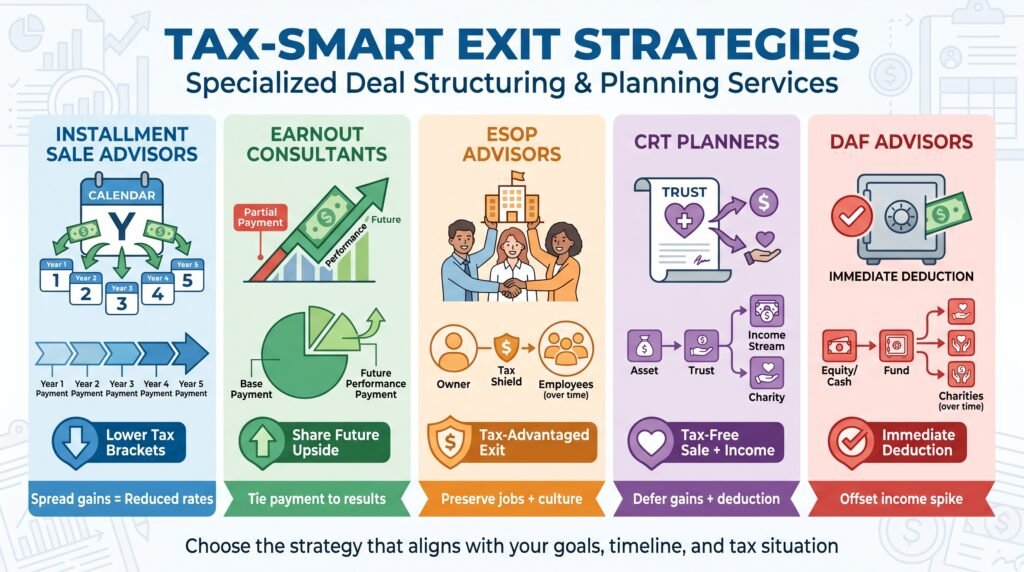
Advisors who focus on installment sales help you negotiate promissory notes, escrow terms, and payment schedules that spread capital gains across many years. This can reduce the rate at which you are taxed by keeping you out of the highest brackets in any single year.
What they do: Model multi-year tax impact, draft seller financing terms, coordinate with legal on security interests.
Best for: Owners comfortable with credit risk who want to smooth tax liability and potentially earn interest on deferred payments.
10. Earnout and Contingent Payment Consultants
Earnout structures tie part of the purchase price to future performance. Consultants help you negotiate terms, classify payments correctly for tax purposes, and manage the risk that targets are not met.
What they do: Advise on earnout metrics, tax classification, risk mitigation, and documentation.
Best for: Owners selling to private equity or strategic buyers who want to share in future upside while managing current tax exposure.
11. Employee Stock Ownership Plan (ESOP) Advisors
ESOPs let you sell your company to your employees over time, often with significant tax advantages. ESOP advisors guide formation, valuation, and structuring, including potential deferral of capital gains under certain conditions.
What they do: Assess ESOP feasibility, coordinate valuation and trustee selection, structure transaction for tax benefits.
Best for: Owners who want to preserve jobs and culture while creating a tax-advantaged exit, especially in S-corps.
12. Charitable Remainder Trust (CRT) Planners
CRT specialists help you transfer appreciated business interests into a trust that sells the asset tax-free, pays you an income stream, and benefits charity at the end. This defers and spreads income while generating an upfront charitable deduction.
What they do: Design CRT structure, coordinate with trustee, model income and tax outcomes, integrate with overall exit plan.
Best for: Owners with strong charitable intent who want to defer capital gains and receive lifetime income.
13. Donor Advised Fund (DAF) Advisors
DAF platforms and advisors help you transfer business equity or cash to a fund, claim an immediate deduction, and recommend grants to charities over time. This can offset a large income spike in the year of sale.
What they do: Facilitate DAF contributions, advise on timing and asset type, manage ongoing grant recommendations.
Best for: Owners who want charitable deductions without immediately choosing specific charities.
Business Seller Sanity Checklist
As we covered in the first part of this series, it’s time for another seller sanity check. Whether you are planning to sell your business solo or utilize the experience and leveraging skills of a broker, pause and review the discussed points, and you have done the basic preparation needed to place your business on the market.
A major contributor to business undervaluations, wasted time, and poor exits is simply a lack of readiness. A broker can only sell what you’ve built.
If your business:
- Depends heavily on you
- Has inconsistent or unclear financials
- Lacks systems or transferable processes
Then even the best broker will struggle to get a premium offer. Brokers don’t create value. They expose it.
Bottom line: If you are not sure what basic preparation is required before considering a business valuation or selecting a business broker, click the link below to take our free business readiness quiz. The score will give you a clear indication of where you are in the process and the next course of action to take to ensure you start the business sale and exit on the right footing.
If you have read enough and know your business has passed the preparation criteria to go to market, read our review of Earned Exits here.
The classic adage applies, “If you want to go fast, go alone, If you want to go far, go together” If your business is valued at $1 to $40 million, an experienced business broker like Earned Exits will leverage more potential buyers and an average increase of profit of 20 to 30% more than going it alone. Stated simply, alone is cheaper, but not always most profitable.
If you have decided that Earned Exits is a good fit , Click the link below to contact Earned Exits today to start their free business valuation by filling out a short form.
If you are further along in the process, read our 3-part article for successful business exit planning when selling your New York business here.
Learn more about profitably exiting your business and many options you have here.
Conclusion: My Top Pick Service & Your Next Step
All of these services and resources can add value at different stages of your exit. If I had to choose the single most impactful starting point, it would be engaging an exit planning consultant such as a business broker or M&A-specialized CPA early in the process.
Exit planners and transaction-focused CPAs serve as the quarterback for your team. They help you set a realistic timeline, identify which other advisors you need, model tax outcomes under different scenarios, and keep everyone aligned as the sale progresses.
They also prevent costly mistakes like choosing the wrong deal structure or missing a residency deadline.
If you are serious about selling your business in New York and keeping the most amount after taxes, the most practical step is to schedule consultations with two or three exit planning firms or M&A CPAs in the next 30 days. Ask them how they have helped other New York business owners reduce state and federal tax through relocation, deal structuring, and advanced planning.
Get a sense of their process, timeline, and fees.
Then, commit to a plan. The earlier you start, the more strategies you can layer in, and the more money you will keep.
You spent years building this business. Investing in the right professional team to navigate the exit is not an expense.
It is one of the highest-return decisions you will make. Every dollar of tax you legally avoid is a dollar that can fund your next venture, support your family, or back the causes you care about
Frequently Asked Questions
1. How much do exit planning services typically cost?
Exit planners and specialized CPAs often charge either an hourly rate (ranging from $300 to $700+ per hour depending on location and expertise) or a project-based fee that can range from $10,000 to $50,000 or more for comprehensive planning. Some wealth advisors offer exit planning as part of a broader relationship and charge based on assets under management.
The cost depends on the complexity of your business, the size of the transaction, and how many years of planning are involved. In most cases, the tax savings far exceed the advisory fees.
2. Can I really avoid New York state tax by moving before I sell?
Yes, but only if you establish genuine residency in another state and meet New York’s tests for nonresidency. For a stock or membership interest sale, nonresidents typically do not owe New York tax on the gain. However, New York audits these cases aggressively.
You need to spend fewer than 184 days in New York, maintain a primary home outside New York, and shift substantial personal and financial ties.
Asset sales of New York-based businesses may still create New York-sourced income even if you move. Work with a tax attorney and residency consultant to build a defensible case.
3. What is the difference between an exit planner and an M&A advisor?
An exit planner focuses on preparing you and your business for a future sale. They help with tax strategy, entity structuring, wealth planning, and coordinating advisors.
An M&A advisor (or investment banker) focuses on executing the sale.
They find buyers, negotiate terms, and manage the transaction process. Many business owners benefit from both.
Start with an exit planner years in advance, and bring in an M&A advisor 12 to 18 months before you want to go to market.
Earned Exits is a comprehensive brokerage company that provides business exiting planning services as well as M&A advisory services.
Brokering over $2.1 Billion in transactions across 17 industries, Earned Exits was named a top business broker in 2025 by IWSP. Click the link below to contact Earned Exits today to start their free business valuation by filling out a short form.
4. How long does it take to establish residency in another state for tax purposes?
There is no fixed timeline, but most advisors recommend at least 12 to 18 months of clear residency in your new state before a major taxable event like a business sale.
This includes spending more than half the year in the new state, buying or leasing a primary home there, obtaining a driver’s license, registering to vote, and shifting personal and professional ties.
Document everything.
New York may audit returns for three to four years after you leave, so the more evidence you have, the better your position.
5. What happens if I sell my business while still living in New York and later regret not planning ahead?
Unfortunately, once the sale closes and you recognize the gain as a New York resident, your options are limited. You cannot retroactively change your residency for past tax years.
The best you can do is work with a tax advisor to make sure you claimed all available deductions, credits, and structural benefits within the deal you completed. This is why planning ahead is so critical.
If you are reading this before your sale, you still have time to engage advisors and apply strategies.
If you have already sold, focus on post-sale tax planning for future investment income and estate tax reduction.

References
- BNY Mellon Wealth Management, “Reducing the Tax Impact on the Sale of Your Business”
- SmartAsset, “How to Avoid Capital Gains Tax on a Business Sale”
- Brighton Jones, “Exit Planning Tax Strategies: Maximizing Your Business Sale”
- Richard Brothers Financial Advisors, “Tax Strategies After Business Sale for Maximizing Profits”
- Cummings & Co. Planning, “3 Ways To Reduce The Taxes You Pay When Selling Your Business to a Third Party”
- U.S. Small Business Administration, “7 Tax Strategies to Consider When Selling a Business”
- RBC Wealth Management, “Minimize tax and maximize your business sale”
- EP Wealth Advisors, “How to Manage Taxes When Selling a High-Value Business”
- U.S. Bank, “Tax Implications of Selling a Business”
- Exit Planning Institute, “Certified Exit Planning Advisor Resources”
*Disclaimer: This article is written for educational purposes and should not be interpreted as financial advice. We may receive compensation for referrals made through this article.