
Quick Summary
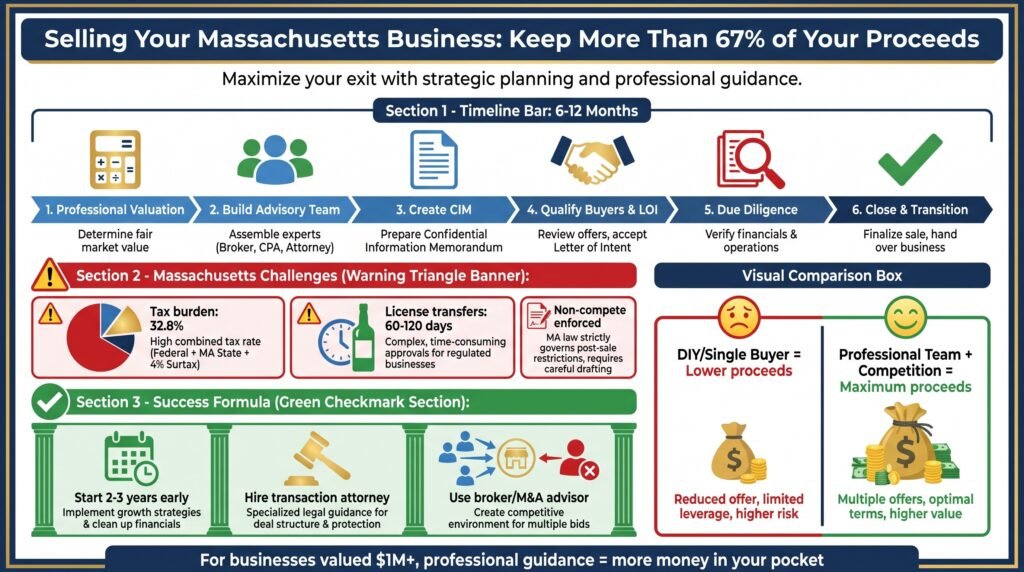
Selling a business in Massachusetts typically takes 6–12 months and involves six key stages: getting a professional valuation, building your advisory team, preparing a Confidential Information Memorandum (CIM), qualifying buyers and negotiating a Letter of Intent, surviving due diligence, and managing the closing and transition.
Massachusetts adds layers of complexity most states don’t have, including up to 32.8% in combined federal, state, and Millionaire’s Surtax obligations, strict license transfer timelines (liquor licenses alone can take 60–120 days), landlord consent requirements on commercial leases, and enforceable non-compete agreements you’ll likely sign at closing.
The sellers who walk away with the most are those who start planning 2–3 years early, hire a transaction attorney before going to market, and use a qualified business broker or M&A advisor to run a competitive process to maximize rather than negotiating with a single buyer.
Bottom line: This is not a transaction to DIY. The right team and the right preparation don’t just reduce stress, they directly increase what you take home. Learn more about how an experienced business broker and M&A advisor is worth the investment if your business is valued over $1 million.
Table of Contents
- Quick Summary
- The Massachusetts Business Sale Process Step by Step
- Massachusetts-Specific Legal Requirements Every Seller Must Know
- Business Seller Checklist
- Frequently Asked Questions
The Massachusetts Business Sale Process Step by Step
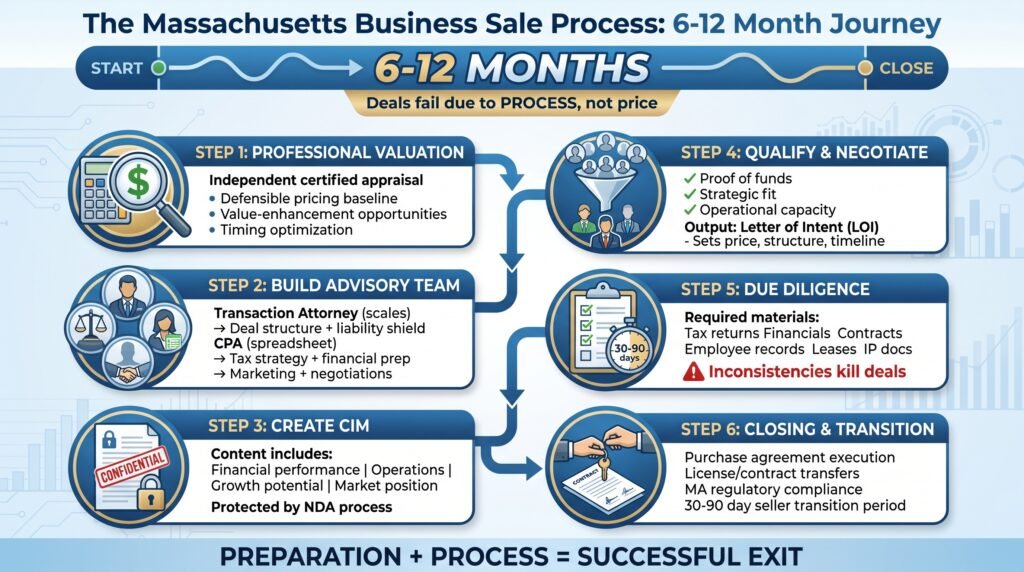
Selling a business in Massachusetts isn’t a single transaction, it’s a process that typically takes 6 to 12 months from the moment you go to market to the day you close. Understanding each stage helps you stay in control, avoid surprises, and make better decisions throughout.
The most common reason deals fall apart isn’t price, it’s process. Sellers who don’t understand what’s coming in the due diligence phase, or who haven’t assembled the right advisory team early, routinely lose deals that should have closed. Preparation and process knowledge are your best defenses against a failed sale.
Here’s how a well-run Massachusetts business sale unfolds from start to finish.
Step 1: Get a Professional Business Valuation
Before you set an asking price or talk to a single buyer, get an independent valuation from a certified business appraiser or an experienced M&A advisor familiar with Massachusetts market conditions. A professional valuation gives you a defensible number to negotiate from, sets realistic expectations, and often surfaces value-enhancement opportunities you hadn’t considered. It also tells you whether now is the right time to sell, or whether 18 more months of preparation would meaningfully change your outcome.
Step 2: Assemble Your Advisory Team Early
The sellers who get the best outcomes in Massachusetts are the ones who build their team before they go to market, not after they have a buyer at the table. At minimum, you need a transaction attorney, a CPA with M&A experience, and either a business broker or an M&A advisor depending on your deal size.
Each advisor plays a distinct role. Your attorney structures the deal and protects you from post-closing liability. Your CPA handles tax strategy and financial due diligence preparation. Your broker or M&A advisor markets the business confidentially, qualifies buyers, and manages the negotiation process. Trying to manage any of these functions yourself while also running your business is a reliable way to leave money on the table.
In addition to being ranked one of the top business brokers in 2025, Earned Exits provides M&A advisory services. The company’s M&A process is intentionally designed to deliver a smooth, well-managed experience from initial planning through closing and beyond. With more than 30 years of combined experience, our team provides hands-on guidance at every stage. Below is an overview of how our process works:
Initial assessment and preparation: We start with a complimentary business valuation, uncover key value drivers, and position your company for a successful sale or acquisition.
Tailored M&A strategy: The company’s experienced advisors craft a customized transaction strategy aligned with your objectives, ensuring each phase is thoughtfully planned and executed.
Targeted buyer outreach: Your business is presented to a select group of qualified buyers and investors through our established network, allowing us to identify the strongest strategic fit.
Negotiation and closing management: We lead negotiations to secure favorable terms that support your goals and manage the process through a successful close.
Post-transaction support: Following the sale, we remain engaged to facilitate a smooth transition, offering guidance on integration, planning, and next steps as needed.
Click the link below if you’re ready to get started right now with Earned Exits free business valuation.
Step 3: Prepare a Confidential Information Memorandum
A Confidential Information Memorandum (CIM) is the primary marketing document for your business. It presents your financial performance, operational overview, growth opportunities, and competitive positioning to prospective buyers, all while maintaining confidentiality through a Non-Disclosure Agreement (NDA) process. A well-crafted CIM doesn’t just inform buyers; it frames your business in the most favorable accurate light and sets the narrative that drives the negotiation.
In the Massachusetts market, where buyers range from local entrepreneurs and search fund operators to regional private equity groups, a professional CIM signals that you are a serious seller with a process, which attracts more qualified buyers and generates competitive offers rather than a single take-it-or-leave-it bid.
Step 4: Qualify Buyers and Negotiate the Letter of Intent
Not every buyer who expresses interest is a buyer who can actually close. Before sharing sensitive financials, your advisor should verify proof of funds or financing capability, assess strategic fit, and evaluate whether the buyer has the operational capacity to run your business post-sale. The Letter of Intent (LOI) that comes out of initial negotiations is non-binding on most terms but sets the framework for price, structure, and timeline, making it one of the most strategically important documents in the entire transaction.
Step 5: Navigate Due Diligence Without Losing the Deal
Due diligence is the period, typically 30 to 90 days, where buyers verify everything in your CIM against your actual records. This is where unprepared sellers lose deals. Buyers will request tax returns, financial statements, customer contracts, employee records, lease agreements, IP documentation, and more. Having these organized, accurate, and readily available keeps the process moving and maintains buyer confidence. Any inconsistency discovered during due diligence becomes a renegotiation point, or a deal-killer.
Step 6: Close the Deal and Manage the Transition
Closing involves executing the purchase agreement, transferring licenses and contracts, handling any required regulatory notifications in Massachusetts, and managing the actual handoff of the business. Many deals include a transition period where the seller works with the new owner for 30 to 90 days, which is often a condition of the sale. Planning your transition role clearly, and negotiating its terms up front, prevents conflicts after the deal is done and protects your earn-out payments if the deal includes performance-based components.
Massachusetts-Specific Legal Requirements Every Seller Must Know
Massachusetts has specific legal requirements that apply to business sales, and failing to address them can delay your closing, expose you to post-sale liability, or in some cases invalidate parts of the transaction. These aren’t technicalities, they’re real compliance obligations with real consequences.
The complexity of these requirements varies significantly by industry. A restaurant sale in Boston involves liquor license transfer approvals from the Massachusetts Alcoholic Beverages Control Commission (ABCC), Board of Health notifications, and health permit reapplications that can take months. A professional services firm sale may involve state licensing board notifications, client consent requirements, and restrictions on how goodwill can be transferred. Knowing your industry’s specific regulatory environment before you go to market prevents costly surprises mid-transaction.
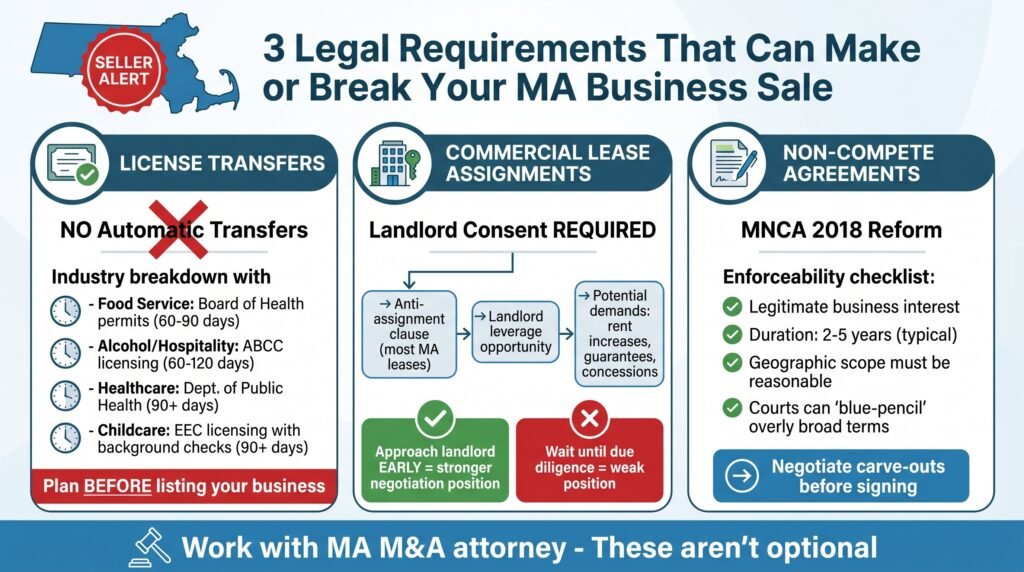
Beyond industry-specific rules, every Massachusetts business sale should address three foundational legal areas: license and permit transferability, commercial lease assignments, and non-compete enforceability. Each of these has unique dimensions under Massachusetts law that differ from other states and directly affect how the deal is structured and what protections you retain after closing.
License Transfers and Regulatory Compliance by Industry
Every business operating in Massachusetts holds some combination of licenses, permits, and registrations, and none of them automatically transfer to a new owner at closing. The buyer must apply for their own licenses, and in many cases, the existing license cannot be used during the transition period, creating a gap that needs to be planned for well in advance.
Industries with the most complex transfer requirements include food service (Board of Health permits, food handler certifications), alcohol retail and hospitality (ABCC licensing, which requires full application review and can take 60 to 120 days), healthcare and home care services (Department of Public Health licensure), and childcare (EEC licensing with background check requirements for new owners). In each of these sectors, the deal timeline must be built around the regulatory approval calendar, not the other way around.
For sellers, the practical implication is this: identify every license and permit your business operates under before you go to market, confirm which ones are transferable and which require new applications, and factor the approval timelines into your target closing date. A deal that’s ready to close in 60 days can be delayed by 90 more if a liquor license transfer wasn’t initiated early enough in the process.
Landlord Consent and Commercial Lease Assignments
If your business operates from a leased commercial space, a storefront, office, warehouse, or restaurant, your lease is likely one of the most critical documents in your entire transaction. Most commercial leases in Massachusetts contain an anti-assignment clause, which means the landlord’s written consent is required before the lease can be transferred to a new owner. Without that consent, the buyer may not be able to occupy the space after closing, which in many cases makes the deal impossible to complete.
Landlords in Massachusetts are not legally required to grant consent unreasonably, but they are permitted to use the assignment request as leverage, requesting rent increases, personal guarantees from the new owner, or other concessions as conditions of approval. Sellers who identify this issue early and approach their landlord proactively, before a buyer is in the picture, are in a much stronger negotiating position than those who surface the issue mid-due-diligence when deal momentum is already built up and timelines are tight.
Non-Compete Agreements Under Massachusetts Law
Massachusetts significantly reformed its non-compete law with the Massachusetts Noncompetition Agreement Act (MNCA), which took effect in 2018. While the MNCA primarily governs employee non-competes, non-compete agreements in the context of a business sale are treated differently and are generally enforceable, provided they meet specific standards of reasonableness in duration, geographic scope, and protected business interest.
As a seller, you will almost certainly be asked to sign a non-compete as part of the purchase agreement, restricting you from starting or working for a competing business for a defined period after closing. These agreements protect the buyer’s investment in the goodwill they’ve purchased. Understanding what you’re agreeing to, and negotiating the scope carefully, is essential, particularly if you plan to remain active in your industry after the sale.
- Non-competes tied to a business sale are enforceable in Massachusetts when they protect a legitimate business interest
- Duration is typically 2 to 5 years for small to mid-sized business sales
- Geographic scope must be reasonable relative to where the business actually operates
- Overly broad non-competes can be partially enforced through judicial “blue-penciling” in Massachusetts courts
- Sellers should negotiate carve-outs for non-competing activities they intend to pursue post-sale
A transaction attorney familiar with Massachusetts M&A practice will review and negotiate the non-compete terms as part of the purchase agreement, this is not a clause to accept at face value or leave to the last minute.
Business Seller Sanity Checklist
As we covered in the first part of this series, it’s time for another seller sanity check. Whether you are planning to sell your business solo or utilize the experience and leveraging skills of a broker, pause and review the discussed points, and you have done the basic preparation needed to place your business on the market.
A major contributor to business undervaluations, wasted time, and poor exits is simply a lack of readiness. A broker can only sell what you’ve built.
If your business:
- Depends heavily on you
- Has inconsistent or unclear financials
- Lacks systems or transferable processes
Then even the best broker will struggle to get a premium offer. Brokers don’t create value. They expose it.
Bottom line: If you are not sure what basic preparation is required before considering a business valuation or selecting a business broker, click the link below to take our free business readiness quiz. The score will give you a clear indication of where you are in the process and the next course of action to take to ensure you start the business sale and exit on the right footing.
If your business is valued at $1 to $40 million, an experienced business broker like Earned Exits will leverage more potential buyers and an average increase of profit of 20 to 30% more than going it alone.
The classic adage applies, “If you want to go fast, go alone, If you want to go far, go together”
Stated simply, alone is cheaper, but not always most profitable. Our comprehensive review of Earned Exits business brokers here.
The company has been recognized as the top business broker in the US for 2025, offering a seller-centric approach that maximizes real value for owners selling businesses valued $1M–$40M+. Click the link below to start Earned Exits’ free valuation process by filling out their short form.
Learn more about Massachusetts tax strategies, common business sales mistakes, and more in this article.
Frequently asked questions
What Taxes Do I Pay When I Sell a Business in Massachusetts?
Massachusetts business sellers face up to four layers of tax: the federal long-term capital gains tax at 20%, the federal Net Investment Income Tax (NIIT) at 3.8%, the Massachusetts state capital gains tax at 5%, and the Massachusetts Millionaire’s Surtax at 4% on income exceeding $1 million in a single tax year. Combined, these can reach 32.8% of your sale proceeds. The exact amount depends on your deal structure, how gains are allocated across asset classes, your total income for the year, and what tax planning strategies you implement before closing.
When Is the Best Time to Start Planning My Business Exit in Massachusetts?
The best time to start planning your exit is at least 2 to 3 years before you want to close. That window gives you time to clean up your financials, reduce customer concentration, implement tax strategies, document your operations, and resolve any legal or compliance issues before buyers find them. If you’re already in conversations with a buyer or close to signing an LOI, the best time is right now, several meaningful tax and structural strategies are still available after LOI, but the window closes fast. The one timeline that reliably produces the worst outcomes is waiting until you’re forced to sell.
Broker vs. M&A Advisor: Which Do You Need?
Business Broker: Works on success fee (8–12%). Focuses on Main Street and lower middle market buyers. Markets through business-for-sale platforms like BizBuySell and local networks.
M&A Advisor: May charge retainer plus success fee. Runs a structured auction or targeted buyer outreach process. Engages private equity, strategic acquirers, and search funds. Provides deal structuring guidance throughout.
No Broker/Advisor: Only advisable if you have a pre-identified buyer (e.g., a family member, partner, or existing employee) and experienced legal and tax advisors managing the transaction.
Regardless of which path you choose, you should never attempt a business sale without a qualified transaction attorney and a CPA with M&A experience. The broker or M&A advisor manages the process and the buyer relationship, the attorney and CPA protect your financial outcome and limit your legal exposure.
In Massachusetts specifically, where deal complexity is amplified by state-specific tax law, employment regulations, and licensing requirements, the cost of good advisors is almost always recovered, and then some, in the final outcome. This is not a transaction to DIY.
In addition to being ranked one of the top business brokers in 2025, Earned Exits provides M&A advisory services.
The company’s M&A process is intentionally designed to deliver a smooth, well-managed experience from initial planning through closing and beyond. With more than 30 years of combined experience, our team provides hands-on guidance at every stage. Below is an overview of how our process works:
Initial assessment and preparation: We start with a complimentary business valuation, uncover key value drivers, and position your company for a successful sale or acquisition.
Tailored M&A strategy: The company’s experienced advisors craft a customized transaction strategy aligned with your objectives, ensuring each phase is thoughtfully planned and executed.
Targeted buyer outreach: Your business is presented to a select group of qualified buyers and investors through our established network, allowing us to identify the strongest strategic fit.
Negotiation and closing management: We lead negotiations to secure favorable terms that support your goals and manage the process through a successful close.
Post-transaction support: Following the sale, we remain engaged to facilitate a smooth transition, offering guidance on integration, planning, and next steps as needed.
Discover how the Earned Exits’ proven 10-step process can help you achieve the maximum value for your business while ensuring a smooth transition to your next chapter. Click the link below to contact Earned Exits today to start their free business valuation by filling out a short form.
References and Sources
Percy Law Group, PC. Buying or Selling a Small Business in Massachusetts: What You Need to Know. Published April 30, 2025. Available at: www.percylawgroup.com. Percy Law Group is a Massachusetts-based full-service legal team specializing in business transactions, mergers and acquisitions, and exit planning for small business owners across the Commonwealth.
Berkshire Money Management. Selling Your Massachusetts Business? 6 Last-Minute Tax Strategies to Keep More of the Sale Proceeds. Available at: berkshiremm.com. This source provided the foundational framework for the six post-LOI tax strategies discussed in this article, including the Deferred Sales Trust, installment sale structures, Opportunity Zone investing, and the mechanics of Massachusetts’ Millionaire’s Surtax as applied to business sale proceeds.
Berkshire Money Management. Exit Without Regret: When Is the Right Time to Sell Your Business? Published January 2, 2026. Available at: berkshiremm.com. This article provided perspective on exit timing, the psychological and financial dimensions of business owner readiness, and the market conditions that influence sale outcomes for Massachusetts business owners.
Internal Revenue Service. IRC Section 453 – Installment Method. IRC Section 1202 – Qualified Small Business Stock Exclusion. These federal tax code provisions govern installment sale treatment and the QSBS exclusion discussed in the tax strategy section. Massachusetts does not conform to IRC Section 1202 for state tax purposes; sellers should verify current federal and state conformity with a qualified CPA before implementing any tax strategy discussed in this article.
*Disclaimer: This article is written for educational purposes and should not be interpreted as financial advice. We may receive compensation for referrals made through this article.