
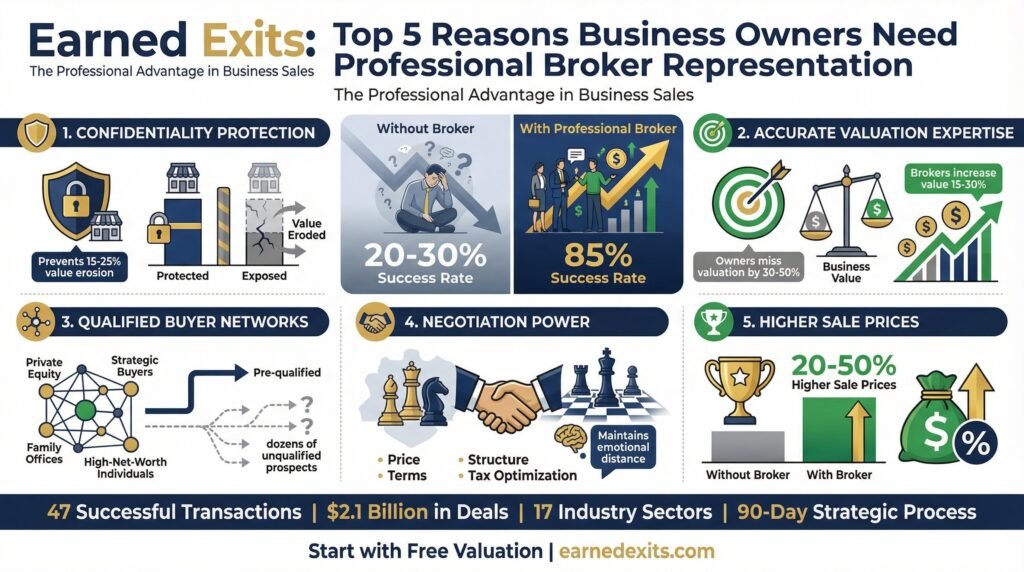
The decision to engage professional representation when selling a business carries significant implications for transaction outcomes. Research consistently demonstrates that professionally represented businesses achieve substantially better results across multiple dimensions. Understanding these specific advantages helps business owners make informed decisions about broker engagement.
1. Confidentiality Protection During the Sales Process
Perhaps the most immediate value professional brokers provide is protecting business confidentiality throughout the sale process. Premature disclosure of sale intentions frequently triggers customer uncertainty, employee departures, competitor opportunism, and supplier concerns that can permanently damage business value.
Elite brokers implement sophisticated confidentiality protocols, including blind profiles, staged information disclosure, and comprehensive non-disclosure agreements that protect business operations throughout extended transaction timelines.
This protection prevents the 15-25% business value erosion that typically occurs when confidentiality breaches happen during sale processes.
2. Accurate Business Valuation Expertise
Professional brokers provide market-based valuation expertise that prevents the costly errors that plague most self-guided business sales.
While unrepresented owners frequently over-value or under-value their businesses by 30-50%, specialized brokers like Earned Exits utilize industry-specific valuation methodologies that incorporate current market conditions, comparable transaction data, and buyer motivation factors.
This expertise ensures businesses are positioned at optimal price points that balance maximizing value with maintaining buyer interest.
The valuation process goes far beyond simple earnings multiples to identify specific value drivers and potential detractors that influence buyer perceptions.
Elite brokers help owners address controllable value detractors before market exposure, often increasing final transaction values by 15-30% through strategic pre-sale improvements. This systematic approach to value optimization represents one of the most significant advantages professional representation provides.
3. Access to Qualified Buyer Networks
Top business brokers maintain extensive networks of qualified, motivated buyers seeking specific acquisition opportunities.
These relationships typically include strategic industry buyers, private equity groups, family offices, and high-net-worth individuals with acquisition criteria matching your business profile. Accessing these pre-qualified buyers dramatically increases the probability of completed transactions while creating competitive dynamics that drive premium valuations.
Earned Exits has developed particularly strong relationships with both financial and strategic buyers across multiple industries.
Their comprehensive buyer vetting process ensures that only financially qualified, experienced acquirers gain access to confidential business information. This selective approach prevents the time-wasting inquiries and confidentiality risks that frequently derail unrepresented business sales.
The quality of these buyer relationships directly impacts transaction timelines and success rates. While unrepresented sellers typically engage with dozens of unqualified prospects before finding legitimate buyers, professionally represented businesses connect directly with pre-qualified acquirers who have demonstrated both capability and motivation to complete transactions.
4. Negotiation Power and Deal Structuring
Business sale negotiations involve a complex interplay between purchase price, payment terms, transition agreements, representations and warranties, non-compete provisions, and numerous other variables.
Professional brokers provide critical negotiating leverage by maintaining competitive tension among multiple prospects while implementing proven negotiation strategies that maximize seller outcomes. This expertise extends far beyond price negotiation to include deal structuring approaches that optimize tax implications and post-closing risk management.
Experienced brokers understand which terms truly matter in business sale agreements and which concessions can be strategically exchanged for higher-priority considerations. This nuanced understanding of transaction structure allows them to navigate complex negotiations while keeping transactions moving forward through inevitable challenges.
Most importantly, professional representation allows owners to maintain appropriate emotional distance from challenging negotiations, preventing the relationship deterioration that frequently derails transactions during direct seller-buyer negotiations.
5. Higher Success Rates and Sale Prices
The most compelling reason to engage professional representation is the dramatic difference in transaction outcomes. Industry data consistently shows that professionally represented businesses sell for 20-50% higher values than comparable unrepresented businesses. Beyond price considerations, represented transactions close at significantly higher rates, with Earned Exits maintaining a transaction success rate exceeding 85% compared to the estimated 20-30% success rate for unrepresented sellers.
These superior outcomes result from the cumulative impact of professional preparation, valuation expertise, marketing reach, qualified buyer networks, and negotiation capabilities that professional brokers provide.
For most business owners, the performance gap between professional and self-guided transactions represents hundreds of thousands, often millions, of dollars in realized value, making broker engagement one of the highest-return investments available during the exit process.
How to Choose the Right Business Broker for Your Exit
Selecting the appropriate business broker represents one of the most consequential decisions in the business exit process.
The right partner dramatically increases both transaction success probability and realized value, while the wrong choice can lead to wasted time, compromised confidentiality, and suboptimal outcomes.
Understanding how to evaluate broker capabilities and alignment with your specific needs is essential for making this critical selection.
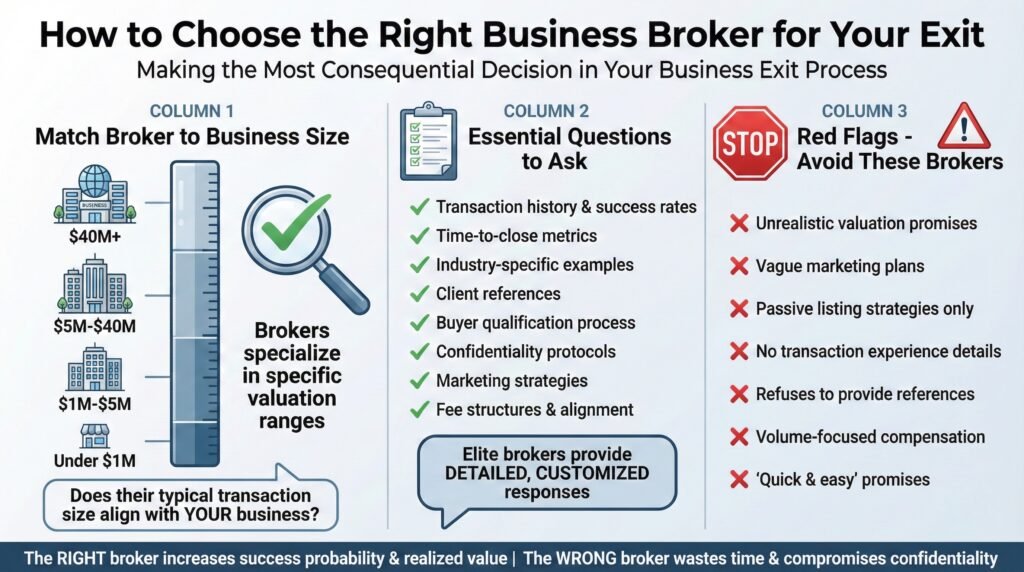
Matching Broker Expertise to Your Business Size ($1M-$40M)
Business size represents a crucial matching factor when selecting an appropriate broker representation.
Small businesses valued under $1 million typically require different marketing approaches and buyer networks than mid-market companies valued between $5-40 million. The most effective brokers specialize within specific valuation ranges rather than attempting to serve all market segments equally.
Earned Exits has developed particular expertise with businesses valued between $1-50+ million, with specific methodologies tailored to different valuation segments within this range.
Their approach recognizes that a $2 million service business requires different positioning and buyer targeting strategies than a $30 million manufacturing operation, even while applying consistent transactional excellence principles across all engagements.
When evaluating potential brokers, assess whether their typical transaction size aligns with your business valuation. Firms that primarily handle transactions significantly smaller or larger than yours may lack the specific expertise and buyer relationships your business requires for optimal outcomes. Earned Exits offers a free business valuation. Click below to get started by filling out their short form.
Questions Every Business Owner Should Ask Before Hiring
Effective broker selection requires asking penetrating questions that reveal true capabilities beyond marketing claims.
Start by requesting detailed transaction history, including success rates, average time-to-close metrics, and specific examples within your industry and valuation range. Superior brokers willingly provide this information along with client references from completed transactions similar to yours.
Additionally, inquire about their buyer qualification process, confidentiality protocols, and specific marketing strategies they would implement for your business. Elite brokers provide detailed, customized responses rather than generic assurances.
Finally, discuss fee structures and alignment with your objectives. The best brokers align their compensation with achieving optimal seller outcomes rather than simply listing businesses or closing quick transactions.
Red Flags That Signal the Wrong Broker Partnership
Several warning signs should immediately disqualify potential brokers from consideration. Be wary of unrealistic valuation promises that significantly exceed market norms, as these frequently indicate “buying the listing” tactics that lead to months of market exposure without realistic transaction prospects.
Similarly, avoid brokers unwilling to provide detailed marketing plans or those who rely exclusively on passive listing strategies without proactive buyer outreach capabilities.
Other concerning indicators include vague answers about transaction experience, reluctance to provide references, and commission structures that incentivize transaction volume over optimal seller outcomes. The most problematic brokers frequently promise fast, easy transactions without acknowledging the complexity and preparation required for successful business transitions.

Your Next Steps: Preparing for a Successful Business Exit & Choosing the Right Broker
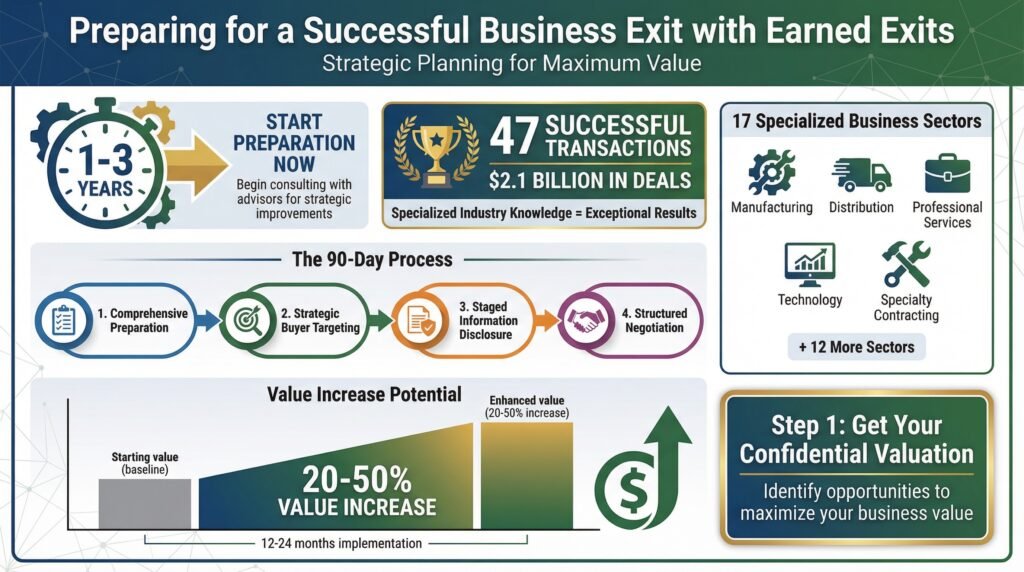
The business sale journey begins well before formal market exposure. Owners contemplating exits within the next 1-3 years should begin preparation immediately by consulting with experienced advisors about strategic improvements that enhance business value.
Earned Exits has facilitated over 47 successful business transactions worth $2.1 Billion, demonstrating how specialized industry knowledge translates to exceptional results.
While many brokers operate as generalists, Earned Exits has developed specialized expertise across 17 distinct business sectors, including manufacturing, distribution, professional services, technology, and specialty contracting.
This industry-specific knowledge allows them to understand the unique value drivers, customer dynamics, and operational considerations that influence buyer perceptions within each sector.
While many brokers employ ad-hoc transaction approaches, Earned Exits has developed a systematic 90-day strategic selling process that maximizes transaction success rates while minimizing disruption to ongoing business operations.
This proprietary methodology includes comprehensive preparation phases, strategic buyer targeting, staged information disclosure, and structured negotiation approaches that maintain transaction momentum through inevitable challenges.
Starting with a confidential valuation from a reputable firm like Earned Exits provides a baseline understanding of current market value while identifying specific opportunities to increase the valuation before sale.
This preparation phase frequently generates the highest return on investment in the entire exit process, with strategic improvements often increasing final transaction values by 20-50% when implemented 12-24 months before planned exits. Click below to get started today with a free business valuation from Earned Exits by filling out their short form.
Frequently Asked Questions
Business owners considering a sale naturally have many questions about the process, timeline, and what to expect. Here are answers to the most common questions reported from small business owners contemplating their exit strategy.
What documents will a business broker need from me?
Comprehensive documentation significantly enhances your sales prospects and often your final price. Be prepared to provide 3-5 years of financial statements, including income statements, balance sheets, and tax returns; year-to-date financials with comparisons to previous periods; detailed asset lists including equipment, inventory, and intellectual property; customer and vendor contracts; lease agreements; employee information (anonymized initially); organizational charts; operation manuals; and marketing materials.
Additionally, your broker will request information about your industry, competitive position, growth opportunities, and potential challenges to help craft compelling marketing narratives that highlight your business’s unique value proposition.
Can a business broker help me improve my business value before selling?
The best business brokers provide significant pre-sale value enhancement guidance. This might include financial restructuring to normalize earnings and demonstrate true profitability; operational improvements to reduce owner dependency; customer diversification strategies; implementing growth initiatives with quick returns; resolving legal or regulatory issues; and documenting systems and processes.
Professional brokers with industry-specific experience can identify the highest-impact improvements given your timeline constraints, helping prioritize efforts that deliver the greatest value enhancement relative to required investment. For businesses not immediately ready for market, many brokers offer pre-sale planning services designed to systematically build value over 1-3 years before listing.
How do brokers maintain confidentiality during the sale process?
Professional brokers implement multi-layered confidentiality protocols including blind business profiles that describe the opportunity without identifying details; comprehensive non-disclosure agreements with personal guarantees and non-solicitation provisions; buyer pre-qualification requiring proof of financial capacity before receiving sensitive information; controlled information release where details are provided incrementally based on demonstrated buyer commitment; secure virtual data rooms with user-specific access controls and document watermarking; and strategic scheduling of site visits and employee meetings to minimize visibility.
Throughout the process, your broker serves as the primary contact for all inquiries, insulating you from direct buyer interaction that might compromise confidentiality while simultaneously monitoring compliance with confidentiality obligations.
What’s the difference between a business broker and a mergers and acquisitions advisor?
While overlap exists, these roles typically differ in client size, transaction complexity, and service approach. Business brokers generally focus on small to mid-sized businesses valued under $5-10 million, providing end-to-end transaction support including valuation, marketing, buyer qualification, negotiation, and closing coordination. Their clients typically include owner-operated businesses where the sale represents a significant life transition.
M&A advisors typically work with larger businesses valued above $5-10 million, often providing more sophisticated financial analysis, strategic positioning, and complex deal structuring. They frequently collaborate with investment bankers on larger transactions and may employ industry specialists who focus exclusively on specific market sectors. For most small business owners, a business broker with relevant industry experience offers the appropriate level of service, though firms like Earned Exits bridge both categories by bringing sophisticated M&A capabilities to small and medium-sized business transactions.
Is it better to hire a local business broker or a national firm?
This decision involves weighing several important factors. Local brokers offer valuable geographic market knowledge, established relationships with regional buyers and advisors, and convenient face-to-face availability. Their community connections and understanding of local business dynamics can prove particularly valuable for businesses serving geographically limited markets or those heavily dependent on local relationships.
National firms typically offer broader marketing reach, larger buyer databases, and specialized expertise across diverse industries. They may bring sophisticated marketing resources, standardized processes, and exposure to national or international buyers willing to pay premium prices for strategic acquisitions. The best national firms combine these advantages with local market knowledge through regional offices or industry specialization.
Ranked a top business broker in 2025, Earned Exits has completed over 47 business transactions worth $2.1 Billion, showing how specialized industry knowledge leads to exceptional results. Get started today with Earned Exits free business valuation by clicking the banner below:

*Disclaimer: This article is written for educational purposes and should not be interpreted as financial advice.
*Disclaimer: This article is written for educational purposes and should not be interpreted as financial advice. We may receive compensation for referrals made through this article.