
Introduction
Most business owners spend decades building something they hope to exit gracefully. They picture themselves closing a deal of a lifetime, celebrating with champagne, and riding off into the sunset with financial security.
That vision feels attainable until you look at what actually happens.
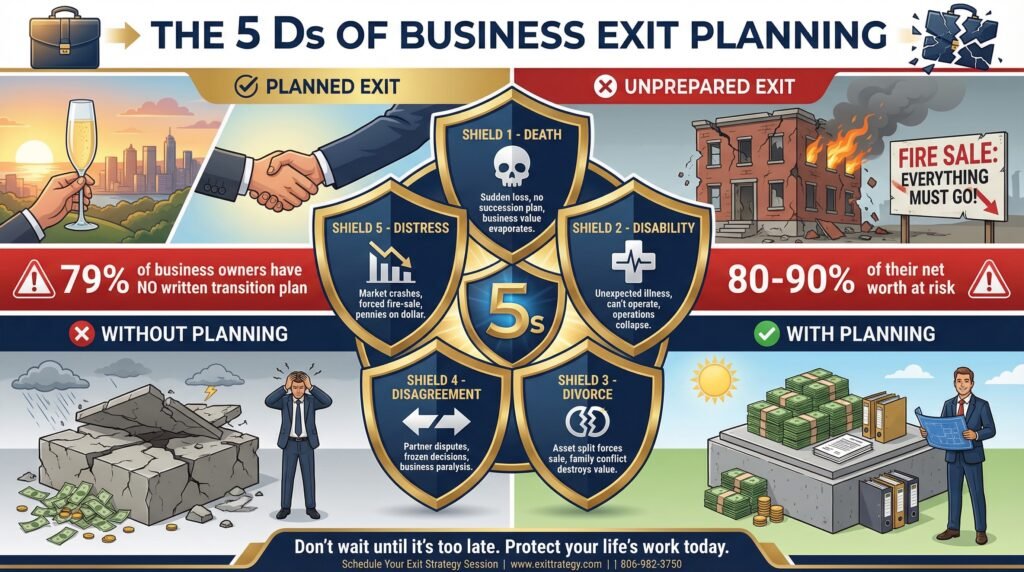
The statistics tell a different story. 79% of business owners have no written transition plan despite their business representing 80-90% of their net worth.
These aren’t casual side ventures we’re talking about. For most owners, the business is their entire financial future. Without proper planning, exits that should be celebrations turn into disasters.
You can protect yourself from forced exits by understanding the five critical threats that derail most transitions. Each threat needs methodical attention and systematic planning.
Skipping even one creates vulnerabilities that can tear through your safety net.
When one of these threats hits unprepared owners, they watch everything they built crumble. The business they poured their lives into gets sold at fire-sale prices or simply collapses.
Comprehensive planning prevents these catastrophic outcomes.
You won’t necessarily experience the fantasy exit you’ve daydreamed about. But you will protect yourself from the devastating losses that hit unprepared owners.
Once you’ve addressed these risks properly, you’ll feel relieved and wonder why you waited so long.
The five D’s that threaten your business exit are Death, Disability, Divorce, Disagreement, and Distress. Each one can destroy your business if you haven’t built proper defenses.
Death
Your business probably can’t survive your death. That sounds harsh, but the numbers prove it repeatedly. When a business owner dies without proper planning, sales typically decline 60% within four years and employment drops 17%.
The business doesn’t just stumble along. It hemorrhages value.
The problem goes far beyond emotional devastation. When you die, decades of relationship capital, operational knowledge, and strategic vision vanish instantly.
Your clients lose their trusted advisor.
Your employees lose the person who understood why the company exists and where it’s heading. That vacuum creates chaos.
I’ve watched this scenario unfold dozens of times. The owner passes unexpectedly, and within weeks, the company’s best clients start taking calls from competitors.
Key employees begin updating their LinkedIn profiles.
The remaining partners or family members start fighting about direction. The business enters a death spiral that feels inevitable because it was entirely preventable.
Key person life insurance forms the financial foundation of death planning. This isn’t the term life policy you bought to protect your family.
This is a business asset specifically designed to fund ownership transitions, cover operational gaps, and maintain liquidity when leadership suddenly vanishes.
The insurance proceeds give surviving stakeholders the capital to execute predetermined succession plans rather than desperately scrambling for cash.
Buy-sell agreements represent the legal framework that makes everything work. These agreements define precisely how your ownership stake transfers when you die, who can buy it, at what price, and under what terms.
When properly funded with life insurance, buy-sell agreements prevent the nightmare scenario where your grieving spouse finds herself in business with your former partners who resent her involvement and want her out.
Estate planning ensures your business interests flow according to your explicit wishes rather than state intestacy laws. Without proper estate documents, your business could end up in probate for months or years, frozen while courts decide ownership.
Your competitors would love nothing more than that kind of paralysis in your organization.
Succession planning identifies and develops the people who’ll actually run the business after you’re gone. You need to systematically transfer operational knowledge, client relationships, and strategic decision-making capacity to people you’ve personally trained.
The best succession plans start five to seven years before a planned exit, giving successors meaningful time to learn the business while you’re still available for guidance.
The best succession plans start five to seven years before a planned exit, giving successors meaningful time to learn the business while you’re still available for guidance.
An experienced business broker can help every business owner and founder with the process of planning their specific business exit. Most owners lose 30–50% of their business’s true potential value when selling because they start the process too late (emotionally ready = rushed & weak negotiating position)
The most profitable exits are engineered, not accidental. Start preparing your business (and yourself) early, ideally 2–3 years ahead, so you can sell when conditions are strong, not when you’re desperate. Waiting until something unforeseen happens is always a losing strategy.
Earned Exits was ranked as a top business broker in 2025 and has performed over $2 billion in transactions. The company’s 10-point process helps companies with $1 to 40 million in revenue find a qualified buyer and make the selling process as easy and streamlined as possible. If you are to start the process now, click the button below to get started by filling out their short form.

Disability
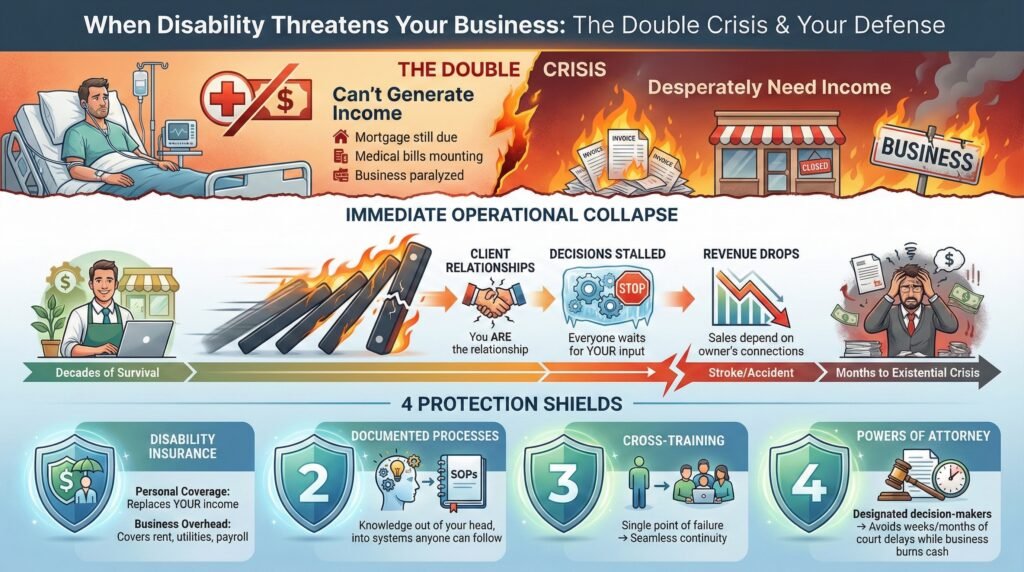
Disability presents a uniquely brutal challenge because you’re simultaneously unable to generate income and desperately dependent on that same income. You can’t work, but your mortgage payment doesn’t care.
Your medical bills pile up, but your business can’t function without you making critical decisions.
The operational impact hits immediately. When you can’t come to work because of a severe injury or sudden illness, essential functions lack coverage.
Client relationships deteriorate because you are the relationship.
Strategic decisions stall because everyone’s accustomed to waiting for your input. The business becomes dangerously vulnerable precisely when it needs strength most.
I’ve seen disability destroy businesses that survived decades of economic cycles and competitive threats. The owner suffers a stroke or serious accident, and within months, the company faces existential threats.
Revenue drops because sales processes depend entirely on the owner’s personal relationships.
Operations falter because key decisions require the owner’s approval. Cash flow tightened because the owner was the only person authorized to make major financial decisions.
Disability insurance provides the financial cushion that prevents immediate catastrophe. Personal disability coverage replaces your income so you can pay your bills and focus on recovery rather than financial survival.
Business overhead disability insurance covers ongoing business expenses like rent, utilities, and payroll when you can’t work.
This coverage prevents the business from collapsing under fixed costs while revenue declines.
Documented processes transform institutional knowledge from something locked in your head into operational systems anyone can follow. When every critical process exists only in your experience and judgment, your disability immediately cripples operations.
When those same processes are documented, trained employees can maintain continuity even without your daily involvement.
Cross-training key employees eliminates single points of failure. If only you know how to manage your largest client relationship, your disability immediately jeopardizes that revenue.
If three people understand that relationship and can step in seamlessly, your absence becomes manageable rather than catastrophic.
Powers of attorney designate trusted people to make medical and financial decisions if you’re incapacitated. Without these documents, your business could be frozen while courts appoint someone to make decisions on your behalf, a process that takes weeks or months while your business burns through cash.
Divorce
Divorce introduces complications that make most business owners genuinely uncomfortable because it forces them to acknowledge that personal relationships directly threaten business assets.
When marriages dissolve, business interests become marital property subject to division, creating scenarios where a non-operating former spouse could gain a controlling interest in your company.
The financial exposure extends well beyond simple asset division. In many states, business value accumulated during marriage forms marital property regardless of whose name appears on ownership documents.
Your spouse might never have set foot in your office, but divorce courts could award them 50% of your business value, or worse, actual ownership shares.
I know owners who’ve found themselves in business with their ex-spouses after contentious divorces. The ex-spouse gained ownership shares through property division, and suddenly the owner faces a hostile partner with legal rights to financial information, voting rights on major decisions, and claims on business profits.
Running a business effectively under those conditions is nearly impossible.
Prenuptial and postnuptial agreements establish a clear separation between personal and business assets. These documents explicitly define business interests as separate property or specify exactly how business ownership would be handled in divorce proceedings.
Many entrepreneurs resist these agreements because they seem unromantic or suggest a lack of trust, but they’re fundamentally business protection mechanisms.
Buy-sell agreements with divorce provisions prevent former spouses from gaining unwanted ownership stakes. These clauses typically require the owner to purchase shares that would otherwise transfer to a spouse through divorce, maintaining ownership concentration among active business participants.
The agreements specify valuation methods and payment terms, preventing disputes about business worth during emotionally charged divorce negotiations.
Shareholder agreements and operating agreements include transfer restrictions that prevent ownership from flowing to unintended parties. These documents typically require existing owners to approve any ownership transfers, giving the business legal mechanisms to block former spouses from gaining operational control or access to confidential business information. Click below to contact Earned Exits today by filling out their short form. Receive a free business valuation and discover how our proven 10-step process can help you achieve the maximum value for your business.
Learn about the final 2 D’s to be aware of in the business exit planning series on best practices here.
People Also Asked
What happens to a business when the owner dies?
When a business owner dies without proper planning, the business typically experiences a significant decline. Sales drop an average of 60% within four years, and employment falls by 17%.
Client relationships deteriorate rapidly because they are often tied to the owner personally.
Key employees leave because of uncertainty about the company’s future. Without predetermined succession plans and proper funding through life insurance, the business often gets sold at fire-sale prices or simply closes.
How much disability insurance do business owners need?
Business owners need two types of disability coverage. Personal disability insurance should replace enough income to cover your living expenses, typically 60-70% of your salary.
Business overhead expense insurance should cover fixed business costs like rent, utilities, and essential payroll during your absence.
Calculate your actual monthly business expenses and confirm your coverage matches that amount for at least 12-24 months.
Can my spouse take my business in a divorce?
In community property states, your spouse may be entitled to 50% of the business value accumulated during the marriage, regardless of whose name is on the ownership documents.
In equitable distribution states, courts divide marital property fairly, which doesn’t always mean equally, but can still result in significant business value going to your spouse.
Prenuptial agreements, postnuptial agreements, and buy-sell agreements with divorce provisions can protect business ownership from divorce settlements.
What should a buy-sell agreement include?
A comprehensive buy-sell agreement should specify trigger events that activate the agreement, including death, disability, retirement, voluntary departure, and divorce. It should define valuation methods for determining business worth, payment terms for buying out departing owners, and funding mechanisms like life insurance.
The agreement should also include transfer restrictions preventing owners from selling to outside parties without approval and dispute resolution procedures.
How long does it take to prepare a business for sale?
Preparing a business properly for sale typically takes three to five years. This timeline allows you to document processes, reduce key person dependencies, strengthen financial performance, diversify customer concentration, and develop management teams that can operate without you.
Businesses sold without this preparation period typically receive significantly lower valuations because buyers discount heavily for transition risks.
What percentage of business value should be kept in cash reserves?
Most businesses should maintain three to six months of operating expenses in cash reserves. However, businesses with high customer concentration should keep six to twelve months.
Companies with long sales cycles, high fixed costs, or exposure to economic volatility should maintain even larger reserves.
The specific amount depends on how quickly you could reduce expenses or generate emergency revenue if your primary income source disappeared.
Let the Earned Exits business advisory team guide you through the business exit planning and execution process. The company specializes in comprehensive exit planning that addresses both financial and personal dimensions of business transitions.
Contact Earned Exits today to begin developing your customized exit strategy designed to maximize value while ensuring post-sale fulfillment and security. Get started today with the company’s free business valuation via the link below and fill out their short form:

*Disclaimer: This article is written for educational purposes and should not be interpreted as financial advice.
*Disclaimer: This article is written for educational purposes and should not be interpreted as financial advice. We may receive compensation for referrals made through this article.