
Quick Summary
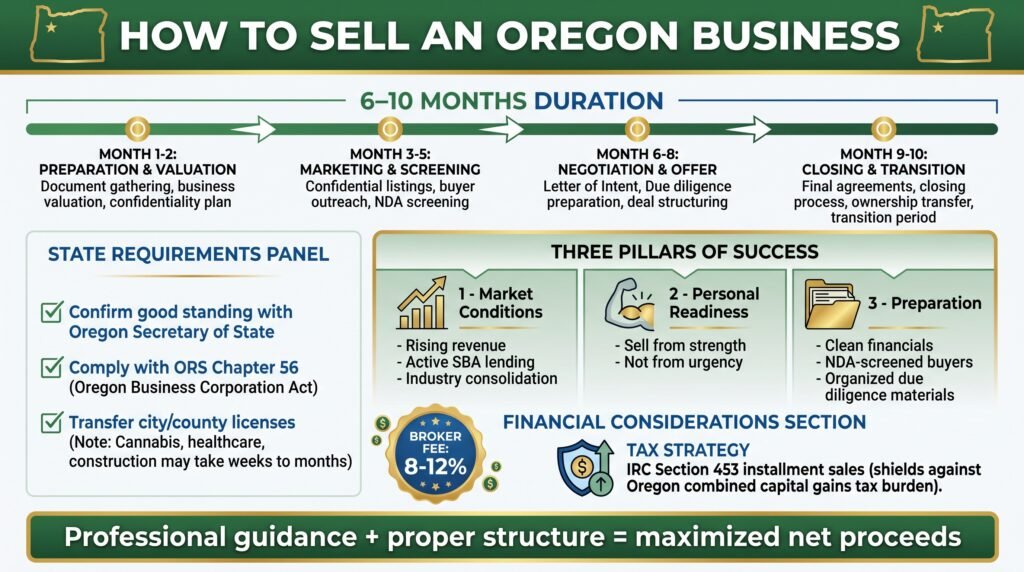
Selling an Oregon business typically takes 6–10 months and involves specific state requirements: confirming good standing with the Oregon Secretary of State, complying with ORS Chapter 56, and transferring city/county licenses (which can take weeks to months for regulated industries like cannabis, healthcare, or construction).
Success depends on aligning three factors — favorable market conditions (rising revenue, active SBA lending, industry consolidation), personal readiness (selling from strength, not urgency), and thorough preparation (clean financials, NDA-screened buyers, organized due diligence materials). Working with a qualified broker (typically 8–12% fee) and structuring the deal well — including options like installment sales under IRC Section 453 — can meaningfully protect net proceeds against Oregon’s combined capital gains tax burden.
Table of Contents
- Quick Summary
- The Best Time to Sell an Oregon Business
- Oregon-Specific Legal Requirements Every Seller Must Meet
- How to Find Qualified Buyers and Negotiate the Sale
- What Business Brokers Do That Most Sellers Cannot Do Alone
- Selling an Oregon Business Takes 6 to 10 Months: Plan Accordingly
- Business Selling Checklist
- Frequently Asked Questions
The Best Time to Sell an Oregon Business
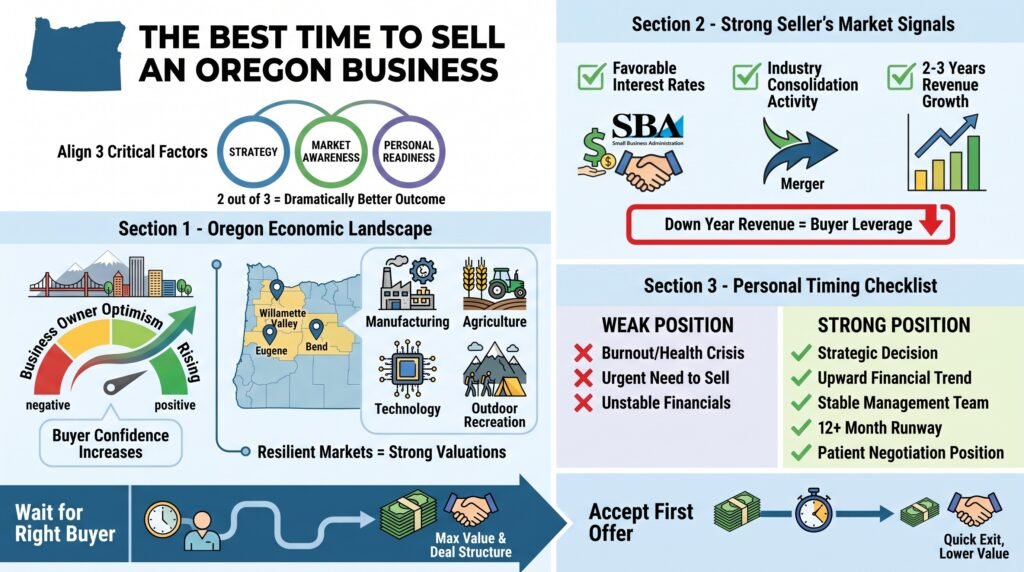
Timing a business sale is part strategy, part market awareness, and part personal readiness. Getting all three aligned is rare, but even getting two out of three right dramatically improves your outcome.
How Portland’s Economic Recovery Affects Buyer Confidence
Portland’s downtown business environment has faced real headwinds over the past several years, but recent surveys indicate a measurably more positive outlook among Portland business owners. That shift in sentiment matters because buyer confidence tracks closely with seller sentiment, when local business owners feel optimistic, buyers are more willing to pay full value and move quickly through due diligence.
Outside of Portland, Oregon’s broader economy, anchored by manufacturing, agriculture, technology, and outdoor recreation, has remained relatively resilient. Buyers looking at businesses in Eugene, Bend, Salem, and the Willamette Valley are operating in markets with strong underlying fundamentals, which supports valuations across a range of industries.
Market Conditions That Signal a Strong Seller’s Market
You’re in a stronger negotiating position when interest rates are favorable for buyers seeking SBA financing, when your industry is seeing consolidation activity, and when your business has posted two to three consecutive years of revenue growth. Each of these conditions increases buyer competition and supports a higher multiple on your earnings. Conversely, selling during a down year in revenue, even if it’s a one-time anomaly, gives buyers leverage to push your valuation down.
How Personal Timing Factors Into the Decision
Market conditions aside, your personal readiness to sell is equally important. Business owners who sell because they’re burned out or facing a health issue rarely get the best price, they’re negotiating from a position of urgency that buyers can sense and exploit. The strongest seller is one who doesn’t have to sell, but has decided strategically that now is the right time.
If you have flexibility, aim to list your business when your financials are trending upward, your management team is stable, and you have at least 12 months of runway before any personal pressure forces your hand. That positioning gives you the patience to wait for the right buyer at the right price rather than accepting the first offer that comes in.
Oregon-Specific Legal Requirements Every Seller Must Meet
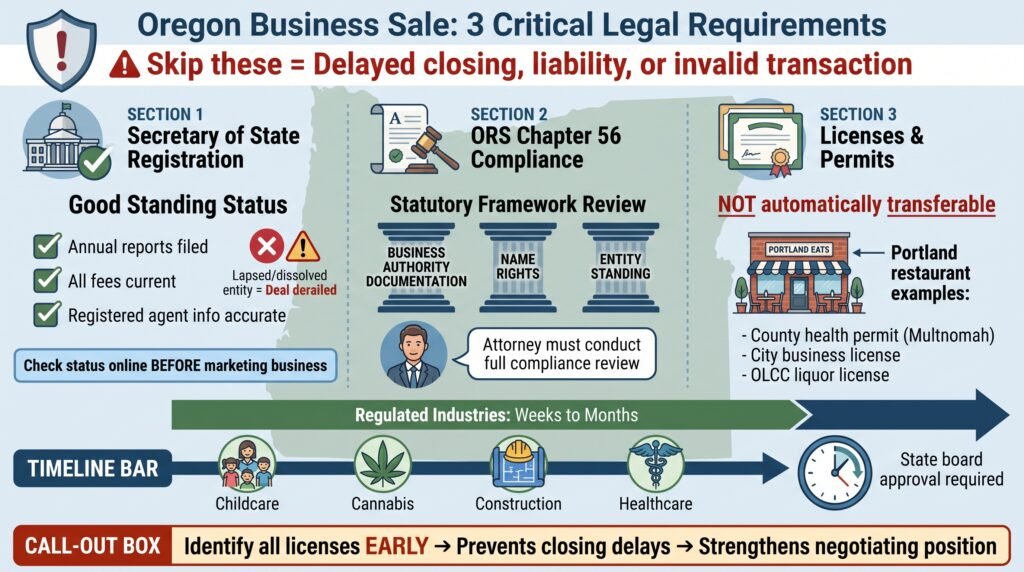
Oregon has specific statutory obligations that business sellers must satisfy before and during a sale. Skipping or mishandling any of these requirements can delay closing, create post-sale liability, or invalidate parts of the transaction entirely. These aren’t just administrative formalities, they’re legal protections that affect both parties.
Secretary of State Registration and Business Standing
Before your business can be legally transferred, it must be in good standing with the Oregon Secretary of State. That means all annual reports are filed, fees are current, and your registered agent information is accurate. A lapsed or administratively dissolved entity creates immediate complications during due diligence and can derail a deal that’s otherwise ready to close. Pull your business’s current status from the Oregon Secretary of State’s online registry before you even begin marketing the business for sale.
ORS Chapter 56 Compliance for Business Sales
Oregon Revised Statutes Chapter 56 outlines the Secretary of State’s duties and statutory framework relevant to business registrations and transfers. As a seller, understanding which obligations fall under this chapter, including proper documentation of business authority, name rights, and entity standing, ensures your transaction is legally sound from the outset. Your business attorney should conduct a full compliance review against ORS Chapter 56 as part of pre-sale preparation.
Transferable Licenses and Permits in Oregon Cities
Many business licenses and operating permits in Oregon are issued at the city or county level, and they are not automatically transferable to a new owner. A restaurant in Portland may require a separate Multnomah County health permit, a city business license, and an OLCC liquor license, each of which has its own transfer or reapplication process. Identifying all active licenses and permits early in the sale process prevents last-minute delays at closing.
For certain regulated industries, childcare, cannabis, construction contracting, and healthcare, the licensing transfer process can take weeks or months and may require state board approval. Build this timeline into your sale schedule proactively. Buyers will want confirmation that all necessary permits will be in place on day one of ownership, and your ability to deliver that assurance directly affects the strength of your negotiating position.
How to Find Qualified Buyers and Negotiate the Sale
Finding a buyer is not the hard part. Finding the right buyer, one who is financially qualified, operationally capable, and serious about closing, is where most sellers waste time and energy. A structured approach to buyer identification and qualification saves months of frustration.
Screening Buyers Before Entering Negotiations
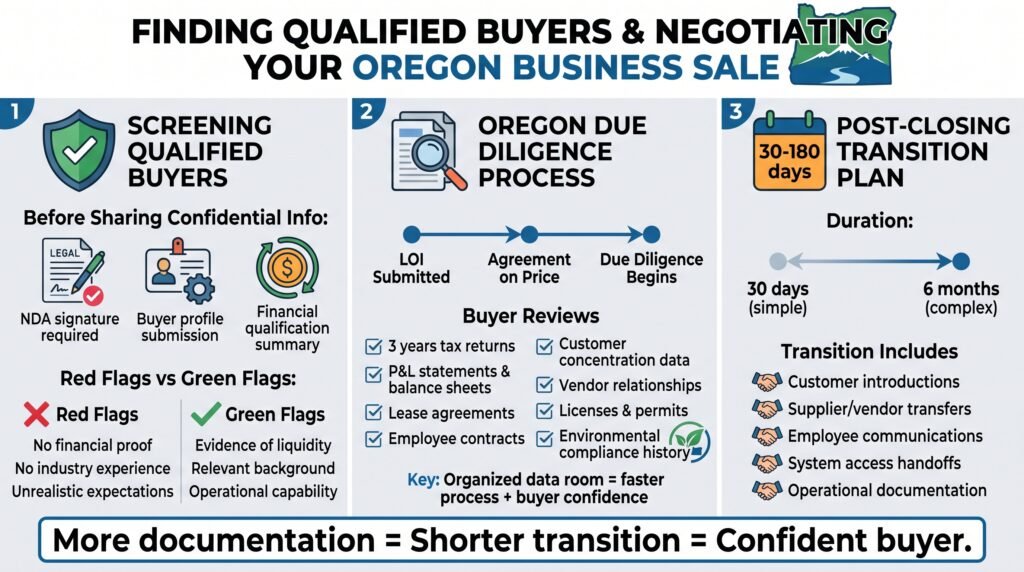
Before sharing any confidential information about your business, require prospective buyers to sign a Non-Disclosure Agreement (NDA) and submit a buyer profile or financial qualification summary. This is standard practice and any serious buyer will expect it. You’re looking for evidence of liquidity, relevant industry experience, and a realistic understanding of what acquiring and operating a business actually requires. A buyer who can’t demonstrate basic financial capacity isn’t worth your time, regardless of how enthusiastic they seem.
What the Due Diligence Process Looks Like in Oregon
Once a buyer submits a Letter of Intent (LOI) and you reach basic agreement on price and structure, due diligence begins. This is the buyer’s formal investigation of everything you’ve represented about the business. Expect them to review three years of tax returns, profit and loss statements, balance sheets, lease agreements, employee contracts, customer concentration data, vendor relationships, and all active licenses and permits.
In Oregon, due diligence also commonly includes a review of environmental compliance history, particularly for manufacturing, agricultural, or real estate-adjacent businesses, since Oregon’s environmental regulations carry meaningful liability implications for buyers. Being prepared with a clean, organized data room dramatically speeds this phase and signals to the buyer that your business is well-managed, which reinforces their confidence in the price they’re paying.
Transition Plans: What a 1 to 6 Month Handoff Involves
Most buyers of small to mid-sized Oregon businesses will require a transition period where you remain involved after closing to transfer relationships, knowledge, and operational know-how. This typically ranges from 30 days on the short end to six months for more complex businesses, and it’s usually built into the purchase agreement as a condition of the sale. The length and compensation for this period is negotiable, but you should go in with a clear picture of what you’re willing to commit to.
A well-structured transition plan covers key customer introductions, supplier and vendor relationship transfers, employee communications, software and system access handoffs, and operational documentation. The more of this you can document before closing, in the form of standard operating procedures, training materials, and process guides, the shorter and smoother your required transition period will be, and the more confident the buyer will feel walking in on day one.
What Business Brokers Do That Most Sellers Cannot Do Alone
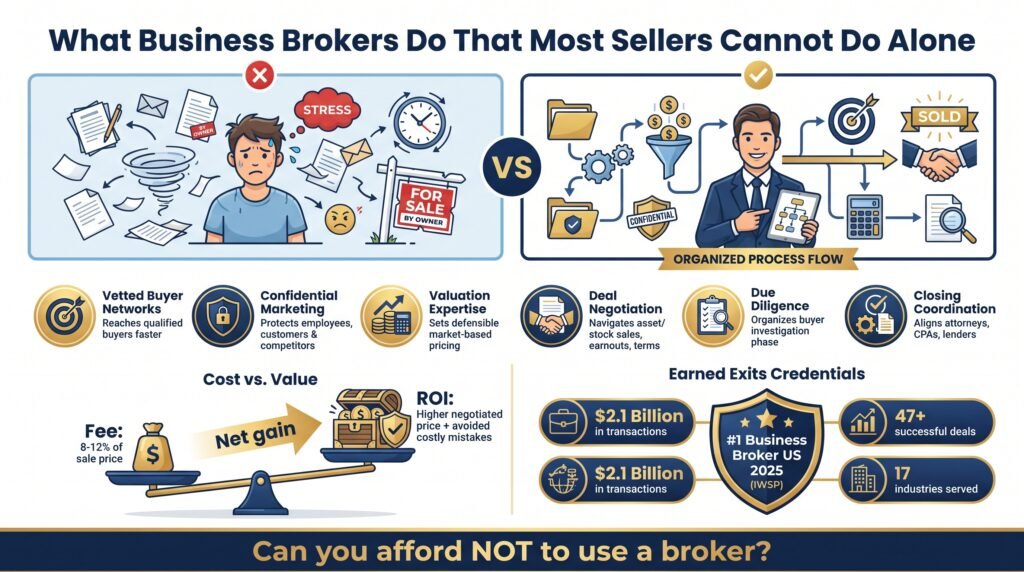
Most business owners are exceptional at running their business. That skill set does not automatically transfer to selling one. Selling a business is a specialized transaction that involves simultaneous negotiation across financial, legal, operational, and emotional dimensions, and doing it wrong while also trying to run the business day-to-day is a recipe for either a failed deal or a dramatically undervalued one.
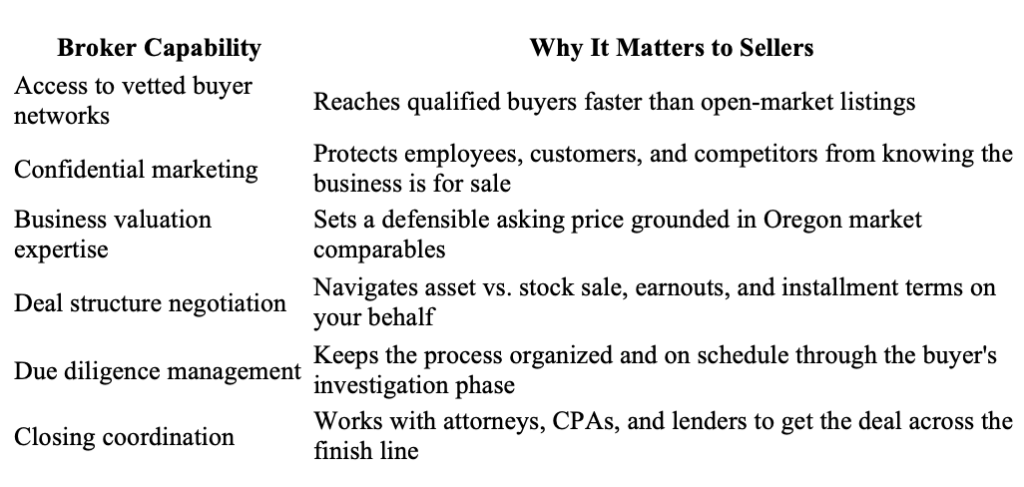
A qualified business broker brings three things most sellers simply don’t have: a pool of pre-screened, financially qualified buyers; the ability to market your business confidentially so that employees, customers, and competitors don’t find out prematurely; and the negotiation experience to protect your interests when deal terms get complicated. Confidentiality alone is worth significant money, a business that becomes publicly known to be “for sale” often loses key employees and customers before a buyer is even found, which directly damages the valuation.
Broker fees typically run between 8% and 12% of the final sale price for small to mid-sized businesses, sometimes structured as a Lehman formula for larger deals. That fee is real money, but for most sellers it is more than offset by the higher price a skilled broker negotiates and the costly mistakes they prevent. The question is not whether you can afford a broker, it’s whether you can afford to go without one.
Brokering over $2.1 Billion in transactions across 17 industries, Earned Exits was named a top business broker in 2025 by IWSP. Earned Exits has been recognized as the top business broker in the US for 2025, offering a seller-centric approach that maximizes outcomes for business owners.
The most effective business brokers maintain confidentiality throughout the sales process while connecting sellers with qualified, vetted buyer networks. Earned Exits has facilitated over 47 successful business transactions worth $2.1 Billion, demonstrating how specialized industry knowledge translates to exceptional results.
If your business size is $1M-$40M+, click the button below to begin their free business valuation by filling out their short contact form.
Selling an Oregon Business Takes 6 to 10 Months: Plan Accordingly
On average, the full process of selling an Oregon business, from initial preparation through closing, takes between 6 and 10 months. Each major phase, including preparation, marketing, buyer screening, due diligence, and closing, can independently consume 2 to 3 months depending on market conditions, the complexity of the business, and buyer financing timelines.
SBA loan approvals alone can add 60 to 90 days to a deal once a buyer is under contract. Sellers who go in expecting a 30- or 60-day process almost always end up making rushed decisions that cost them money, build the full timeline into your planning from day one.
Frequently Asked Questions
Selling a business in Oregon raises a lot of specific questions, about taxes, legal compliance, timing, and process. The answers below address the most common one’s sellers face, with the specificity you need to actually move forward with confidence.
If you’re early in the process, read through all of them. Even the questions that don’t seem immediately relevant often surface important considerations that sellers wish they’d thought about earlier.
What Licenses and Permits Need to Be Transferred When Selling an Oregon Business?
Every active license and permit tied to the business operation must be identified and addressed before closing. Oregon business licenses are issued at both the state and local level, and most are not automatically transferable, the new owner must either apply for a new license or go through a formal transfer process with the issuing authority. City-specific licenses in Portland, Eugene, Salem, and Bend each have their own procedures and timelines.
For regulated industries, including cannabis, childcare, healthcare, and construction contracting, state board approval may be required before a license can transfer, and that process can take weeks or months. Start your license inventory early, build the transfer timeline into your closing schedule, and ensure your purchase agreement clearly specifies which party is responsible for each transfer obligation and what happens if a critical license cannot be transferred before the closing date.
How Is My Oregon Business Valued During the Sale Process?
Professional business valuators use three primary methods: the income approach (most common for operating businesses, based on a multiple of SDE or EBITDA), the market approach (comparing your business to recent sales of similar Oregon businesses), and the asset-based approach (calculating net asset value, most relevant for asset-heavy or low-profit businesses). In practice, a valuator will often use more than one method to cross-validate results and produce a defensible number that holds up under buyer scrutiny.
The accuracy and completeness of your financial records directly determines how smooth and favorable your valuation will be. Businesses with three or more years of clean, CPA-reviewed financials consistently achieve higher multiples because buyers have higher confidence in what they’re acquiring. Disorganized, inconsistent, or incomplete records give buyers a reason to discount their offer or walk away entirely.
What Is an Installment Sale and Can It Reduce My Tax Burden in Oregon?
An installment sale is a deal structure where the buyer pays the purchase price over multiple years rather than in a lump sum at closing. Under IRC Section 453, which Oregon recognizes, this allows you to spread your taxable gain across the years in which you receive payments, potentially keeping your income in lower tax brackets in any single year and reducing the total tax bite over the life of the deal.
The tradeoff is that you carry credit risk on the buyer, if they default on future payments, recovering the money can be costly and complicated. Always secure an installment sale with a promissory note, a personal guarantee, and a security interest in the business assets.
Do I Need a Business Broker to Sell My Oregon Business?
You are not legally required to use a broker, but for the vast majority of sellers, going without one is a costly decision. Brokers bring a pre-qualified buyer pool, confidential marketing capability, valuation expertise, and deal negotiation experience that most business owners simply don’t have.
They also manage the process, keeping due diligence on track, coordinating between attorneys, CPAs, and lenders, and preventing the dozens of small breakdowns that can derail a transaction. Broker fees typically run 8% to 12% of the sale price, but that cost is almost always recovered through a higher final price and fewer costly mistakes.
What Oregon Laws Apply Specifically to Business Sales?
Oregon Revised Statutes Chapter 56 governs the Secretary of State’s role in business registrations and transfers, establishing the statutory framework that sellers must comply with regarding entity standing, name rights, and business authority documentation. This is the foundational legal reference point for any Oregon business sale and should be part of your attorney’s pre-sale compliance review.
Beyond ORS Chapter 56, Oregon’s bulk sale laws, derived from Article 6 of the Uniform Commercial Code, may apply if you are selling business assets to a buyer and have existing creditors. Compliance with bulk sale notice requirements protects both parties from post-closing creditor claims, and your attorney should assess whether these rules apply to your specific transaction structure.
Oregon’s employment laws also carry implications for sellers, particularly around the treatment of existing employees during a business transfer. Whether employees are retained, terminated, or transitioned under new ownership triggers specific obligations under Oregon wage and hour law, final paycheck requirements, and potentially WARN Act provisions if the transaction involves significant workforce changes.
Finally, industry-specific regulations, environmental compliance for manufacturers, OLCC licensing for alcohol-related businesses, Oregon Health Authority requirements for healthcare businesses, and ODA oversight for agricultural operations, all create additional legal touchpoints that must be addressed before and during the sale. Engaging an Oregon business transaction attorney early in the process ensures none of these obligations get missed in the rush to close.
Earned Exits specializes in helping business owners navigate complex sales transactions with confidence, from valuation through closing. Click banner below get started with their free business valuation by filling out their short contact form.

Sources
https://www.websiteclosers.com/resources/how-to-sell-a-business-in-oregon
*Disclaimer: This article is written for educational purposes and should not be interpreted as financial advice. We may receive compensation for referrals made through this article.