
Quick Summary
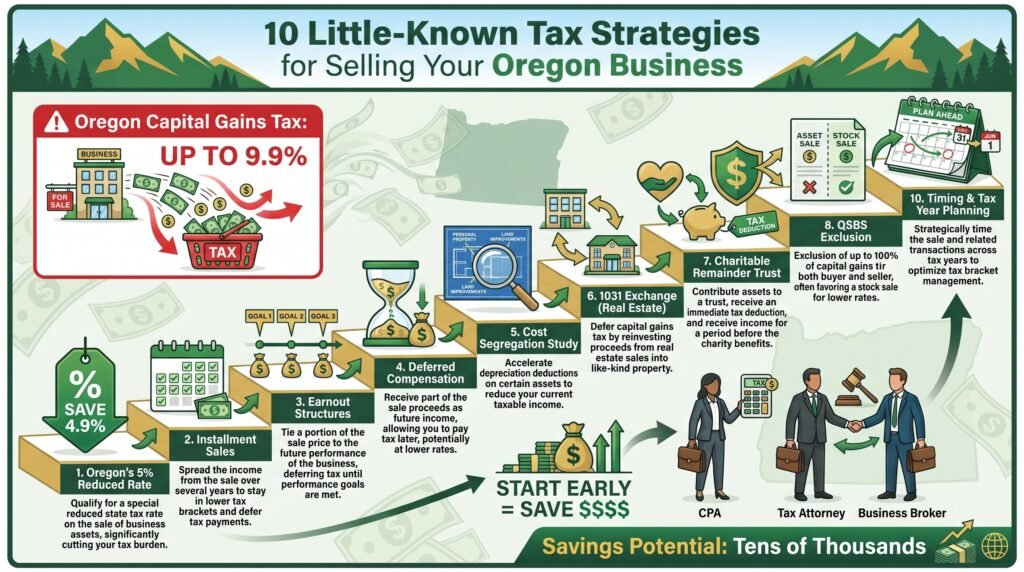
Oregon taxes capital gains as ordinary income up to 9.9%, making tax planning critical before selling a business. This guide covers 10 lesser-known strategies, from qualifying for Oregon’s reduced 5% business sale rate to structuring earnouts, deferred compensation, cost segregation studies, and 1031 exchanges for real estate holdings, that can save sellers tens of thousands of dollars. Pairing these tactics with the right CPA, tax attorney, and business broker early in the exit process is the difference between keeping proceeds and losing them to avoidable tax.
Table of Contents
- Quick Summary
- Tax Strategies When Selling a Business in Oregon
- Business Exiting Checklist
- Final Thoughts and Next Steps
- Frequently Asked Questions
Tax Strategies When Selling a Business in Oregon
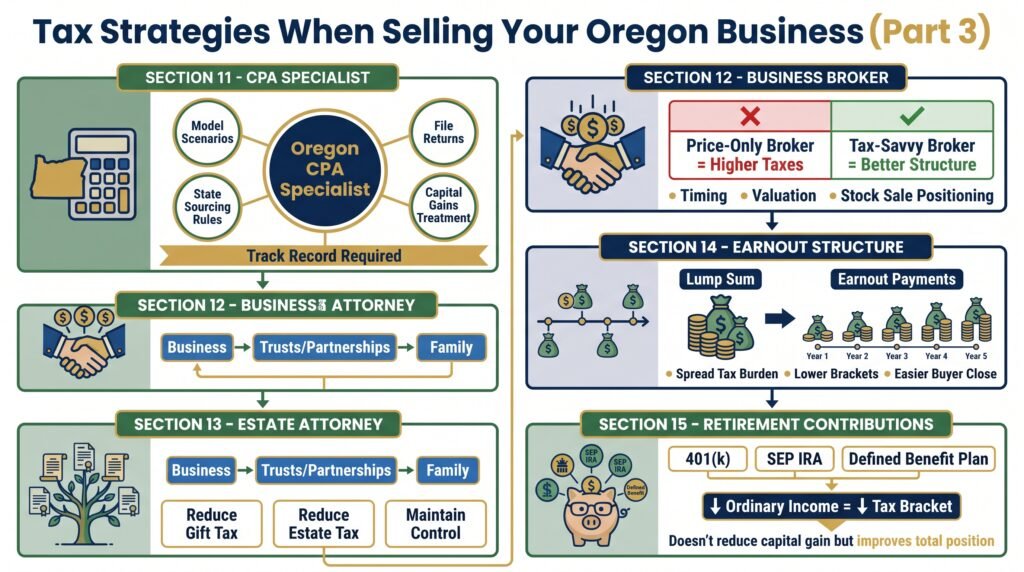
11. Work with a CPA Who Specializes in Oregon Business Sales
A CPA with Oregon exit experience can model different scenarios, prepare projections, and file the returns correctly. They’ll also advise on estimated payments, state sourcing rules, and the interaction between federal and Oregon tax.
Not every CPA handles complex business sales, so look for someone with a track record in this area.
They should be able to explain how Oregon’s ordinary income treatment of capital gains affects your specific situation.
Total time: Engage early in the planning phase.
Setup: Schedule consultation, provide tax returns and financials.
How easy to start: Easy with the right referral.
Requirements: Business tax history, financial statements, sale details.
12. Use a Business Broker Who Understands Tax Implications
Business brokers who understand tax issues can help you market the business in a way that attracts buyers willing to structure deals favorably. They can also advise on timing, valuation, and how to position the business to justify a stock sale or other seller-friendly terms.
A broker who only focuses on price may get you a higher number but cost you more in taxes.
Total time: Engage 6 to 12 months before listing.
Setup: Interview brokers, sign listing agreement, prepare business for sale.
How easy to start: Easy if you research candidates.
Requirements: Business financials, valuation, marketing materials.
Resources: Earned Exits Review – Voted Top Business Broker in 2025
13. Consult an Estate Planning Attorney for Succession
If you’re passing the business to family or using gifting strategies to reduce your estate, an estate planning attorney can structure the transfer to minimize gift and estate taxes. They can also set up trusts or family partnerships that give you control while moving ownership.
This works best when combined with a sale or phased transition, and it can reduce both income and estate tax exposure.
Total time: Six months to a year for complex planning.
Setup: Consultation, document preparation, ownership transfers.
How easy to start: Requires coordination with tax and legal advisors.
Requirements: Family succession plan, current estate plan, business valuation.
14. Negotiate Earnouts Instead of Lump Sum Payments
Earnouts tie part of the purchase price to future performance, which spreads payments and tax over multiple years. This functions like an installment sale and reduces buyer risk, making it easier to close deals.
You’ll recognize income as each earnout payment is received, which can keep you in lower brackets and give you more control over timing.
Total time: Earnout periods typically run one to three years.
Setup: Negotiate terms in the purchase agreement.
How easy to start: Common in transactions, needs clear performance metrics.
Requirements: Agreement language, tracking system, buyer reliability.
15. Maximize Retirement Contributions in the Sale Year
If you’re still on payroll before the sale, maximize contributions to 401(k), SEP IRA, or defined benefit plans. This reduces your ordinary income in the sale year and can lower your overall tax bracket.
It won’t reduce the capital gain directly, but it can reduce the marginal rate applied to other income, which improves your total tax position.
Total time: Must contribute before year-end.
Setup: Work with your payroll provider and CPA.
How easy to start: Easy if you have cash flow.
Requirements: Active payroll, qualified retirement plan, contribution limits.
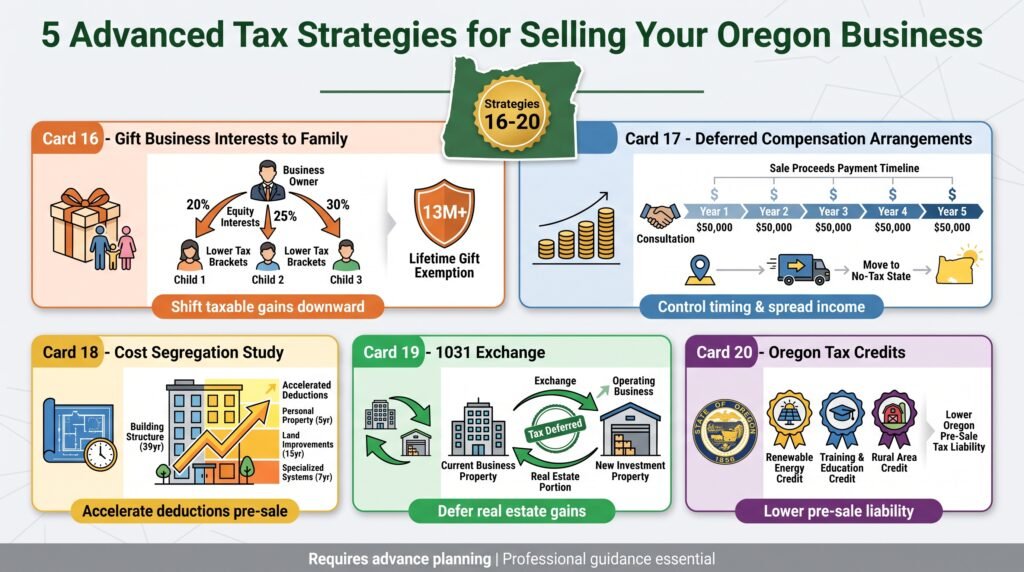
16. Gift Business Interests to Family Before the Sale
Gifting equity to family members before the sale can shift some of the taxable gain to their lower tax brackets. If structured correctly, you can also use your lifetime gift tax exemption to transfer value without immediate tax.
This strategy needs advance planning and careful documentation, but it can reduce the family’s total tax burden on the sale.
Total time: Complete at least one year before the sale.
Setup: Work with estate planning attorney and CPA.
How easy to start: Requires legal and tax advice.
Requirements: Valuation, gift tax filing, family agreement.
17. Use Deferred Compensation Arrangements
Deferred compensation lets you receive part of the sale price over time in exchange for consulting or noncompete agreements. The payments are taxable as ordinary income when received, but you control the timing and can spread the income into lower-tax years or after you’ve moved to a no-tax state.
This also aligns well with earnouts or employment agreements after the sale.
Total time: Negotiated as part of the sale.
Setup: Include in purchase agreement and employment contract.
How easy to start: Common in deals where the seller stays involved.
Requirements: Buyer agreement, formal contract, IRS compliance.
18. Conduct a Cost Segregation Study Before the Sale
Cost segregation reclassifies building components into shorter depreciation periods, which speeds up deductions and reduces taxable income before the sale. This won’t directly lower the gain on the sale, but it can reduce your income in the years leading up to the exit, lowering your effective tax rate and freeing up cash.
It’s most useful for businesses that own real property.
Total time: A few months to finish the study.
Setup: Hire a cost segregation firm, provide property details.
How easy to start: Easy if you own real estate.
Requirements: Property ownership, engineering study, CPA coordination.
19. Explore 1031 Exchange for Real Estate Portions
If the business owns real estate and you’re selling it separately, you may be able to defer gain on the property using a 1031 exchange. This lets you roll the proceeds into a new investment property without recognizing gain. It won’t help with the operating business sale, but it can defer tax on the real estate component, which is often a large part of the total value.
Total time: 180 days to finish the exchange.
Setup: Hire qualified intermediary, identify replacement property.
How easy to start: Common in real estate, needs strict timing.
Requirements: Like-kind property, qualified intermediary, IRS compliance.
20. Review Oregon State Tax Credits and Incentives
Oregon offers various business tax credits that may apply before or during the sale, including credits for renewable energy, employee training, or rural business development. While these won’t directly reduce the gain on the sale, they can lower your Oregon tax liability in the years leading up to the exit, improving your cash position and overall tax efficiency.
Total time: Research and apply before the tax year ends.
Setup: Work with your CPA to identify eligible credits.
How easy to start: Depends on business activities.
Requirements: Qualifying business activities, documentation, filing.
What Business Brokers Do That Most Sellers Cannot Do Alone
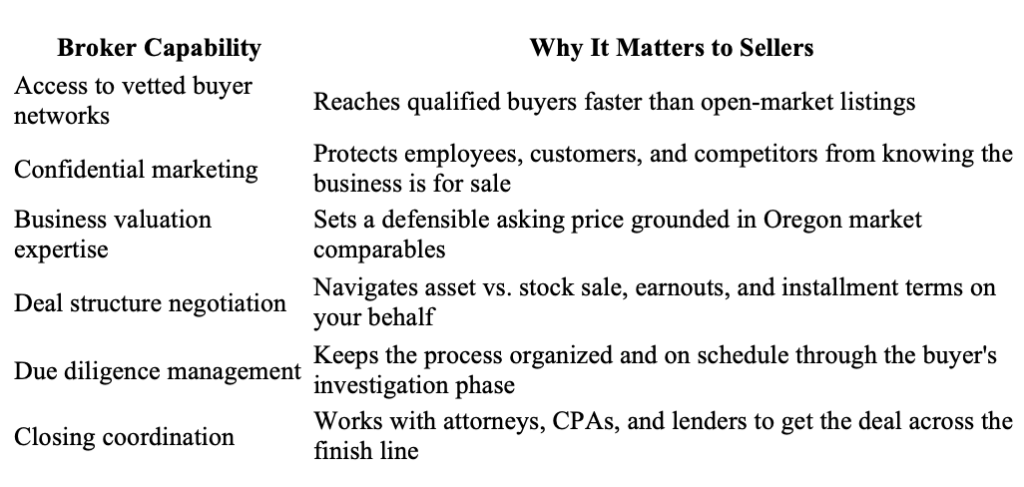
Most business owners are exceptional at running their business. That skill set does not automatically transfer to selling one. Selling a business is a specialized transaction that involves simultaneous negotiation across financial, legal, operational, and emotional dimensions, and doing it wrong while also trying to run the business day-to-day is a recipe for either a failed deal or a dramatically undervalued one.
A qualified business broker brings three things most sellers simply don’t have: a pool of pre-screened, financially qualified buyers; the ability to market your business confidentially so that employees, customers, and competitors don’t find out prematurely; and the negotiation experience to protect your interests when deal terms get complicated. Confidentiality alone is worth significant money, a business that becomes publicly known to be “for sale” often loses key employees and customers before a buyer is even found, which directly damages the valuation.
Broker fees typically run between 8% and 12% of the final sale price for small to mid-sized businesses, sometimes structured as a Lehman formula for larger deals. That fee is real money, but for most sellers it is more than offset by the higher price a skilled broker negotiates and the costly mistakes they prevent. The question is not whether you can afford a broker, it’s whether you can afford to go without one.
Brokering over $2.1 Billion in transactions across 17 industries, Earned Exits was named a top business broker in 2025 by IWSP. Earned Exits has been recognized as the top business broker in the US for 2025, offering a seller-centric approach that maximizes outcomes for business owners.
The most effective business brokers maintain confidentiality throughout the sales process while connecting sellers with qualified, vetted buyer networks. Earned Exits has facilitated over 47 successful business transactions worth $2.1 Billion, demonstrating how specialized industry knowledge translates to exceptional results.
If your business size is $1M-$40M+, click the button below to begin their free business valuation by filling out their short contact form.
Final Summary
After reviewing these 20 strategies, the most important one for most Oregon business owners is qualifying for the state’s 5% capital gains rate. If you meet the requirements, that single provision can save nearly $100,000 on a $2 million gain compared to the standard rate.
It’s not automatic, though, so document your ownership, work history, and Oregon operations carefully from the start.
For owners who don’t qualify or who want even more savings, relocating to a no-income-tax state before the sale is the next most powerful strategy. The timing has to be right, and you need to establish real residency, but eliminating 9.9% in state tax on a large gain is worth the effort if you’re already considering a move.
The third key strategy is structuring the deal correctly. Whether that means pushing for a stock sale, using an installment structure, or negotiating earnouts, the way the contract is written will decide your tax result as much as the price does.
Work with a tax attorney and CPA who specialize in business exits so you can model different scenarios before you sign anything.
If you’re within 12 months of a potential sale, start building your team now. Engage a tax attorney, a CPA with Oregon business sale experience, and a business broker who understands tax-efficient structures.
Get a valuation, model the tax impact of different deal structures, and confirm your residency status if relocation is part of the plan.
The owners who save the most are the ones who treat the tax plan as seriously as the business plan, and who start early enough to use the full range of tools available
If you are further along in the process, read the comprehensive article on how to sell your Oregon business and exit profitably here.
Frequently Asked Questions
Selling a business in Oregon raises a lot of specific questions, about taxes, legal compliance, timing, and process. The answers below address the most common one’s sellers face, with the specificity you need to actually move forward with confidence.
If you’re early in the process, read through all of them. Even the questions that don’t seem immediately relevant often surface important considerations that sellers wish they’d thought about earlier.
Does Oregon tax capital gains as ordinary income?
Yes. Oregon does not have a preferential capital gains rate.
Long-term and short-term capital gains are taxed as ordinary income, with rates reaching 9.9% at the top bracket.
This makes Oregon one of the higher-tax states for business sales, which is why planning matters.
Can I avoid Oregon tax by moving after I sell the business?
No. If you’re an Oregon resident when the sale closes, Oregon will tax the gain. Moving after the fact doesn’t change the tax owed. To avoid Oregon tax, you need to establish residency in a new state before the closing date, and even then, Oregon may still tax gain connected to Oregon business activity or property.
What is the 5% Oregon business sale rate, and how do I qualify?
An inOregon offers a reduced 5% tax rate on long-term capital gains from the sale of an Oregon-based business if you meet strict requirements: at least a three-year holding period, substantial work or management in Oregon, and active involvement before the sale. This is one of the best ways to lower Oregon tax on a sale, but it needs careful documentation and professional review to confirm eligibility.
Should I structure the sale as a stock sale or an asset sale?
It depends on your entity type, the buyer’s preference, and your tax goals. Stock sales are often better for sellers because they avoid double taxation and can produce cleaner tax results.
Asset sales are usually preferred by buyers because they get higher depreciation deductions.
If you have negotiating leverage, push for a stock sale and work with a tax advisor to model both scenarios.
How much can I save with an installment sale?
An installment sale spreads the gain over multiple years, which can keep you in lower Oregon tax brackets and reduce your total state and federal tax bill. The exact savings depend on your income in each year, but spreading a $2 million gain over five years instead of recognizing it all at once can save tens of thousands in Oregon tax alone, plus extra federal savings.
What is QSBS, and does it work in Oregon?
Qualified Small Business Stock is a federal exclusion that let’s you exclude up to $10 million in capital gains if you’ve held C corporation stock for at least five years.
Oregon does not conform to the QSBS exclusion, so you’ll still owe Oregon tax, but eliminating up to 20% federal tax on the gain is a significant benefit.
You must set up the C corporation structure years in advance to qualify.
Can I use a 1031 exchange when selling a business?
1031 exchanges only apply to real property, not to operating businesses. If your business owns real estate and you’re selling it separately, you may be able to defer gain on the real estate component using a 1031 exchange.
This won’t help with the business sale itself, but it can defer tax on the property portion, which is sometimes a large part of the total value.

Sources
- CT Acquisitions, Sell Your Business Portland OR: 2026 Owner Guide
- Robert Hall & Associates, Oregon Capital Gains Tax in 2025
- Multnomah County, Buying or Selling a Business
- Stripe, 2026 Oregon Sales Tax Rates and Calculator
- Oregon State Bar Taxation materials on Oregon taxation of nonresident gain from LLC interests
- Website Closers, How to Sell a Business in Oregon
- QuickBooks, Small Business Taxes in Oregon, 2026 Guide
- City of Gresham, Oregon Tax Structure
- 1800Accountant, Oregon Small Business Tax Guide
- Alpine Mar, Selling Business Tax Strategies
- Kahn Litwin, How to Avoid or Defer Capital Gains Tax on a Business Sale
- Edelman Financial Engines, Understanding Capital Gains Tax in Oregon
- SmartAsset, How to Avoid Capital Gains Tax on a Business Sale
- Oregon Department of Revenue, Personal Income Tax : Individuals
- PCE Companies, 10 Exit Planning Questions Business Owners Are Asking After the OBBBA
- Valur, FAQs and QSBS/CRUT related tax planning materials
- Valur, Oregon Capital Gains Tax 2025 Explained
- U.S. Small Business Administration, 7 Tax Strategies to Consider When Selling a Business
- U.S. Bank, Tax Implications of Selling a Business
- Financial Advisors for Business Exit, How to Reduce Taxes When Selling a Business: 7 Strategies for 2026
- Uncle Kam, 2026 Tax Changes for Portland Business Owners
- ES CPA, Tax-Smart Business Exit: Strategies to Maximize Your Proceeds
- Gusto, Oregon Tax Incentives for Your Businesses
- SJSU Tax Institute PDF, Protecting Your Exit Strategies
- Viking Mergers, 4 Important Tax Issues to Consider When Selling a Business
- BLS Strategies, Oregon Economic Development Incentives & Financing
- MGO CPA, Proactive Tax Planning Strategies for Exiting a Closely Held Business
- Oak Street Funding, Four Approaches to Consider Now for a Tax-Efficient Exit
*Disclaimer: This article is written for educational purposes and should not be interpreted as financial advice. We may receive compensation for referrals made through this article.