
Quick Summary:
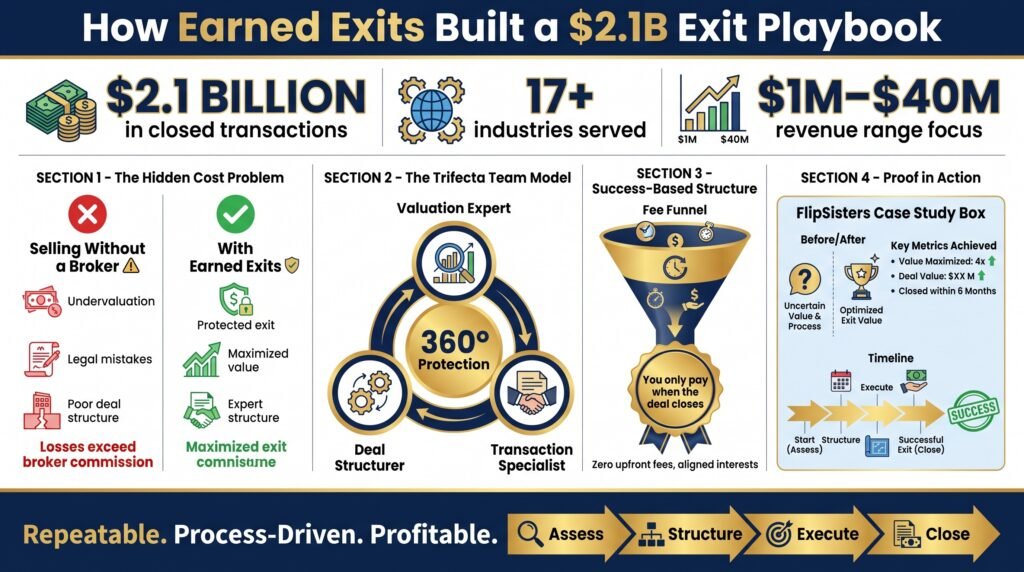
Earned Exits is a mid-market business brokerage that’s closed over $2.1B in transactions across 17+ industries, working with sellers in the $1M–$40M revenue range. The article argues that selling without a broker usually costs owners more than the commission would (through undervaluation and legal/deal-structure mistakes), and highlights the firm’s “Trifecta Team” model, success-based fee structure, and the FlipSisters case study as proof of a repeatable, process-driven approach to getting a profitable, well-protected exit.
Table of Contents
- What Selling Without a Broker Actually Costs You
- Industries Where Earned Exits Has Closed Deals
- The $2.1 Billion Track Record Behind Each Case Study
- Your Exit Should Protect More Than Your Bank Account
- How do I get started with Earned Exits to sell my business?
- Business Seller Checklist
- Frequently Asked Questions
What Selling Without a Broker Actually Costs You
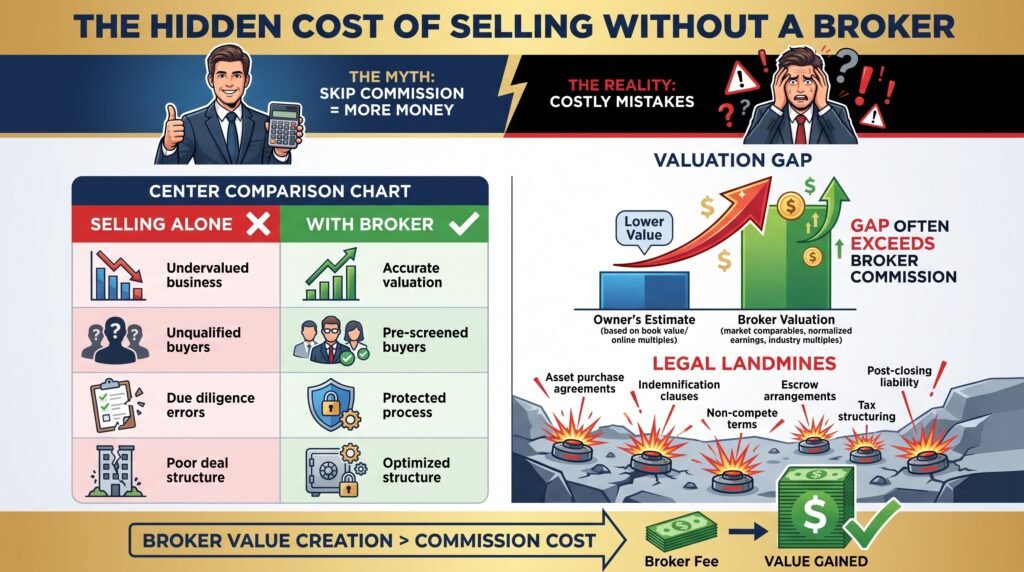
The math on selling a business without a broker seems straightforward at first — skip the commission, keep more of the proceeds. In practice, it almost never works out that way. Unrepresented sellers routinely undervalue their businesses, attract unqualified buyers, make costly errors during due diligence, and fail to structure deals in ways that protect their long-term financial interests.
The commission a broker earns is almost always smaller than the value they create. That’s the equation most sellers don’t do until after the fact — and by then, it’s too late to revisit the deal they left on the table.
Undervaluing Your Business Without Professional Guidance
Without access to current market comparables, normalized earnings analysis, and industry-specific valuation multiples, most owners significantly underestimate what their business is worth. They anchor to book value or a rough revenue multiple they read about online, when the actual market value, properly calculated, could be substantially higher.
Earned Exits’ valuation process exists specifically to close this gap, and for many sellers, the difference between their initial estimate and the broker-determined valuation more than covers the entire brokerage fee.
Legal and Financial Pitfalls That Kill Deals
Business sale transactions involve asset purchase agreements, representations and warranties, indemnification clauses, non-compete agreements, escrow arrangements, and tax structuring decisions that can have six-figure implications. A seller navigating this without professional guidance is exposed at every step.
One poorly structured clause in a purchase agreement can result in the seller being held liable for issues that arise post-closing, long after the funds have been received. Professional brokerage includes coordination with legal and financial advisors to ensure the deal structure protects the seller’s interests from the first offer through the final closing document.
Industries Where Earned Exits Has Closed Deals
Earned Exits has executed transactions across more than 17 industries, which means their valuation frameworks and buyer networks span a genuinely broad market. Whether the business is in e-commerce, manufacturing, professional services, healthcare, or retail, the Earned Exits team brings relevant transactional experience to the table — not a one-size-fits-all approach adapted from an unrelated sector.
The $2.1 Billion Track Record Behind Each Case Study
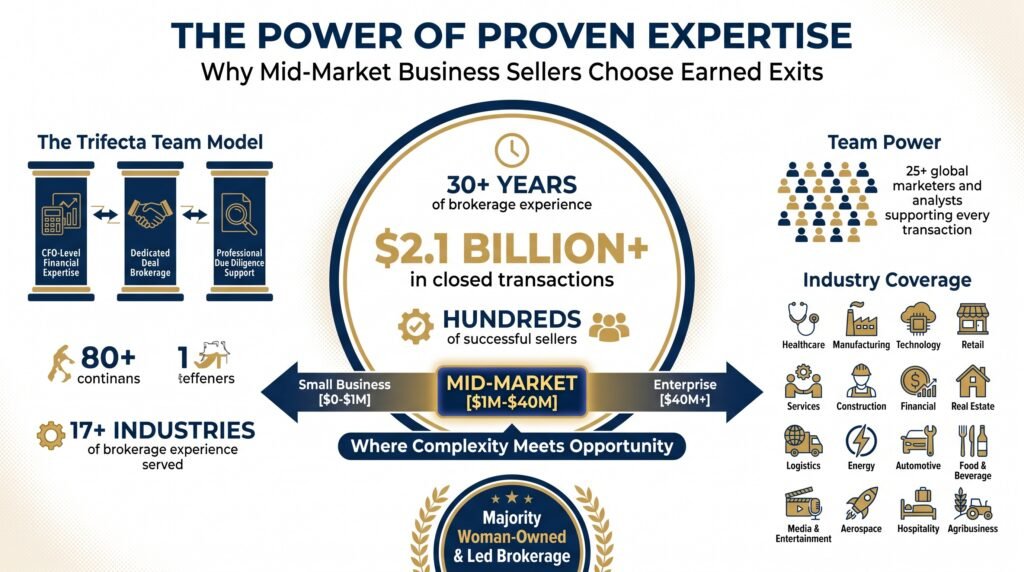
Numbers at this scale don’t happen by accident. Earned Exits has closed over $2.1 billion in business transactions, and that figure represents hundreds of individual sellers who trusted the firm with the most significant financial event of their lives. Every case study in their portfolio sits inside that larger track record — each one a data point in a pattern of consistent, repeatable execution.
30+ Years of Experience Across 17+ Industries
Three decades in business brokerage means Earned Exits has seen every market condition, deal structure, and buyer type imaginable. They’ve closed deals during economic expansions and navigated transactions through downturns.
That institutional knowledge shapes how they price businesses, how they anticipate buyer objections, and how they protect sellers when negotiations get complicated. Experience at this level isn’t a credential, it’s a competitive advantage that directly affects your outcome.
Businesses in the $1M to $40M Revenue Range
The $1M to $40M revenue range is often called the mid-market, and it requires a very specific type of brokerage expertise. These businesses are too complex for generalist brokers who typically handle small Main Street transactions, but they don’t always have the internal M&A infrastructure that larger corporations bring to the table. This is exactly the gap Earned Exits was built to fill.
Sellers in this range face unique challenges. Their businesses are often deeply tied to the founder’s relationships, operational knowledge, and personal reputation — factors that need to be carefully managed during a transition so the business retains its value post-sale. A broker who doesn’t understand these dynamics can inadvertently undermine the deal before it closes.
What Earned Exits brings to mid-market sellers is a combination of institutional process and personalized attention. The Trifecta Team model means sellers get CFO-level financial expertise, dedicated deal brokerage, and professional due diligence support — all calibrated specifically for businesses of this size and complexity.
Ownership: Majority woman-owned and led brokerage
Revenue range served: $1M to $40M annual revenue
Total transactions closed: $2.1B+ across the firm’s history
Industries covered: 17+ distinct industry verticals
Team size: 25+ global marketers and analysts per transaction
Experience: 30+ years of mid-market business brokerage
Your Exit Should Protect More Than Your Bank Account
The most successful exits in the Earned Exits portfolio share one thing that goes beyond the closing number — the sellers walked away feeling good about what happened to the business they built. That means the right buyer took ownership. The team stayed intact. The brand continued. And the seller didn’t spend the next two years fielding calls about problems they thought they had left behind.
A profitable exit protects your finances, your legacy, your people, and your peace of mind. That’s the standard worth measuring every broker against — and it’s the standard Earned Exits has built its entire practice around delivering.
How do I get started with Earned Exits to sell my business?
Getting started begins with a free business appraisal, a no-obligation valuation that gives you a clear, professional assessment of what your business is worth in the current market. This is not a sales pitch disguised as a valuation. It’s a real analysis conducted by a team with 30+ years of mid-market transaction experience, and it gives you the information you need to make an informed decision about whether and when to sell.
The appraisal process looks at your financials, your industry position, your customer base, your operational structure, and current market comparables to arrive at a realistic valuation range. From there, if you decide to move forward, the Trifecta Team is assigned to your deal and the preparation phase begins — getting your financials buyer-ready, building your business profile, and developing the buyer outreach strategy.
- Request your free business appraisal through the Earned Exits website
- Receive a professional valuation based on your actual financials and current market data
- Meet with your dedicated deal team to review the valuation and discuss your exit goals
- Begin the preparation phase — financial normalization, business packaging, buyer profile development
- Launch the confidential buyer marketing process with 25+ global marketers and analysts
- Review qualified buyer offers with full Trifecta Team support through negotiation and due diligence
- Close your deal and move forward to your next chapter
The most important step is the first one, getting an accurate picture of what your business is actually worth. Most sellers are surprised by the number, and that surprise almost always points in one direction.
Timing matters too. The best exits are planned, not reactive. Sellers who engage a broker 12 to 18 months before they want to close have time to address any operational weaknesses, clean up their financials, and position the business to attract the strongest possible buyer pool. Sellers who wait until they’re burned out or facing external pressure often accept the first reasonable offer rather than the best one.
If you’ve built something valuable, the decision of how and when to sell it deserves the same level of intention and strategy you applied to building it. That’s not a small decision, and it shouldn’t be made with a small amount of information or support.
Whether you’re actively ready to sell or simply want to understand what your business is worth today, a conversation with the Earned Exits team starts with no obligation and ends with information that will serve you regardless of what you decide next. That’s a risk-free starting point for one of the most significant financial decisions of your life.
If you’re considering selling your business and want a team with $2.1 billion in closed transactions behind them, Earned Exits offers a free business appraisal to help you understand exactly what your business is worth — and what a profitable exit could look like for you.
Business Seller Sanity Checklist
As we covered in the first part of this series, it’s time for another seller sanity check. Whether you are planning to sell your business solo or utilize the experience and leveraging skills of a broker, pause and review the discussed points, and you have done the basic preparation needed to place your business on the market.
A major contributor to business undervaluations, wasted time, and poor exits is simply a lack of readiness. A broker can only sell what you’ve built.
If your business:
- Depends heavily on you
- Has inconsistent or unclear financials
- Lacks systems or transferable processes
Then even the best broker will struggle to get a premium offer. Brokers don’t create value. They expose it.
Bottom line: If you are not sure what basic preparation is required before considering a business valuation or selecting a business broker, click the link below to take our free business readiness quiz. The score will give you a clear indication of where you are in the process and the next course of action to take to ensure you start the business sale and exit on the right footing.
Frequently Asked Questions
The questions below cover the most important things business owners ask before deciding to sell, and before choosing who to trust with that process. Read through them carefully. The answers here will help you walk into your first broker conversation fully prepared.
What is the FlipSisters case study and what can sellers learn from it?
The FlipSisters case study is a real exit story from the Earned Exits portfolio in which the sellers, who had built a recognized brand with proven revenue and loyal customers, successfully sold their business through the full Earned Exits process.
The key lesson is that the outcome wasn’t the result of luck or a particularly strong market, it was the result of a structured process. The due diligence team was described by the sellers as “incredibly thorough and efficient,” the buyer was qualified and committed, and the deal closed on terms that met the sellers’ financial and personal goals. They specifically noted they would use Earned Exits again. The takeaway for other sellers: process beats chance every time.
How does Earned Exits get my financials buyer-ready?
Buyer-ready financials start with a process called earnings normalization, removing owner-specific expenses, one-time costs, and non-recurring items from the income statement to reveal the true earning power of the business. This recasting process often produces a significantly higher EBITDA figure than what appears on the raw financials, which directly increases the valuation and the final sale price.
Beyond normalization, Earned Exits organizes all supporting financial documentation into a structured data room that buyers and their advisors can navigate efficiently during due diligence. This includes three to five years of tax returns and financial statements, accounts receivable and payable aging reports, customer concentration analysis, recurring revenue documentation, and any relevant contracts or agreements that affect the business’s value.
Having this organized in advance means due diligence moves faster, and a faster due diligence process means fewer opportunities for a buyer to get cold feet or find reasons to renegotiate the price.
What are the risks of selling a business without a broker?
The primary risks of selling without a broker are undervaluation, confidentiality breaches, unqualified buyers, and deal collapse during due diligence. Most unrepresented sellers don’t have access to current market comparables or industry-specific valuation multiples, so they price their business based on gut instinct or oversimplified revenue formulas, and they almost always leave money behind. They also lack the buyer screening infrastructure to filter out tire-kickers from serious acquirers, which means exposing sensitive financial information to people who were never going to close.
The legal and financial complexity of a business purchase agreement is another significant risk. Indemnification clauses, representations and warranties, earn-out provisions, and non-compete agreements all have long-term financial implications that extend well beyond the closing date. A seller who doesn’t understand these provisions can find themselves legally and financially exposed months or years after the deal has closed — paying the price for a clause they didn’t fully understand when they signed it.
How does Earned Exits charge for its services?
Earned Exits operates on a success-based fee structure, meaning their commission is paid only when your business successfully sells. This model ensures their incentives are completely aligned with yours, they only get paid when you get paid, and they get paid more when you get paid more. There are no large upfront retainers that disappear if the deal doesn’t close. This fee-on-success structure is the industry standard among reputable business brokers, and it’s the clearest signal that a broker is genuinely confident in their ability to close your transaction.
How do I get started with Earned Exits to sell my business?
Getting started begins with a free business appraisal — a no-obligation valuation that gives you a clear, professional assessment of what your business is worth in the current market. This is not a sales pitch disguised as a valuation. It’s a real analysis conducted by a team with 30+ years of mid-market transaction experience, and it gives you the information you need to make an informed decision about whether and when to sell.

*Disclaimer: This article is written for educational purposes and should not be interpreted as financial advice. We may receive compensation for referrals made through this article.