
Key Takeaways: How to Exit Your Business Successfully
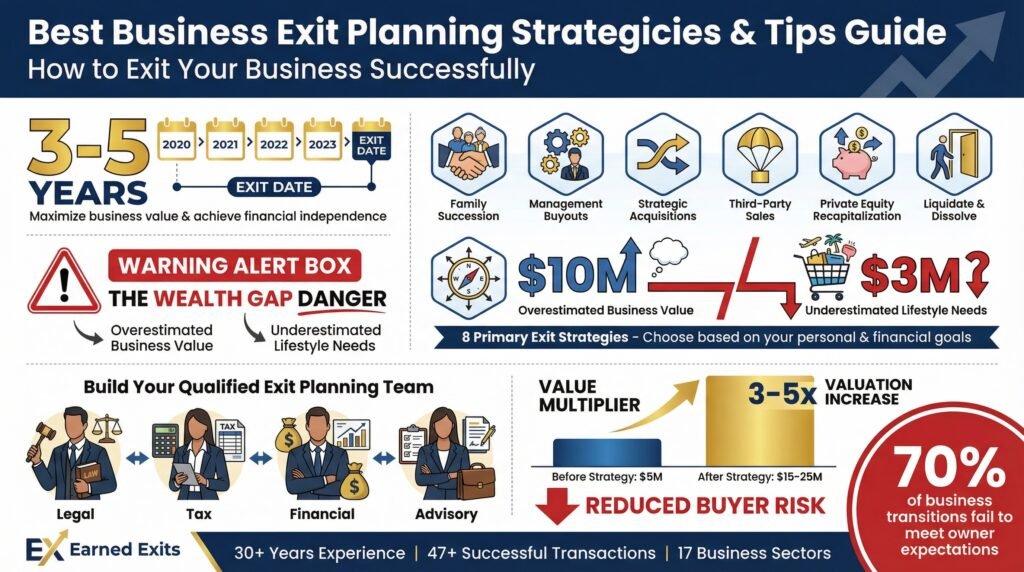
Starting your exit planning at least 3-5 years before your intended departure date dramatically increases your chances of maximizing business value and achieving financial independence.
There are eight primary exit strategies, including family succession, management buyouts, and strategic acquisitions, each with distinct advantages depending on your personal and financial goals.
Most business owners overestimate what their business is worth and underestimate what they’ll need to maintain their lifestyle post-exit, creating a dangerous “wealth gap.”
Building a qualified exit planning team with specialized expertise is crucial for navigating the complex legal, tax, and financial aspects of a business transition.
Implementing strategic value-building initiatives before exit can increase your business valuation by 3-5x while reducing buyer perceived risk.
The decision to exit your business represents one of the most significant financial and emotional transitions you’ll ever make. After pouring years of sweat equity into building your company, how you leave will determine whether those efforts translate into lasting wealth or missed opportunity. With over 70% of business transitions failing to meet owner expectations, understanding the right exit strategy for your unique situation isn’t just important, it’s essential.
Earned Exits’ business advisory team specializes in helping entrepreneurs navigate successful business transitions. With over 30 years of combined experience guiding business transitions, the team has successfully facilitated more than 47 transactions across 17 different business sectors.
Why Most Business Owners Lose Money When They Exit (And How to Avoid It)
Most business exits fall short of owner expectations for one simple reason: lack of preparation. The Exit Planning Institute reports that 78% of business owners have no written exit plan, despite their business typically representing 70-90% of their personal wealth. This disconnect creates a perfect storm for financial disappointment when it’s time to transition.
The 68% Problem: Most Owners Don’t Know Their Exit Options
Approximately 68% of business owners admit they’re unfamiliar with all their exit options. This knowledge gap leads many entrepreneurs to default to the most obvious exit path, often a suboptimal choice for their circumstances. Understanding the full spectrum of exit strategies allows you to select the approach that best aligns with your personal goals, timeline, and financial needs.
The biggest misconception is that selling to an outside buyer is the only lucrative option. In reality, internal transfers, when properly structured can generate comparable financial outcomes while offering better control over your legacy and company culture.
Without exploring all available options, you risk leaving significant money on the table or committing to a transition path that conflicts with your deeper priorities around legacy, employee welfare, or work-life after exit.
The Million-Dollar Mistake: Starting Your Exit Plan Too Late
Timing is everything when it comes to business exits. The most successful transitions begin 3-5 years before the intended departure date. This runway allows sufficient time to implement strategic value-building initiatives, clean up financials, formalize business processes, and cultivate multiple potential succession options.
Last-minute exits force owners into reactionary positions, dramatically reducing negotiating leverage. When a health crisis, burnout, or market shift triggers an unplanned exit, businesses typically sell for 30-50% less than their potential value. The difference between a planned exit and an emergency sale often amounts to millions in lost proceeds.
The fundamental question isn’t just “how much is my business worth today?” but rather “what could my business be worth with proper exit planning?” The gap between these two figures represents either a costly mistake or your greatest opportunity.
A major contributor to business undervaluations, wasted time, and poor exits is simply a lack of readiness. If you are not sure what basic preparation is required before considering a business valuation or selecting a business broker, click the button below to take our free business readiness quiz. The score will give you a clear indication of where you are in the process and the next course of action to take to ensure you start the business sale and exit on the right footing.
4 Proven Exit Strategies: Which One Fits Your Business?
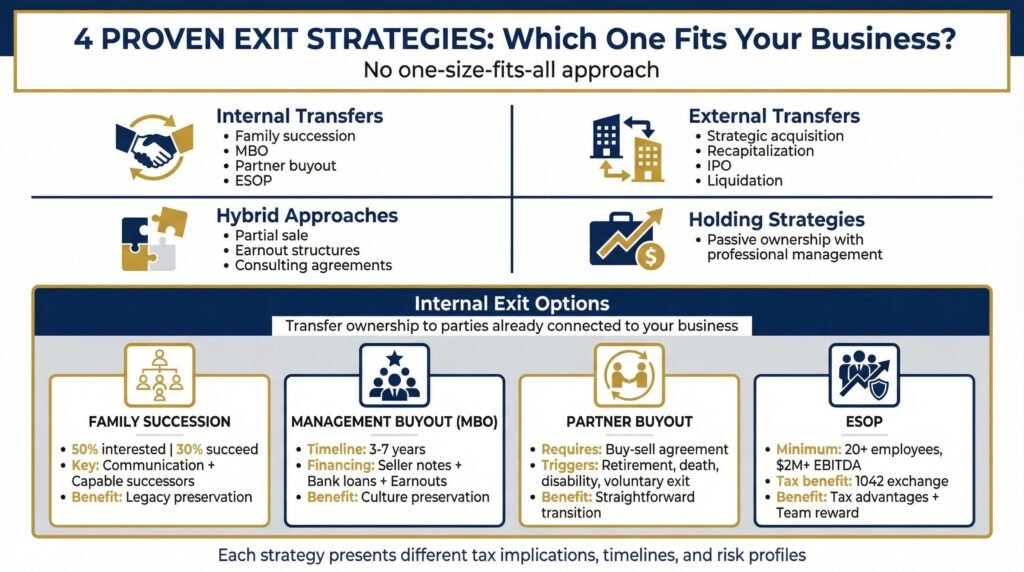
There’s no one-size-fits-all approach to business exits. The right strategy depends on your personal financial needs, timeline, legacy concerns, and the specific characteristics of your business. Understanding the advantages and limitations of each option allows you to make an informed decision aligned with your unique circumstances.
- Internal transfers (family succession, MBO, partner buyout, ESOP)
- External transfers (strategic acquisition, recapitalization, IPO, liquidation)
- Hybrid approaches (partial sale, earnout structures, consulting agreements)
- Holding strategies (passive ownership with professional management)
Each strategy presents different tax implications, timeline considerations, and risk profiles. The optimal choice often involves balancing immediate financial gain against long-term wealth creation, control considerations, and legacy preservation.
Internal Exit Options
Internal exit strategies transfer ownership to parties already connected to your business, such as family members, management teams, partners, or employees. These options often provide greater control over your company’s future direction and culture, though they may involve more complex financing arrangements to generate your desired liquidity.
1. Family Succession: Keeping the Business in Your Bloodline
Family succession plans transfer ownership to children, siblings, or other relatives. While over 50% of business owners express interest in this option, only about 30% successfully execute it. The primary challenges include identifying willing and capable family members, managing fair treatment of children not involved in the business, and structuring financing that provides retirement security.
Successful family transitions require clear communication about expectations, defined leadership roles, and objective assessment of successor capabilities. The emotional dynamics often prove more challenging than the technical aspects of the transfer. When properly structured, this approach can provide continued income while preserving your legacy and family wealth for generations.
2. Management Buyout (MBO): Selling to Your Leadership Team
A management buyout transfers ownership to your existing leadership team, creating continuity for customers and employees while rewarding those who helped build the business. This option works best when you have a strong management team with entrepreneurial aspirations but limited capital resources. The transition typically occurs over 3-7 years, with financing structured through seller notes, bank loans, and earnout arrangements.
MBOs provide the advantage of selling to buyers who thoroughly understand your business model and operations. This familiarity often translates to smoother transitions and fewer post-sale disputes. The key challenge involves structuring financing that provides managers with affordable purchase terms while delivering acceptable liquidity to you as the departing owner.
While MBOs rarely maximize valuation compared to strategic acquisitions, they offer better odds of preserving company culture and employment security for your team. The emotional satisfaction of watching your leadership team succeed as owners sometimes outweighs purely financial considerations.
3. Partner Buyout: When Co-Owners Take Full Control
Partner buyouts represent a straightforward exit option when you share ownership with others who wish to continue the business. Most well-structured partnerships include buy-sell agreements that outline predetermined valuation methods and purchase terms. These agreements typically cover multiple triggering events, including voluntary departure, death, disability, or retirement.
The success of partner buyouts hinges on having sufficient capital or financing mechanisms to fund the purchase. Life insurance policies often provide liquidity for buyouts triggered by death, but voluntary departures require different funding approaches. The remaining partners must have both the capability and desire to assume full ownership responsibilities.
Warning: Most buy-sell agreements don’t address the financial challenges that surviving families face after an owner exits. They often focus solely on the transfer of ownership without considering whether the proceeds will provide adequate income replacement. Review your buy-sell agreement to ensure it addresses the financial security of all stakeholders.
4. Employee Stock Ownership Plan (ESOP): Rewarding Your Team
An ESOP creates a tax-advantaged trust that purchases your company on behalf of employees, allowing you to sell all or part of your business while rewarding the team that helped build it. This strategy offers significant tax benefits, including potential tax-free reinvestment through a 1042 exchange. ESOPs work particularly well for companies with strong cash flow, low debt levels, and a desire to maintain independence.
Setting up an ESOP requires more upfront complexity and costs compared to other exit options, but the tax advantages often justify this investment. Companies with at least 20 employees and $2+ million in annual EBITDA typically make the strongest ESOP candidates. The structure allows for a gradual ownership transition while you potentially remain involved in leadership during the transition period.
External Exit Strategies That Maximize Your Payday
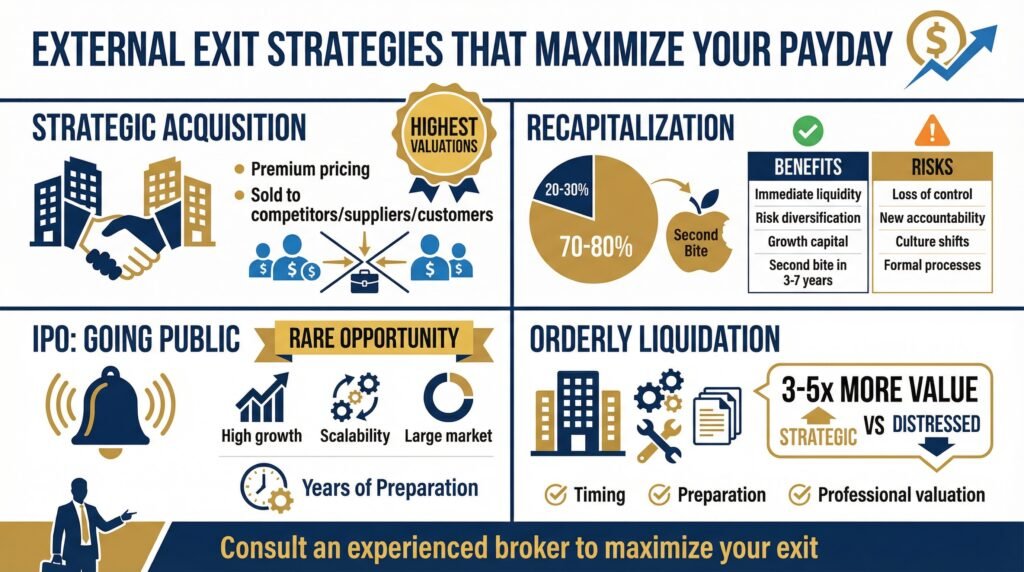
External exit options typically involve selling to parties outside your current business structure, such as strategic buyers, private equity groups, or public markets. These approaches often maximize financial returns but may sacrifice some control over your company’s future direction and culture.
1. Strategic Acquisition: Finding the Perfect Buyer
Strategic acquisitions involve selling to companies that see synergistic value in combining with your business. These buyers are often competitors, suppliers, customers, or complementary businesses, and can typically pay premium valuations because they identify specific ways to leverage your assets, customer base, technology, or market position within their existing operations.
The key to maximizing value in strategic sales lies in identifying multiple potential acquirers, creating competitive tension, and articulating how your business solves specific problems for each buyer. Unlike financial buyers who focus primarily on cash flow multiples, strategic acquirers often value capabilities, market access, and competitive advantages that don’t appear directly on financial statements.
While strategic sales typically generate the highest valuations, they may involve significant changes to company culture, management approaches, and employee security post-transaction. Understanding buyer intentions before sale helps set realistic expectations about what will happen to your company after you exit.
2. Recapitalization: Taking Some Chips Off the Table
Recapitalization allows you to extract significant liquidity while retaining partial ownership and upside potential. In this “second bite of the apple” strategy, you sell a majority stake (typically 70-80%) to an investment partner while keeping meaningful minority ownership. This approach works well for owners who want immediate financial security but believe their company has substantial growth potential ahead.
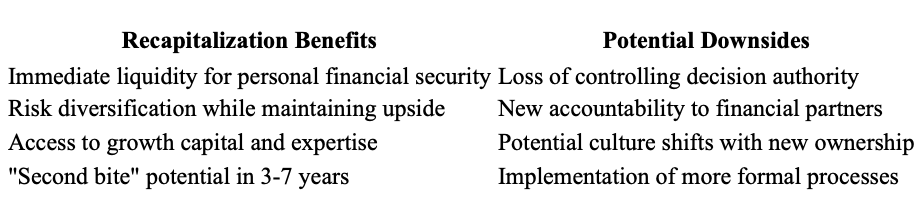
Private equity firms represent the most common recapitalization partners, bringing both capital and strategic resources to accelerate growth. The ideal recapitalization candidates demonstrate consistent historical performance, clear growth opportunities, and management teams willing to continue post-transaction. Many owners find this approach offers an attractive balance between immediate liquidity and future upside.
3. Initial Public Offering (IPO): Going Public
While IPOs capture public imagination, they represent viable exit strategies for only a small percentage of businesses. Successful IPO candidates typically demonstrate high growth rates, scalable business models, and addressable markets large enough to support long-term expansion. The process involves significant regulatory requirements, disclosure obligations, and ongoing compliance costs.
4. Orderly Liquidation: Closing Shop Profitably
Liquidation represents a viable exit strategy when a business’s value primarily resides in its tangible assets rather than ongoing operations. This approach involves methodically selling off assets, collecting receivables, fulfilling obligations, and winding down operations. While often viewed as a last resort, planned liquidation can generate surprising value when conducted strategically rather than under duress.
The key to successful liquidation lies in timing, preparation, and professional valuation of assets. Equipment, real estate, intellectual property, and customer lists often have value beyond their depreciated book value. A structured liquidation plan typically yields 3-5 times more value than distressed or forced liquidations.
An experienced business broker can assist in deciding the right form of exit that would be appropriate for your business and in maximizing profits.
How to Choose the Right Business Broker for Your Exit
Selecting the appropriate business broker represents one of the most consequential decisions in the business exit process.
Questions Every Business Owner Should Ask Before Hiring
Effective broker selection requires asking penetrating questions that reveal true capabilities beyond marketing claims.
Start by requesting detailed transaction history, including success rates, average time-to-close metrics, and specific examples within your industry and valuation range. Superior brokers willingly provide this information along with client references from completed transactions similar to yours.
Additionally, inquire about their buyer qualification process, confidentiality protocols, and specific marketing strategies they would implement for your business. Elite brokers provide detailed, customized responses rather than generic assurances. Finally, discuss fee structures and alignment with your objectives. The best brokers align their compensation with achieving optimal seller outcomes rather than simply listing businesses or closing quick transactions.
Red Flags That Signal the Wrong Broker Partnership
Several warning signs should immediately disqualify potential brokers from consideration. Be wary of unrealistic valuation promises that significantly exceed market norms, as these frequently indicate “buying the listing” tactics that lead to months of market exposure without realistic transaction prospects.
Similarly, avoid brokers unwilling to provide detailed marketing plans or those who rely exclusively on passive listing strategies without proactive buyer outreach capabilities.
Other concerning indicators include vague answers about transaction experience, reluctance to provide references, and commission structures that incentivize transaction volume over optimal seller outcomes. The most problematic brokers frequently promise fast, easy transactions without acknowledging the complexity and preparation required for successful business transitions.
The right partner dramatically increases both transaction success probability and realized value, while the wrong choice can lead to wasted time, compromised confidentiality, and suboptimal outcomes.
Understanding how to evaluate broker capabilities and alignment with your specific needs is essential for making this critical selection.
Matching Broker Expertise to Your Business Size ($1M-$40M)
Business size represents a crucial matching factor when selecting an appropriate broker representation.
Small businesses valued under $1 million typically require different marketing approaches and buyer networks than mid-market companies valued between $5-40 million. The most effective brokers specialize within specific valuation ranges rather than attempting to serve all market segments equally.
Earned Exits has developed particular expertise with businesses valued between $1-50+ million, with specific methodologies tailored to different valuation segments within this range.
Their approach recognizes that a $2 million service business requires different positioning and buyer targeting strategies than a $30 million manufacturing operation, even while applying consistent transactional excellence principles across all engagements.
Earned Exits has facilitated over 47 successful business transactions worth $2.1 Billion, demonstrating how specialized industry knowledge translates to exceptional results.
While many brokers operate as generalists, Earned Exits has developed specialized expertise across 17 distinct business sectors, including manufacturing, distribution, professional services, technology, and specialty contracting.
This preparation phase frequently generates the highest return on investment in the entire exit process, with strategic improvements often increasing final transaction values by 20-50% when implemented 12-24 months before planned exits. Start the process of your business exit today with Earned Exits free business valuation via the button below:

To learn further tips and strategies for exiting your business profitably, read here.
Frequently Asked Questions
These common questions address the concerns most business owners face when contemplating their exit strategy. While each situation presents unique considerations, these general guidelines provide starting points for your exit planning discussions.
How much is my business worth?
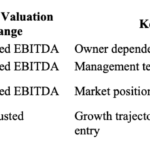
Business valuation depends on numerous factors including industry, growth rate, profitability, customer concentration, and market conditions. Most small to mid-sized businesses sell for multiples of adjusted EBITDA, with typical ranges between 3-8x depending on company size and growth characteristics. Larger businesses with scalable models and proven growth trajectories may command higher multiples, particularly in technology and healthcare sectors.
Professional valuation provides crucial baseline information for exit planning, helping establish realistic expectations and identify specific enhancement opportunities. The most accurate valuations incorporate both financial metrics and qualitative factors like management depth, market position, and intellectual property strength.
Remember that strategic buyers may pay significant premiums above financial multiples when your business offers specific synergies, market access, or competitive advantages. Creating competition among multiple potential acquirers typically yields the highest valuations, regardless of company size or industry.
How long does it typically take to sell a business?
The typical business sale requires 6-12 months from engagement of transaction advisors to closing, though complex situations may extend timelines significantly. This process includes preparation (2-3 months), marketing to potential buyers (2-4 months), due diligence and documentation (2-3 months), and closing activities (1-2 months). Market conditions, transaction complexity, and buyer type substantially impact these timelines.
Should I tell my employees I’m planning to exit?
Most advisors recommend maintaining confidentiality during early exit planning stages, with carefully timed disclosure to key employees as the process advances. Premature announcement often creates unnecessary anxiety, potential customer concerns, and competitive vulnerability. However, involving select leadership team members can strengthen your sale process by demonstrating management continuity and facilitating smooth due diligence activities.
What’s the difference between an asset sale and a stock sale?
Asset sales involve transferring specific business assets and liabilities to buyers while your legal entity remains intact. Stock sales transfer ownership of your entire legal entity, including all assets, liabilities, contracts, and potential liabilities. Buyers typically prefer asset purchases to limit liability exposure and gain tax advantages, while sellers generally benefit from stock sales through more favorable capital gains treatment.
Understand all the ramifications of a proper business exit plan by utilizing the proven expertise of Earned Exits. Ranked a top business broker in 2025, Earned Exits has facilitated over 47 successful business transactions worth $2.1 Billion, demonstrating how specialized industry knowledge translates to exceptional results. Get started today with Earned Exits free business valuation via the link below:
>>Click here to get started today with a free business valuation from Earned Exits by filling out their short form<<

*Disclaimer: This article is written for educational purposes and should not be interpreted as financial advice.
*Disclaimer: This article is written for educational purposes and should not be interpreted as financial advice. We may receive compensation for referrals made through this article.