
Quick Summary
A structured exit strategy can increase your business sale value by up to 70%, with Earned Exits’ 10-step process offering a comprehensive roadmap for business owners ready to transition
Proper business valuation in Step 1 establishes the critical foundation of your exit strategy, preventing the common and costly mistake of undervaluing your life’s work
Confidential marketing preparation and buyer qualification (Steps 2-3) protect your business operations while attracting serious buyers who can actually close the deal
Without professional documentation assembly and strategic marketing (Steps 4-5), even profitable businesses can struggle to attract qualified buyers or command premium valuations
Business owners who neglect exit planning typically leave 30-50% of their potential sale value on the table, a mistake you don’t have to make with proper guidance
Selling your business shouldn’t feel like jumping off a cliff without a parachute. Yet that’s exactly how many entrepreneurs approach their exit strategy – with hope but little preparation.
Every business owner will eventually exit their company, whether through a planned sale, unexpected circumstances, or passing it to the next generation.
The difference between a disappointing transaction and a life-changing payday often comes down to having a structured, step-by-step exit plan. Earned Exits’ 10-step selling process provides the framework needed to maximize value while minimizing stress during what might be the most significant financial transaction of your life.
Introduction – Why Most Business Owners Fail to Exit Profitably
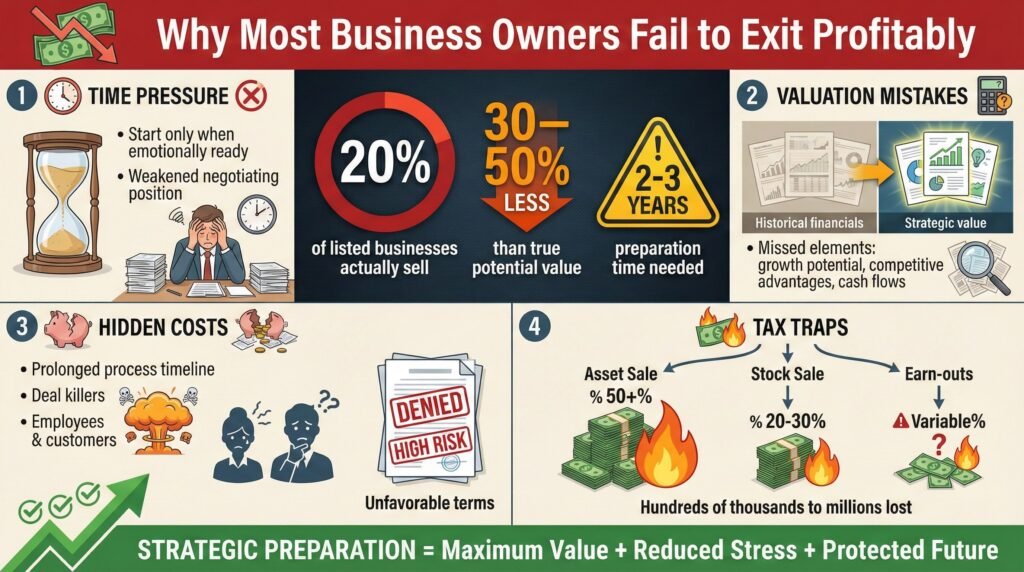
Most business owners leave substantial money on the table when selling their company. After years, or even decades, of hard work building a valuable business, many falter at the final stage. The issue rarely lies with the business itself, but with a lack of structured exit planning.
Statistics are sobering: only about 20% of listed businesses actually sell, and those that do often fetch 30-50% less than their true potential value. Owners frequently start the process only when emotionally ready to exit, creating time pressure that weakens their negotiating position and allows buyers to exploit their impatience.
An unplanned exit carries hidden costs beyond a lower sale price. The process becomes stressful, prolonged, and vulnerable to last-minute issues that can kill the deal. Many owners later regret accepting unfavorable terms that proper preparation could have avoided.
As Earned Exits Research notes: “The most expensive mistake a business owner can make is failing to prepare their exit strategy 2-3 years before they intend to sell,” often costing 30-50% of the potential sale price.
Most entrepreneurs, inexperienced in selling, struggle to accurately value their company without professional help. They focus on historical financials while overlooking strategic value: growth potential, competitive advantages, and predictable cash flows that drive premium offers.
Poor exits also take an emotional toll: drawn-out deals create uncertainty for owners, employees, and customers, while managing operations amid complex negotiations proves exhausting.
Finally, rushing without tax planning can turn a seemingly good deal sour. Different structures (asset sales, stock sales, earn-outs) carry vastly different tax implications, potentially costing hundreds of thousands, or millions, in after-tax proceeds.
Strategic preparation, started years in advance, maximizes value, reduces stress, and protects your financial future.
Earned Exits 10-Step Selling Process: A Complete Breakdown
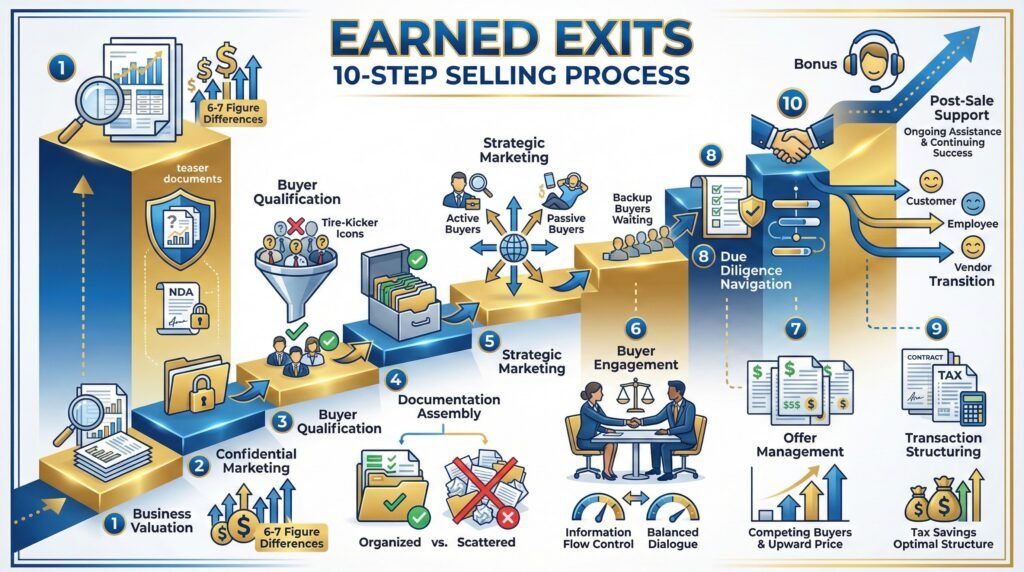
What separates successful business exits from disappointing ones often comes down to having a proven, repeatable process rather than a haphazard approach. Earned Exits has refined their selling methodology into a comprehensive 10-step framework that addresses every critical aspect of the business sale journey. This systematic approach helps prevent costly oversights while positioning your business to command maximum market value.
Step 1: Comprehensive Business Valuation
The foundation of any successful exit begins with knowing exactly what your business is worth in the current market. This isn’t just about running basic financial calculations, it’s about understanding how buyers in your specific industry evaluate acquisition targets.
Earned Exits’ valuation process examines both quantitative financial metrics and qualitative factors that influence buyer perception.
A professional valuation provides more than just a number, it delivers strategic insights into which aspects of your business drive value and which areas might be depressing your potential sale price. By identifying these value drivers early, you gain time to address weaknesses before they become negotiating points that erode your asking price. This single step often translates into six or seven-figure differences in final sale prices.
The valuation also establishes realistic price expectations, preventing the common trap of overpricing (which scares away qualified buyers) or underpricing (which leaves your hard-earned money on the table). Having this objective baseline protects you from emotional decision-making when offers start arriving.
Step 2: Confidential Marketing Preparation
Confidentiality breaches during a business sale can devastate operations, spook employees, alert competitors, and concern customers, all factors that can ultimately reduce your sale price. Earned Exits’ second step involves creating marketing materials that showcase your business’s value while strategically obscuring identifying details until serious buyers have been properly vetted and have signed legally binding confidentiality agreements.
This preparation includes developing a compelling “teaser” document that generates interest without revealing your company’s identity, along with comprehensive marketing packages that present your business in the most favorable light once confidentiality is established.
The goal is to create materials that tell your business story effectively, highlighting growth opportunities that justify premium valuations while addressing potential concerns before they become objections.
Step 3: Buyer Qualification Strategy
Not all interested buyers are created equal. Some lack financial capacity, others lack relevant experience, and many are simply “tire-kickers” who waste valuable time without serious purchase intent. Earned Exits implements rigorous buyer qualification protocols that filter out these time-wasters while identifying buyers most likely to close at favorable terms.
This qualification process examines potential buyers’ financial capability, industry experience, acquisition history, and strategic fit. By focusing exclusively on well-matched buyers from the beginning, you avoid the common pitfall of investing weeks or months with prospects who ultimately can’t or won’t complete the transaction. This targeted approach also creates competitive tension among qualified buyers, often driving up the final price.
Step 4: Professional Documentation Assembly
Disorganized or incomplete documentation is one of the primary deal-killers in business transactions. Buyers need to clearly understand what they’re purchasing, and uncertainty creates risk which translates directly into lower offers. The fourth step in the Earned Exits process involves methodically assembling and organizing all documentation buyers will require during due diligence.
This proactive approach to documentation serves multiple purposes: it speeds up the due diligence process, demonstrates professional management, builds buyer confidence, and prevents last-minute surprises that could derail the deal or force price renegotiations. By addressing potential documentation concerns before they become issues, this step maintains your negotiating leverage throughout the process.
Step 5: Strategic Marketing Implementation
Finding the right buyer requires more than just listing your business on public marketplaces. Earned Exits implements a multi-channel marketing strategy that reaches both active buyers already seeking acquisitions and passive strategic buyers who aren’t actively searching but might pay premium prices for the right opportunity. This dual approach significantly expands your buyer pool beyond what most business owners could access independently.
The strategic marketing implementation leverages industry-specific networks, private equity relationships, and competitor analysis to identify potential buyers who might see unique synergistic value in your business. By creating competitive tension among multiple qualified buyers, this approach frequently results in multiple offers and improved deal terms beyond just purchase price.
If you are ready to get started with Earned Exits free business valuation, click the banner below to get started by filling out their short information form.

Maximizing Your Sale Through Strategic Preparation
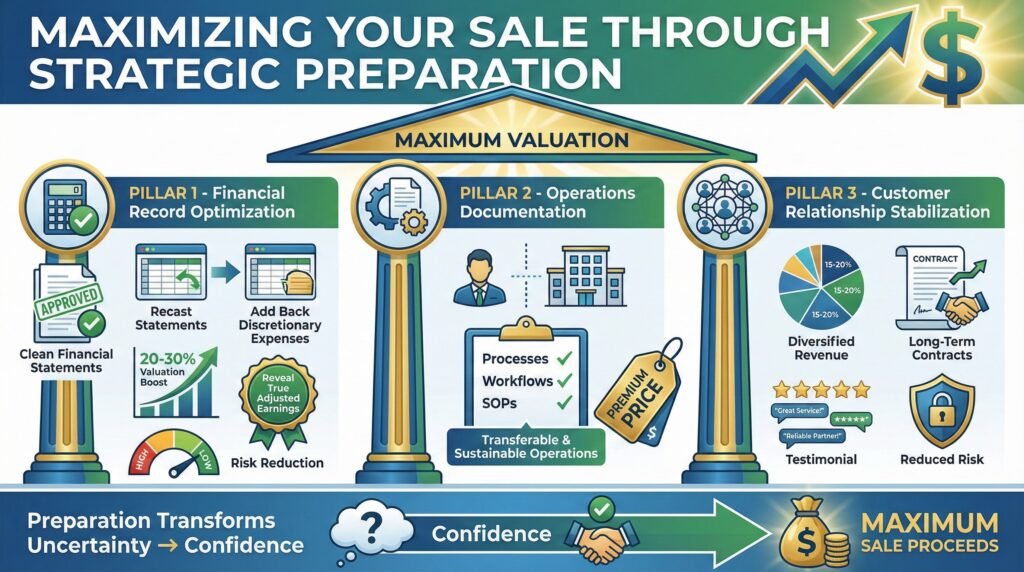
Before diving into the remaining steps, it’s crucial to understand how proper preparation amplifies your company’s perceived value. The most successful exits aren’t accidental, they’re engineered through deliberate enhancement of key business aspects that buyers scrutinize most closely.
Financial Record Optimization: Clean, professional financials are essential for maximum valuation. Work with accountants to recast statements, adding back discretionary expenses and one-time costs to reveal true adjusted earnings. This normalization highlights sustainable profitability and reduces perceived risk. Many brokers report that optimized records can boost valuations by 20-30% by presenting the same performance more effectively.
Operations Documentation: Buyers pay premiums for businesses that run independently of the owner. Create comprehensive documentation: detailed processes, workflows, and SOPs to make operations transferable and sustainable post-sale.
Customer Relationship Stabilization: Avoid customer concentration risk (where one client exceeds 15-20% of revenue), which lowers offers. Diversify your base, secure long-term contracts, and showcase loyalty through metrics, testimonials, and case studies to demonstrate stability.
Thorough preparation transforms uncertainty into confidence, maximizing your sale proceeds.
Negotiation and Due Diligence: The Critical Middle Phase
Once preparation is complete and marketing has generated interest, the process enters its most delicate phase. This is where deals are won or lost, and where professional guidance proves most valuable. The next three steps in the Earned Exits process focus on maximizing leverage during buyer interactions while preventing common pitfalls that derail promising deals.
Step 6: Buyer Engagement Protocol
Initial buyer meetings set the tone for the entire transaction. Earned Exits implements structured engagement protocols that maintain seller leverage while building buyer confidence. This includes controlling the flow of information, setting clear expectations for the process, and expertly fielding questions in ways that address concerns without creating new ones.
The goal is to position your business as an opportunity rather than allowing the conversation to devolve into an interrogation about problems.
Step 7: Offer Management Tactics
Receiving offers is just the beginning of the negotiation process. Each offer contains numerous terms beyond just price that significantly impact the actual value you’ll receive.
Earned Exits’ offer management process includes detailed comparative analysis of multiple offers, strategic counteroffers, and negotiation of key terms that protect sellers from post-closing liabilities and payment risks. This step often involves creating competitive tension among multiple buyers to improve terms across all offers.
Step 8: Due Diligence Navigation
Due diligence is where unprepared sellers often lose negotiating power. This intensive examination period gives buyers opportunities to find reasons to reduce their offers or request concessions.
Earned Exits’ approach flips this dynamic by proactively addressing potential issues before they become negotiating points. By controlling the flow of information, setting clear timelines, and maintaining multiple backup buyers, this step preserves deal momentum while protecting the agreed-upon terms.
Closing the Deal Successfully
The final phase of the exit process converts a promising deal into actual funds in your bank account. Many seemingly solid agreements fall apart in these final stages without proper structure and attention to detail.
Step 9: Transaction Structuring
The way your deal is structured can have profound implications for tax liability, risk exposure, and the actual cash you receive. Earned Exits works with legal and tax professionals to optimize transaction structures based on each seller’s specific circumstances. This includes evaluating asset vs. stock sales, installment payments, earn-outs, seller financing options, and employment/consulting agreements to maximize after-tax proceeds while minimizing post-closing risks.
- Tax optimization strategies that can save hundreds of thousands in unnecessary liabilities
- Risk mitigation through careful escrow and representation provisions
- Earn-out structures that protect sellers from performance variables outside their control
- Clear post-closing obligations with reasonable time commitments
Step 10: Seamless Transition Planning
A successful transition ensures you receive all the value agreed upon in your deal while setting up the new owner for success. This final step in the Earned Exits process creates detailed plans for transferring customer relationships, employee responsibilities, vendor contracts, and operational knowledge.
Proper transition planning prevents the post-closing disputes that often lead to withheld payments or legal complications that can consume your time and money long after the deal closes.
Post-Sale Support Systems
Even after closing, questions and issues invariably arise that require attention. Earned Exits provides ongoing support through the transition period to ensure all parties fulfill their obligations and to quickly address any unexpected challenges. This support helps sellers move confidently into their post-business life while ensuring all financial benefits from the transaction are fully realized.
Your Next Steps Toward a Profitable Exit
Whether you’re planning to exit in the next few months or the next few years, implementing a structured approach now will significantly enhance your eventual outcome. Begin by honestly assessing your current exit readiness across business operations, financial documentation, customer relationships, and personal goals. Identify gaps between your current state and ideal selling condition, then create specific action plans to address each area.
The Earned Exits 10-step process provides a comprehensive framework that has helped hundreds of business owners achieve life-changing exits. By following this proven methodology, you can avoid the costly mistakes that plague unprepared sellers while positioning your business to command maximum value when you decide the time is right to transition to your next chapter.
Click the link below to contact Earned Exits today to receive a free business valuation by filling out their short form. Discover how our proven 10-step process can help you achieve the maximum value for your business.

Frequently Asked Questions
Business owners considering an exit strategy typically have similar concerns about the process. Here are straight answers to the most common questions we encounter:
How long does the average business sale take using the Earned Exits process?
Most businesses using the complete 10-step Earned Exits process sell within 6-9 months from engagement to closing. This timeline can vary based on business complexity, industry, and deal structure.
Proper preparation significantly reduces this timeframe compared to the industry average of 9-12 months for businesses of similar size. The most time-intensive phases typically occur at the beginning (preparation) and middle (due diligence) of the process.
Initial valuation and preparation: 4-8 weeks
Marketing and buyer identification: 6-12 weeks
Due diligence and negotiation: 8-12 weeks
Closing and transition: 4-6 weeks
Businesses with clean financial records, documented operations, and strong management teams generally move through the process more quickly. The key to an efficient timeline is comprehensive preparation before going to market, which prevents the common delays caused by disorganized documentation or financial inconsistencies discovered during due diligence.
While speed isn’t always the primary goal (maximizing value is), a well-executed process prevents the deal fatigue that often leads to concessions or failed transactions in prolonged sales.
What percentage of business value can I expect to lose without proper exit planning?
Businesses sold without strategic exit planning typically receive 30-50% less than their optimized potential value. This value gap stems from several factors: inadequate financial presentation, failure to identify and address operational weaknesses, insufficient marketing to qualified buyers, and weak negotiating position during due diligence and deal structuring.
The most significant losses often occur in businesses with owner-dependent operations, customer concentration issues, or inconsistent financial documentation.
The value gap becomes even more pronounced in larger businesses ($5M+ in revenue) where sophisticated buyers conduct rigorous due diligence and have experience negotiating favorable terms. In these transactions, professional representation through the Earned Exits process often delivers an ROI of 10-20x the cost of services through improved valuations, better deal terms, and tax-advantaged structures.
Can I continue running my business during the sale process?
Not only can you continue running your business during the sale process, but it’s absolutely critical that you do so with undiminished focus and energy. One of the primary benefits of the Earned Exits approach is that it shields business owners from the time-consuming aspects of the sale process while ensuring operations continue without disruption. This dual focus protection is essential because business performance during the sale directly impacts buyer confidence and final valuations. Any decline in results during this period can lead to renegotiated terms or failed transactions.
What types of buyers does the Earned Exits process typically attract?
The Earned Exits marketing approach targets multiple buyer categories simultaneously to create maximum competition and optimal outcomes. These typically include strategic buyers (competitors or complementary businesses seeking expansion), financial buyers (private equity firms and family offices), and individual buyers (often experienced executives or entrepreneurs seeking acquisition opportunities).
Each buyer type brings different priorities, valuation methods, and deal structures to the table. By engaging multiple buyer categories, the process creates leverage that frequently results in improved terms beyond just purchase price, including more favorable payment structures, reduced earn-out requirements, and limited post-closing obligations.
How do I know if my business is ready to sell?
Business sale readiness extends beyond just the decision to exit. True readiness involves having clean financial records for the past 3-5 years, documented operational procedures, diversified customer relationships, limited owner dependency, and positive growth trends.
The Earned Exits valuation process includes a comprehensive readiness assessment that identifies specific areas requiring attention before going to market. This assessment prevents the common and costly mistake of prematurely listing an unprepared business, which often results in failed transactions after months of wasted effort and potential damage to business operations through confidentiality breaches.
Many owners benefit from starting the exit planning process 1-3 years before their target sale date. This timeline allows for strategic improvements that can significantly enhance valuation while creating options around timing to capitalize on favorable market conditions when they arise.
Whether you’re ready to exit now or planning for the future, implementing the Earned Exits 10-step process provides the structure and expertise needed to maximize the value of your life’s work when the time comes to transition to your next chapter.
Contact Earned Exits today to discover how our proven 10-step process can help you achieve the maximum value for your business while ensuring a smooth transition to your next chapter. Click the link below to start the process by filling out their short contact form.
*Disclaimer: This article is written for educational purposes and should not be interpreted as financial advice.
*Disclaimer: This article is written for educational purposes and should not be interpreted as financial advice. We may receive compensation for referrals made through this article.