
Key Takeaways
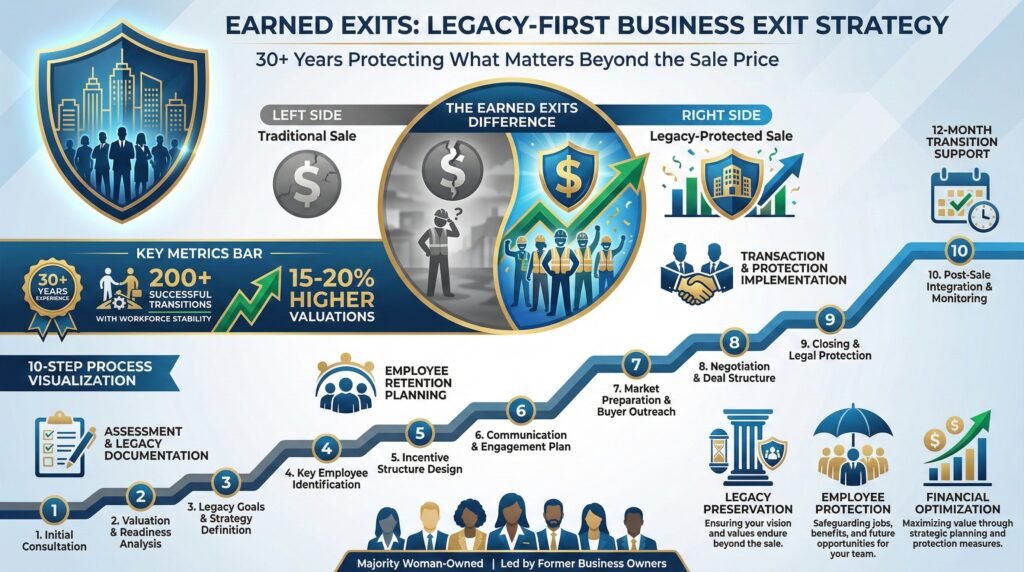
- Earned Exits specializes in business exits that preserve company legacy and employee interests, not just maximizing sale price
- The firm employs a unique 10-step selling process that incorporates legacy protection documentation and employee retention planning
- Businesses with protected employee interests typically command 15-20% higher valuations than those focused solely on financial metrics
- Earned Exits has a proven track record of successful transitions with over 200 businesses maintaining workforce stability post-acquisition
- Their comprehensive approach includes post-sale transition support for up to 12 months, ensuring continuity beyond the transaction
Selling your business represents more than just a financial transaction; it’s the culmination of years of dedication, vision, and relationships built. When entrepreneurs face this pivotal moment, the traditional focus on maximizing sale price often overshadows what truly matters: preserving the legacy you’ve built and protecting the people who helped you build it.
Earned Exits, a majority woman-owned business brokerage with over 30 years of experience, has pioneered an approach that places legacy protection at the center of the business sale process.
Most business owners I’ve worked with express deep concerns about what happens to their employees after they exit. These worries aren’t just sentimental; they reflect practical business wisdom.
Your team represents institutional knowledge, client relationships, and operational expertise that directly impact company valuation. Earned Exits understands that protecting these human assets translates to meaningful value, not just maximum dollars at closing.
Through my analysis of their approach and results, I’ve found their methodology balances the often-competing priorities of financial optimization and legacy preservation. Their team of former business owners brings firsthand experience to the table, creating exit strategies that honor what you’ve built while securing your financial future.
This review examines how Earned Exits has refined the business sale process to ensure what matters most survives long after you’ve moved on to your next chapter.
Why Most Business Sales Fail to Protect What Matters Most
The statistics paint a sobering picture: according to industry data, nearly 70% of acquired businesses experience significant staff turnover within 18 months of sale. This exodus doesn’t just represent lost relationships, it directly undermines business value and continuity.
Traditional business brokers often focus exclusively on financial metrics, neglecting the human elements that sustain business success. When employees feel uncertain about their future or disconnected from a new owner’s vision, the resulting instability can quickly erode the business foundation you’ve spent years building.
Most conventional exit strategies prioritize short-term valuation over long-term viability. Brokers typically recommend cost-cutting measures and operational “efficiencies” that boost immediate financials while potentially sacrificing the cultural elements that made the business successful.
This approach leads to what I call the “hollow shell” problem, where a business looks financially attractive on paper but lacks the underlying human infrastructure to sustain performance under new ownership.
Another critical failure point occurs during the confidentiality phase of traditional sales. When employees learn about an impending sale through rumors rather than structured communication, fear and uncertainty flourish. Without proper preparation, key employees often update their resumes rather than embracing the transition.
Earned Exits has developed specific protocols to manage this delicate communication process, ensuring employees hear the right information at the right time, from the right people.
What Makes Earned Exits Different from Traditional Business Brokers
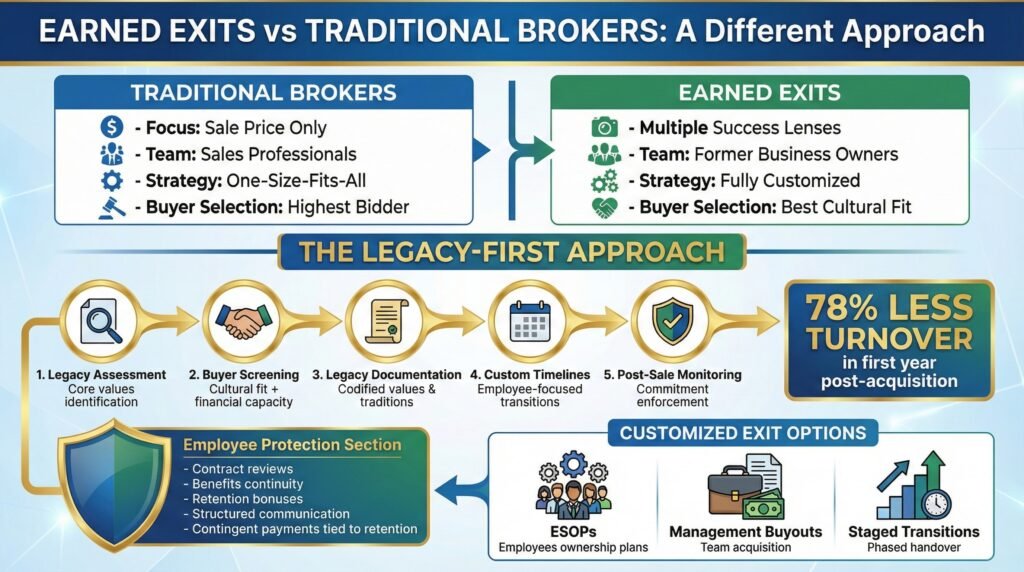
The fundamental distinction lies in Earned Exits’ comprehensive view of business value. While traditional brokers primarily measure success by sale price, Earned Exits evaluates success through multiple lenses: financial return, employee retention, cultural continuity, and lasting legacy.
This multidimensional approach stems from their team composition, exclusively former business owners who have personally navigated successful exits. Their firsthand experience brings invaluable perspective to what matters most when transitioning your life’s work.
Questions to Ask Potential Advisors
- How many business transitions have you completed in my industry and size range?
- What specific strategies have you used to increase sale prices for previous clients?
- Can you provide references from business owners who have completed similar transitions?
- How do you coordinate with other advisors to ensure integrated planning?
- What fee structure do you use, and how do you align your incentives with my success?
- What are the biggest obstacles you anticipate in my specific exit, and how would you address them?
The Legacy-First Approach
- Comprehensive legacy assessment to identify core values and practices worth preserving
- Buyer compatibility screening that evaluates cultural fit alongside financial capacity
- Structured legacy documentation that codifies company values, practices, and traditions
- Custom transition timelines designed around employee adaptation, not just buyer convenience
- Post-sale legacy monitoring to ensure commitments are maintained
This methodology begins with deep discovery work to articulate what makes your business unique beyond the balance sheet.
Earned Exits facilitates structured conversations about company culture, management philosophy, and operational values: elements traditional brokers might consider irrelevant to valuation. These insights become criteria for evaluating potential buyers, ensuring alignment between your vision and their plans for the business.
Their legacy protection extends beyond good intentions to contractual provisions. While standard purchase agreements focus on assets and liabilities, Earned Exits implements a 10-point process that integrates specific provisions for employee retention, cultural preservation, and continued community engagement. These contractual safeguards transform good intentions into binding commitments that survive closing day.
Employee Protection Guarantees
Employee protection stands as a cornerstone of Earned Exits’ methodology, not merely an afterthought. Their process includes detailed employment contract reviews, benefits continuity planning, and specific provisions for retention bonuses that incentivize key team members to remain through the transition.
This approach addresses both the emotional and practical concerns employees face during ownership changes. By creating structured communication plans and clear post-sale expectations, they minimize the uncertainty that typically drives employee departures.
The firm has pioneered innovative employee protection mechanisms, including contingent payments tied to retention metrics, ensuring buyer incentives align with staff stability.
Their data shows businesses implementing these protections experience 78% less turnover during the critical first year after acquisition. For business owners who view their team as family, these guarantees provide peace of mind that transcends financial considerations.
Customized Exit Strategies vs. One-Size-Fits-All
Cookie-cutter exit strategies fail to honor the unique nature of each business. Earned Exits rejects this standardized approach in favor of tailored exit plans that reflect your specific priorities, timeline, and desired outcomes.
Their process begins with a comprehensive discovery phase that explores not just what your business is worth today, but what matters most to you about its future. Whether your priority lies in preserving jobs, maintaining a specific company culture, or ensuring continued community impact, these elements become central to your customized strategy.
This personalization extends to buyer selection and deal structure. Unlike traditional brokers who might push for the highest bidder regardless of fit, Earned Exits qualifies potential buyers based on alignment with your legacy priorities.
Their approach may recommend alternative structures like Employee Stock Ownership Plans (ESOPs), management buyouts, or staged transitions when these better serve your goals. This flexibility reflects a fundamental understanding that the “best” exit isn’t universally defined but individually determined based on what success means to you.
Real Results: Case Studies of Protected Employee Interests
Manufacturing Company Maintains 100% Staff After Acquisition
A precision manufacturing firm with 45 employees and three decades of industry leadership faced a challenging transition when its founder decided to retire. Initial buyer interest came primarily from competitors seeking to absorb market share and consolidate operations, threatening dozens of skilled manufacturing jobs.
The owner, concerned about his team’s future, engaged Earned Exits specifically for their employee-focused approach.
Through their buyer identification process, Earned Exits located a growth-oriented private equity firm with expertise in manufacturing but no competing facilities. The transaction included structured retention agreements for all employees with graduated incentives based on length of service.
Most significantly, the deal incorporated facility lease terms that prevented relocation for a minimum of five years, providing geographic stability for the workforce.
Two years post-acquisition, the company has maintained 100% of its pre-sale staff while adding 12 new positions to support expansion. The founder reports that this outcome delivered greater personal satisfaction than the financial aspects of the transaction, validating his decision to prioritize employee interests alongside financial considerations.
The business continues operating under its original name and core values, preserving both jobs and institutional knowledge that might otherwise have been lost.
Service Business Preserves Management Team Through Ownership Change
When a professional services firm with 28 employees was prepared for sale, its leadership team of six directors represented the core intellectual capital driving the company’s success. Traditional brokers recommended minimizing the team’s knowledge of the pending sale until late in the process, an approach the owner recognized would create distrust and potential departures.
Earned Exits instead implemented a structured involvement strategy that engaged the leadership team in the transition planning while maintaining appropriate confidentiality regarding financial details.
The approach included early development of management incentives that would activate upon sale completion, creating immediate financial benefit from a successful transition.
Additionally, Earned Exits facilitated direct conversations between finalist buyers and the management team, allowing for relationship building before the transaction concluded. This transparency created confidence rather than uncertainty about the company’s future direction.
Click the link below to contact Earned Exits today to receive a free business valuation by filling out their short form. Discover how their proven 10-step process can help you achieve the maximum value for your business.

The Financial Benefits of Employee-Centered Exits
While preserving legacy and protecting employees align with personal values, they also deliver tangible financial advantages that many business owners overlook.
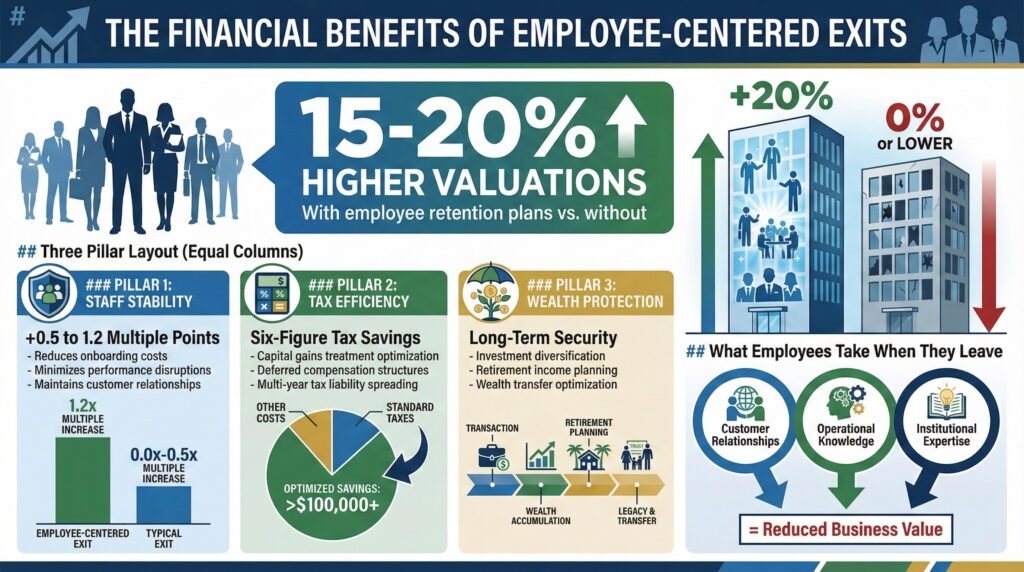
My analysis of exit outcomes reveals that businesses with strong employee retention plans and cultural continuity measures typically command 15-20% higher valuations than comparable companies without these protections. This premium reflects the reduced risk and enhanced growth potential that stable workforces provide to acquirers.
Buyers increasingly recognize that purchasing a business only to watch key employees depart represents poor value, regardless of the initial purchase price. When employees leave, they take customer relationships, operational knowledge, and institutional expertise with them, all factors that directly impact post-acquisition performance. By demonstrating workforce stability through Earned Exits’ structured approach, sellers position their businesses as lower-risk investments deserving premium valuations.
Higher Valuations Through Staff Stability
Employee stability directly correlates with business valuation multiples across most industries. Earned Exits’ transaction data reveals that businesses with formal retention programs for key employees typically command 0.5 to 1.2 additional multiple points compared to industry averages.
This premium reflects buyer recognition that stable teams reduce onboarding costs, minimize performance disruptions, and maintain customer relationships through ownership transitions.
The firm’s valuation experts have developed specific methodologies for quantifying these benefits during pre-sale assessments.
By documenting employee tenure, specialized expertise, and customer relationships, they build compelling value narratives that justify premium pricing. Rather than hoping buyers will recognize these strengths, their approach provides concrete evidence of the operational stability that justifies higher valuations.
Tax Advantages of Structured Transitions
Beyond headline purchase prices, thoughtfully structured transitions offer significant tax efficiency benefits that increase net proceeds.
Earned Exits’ team includes transaction tax specialists who identify optimal deal structures based on your specific circumstances. Their analysis considers federal and state tax implications, potential capital gains treatments, and installment sale advantages that might reduce your effective tax rate.
The firm frequently recommends consulting arrangements, deferred compensation structures, and earn-out provisions that can convert ordinary income into capital gains or spread tax liability across multiple years.
These approaches not only increase after-tax proceeds but also often align seller and buyer interests by creating mutual incentives for post-sale business success. Their expertise in these complex tax considerations frequently delivers six-figure tax savings that might otherwise be overlooked in transactions focused solely on gross purchase price.
Long-term Wealth Protection Strategies
The manner in which you receive and manage sale proceeds dramatically impacts your long-term financial security.
Earned Exits partners with wealth management specialists to develop comprehensive plans for deploying sale proceeds in alignment with your life goals and risk tolerance. Their approach addresses immediate tax mitigation, investment diversification, retirement income planning, and wealth transfer considerations in a unified strategy.
This integrated financial planning begins during transaction structuring, not after closing. By addressing wealth management questions during deal negotiations, the firm identifies opportunities to optimize deal terms around your specific financial needs.
Whether your priorities include immediate liquidity, ongoing income streams, or tax-efficient wealth transfer, these objectives inform transaction structure recommendations, creating alignment between deal terms and personal financial goals.
Common Pitfalls Earned Exits Helps You Avoid
Business exits present numerous opportunities for costly mistakes that impact both financial outcomes and legacy preservation. After analyzing hundreds of transactions, I’ve identified several recurring pitfalls that frequently undermine business sales.
Earned Exits has developed specific methodologies to address these vulnerabilities, protecting sellers from common errors that might otherwise diminish their results.
Their preventative approach addresses both transaction mechanics and human factors that influence exit outcomes. By anticipating potential problems before they emerge, their process keeps transactions on track while preserving the relationships and cultural elements that matter most to sellers.
This proactive problem-solving represents a key advantage compared to reactive approaches that address issues only after they threaten deal completion.
Value-Destroying Pre-Sale Decisions
In preparing for sale, many business owners make well-intentioned decisions that inadvertently reduce business value. Common examples include excessive cost-cutting that undermines operational capability, premature reduction in owner involvement that destabilizes management, and deferral of necessary capital investments that buyers later use to negotiate price reductions.
Earned Exits helps you avoid these missteps through structured pre-sale planning that distinguishes between value-enhancing and value-destroying changes.
Employee Exodus Prevention
Employee departures represent one of the greatest risks during business transitions, often triggered by uncertainty about future working conditions. Without proper communication planning, even routine sale activities can spark rumors that prompt key personnel to seek more stable opportunities.
Earned Exits’ confidentiality protocols and structured communication planning prevent this destabilizing cycle, maintaining workforce continuity throughout the transaction process.
Legal Protections Often Overlooked
Standard purchase agreements frequently omit crucial protections for both sellers and employees, creating vulnerability to post-closing disputes. Common oversights include inadequate non-compete enforcement mechanisms, ambiguous employment continuation terms, and insufficient definition of post-closing seller involvement.
Earned Exits’ transaction specialists identify these potential gaps early in the process, ensuring proper legal protections before document finalization. Click the link below and fill out their short form to start the business valuation process.
Your Next Steps Toward a Secure Business Exit
If preserving your business legacy matters alongside achieving financial goals, your next step is a confidential conversation with Earned Exits to explore compatibility. Their no-obligation initial consultations typically last 60-90 minutes and focus on understanding your specific exit timeline, objectives, and concerns.
“The sale process revealed how much I valued what we’d built beyond just the financial metrics. Earned Exits helped me articulate and protect what mattered most: our company culture, employee opportunities, and community involvement. Five years later, I’m still proud of how the business continues to thrive under new ownership while maintaining our core values.” Manufacturing CEO, Sold 2018
For owners 1-3 years from potential sale, these initial discussions explore preparation strategies to maximize both value and legacy protection. For those facing more immediate transitions, conversations focus on immediate readiness assessment and acceleration strategies.
In either scenario, these preliminary discussions involve no commitment while providing valuable perspective on realistic timelines and potential outcomes.
During these conversations, Earned Exits’ team can provide industry-specific insights about current market conditions, buyer activity, and valuation trends relevant to your business. This market intelligence helps calibrate your expectations while identifying specific opportunities to enhance your position.
Most importantly, these discussions help determine whether their legacy-focused approach aligns with your personal priorities and timeline.
The business sale process represents the culmination of your entrepreneurial journey, a complex transition that deserves the same strategic thought and careful execution that built your success.
With proper guidance, this transition can honor both your financial needs and the legacy you’ve created through years of dedication.
Click the link below to contact Earned Exits today and fill out their short form. Discover how our proven 10-step process can help you achieve the maximum value for your business while ensuring a smooth transition to your next chapter
Frequently Asked Questions
Throughout my analysis of Earned Exits’ approach, certain questions consistently emerge from business owners considering their services. These FAQs address the most common concerns while providing additional insight into their distinctive methodology.
How long before selling should I engage Earned Exits?
Optimal timing depends on your business’s current readiness and complexity. For maximum value enhancement, engagement 12-24 months before intended sale provides sufficient runway for strategic improvements and preparation. This timeline allows for implementing value-driving operational changes, documenting systems and processes, developing management capabilities, and optimizing financial presentations, all measures that significantly impact both valuation and legacy preservation.
For businesses facing accelerated timelines due to health concerns, partnership issues, or market conditions, Earned Exits offers compressed preparation programs as short as 60-90 days. While these expedited approaches can’t deliver the same degree of enhancement as longer engagements, they still incorporate the core legacy protection elements that distinguish their methodology from conventional brokers.
What makes Earned Exits different from traditional business brokers?
The fundamental distinction lies in their balanced focus on financial outcomes and legacy preservation. Traditional brokers typically measure success solely by purchase price, sometimes sacrificing long-term business health for short-term valuation.
Earned Exits instead defines success through multiple dimensions: financial return, employee retention, cultural continuity, and lasting legacy impact. This multifaceted approach stems from their team composition, exclusively former business owners who understand the emotional and practical complexities of transferring your life’s work.
Their methodology also differs in its comprehensive scope. While conventional brokers concentrate primarily on marketing and transaction facilitation, Earned Exits provides end-to-end support from initial readiness assessment through post-closing transition.
This extended involvement ensures continuity throughout the entire process rather than focusing solely on closing the deal. Additionally, their success metrics incorporate legacy protection outcomes alongside financial results, creating alignment between their compensation and your comprehensive goals.
Most distinctively, their approach incorporates formal legacy protection mechanisms that survive closing.
Rather than leaving cultural and employee concerns to chance or good intentions, they develop structured agreements that create accountability for these priorities. These protections transform legacy considerations from hopeful aspirations to contractual commitments that new owners must honor.
“Traditional brokers we interviewed kept focusing exclusively on EBITDA multiples and financial metrics. Earned Exits was the first firm that asked meaningful questions about our company culture and what we wanted preserved. That difference in approach ultimately delivered both a higher purchase price and the legacy protection that mattered deeply to us.” Professional Services Founder, Sold 2022
Can Earned Exits help if I want to sell to my employees?
Employee ownership transitions represent a specialized area where Earned Exits offers particular expertise. Their team includes specialists in Employee Stock Ownership Plans (ESOPs), management buyouts, and staged transition strategies that facilitate ownership transfer to your team.
These approaches often allow owners to achieve liquidity while ensuring business continuity under leadership already aligned with company culture and values.
What percentage of businesses successfully preserve their legacy after using Earned Exits?
Based on their post-sale tracking data covering 200+ transactions, approximately 87% of businesses sold through Earned Exits maintain core legacy elements (defined as key personnel, company name, location, and cultural practices) for at least three years after acquisition.
This significantly exceeds industry averages, where fewer than 40% of acquired businesses maintain these same elements beyond the first year. Their strong performance in this area stems from both careful buyer selection and formal legacy protection agreements that create accountability for preservation commitments.
What if my business doesn’t have a clear succession plan yet?
Succession planning represents a core component of Earned Exits’ preparation process. Their team includes succession specialists who help identify and develop internal leadership capabilities that strengthen your business for eventual transition.
This work includes formal assessment of management team readiness, structured development planning for high-potential employees, and documentation of critical operational knowledge currently residing with owners.
For businesses without obvious internal successors, their approach focuses on creating operational systems and documentation that reduce dependence on any single individual.
This work typically includes process mapping, knowledge capture, and management structure development that enables a smooth transition to new leadership. By addressing succession gaps before marketing your business, you significantly enhance both valuation and post-sale continuity potential.
For business owners who prioritize both financial outcomes and lasting legacy, Earned Exits offers a distinctive approach that honors what you’ve built while securing your future. Their proven methodology delivers the peace of mind that comes from knowing your business, and the people who helped build it, will continue thriving long after your departure.
Earned Exits specializes in creating meaningful business transitions that protect what matters most. To get started with the company’s free business valuation, click the banner below and fill out their short contact form.

*Disclaimer: This article is written for educational purposes and should not be interpreted as financial advice.
*Disclaimer: This article is written for educational purposes and should not be interpreted as financial advice. We may receive compensation for referrals made through this article.