
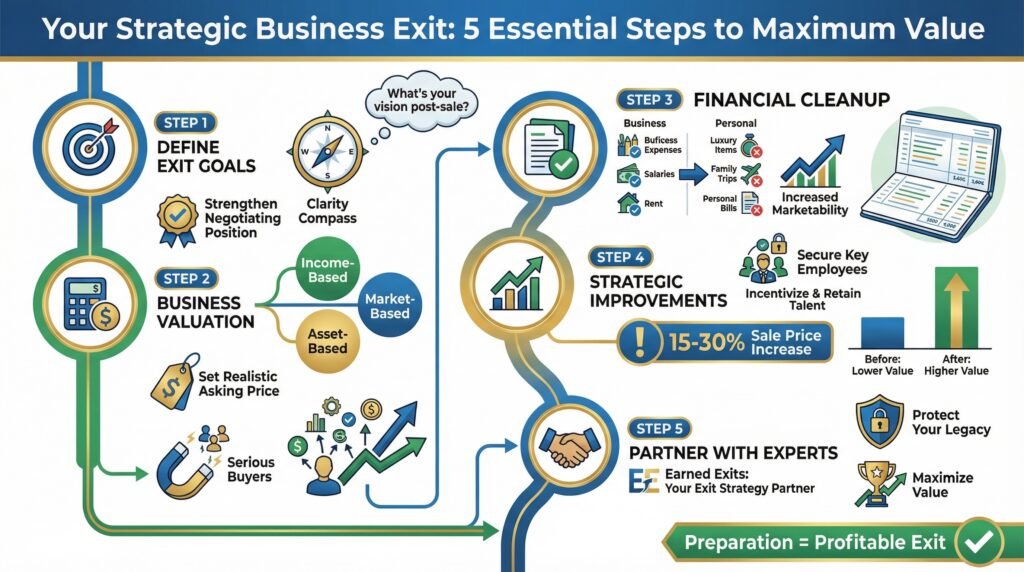
Quick Summary: Your Business Sale Roadmap
- Defining your exit goals before listing your business creates clarity and strengthens your negotiating position throughout the sale process.
- Proper business valuation using multiple methods is essential for setting a realistic asking price that attracts serious buyers.
- Cleaning up financial records and separating personal expenses from business operations can significantly increase your business’s marketability.
- Strategic improvements to reduce owner dependency and secure key employees can increase your sale price by 15-30%.
- Earned Exits helps business owners navigate the complex selling process with personalized exit strategies that protect your legacy while maximizing value.
Selling your business isn’t just a transaction—it’s the culmination of years of hard work, sacrifice, and vision. When you approach this process strategically, you can maximize your sale price while ensuring a smooth transition that preserves your legacy. This comprehensive guide walks you through each critical step, from preparation to closing, with actionable insights that successful sellers consistently implement.
The difference between a stressful, undervalued sale and a smooth, profitable exit often comes down to preparation and understanding the complete process before you begin. By following this checklist, you’ll avoid common pitfalls and position your business as an attractive, valuable asset to qualified buyers.
What You Need Before Selling Your Business
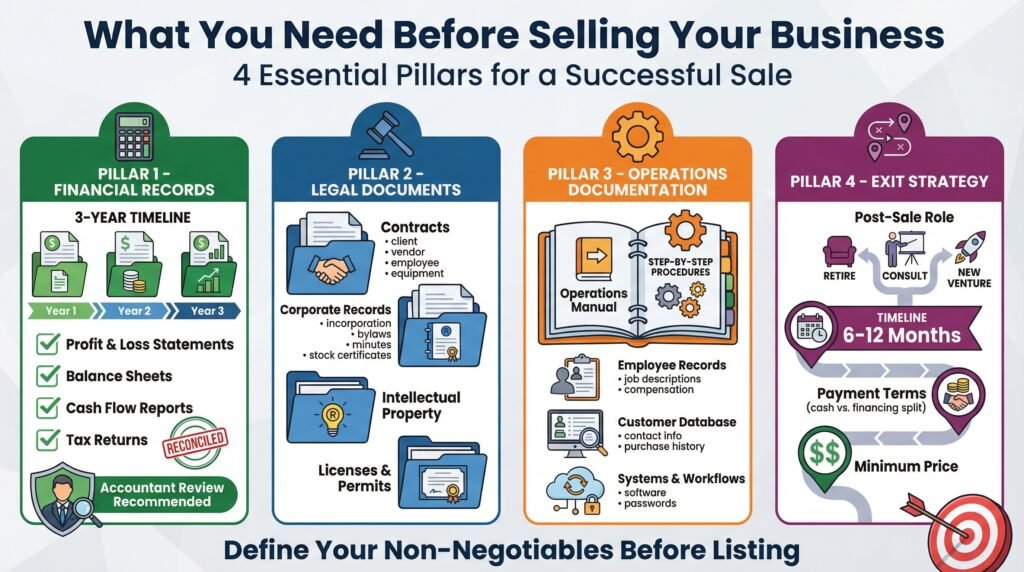
Before placing your business on the market, you need to align on what you truly want from the sale. This preparation phase is where many business owners make mistakes that cost them significantly at closing. Take time to define your non-negotiables, ideal timeline, and the role you’re willing to play during transition—these decisions will shape every aspect of your sale strategy.
Financial Records to Get in Order First
Buyers will scrutinize your financial history more thoroughly than anything else. At a minimum, prepare clean financial statements for the past three years, including profit and loss statements, balance sheets, and cash flow reports. Tax returns should reconcile with your financial statements, and any discrepancies should be explainable. Consider having your accountant prepare a financial review or compilation to strengthen buyer confidence in your numbers.
Legal Documents That Buyers Will Request
Your legal foundation directly impacts transferability and sale value. Collect and organize all current contracts, including client agreements, vendor relationships, employee contracts, and equipment leases. Ensure your corporate records are complete with articles of incorporation, bylaws, meeting minutes, and stock certificates. Confirm that intellectual property is properly registered and transferable. If your business operates in a regulated industry, gather all relevant licenses, permits, and inspection records to demonstrate compliance history.
Business Operations Documentation
Documented operations convert your personal expertise into transferable business value. Create or update your operations manual with step-by-step procedures for all key business functions. Organize employee information, including job descriptions, compensation details, and performance history. Compile customer lists with complete contact information, purchase history, and profitability metrics. Document your systems, software, passwords, and key operational workflows that make your business run smoothly without your constant involvement.
Your Exit Strategy and Timeline
A clear exit strategy prevents emotional decision-making when offers arrive. Define your minimum acceptable price and ideal terms, including how much cash you need at closing versus your willingness to accept seller financing. Decide on your preferred timeline, recognizing that most business sales take 6-12 months from listing to closing. Consider your personal plans after the sale—will you retire completely, consult for the new owner, or start something new? These decisions impact both deal structure and buyer selection criteria.
Step 1: Value Your Business Accurately
Setting the right price is perhaps the most crucial decision in your business sale journey. Price too high, and you’ll scare away qualified buyers before conversations begin; price too low, and you leave hard-earned money on the table. A proper valuation combines objective financial analysis with industry knowledge and current market conditions to arrive at a defensible asking range.
- Underpricing typically happens when owners focus solely on financial formulas without considering strategic value to specific buyers
- Overpricing commonly occurs when emotional attachment clouds the objective assessment of what the market will bear
- The ideal asking price creates enough room for negotiation while still attracting serious interest
Common Business Valuation Methods
No single valuation approach works for every business, which is why professionals typically use multiple methods. The market approach compares your business to similar companies that have recently sold, adjusting for differences in size, growth, and profitability. The income approach, including Discounted Cash Flow analysis, calculates the present value of your projected future earnings. The asset approach establishes a baseline value by calculating the fair market value of your tangible and intangible assets minus liabilities.
For most small businesses, a multiple of adjusted earnings (SDE or EBITDA) remains the primary valuation method. This multiple varies significantly by industry, typically ranging from 2-3x for service businesses to 4-6x for established companies with strong systems and growth potential. Your specific multiple depends on factors like revenue trends, customer concentration, transferability of customer relationships, and market position.
Smart sellers understand that different buyers may value the same business differently based on strategic fit, synergies, and growth opportunities. This reality creates room to negotiate for premium pricing with the right buyer who recognizes unique value in your specific operation.
When to Hire a Professional Appraiser or Broker
- Businesses with significant assets or complex operations benefit most from professional valuation
- When family succession or partner buyouts are involved, third-party validation reduces conflict
- If you plan to seek SBA financing for your buyer, lenders typically require professional valuations
- Regulated industries or businesses with specialized equipment often need industry-specific valuation expertise
Red Flags That Lower Your Business Value
Addressing value detractors before listing can significantly increase your final sale price. Customer concentration becomes a major concern when any single client represents more than 15-20% of your revenue. Heavy owner involvement in daily operations without capable management raises transition risk.
Declining revenues or profit margins in recent years have created buyer hesitation regardless of explanations. Outdated technology, equipment requiring imminent replacement, or lease agreements with unfavorable terms all undermine value. Identifying and addressing these issues proactively demonstrates transparency while potentially increasing your business’s marketability.
Step 2: Create a Compelling Business Listing and Marketing
Your business listing creates the critical first impression that determines whether potential buyers pursue or pass on your opportunity. This isn’t merely about disclosing information—it’s about crafting a compelling narrative that highlights your business’s unique value proposition while maintaining appropriate confidentiality. The goal is to generate genuine interest from qualified buyers without revealing sensitive details that could harm operations if the information circulated widely.
- Focus on the business opportunity rather than just operational details
- Highlight transferable value like systems, contracts, and recurring revenue
- Address potential concerns proactively with honest but positive framing
- Include growth opportunities that the right buyer could capitalize on
Remember that different information should be revealed at different stages of the process. Your initial listing provides enough detail to generate interest, while more sensitive information is shared later with qualified buyers who have signed confidentiality agreements and demonstrated financial capability.
Writing a Business Profile That Sells
Your business profile should tell a compelling story that goes beyond just numbers. Start with a concise executive summary that provides an overview of what makes your business special and profitable. Explain your business model in clear terms that even someone outside your industry could understand. Highlight your competitive advantages, market position, and what barriers to entry protect your business from easy competition. Be specific about the lifestyle benefits the business provides its owner, as this often drives buyer interest as much as financial returns.
What to Include in Your Selling Memorandum
A comprehensive selling memorandum or prospectus serves as the detailed roadmap of your business for serious prospects. Include an industry overview with trends and growth projections that contextualize your business opportunity. Provide detailed information about your products or services, pricing strategies, and what makes them valuable to customers. Outline your marketing and sales processes, including customer acquisition methods and costs.
The financial section should include 3-5 years of financial history and realistic projections for the next 2-3 years. Be prepared to explain any significant fluctuations or anomalies in historical performance. Include information about key employees who will remain after the sale, emphasizing the strength of your management team beyond just your own involvement.
Information to Keep Confidential Until Later
Certain information should only be shared with serious buyers after they’ve signed confidentiality agreements and demonstrated their financial capability. Protect specific customer names and contact information until later stages of discussion. Withhold proprietary processes, recipes, or intellectual property details that constitute your competitive advantage. Keep employee names, compensation details, and organizational charts confidential during initial discussions.
Financial details should be presented in stages, with high-level summaries provided initially and detailed financial statements, tax returns, and customer profitability analyses shared only with qualified prospects. Never disclose information about potential weaknesses, ongoing negotiations, or pending legal issues in your initial materials—these should be addressed transparently but only with serious candidates who have demonstrated commitment.
Business Broker Valuation and Marketing Services
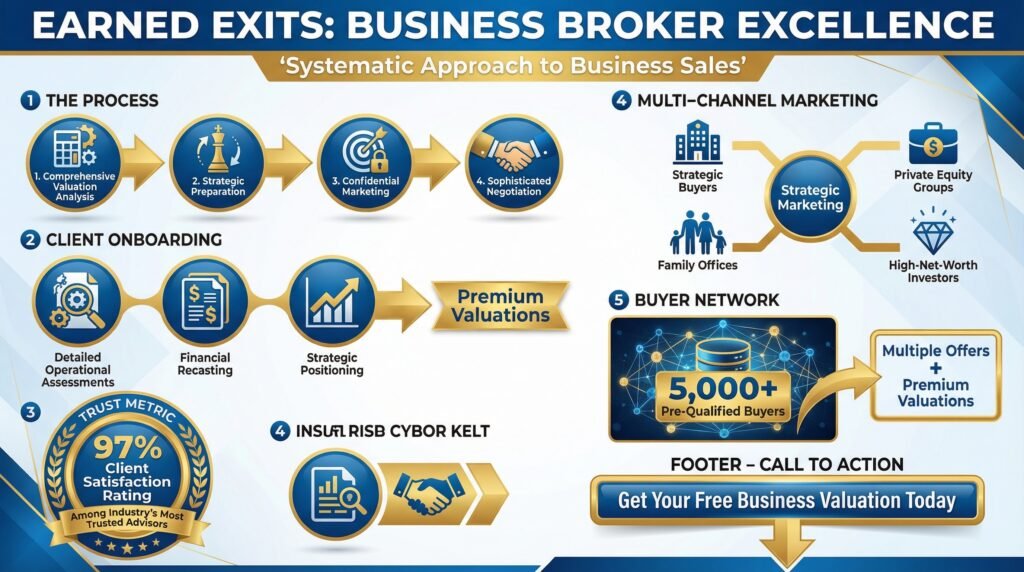
Earned Exits is a business broker that provides a systematic approach to business sales. It encompasses a comprehensive valuation analysis, strategic preparation, confidential marketing to qualified buyers, and sophisticated negotiation strategies. By combining deep industry knowledge with transaction expertise, Earned Exits has established a proven methodology that maximizes both financial outcomes and transition success for business owners across diverse sectors.
Their client onboarding process includes detailed operational assessments, financial recasting, and strategic positioning work that has consistently led to premium valuations. This commitment to excellence has resulted in a client satisfaction rating that exceeds 97%, placing Earned Exits among the most trusted advisors in the industry.
Superior business brokers implement sophisticated, multi-channel marketing strategies rather than simply listing businesses on marketplaces. These comprehensive campaigns combine confidential direct outreach to strategic buyers, engagement with qualified private equity groups, and targeted approaches to family offices and high-net-worth investors seeking specific acquisition opportunities. The quality of these buyer relationships directly impacts both valuation outcomes and transaction success rates.
Earned Exits has developed particular expertise in strategic buyer identification, maintaining extensive relationships with acquirers across multiple industries. Their proprietary database includes over 5,000 pre-qualified buyers actively seeking specific acquisition opportunities.
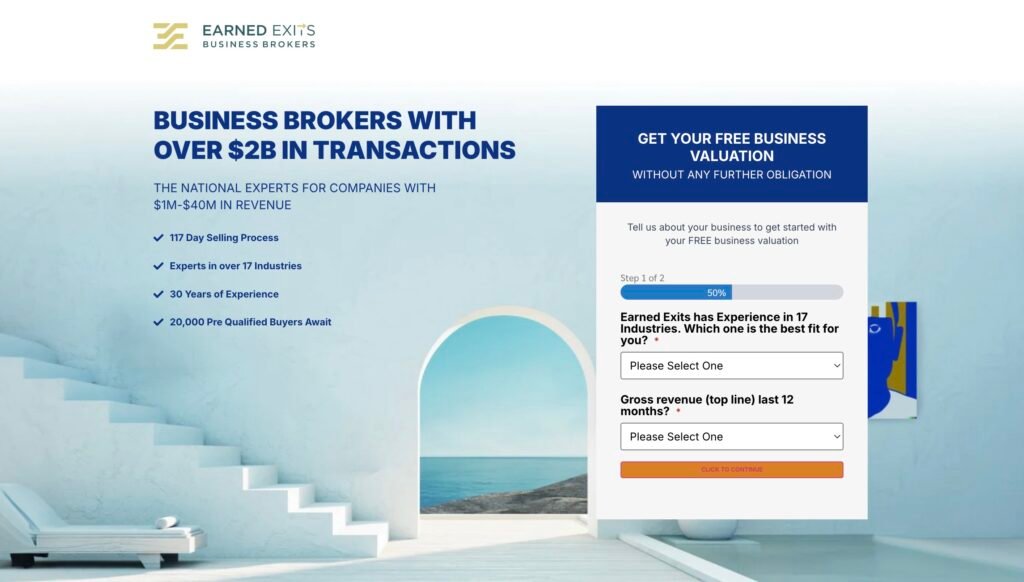
This buyer network creates competitive dynamics that frequently result in multiple offers and premium valuations for properly positioned businesses. Click the link below to contact Earned Exits today to start their free business valuation by filling out a short contact form.
Learn more about finding and screening potential buyers, negotiating a sales structure, and more here.
Frequently Asked Questions
The following questions address common concerns that arise during business sale preparations. While every business has unique circumstances, these general guidelines provide a foundational understanding of what to expect throughout the process.
How long does it typically take to sell a business?
Most business sales take 6-12 months from initial preparation to closing, though timelines vary significantly based on business size, industry, and market conditions. Preparation typically requires 1-3 months to organize financial records, operational documentation, and marketing materials. Finding a qualified buyer generally takes 3-8 months, with complex or highly specialized businesses often requiring longer marketing periods. Due diligence and closing processes add another 2-4 months after identifying a buyer and signing a letter of intent.
What’s the best time of year to sell my business?
While conventional wisdom suggests listing after completing your fiscal year with strong results, the ideal timing depends more on your specific business cycle and buyer demographics. For seasonal businesses, begin marketing after demonstrating strong performance during your peak period. Businesses with consistent performance can enter the market anytime, though January-April often sees increased buyer activity as people implement new year career changes.
More important than calendar timing is your business’s performance trend; selling during growth phases typically commands premium valuations compared to plateaus or declines. Your personal readiness and industry conditions generally impact value more than specific listing months.
How do I keep the sale confidential from employees and competitors?
Strict confidentiality protocols protect business value during the sales process. Use blind listings that describe your business without identifying details in initial marketing. Require signed non-disclosure agreements before revealing your company name or specific information. Schedule buyer visits after hours or presented as vendor/consultant meetings to avoid raising employee suspicions. Work with professional advisors experienced in maintaining confidentiality throughout complex transactions.
What percentage do business brokers typically charge?
Business broker commissions typically range from 8-12% for small businesses valued under $1 million, scaling down to 4-8% for businesses valued between $1-5 million, and 2-6% for larger enterprises. Most use a success fee structure with payment due only upon closing. Some brokers, particularly for larger businesses, charge upfront retainers or marketing fees in addition to success fees.
Commission structures may include minimum fees, tiered percentages based on final sale price, or performance incentives for achieving specific price thresholds. When evaluating broker costs, consider their marketing reach, buyer network, negotiation expertise, and transaction management capabilities rather than focusing solely on percentage rates.
Can I sell my business if it’s losing money?
Yes, unprofitable businesses can sell successfully when they offer other compelling value. Assets, including equipment, inventory, real estate, intellectual property, or established customer lists, often hold value independent of profitability.
Strategic buyers may identify cost-saving synergies or revenue growth opportunities not available to the current ownership. Turnaround investors specifically seek distressed businesses with fixable problems and attractive purchase terms. The key is clearly articulating the value proposition beyond current financial performance, whether that’s untapped potential, specific assets, or strategic positioning.
When facing questions such as these, working with an experienced business broker that has worked in the trenches in a variety of business sales situations is crucial.
Choosing Earned Exits means partnering with a committed team focused entirely on your success. Our strategic methodology, proven history of results, and unwavering dedication to clients position us as the go-to advisor for owners navigating the intricacies of mergers and acquisitions.
Reach out to Earned Exits today to arrange a consultation with one of our expert advisors and begin moving toward a rewarding transaction.
Click the banner below to start Earned Exits’ free valuation process by filling out their short contact form.

*Disclaimer: This article is written for educational purposes and should not be interpreted as financial advice.
*Disclaimer: This article is written for educational purposes and should not be interpreted as financial advice. We may receive compensation for referrals made through this article.