
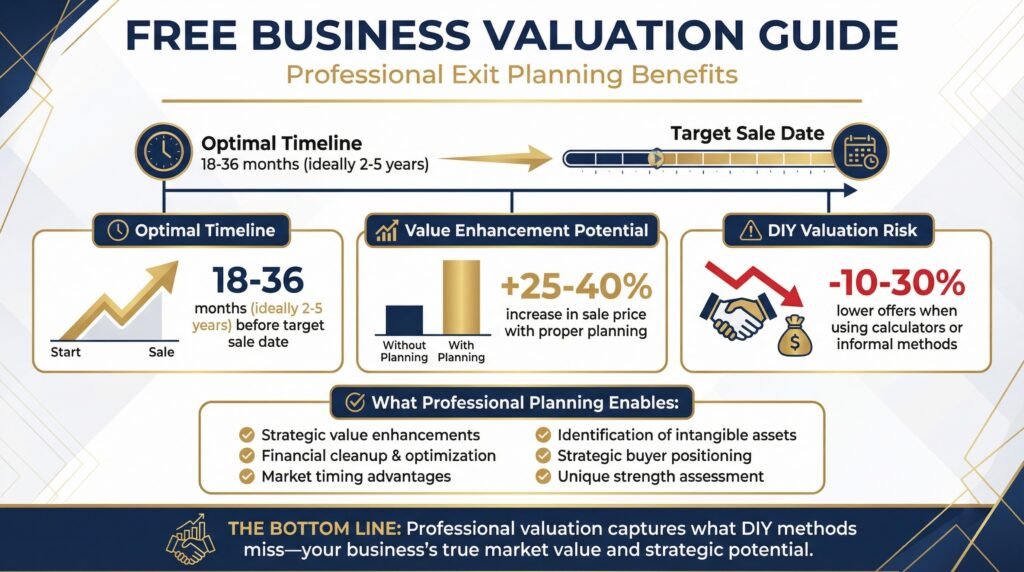
Quick Summary: Business Valuation Timeline and Expectations
Start exit planning and professional valuation 18-36 months (ideally 2-5 years) before your target sale date, this allows time for strategic value enhancements, financial cleanup, and market timing, often boosting sale price by 25-40% (or more).
Most owners undervalue their business using DIY methods or online calculators, which miss unique strengths, intangible assets, strategic buyer potential, and current market realities, leading to 10-30%+ lower offers.
Professional valuation (often <1% of deal value) delivers:
- Credible, data-backed pricing and strong negotiation leverage
- Identification of hidden value drivers (e.g., IP, brand, synergies)
- Tailored recommendations for value growth
- Better positioning for strategic buyers (who pay 30-100% premiums vs. financial buyers)
It also supports optimal tax planning, asset vs. stock sale decisions, capital gains strategies, allocation, installment sales, etc., potentially saving 10-20%+ in taxes and increasing after-tax proceeds significantly.
Case study example: A manufacturing business went from a $2.5M rule-of-thumb estimate to $3.8M professional valuation + $175K tax savings = $1.3M+ total benefit.
Bottom line: Treat valuation as a high-ROI investment, not a last-minute step. Earned Exits offers free professional valuations, gather 3 years of financials + operational docs, and start early to maximize your life’s work. Don’t leave money on the table.
The Valuation Timeline: When to Start and What to Expect
In part 1 of this article, we discussed the ground-level basics of a professional business valuation, why most business owners undervalue their companies, the downsides of a poor valuation, the different valuation methods, and much more.
Proper business valuation isn’t a last-minute exercise but an integral component of exit planning that should begin 18-36 months before your target sale date. This timeline allows for strategic value enhancement, financial optimization, and proper market positioning. Starting too late limits your ability to implement the improvements that maximize the sale price.
18-Month Exit Planning Window
“The biggest regret I hear from business sellers isn’t about the final price, it’s about not starting valuation and exit planning earlier. Those extra 12-24 months of preparation typically yield 25-40% higher valuations through strategic enhancements and timing advantages.” — Business Exit Planning Specialist
A strategic exit timeline typically begins with a baseline valuation to identify strengths and weaknesses, followed by targeted value enhancement initiatives addressing the specific factors most relevant to your industry and business model. The middle phase focuses on financial optimization, including expense normalization, revenue recognition, and tax planning. The final pre-sale period concentrates on market positioning, buyer targeting, and preliminary marketing preparations.
This methodical approach not only increases valuation but also reduces transaction stress by spreading preparation activities across manageable timeframes. It also provides flexibility to time your market entry to coincide with favorable industry conditions or personal readiness.
Key Documentation You’ll Need to Provide
Comprehensive valuation requires specific financial and operational documentation that creates an accurate business profile. Gathering these materials early streamlines the process and ensures nothing important gets overlooked. Beyond basic financial statements, valuations benefit from detailed operational metrics, customer analyses, and market positioning information.
Being proactive with documentation preparation demonstrates organizational competence that positively impacts buyer perception. It also helps identify information gaps that might need addressing before formal sale processes begin. Complete documentation packages not only facilitate accurate valuations but also accelerate subsequent due diligence processes when you find the right buyer.
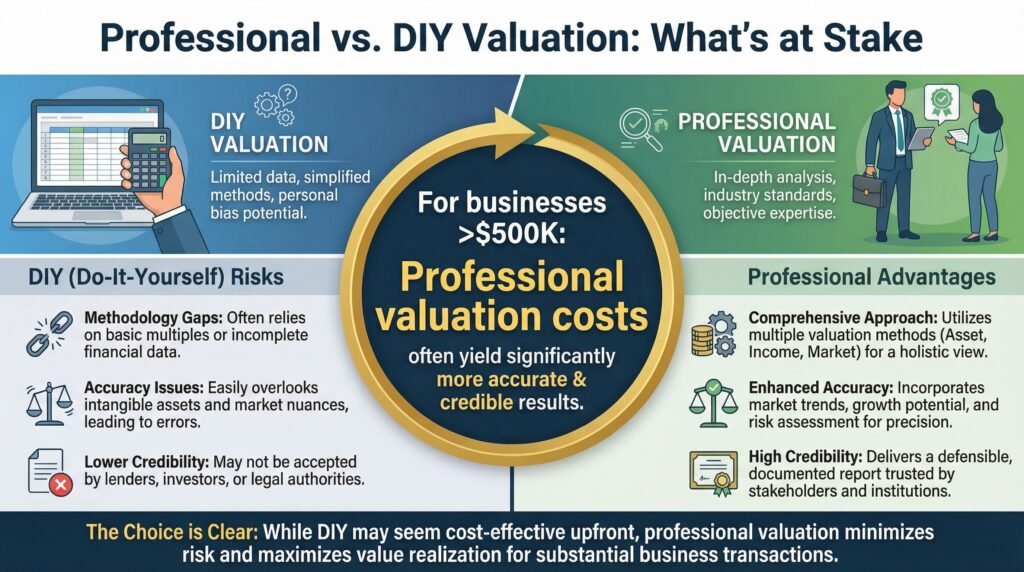
Professional vs. DIY Valuation: What’s at Stake
The gap between professional business valuation and do-it-yourself approaches extends far beyond the immediate price difference.
Professional valuations provide market credibility, negotiation leverage, and specific enhancement recommendations that typically deliver returns many times their cost. They also identify hidden value drivers and risk factors that owners frequently overlook.
For businesses exceeding $500,000 in value, professional valuation typically represents less than 1% of total transaction value while potentially increasing sale price by 10-30%. This investment-return ratio makes professional valuation one of the highest-ROI components of exit planning.
The Limits of Online Calculators and Templates
- Generic industry multipliers fail to capture your specific business strengths
- Template-based approaches miss context-specific value drivers
- Calculators cannot identify strategic buyer opportunities
- Online tools lack integration with current market conditions
- DIY approaches provide limited credibility in negotiations
Online valuation tools serve as useful starting points but consistently fall short in capturing business-specific nuances that significantly impact true market value. These tools typically apply standardized multiples to basic financial inputs without considering qualitative factors, competitive positioning, or strategic opportunities that often drive premium valuations.
The primary limitation of DIY approaches isn’t the methodology but the lack of contextual market knowledge. Professional valuators bring transaction databases, buyer insights, and negotiation experience that owners simply cannot access independently.
This market intelligence often identifies premium buyer categories or strategic positioning opportunities invisible through templated approaches.
When Professional Help Pays for Itself
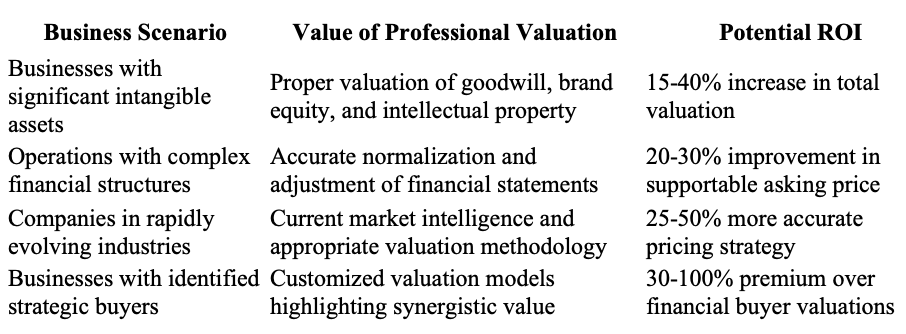
Professional valuation delivers particular value for businesses with complex operations, significant growth potential, or strategic acquisition appeal. In these scenarios, standardized approaches typically undervalue unique business attributes that sophisticated buyers willingly pay premiums to acquire.
The investment in professional analysis becomes especially worthwhile when targeting strategic buyers who may value your operation substantially higher than financial buyers using standard multiples.
How to Use Your Valuation as a Powerful Negotiation Tool
A professional valuation serves as far more than a pricing guide, it becomes your most powerful negotiation asset when properly utilized. The comprehensive analysis provides data-backed responses to buyer objections, highlights value drivers that justify your asking price, and creates a professional foundation that elevates the entire transaction process.
Setting the Anchor Price Strategically
Establish credibility with data-backed valuation ranges
Position the initial asking price to allow negotiation flexibility
Differentiate price justification by buyer category
Document premium value drivers specific to your operation
Create comparison frameworks favorable to your business model
The initial asking price establishes a psychological anchor point that influences the entire negotiation process. Professional valuations help set this anchor at optimal levels, high enough to maximize outcome but credible enough to attract serious interest.
Without proper valuation support, owners often either overshoot sustainability (deterring qualified buyers) or undersell by starting too low (leaving no room for expected negotiation).
Strategic pricing considers not just the numerical value but also the specific buyer profile and transaction structure. For instance, seller financing scenarios typically support higher asking prices than all-cash deals, while strategic buyers might justify premium pricing unavailable from financial purchasers. Professional valuation helps identify these nuances and position your business optimally for target buyer categories.
Most importantly, proper valuation prevents the common mistake of arbitrary discounting during negotiations. When faced with buyer objections, sellers without valuation support often make unnecessary price concessions rather than addressing specific concerns with targeted information.
A comprehensive valuation provides the confidence and supporting data to maintain price integrity throughout the sale process.
Justifying Your Asking Price with Valuation Data
The difference between an unsupported asking price and a valuation-backed position becomes immediately apparent during buyer negotiations.
Professional valuations provide a detailed analysis of how each business component contributes to overall value, creating defensible positions for each aspect of pricing. This granular approach allows targeted responses to specific buyer concerns rather than across-the-board price adjustments.
Effective price justification combines industry benchmarking, financial analysis, and business-specific qualitative factors into a compelling value narrative.
The most successful sellers prepare valuation summaries highlighting key value drivers, competitive advantages, growth opportunities, and risk mitigation factors. This professional preparation demonstrates business sophistication that enhances buyer confidence while supporting optimal pricing.
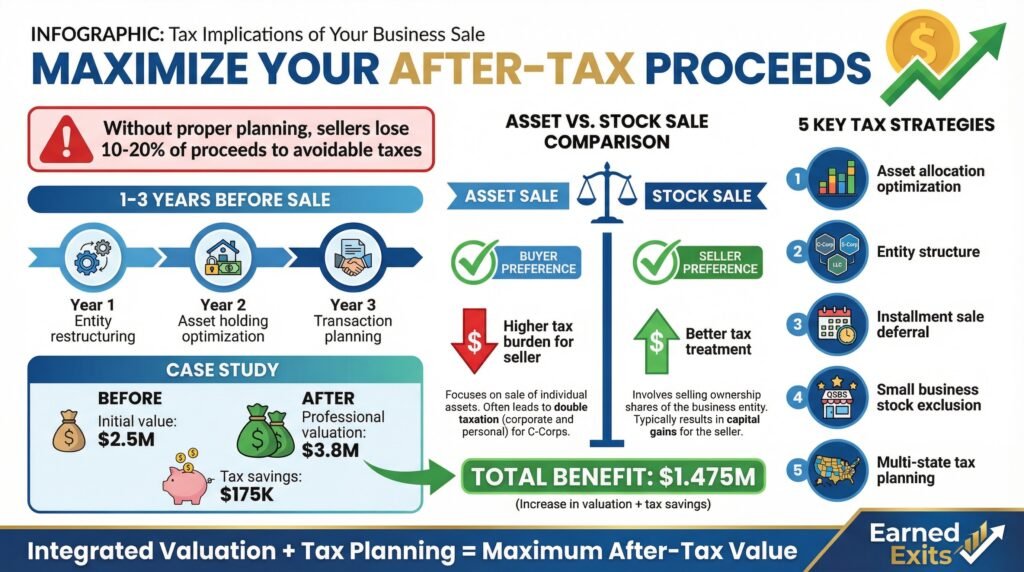
Tax Implications of Your Business Sale
The structure of your business sale significantly impacts your after-tax proceeds, often by hundreds of thousands of dollars. Professional valuation includes allocation analysis that helps optimize tax outcomes while maintaining transaction viability.
Without proper tax planning, sellers frequently lose 10-20% of their proceeds to avoidable tax consequences.
Tax considerations should influence not just transaction structure but also pre-sale preparation, entity selection, and timing decisions.
Effective tax planning begins 1-3 years before sale to implement strategies like entity restructuring, asset holding periods, and installment sale opportunities. These approaches create substantial tax advantages without compromising overall sale value.
- Asset allocation strategies that balance buyer and seller tax priorities
- Entity structure considerations (C-Corp, S-Corp, LLC implications)
- Installment sale opportunities for tax deferral
- Qualified small business stock exclusion possibilities
- State tax considerations for multi-jurisdiction businesses
The most successful exit strategies coordinate valuation, legal structure, and tax planning into an integrated approach that maximizes after-tax proceeds while maintaining transaction appeal for target buyers. This holistic perspective requires specialized expertise but delivers returns that dramatically exceed the professional fees involved.
Asset Sale vs. Stock Sale Considerations
The decision between asset and stock sales represents one of the most consequential tax choices facing business sellers. While buyers typically prefer asset purchases for step-up basis benefits, sellers usually achieve more favorable tax treatment through stock sales.
Professional valuation helps quantify the financial impact of each approach, creating informed negotiation positions that balance competing interests.
Capital Gains Planning Opportunities
Proper transaction structuring often converts ordinary income into more favorable long-term capital gains, creating substantial tax savings. This approach requires careful allocation of sale proceeds across business components, each potentially qualifying for different tax treatment. Professional valuation provides the documented support necessary for these allocations to withstand potential IRS scrutiny.
Beyond basic capital gains strategies, sophisticated tax planning might incorporate installment sales, opportunity zone investments, charitable remainder trusts, or other tax-advantaged approaches. These strategies don’t reduce the business’s market value but significantly increase the seller’s after-tax proceeds through legally compliant tax efficiency structures.
Case Study: Strategic Valuation Impact
A manufacturing business owner initially valued his company at $2.5M using industry rules of thumb. Professional valuation identified proprietary processes, exclusive supplier relationships, and real estate appreciation that justified a $3.8M valuation.
The comprehensive analysis not only increased the selling price but also supported favorable tax allocation that saved an additional $175,000 in taxes. Total benefit: $1.3M in additional sale price plus $175,000 in tax savings.
Earned Exits provides integrated valuation and tax planning guidance that addresses both sale price maximization and after-tax optimization. This comprehensive approach ensures you retain the maximum possible value from your life’s work.
Brokering over $2.1 Billion in transactions across 17 industries, Earned Exits was named a top business broker in 2025 by IWSP. Ready to get started now? Click the link below to contact Earned Exits today to start their free business valuation by filling out a short contact form.

Your Next Steps: Getting Your Free Professional Valuation
Understanding your business’s true market value represents the essential first step in successful exit planning. Earned Exits offers complimentary professional valuations that provide actionable insights into your current market position and specific opportunities for value enhancement. This no-obligation analysis helps clarify your options while establishing realistic expectations for your eventual exit strategy.
Required Financial Documents Checklist
Preparing for your valuation consultation begins with gathering key financial and operational information. The more comprehensive your documentation, the more accurate and valuable your valuation analysis will be. While our process accommodates businesses at various documentation levels, optimal results come from complete information sets.
At minimum, prepare your last three years of financial statements (balance sheets and income statements), recent tax returns, current year-to-date financials, and a basic overview of your operations, customer base, and competitive position. Additional helpful items include sales analyses by product/service line, customer concentration reports, equipment lists, and lease documentation. Our team provides a detailed checklist upon scheduling your consultation.
What to Expect During Your Consultation
Your valuation consultation combines data analysis with contextual business discussion to create a comprehensive market value assessment. The process typically begins with a financial review and industry benchmark comparison, followed by a detailed discussion of your specific business attributes, competitive advantages, and growth opportunities.
This collaborative approach ensures all value drivers receive proper consideration in the final analysis. Click the link below to contact Earned Exits today to start their free business valuation by filling out a short contact form.
Frequently Asked Questions
When should I start the business valuation and exit planning process?
Ideally, begin 18-36 months (or 2–5 years) before your target sale date. Starting early allows time for strategic value enhancements, financial optimization, addressing weaknesses, and timing the market, often resulting in 25-40% (or higher) increases in sale price. Waiting until the last minute severely limits your ability to maximize value.
Why is a professional valuation better than DIY methods or online calculators?
DIY tools and generic multipliers miss your business’s unique strengths, intangible assets (like brand, IP, or proprietary processes), strategic buyer synergies, and current market conditions, frequently leading to 10-30%+ undervaluation. A professional valuation provides credible, data-backed insights, hidden value drivers, tailored recommendations, and strong negotiation leverage, typically delivering ROI many times its cost (often
How does professional valuation help with taxes when selling my business?
It supports optimal tax planning by analyzing asset vs. stock sale structures, allocation of proceeds, capital gains strategies, installment sales, and other tools (e.g., QSBS exclusions). Poor planning can cost sellers 10-20% (or more) in avoidable taxes; coordinated valuation and tax advice maximizes your after-tax proceeds without hurting the deal’s appeal to buyers.
Can a professional valuation really increase my business’s sale price significantly?
Yes, it identifies overlooked value drivers, positions your business for strategic buyers (who often pay 30-100% premiums over financial buyers), and provides defensible data to set an optimal anchor price and resist unnecessary concessions. Example: One manufacturing business jumped from a $2.5M rule-of-thumb estimate to $3.8M via professional valuation, plus $175K in tax savings, a total benefit of over $1.3M.
What does the free professional valuation from Earned Exits involve, and what do I need to prepare?
The complimentary valuation delivers actionable insights into your current market value, strengths/weaknesses, and specific opportunities for value growth, with no obligation. Prepare at minimum: the last 3 years of financial statements (balance sheets & income statements), recent tax returns, current year-to-date financials, plus a basic overview of operations, customers, and competition.
More details (e.g., customer concentration, equipment lists) improve accuracy. The team provides a full checklist when you schedule. Click the link below to start Earned Exits’ free valuation process by filling out their short contact form.

*Disclaimer: This article is written for educational purposes and should not be interpreted as financial advice.
*Disclaimer: This article is written for educational purposes and should not be interpreted as financial advice. We may receive compensation for referrals made through this article.