
Quick Summary
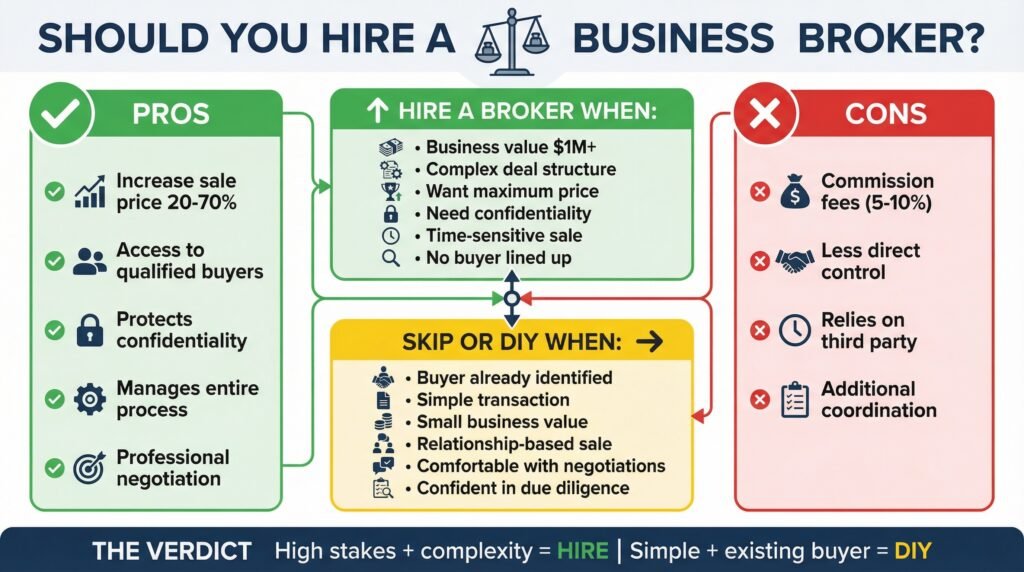
Hiring a business broker makes sense when the deal is complex, high-value, or time-sensitive, but may not be necessary for small, simple, or relationship-based sales. The decision comes down to a tradeoff: higher price and smoother execution vs. paying fees and giving up some control.
- Pros: Brokers can significantly increase sale price, bring qualified buyers, protect confidentiality, and manage the entire process—often improving outcomes by 20–70%.
- Cons: You’ll pay a commission, rely on a third party, and may not need one for smaller or straightforward deals.
- Best time to hire: When your business is valuable ($1M+), the sale is complex, or you want to maximize price and reduce risk.
- Skip or reconsider: If you already have a buyer, the deal is simple, or you’re comfortable handling negotiations and due diligence yourself.
Bottom line:
A broker is usually worth it when stakes are high and complexity increases—otherwise, a DIY sale can work if you know what you’re doing.
Introduction
Hundreds of business owners agonize over this decision. You’ve built something valuable, something that represents years of your life, and now you’re facing one of the biggest financial moves you’ll ever make.
The question of whether to hire a business broker comes down to control, expertise, and honestly, peace of mind.
The stakes here are genuinely high. A bad decision can cost you hundreds of thousands of dollars, either in excessive fees or in leaving money on the table.
The right decision can mean the difference between a smooth, profitable exit and a drawn-out nightmare that damages your business value before you even close.
I’m going to walk you through the realities of working with business brokers, including some uncomfortable truths that most articles gloss over.
What Business Brokers Actually Do
Let me clear up some misconceptions right away. A business broker doesn’t just post your business on a website and wait for calls.
The good ones are part detective, part psychologist, and part financial engineer.
Business brokers act as intermediaries between you and potential buyers. They value your business accurately, identify and qualify potential buyers, manage the sales process from start to finish, and negotiate on your behalf.
The quality of how they do these things varies dramatically. The valuation piece is where things get interesting. A skilled broker doesn’t just plug your numbers into a formula.
They’re analyzing your customer concentration.
If one client represents 40% of your revenue, that’s a massive risk factor that tanks your valuation. They’re looking at your competitive moat, your growth trajectory, the strength of your management team, and dozens of other variables that decide what someone will actually pay.
The buyer network component is where you see the real separation between average brokers and exceptional ones. The best brokers have spent years cultivating relationships with private equity groups, strategic acquirers, family offices, and person investors.
They know who’s actively looking, what industries they’re targeting, and what price ranges they operate in. This information isn’t something you can Google.
This is relationship capital built over decades.
Process management might sound boring, but this is where most DIY sales fall apart. You’re juggling confidentiality agreements, information memorandums, data room preparation, buyer calls, site visits, and letter of intent negotiations.
Meanwhile, you’re trying to run your actual business, which needs to stay healthy or the whole deal craters.
A broker manages all these moving pieces while you keep your company performing.
The Real Benefits of Hiring a Business Broker Nobody Talks About
Everyone knows brokers bring buyer access and negotiation skills. But some less obvious advantages can be absolutely game-changing.
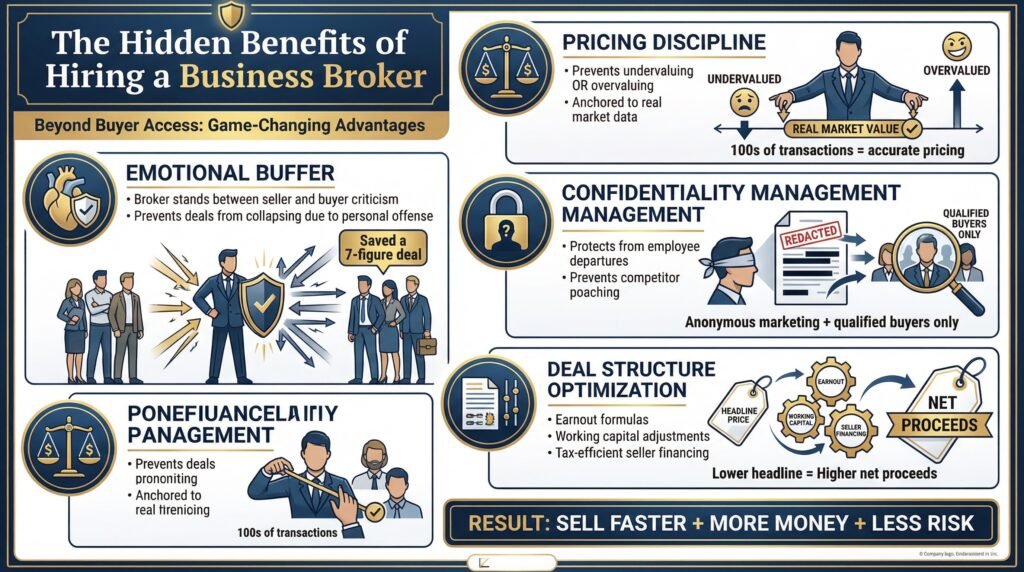
First, there’s the emotional buffer. Selling your business is deeply personal.
You’ve poured your life into this thing, and now someone’s going to pick it apart during due diligence, question your decisions, and try to negotiate down your price.
Having a broker as your intermediary means you’re not taking every criticism personally or making emotional decisions during heated negotiations.
I’ve seen deals almost collapse because a seller got offended by a buyer’s assessment of their business. The broker smoothed things over, reframed the conversation, and saved a seven-figure transaction.
That emotional distance is worth real money.
Brokers bring pricing discipline. Most business owners fall into one of two traps: they either undervalue their business because they don’t understand market multiples, or they massively overvalue it because of emotional attachment.
A broker with real market data keeps you anchored to reality.
They’ve seen dozens or hundreds of transactions in your industry and size range. They know what businesses actually sell for, not what owners wish they’d sell for.
The confidentiality management is another huge benefit that gets overlooked. If your employees find out you’re selling before there’s a signed deal, you risk mass departures. If competitors learn you’re exploring a sale, they might poach your best clients.
Brokers know how to market your business anonymously, use blind profiles, and qualify buyers before revealing identifying information.
They’ve developed systems over the years to maintain secrecy while still reaching qualified prospects.
Deal structure optimization is where experienced brokers really shine. The purchase price is just one variable.
A skilled broker might negotiate a better earnout formula, more favorable working capital adjustments, or seller financing terms that reduce your tax burden.
I’ve seen situations where the headline price was lower, but the actual net proceeds to the seller were higher because of superior deal structuring. Most sellers don’t even know these levers exist, let alone how to pull them effectively.
Bottom line: The benefits of a business broker provide you access to qualified buyers, a smarter pricing strategy, confidential marketing, expert negotiation, emotional support, and full transaction support—ultimately helping you sell faster, for more money, and with less risk.
The Costs of Hiring a Dedicated Business Broker
Let’s talk about what this actually costs, because the numbers matter.
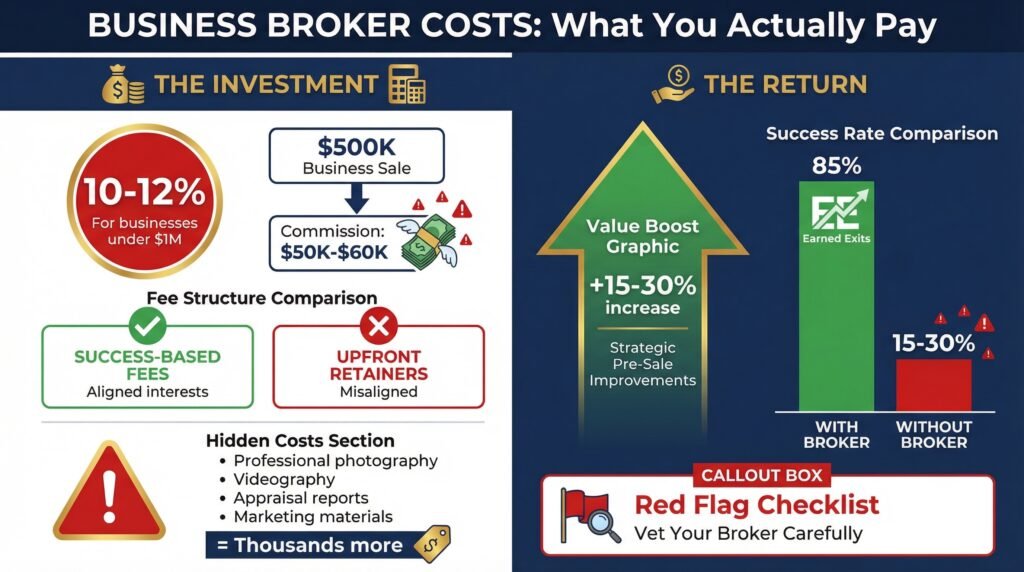
For businesses under $1 million, you’re typically looking at 10-12% commission. On a $500,000 sale, that’s $50,000-$60,000 walking out the door.
For some small business owners, that’s a brutal pill to swallow.
Success-based fees at least align the broker’s interests with yours. Upfront retainers do the opposite. Knowing this, it is important to know the right questions to ask and possible ‘red flags’ that can be spotted when vetting a potential broker for your business.
In contrast, experienced brokers help owners address controllable value detractors before market exposure, often increasing final transaction values by 15-30% through strategic pre-sale improvements. This systematic approach to value optimization represents one of the most significant advantages professional representation provides.
Beyond price considerations, represented transactions close at significantly higher rates, with Earned Exits maintaining a transaction success rate exceeding 85% compared to the estimated 15-30% success rate for unrepresented sellers.
There are also hidden costs that creep in. Your broker might charge separately for professional photography, videography, appraisal reports, or marketing materials. These can add thousands more to your total cost.
Beyond price considerations, represented transactions close at significantly higher rates, with Earned Exits maintaining a transaction success rate exceeding 85% compared to the estimated 15-30% success rate for unrepresented sellers.
When a Broker Makes Complete Sense
Despite these concerns, there are situations where hiring a broker is absolutely the right call.
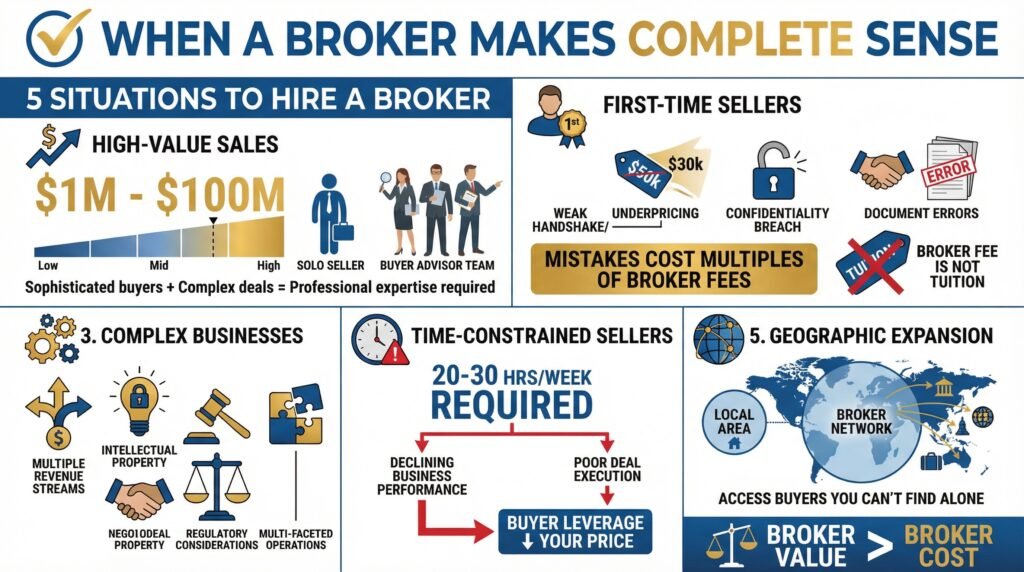
If you’re selling a business valued between $1 million and $100 million, a quality broker or M&A advisor typically adds more value than they cost. The buyer universe at this level is sophisticated, the deal structures are complex, and the negotiation dynamics need professional expertise.
You’re competing against buyers who have teams of advisors.
Going alone puts you at a serious disadvantage.
First-time sellers almost always benefit from broker representation. You don’t know what you don’t know, and the mistakes you can make, underpricing, inadequate confidentiality protection, poor deal structure, weak negotiation, can cost you multiples of the broker’s fee.
Your first business sale shouldn’t be a learning experience.
The tuition is too expensive.
If your business has complex operations, many revenue streams, significant intellectual property, or regulatory considerations, you need someone who’s navigated these issues before. Buyers will have sophisticated advisors.
You should, too.
A complex business creates a complex sale, and complexity creates opportunities for mistakes that cost real money.
Time-constrained sellers should seriously consider broker engagement. If you’re still actively running your business and can’t dedicate 20-30 hours per week to the sales process, something will suffer, either your business performance or your deal execution. Both outcomes are expensive.
A declining business during the sale process gives buyers leverage to renegotiate downward or walk away entirely.
Geographic distance matters too. If you’re trying to find buyers outside your immediate area or internationally, broker networks become invaluable.
You simply don’t have access to those buyer pools independently.
A broker with national or international reach can surface buyers you’d never find on your own.
When You Should Skip the Broker
There are definitely situations where paying broker fees doesn’t make sense.
If you’ve already identified your buyer, maybe a competitor who’s approached you, a key employee who wants to buy you out, or a strategic partner who’s expressed interest, bringing in a broker just adds cost. You might still want a transaction attorney and accountant, but a full-service broker is overkill.
You’re paying for buyer identification and marketing services you don’t need.
For very small businesses under $200,000, the economics often don’t work. A 10% commission on a $150,000 sale is $15,000, which might represent your entire profit margin for a year.
At that scale, direct sales through business-for-sale websites or industry networks make more sense. The value a broker adds often doesn’t justify the cost when the total transaction is small.
Seller Sanity Check – Is Your Business Actually Ready to Sell?
A major contributor to business undervaluations, wasted time, and poor exits is simply a lack of readiness. A broker can only sell what you’ve built.
If your business:
- Depends heavily on you
- Has inconsistent or unclear financials
- Lacks systems or transferable processes
Then even the best broker will struggle to get a premium offer.
Brokers don’t create value. They expose it.
Bottom line: If you are not sure what basic preparation is required before considering a business valuation or selecting a business broker, click the button below to take our free business readiness quiz. The score will give you a clear indication of where you are in the process and the next course of action to take to ensure you start the business sale and exit on the right footing.
Choosing the Right Broker
If you decide to hire a broker, the selection process is critical. Not all brokers are created equal, and a bad broker is worse than no broker.
Start by looking at specialization. Does this broker regularly handle businesses in your industry and size range?
Someone who sells restaurants has very different expertise from someone who sells software companies.
Match your business type to broker experience. A broker who’s never sold a business like yours is essentially learning on your dime.
Ask for recent transaction history. Don’t just accept vague claims.
Request specific examples of businesses they’ve sold in the past 24 months, including sale prices and time to close.
Verify these transactions independently if possible. Some brokers inflate their track records or include deals they barely touched. You want proof of recent, relevant success.
Check references obsessively. Talk to at least three recent clients, and ask pointed questions: How long did the sale take?
Did the broker deliver on promised valuations?
How was communication? Would they use this broker again?
Push past the standard references the broker provides and ask those references for extra contacts.
You want the unvarnished truth, not just the happy customers the broker chooses.
Understand their fee structure completely. Get everything in writing: commission rates, least fees, retainer requirements, what happens if the deal falls through, and whether retainers credit against final commissions.
Ask about their policy if you find your own buyer.
Do they still get full commission? Some brokers have “tail provisions” that entitle them to commission on sales that close within a year after your agreement expires, even if they didn’t facilitate the deal.
Know what you’re signing.
Evaluate their marketing approach. How will they position your business?
What channels will they use?
How do they maintain confidentiality while reaching qualified buyers? Request examples of marketing materials they’ve created for similar businesses.
If their marketing looks generic or unprofessional, that’s how your business will be presented to buyers.
Top-tier brokers like Earned Exits go far beyond basic marketplace listings. They deploy sophisticated, multi-channel campaigns that include:
– Confidential direct outreach to strategic acquirers
– Targeted engagement with private equity groups
– Connections to family offices and high-net-worth investors seeking precise opportunities
The strength of these relationships directly drives better valuations and higher close rates. If you are ready to start the process of finding your broker, see the button below to receive Earned Exits free business valuation. Fill out the short contact form to get started.
Preparing for Maximum Broker Effectiveness
If you hire a broker, you can dramatically improve outcomes through proper preparation. Having a business exit and selling checklist is always helpful.
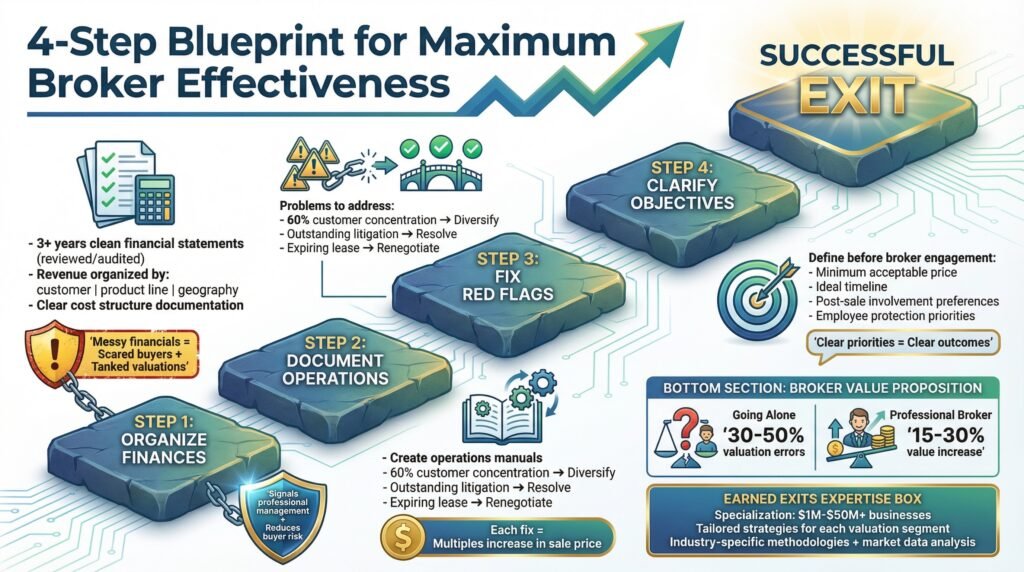
Get your financial house in order first. That means clean financial statements for at least three years, preferably reviewed or audited. Organize revenue by customer, product line, and geography.
Document your cost structure clearly.
The more organized your financials, the faster and more effectively your broker can market your business. Messy financials scare buyers and tank valuations.
Document your operational systems. Buyers want to understand how your business actually runs.
Create operations manuals, document key processes, and organize employee roles and responsibilities.
This due diligence preparation speeds up sales and increases buyer confidence. A well-documented business signals professional management and reduces perceived risk.
Address obvious problems before listing. If you have one customer representing 60% of revenue, try to diversify before going to market.
If you have outstanding litigation, decide it.
If your lease is expiring soon, renegotiate it. These red flags tank valuations and complicate sales.
Every problem you fix before listing increases your final sale price by multiples of what fixing it costs.
Clarify your own objectives before engaging a broker. What’s your least acceptable price?
What’s your ideal timeline?
Do you want to stay involved post-sale? Are there employees you want protected?
The clearer your priorities, the better your broker can represent you. Vague goals lead to vague outcomes.
Once these preliminary tasks are addressed, consider the benefits of a professional business valuation that eventually leads to a higher value discovery and, eventually, a more profitable exit than going it alone.
Experienced brokers help owners address controllable value detractors before market exposure, often increasing final transaction values by 15-30% through strategic pre-sale improvements. This systematic approach to value optimization represents one of the most significant advantages professional representation provides.
While unrepresented owners frequently over-value or under-value their businesses by 30-50%, specialized brokers like Earned Exits utilize industry-specific valuation methodologies that incorporate current market conditions, comparable transaction data, and buyer motivation factors.
Earned Exits has developed particular expertise with businesses valued between $1-50+ million, with specific methodologies tailored to different valuation segments within this range.
Their approach recognizes that a $2 million service business requires different positioning and buyer targeting strategies than a $30 million manufacturing operation, even while applying consistent transactional excellence principles across all engagements.
Read our full review of Earned Exits here and decide whether they are a good match for your specific business.
Final Thoughts: A Broker Isn’t a Cost, They’re a Value Multiplier
Selling a business involves dozens of moving parts, especially during due diligence and closing.
A broker helps manage:
- Buyer communications and timelines
- Document requests and data room organization
- Coordination with attorneys, CPAs, and lenders
- Issue resolution during due diligence
- Keeping momentum through to closing
Without experienced guidance, deals often stall, drag out, or collapse under the weight of complexity.
Why this matters:
A broker keeps the deal on track, reduces stress, and dramatically improves your chances of successfully closing.
Many owners hesitate to hire a broker because of fees. But in most cases, the right broker:
- Increases your sale price
- Improves deal terms
- Reduces risk
- Saves time
- Maximizes the likelihood of closing
In other words, they don’t just help you sell your business—they help you sell it right.
If you are already at the valuation and broker selection stage of the process, click the link below to contact Earned Exits today to start their free business valuation by filling out a short form. Discover how the Earned Exits’ proven 10-step process can help you achieve the maximum value for your business while ensuring a smooth transition to your next chapter.
Key Takeaways
Broker fees typically range from 8-12% for businesses under $1 million and follow the Double Lehman formula for larger deals, representing significant but potentially worthwhile costs.
The broker value proposition includes professional valuation, qualified buyer access, negotiation expertise, confidentiality management, and deal structure optimization that often exceeds commission costs.
First-time sellers, businesses valued between $1-100 million, complex operations, and time-constrained owners benefit most from broker representation.
Businesses with identified buyers, very small operations under $200,000, highly specialized niches, or liquidation scenarios often see better outcomes without traditional brokers.
Proper preparation, clean financials, documented operations, resolved problems, and clear goals dramatically improve broker effectiveness and sales outcomes.
Broker selection matters enormously: verify industry specialization, recent transaction history, references, fee transparency, and marketing approach before signing exclusive agreements.
Deal structure affects net proceeds as much as headline price. Professional advisors improve earnouts, seller financing, working capital adjustments, and tax treatment to maximize your actual take-home value.
Frequently Asked Questions
How much does a business broker cost?
Business brokers typically charge 10-12% commission for businesses under $1 million. For larger businesses, many use the Double Lehman formula: 10% on the first million, 8% on the second, 6% on the third, 4% on the fourth, and 2% above that.
Some brokers also charge upfront retainer fees ranging from $5,000 to $50,000.
Do I need a business broker to sell my business?
You don’t legally need a broker, but one typically adds value for first-time sellers, businesses valued over $1 million, complex operations, and sellers who can’t dedicate 20-30 hours weekly to the process. If you’ve already identified your buyer or you’re selling a very small business under $200,000, you might skip the broker.
How long does it take to sell a business with a broker?
Expect 6-12 months for most small to mid-sized businesses. Complex businesses or those requiring specialized buyers can take 18-24 months.
This includes preparation, marketing, negotiation, due diligence, and closing.
Quick sales usually mean you’ve underpriced your business.
What’s the difference between a business broker and an M&A advisor?
Business brokers typically handle smaller businesses (under $5 million), while M&A advisors work with middle-market companies ($5 million to $500 million). M&A advisors generally have more sophisticated financial expertise and charge higher fees, but the line between the two has blurred in recent years.
Can I negotiate business broker fees?
Yes, especially on larger deals. Everything is negotiable, commission rates, least fees, retainer amounts, and exclusivity periods.
Brokers would rather negotiate fees than lose a good listing.
Get many proposals and use them as leverage.
What happens if my business doesn’t sell?
If you paid a retainer, you typically lose that money. Commission-based fees mean the broker only gets paid on a successful sale.
Check your agreement for specifics on what happens if the deal falls through or if you take the business off the market.
How do I know if a business broker is any good?
Ask for recent transaction history with verified sale prices and timelines. Check references from at least three recent clients.
Verify they have experience in your industry and size range.
Review their marketing materials and approach. Trust your gut, if they overpromise or pressure you, walk away.
What’s an earnout in a business sale?
An earnout ties part of your sale proceeds to future business performance after closing. For example, you might receive $3 million upfront and another $1 million if the business hits certain revenue targets over the next two years.
Earnouts bridge valuation gaps but can create disputes if metrics aren’t precisely defined. Earned Exits specializes in creating meaningful business transitions that protect what matters most. Click the link below to start Earned Exits’ free valuation process by filling out their short contact form.
*Disclaimer: This article is written for educational purposes and should not be interpreted as financial advice.
*Disclaimer: This article is written for educational purposes and should not be interpreted as financial advice. We may receive compensation for referrals made through this article.