
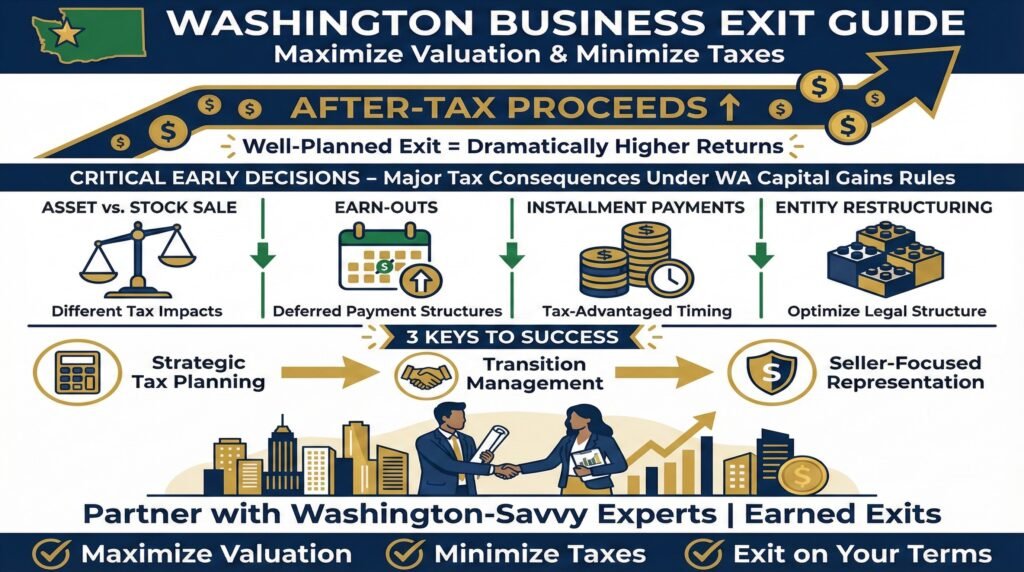
Quick Summary
A well-planned business exit in Washington can dramatically increase your after-tax proceeds, but only if legal, tax, and deal-structure decisions are made early. Choices like asset vs. stock sales, earn-outs, installment payments, and entity restructuring have major tax consequences under Washington’s capital gains rules.
Strategic tax planning, transition management, and seller-focused representation are critical. Working with an experienced, Washington-savvy broker like Earned Exits helps business owners maximize valuation, minimize taxes, and exit on their terms with confidence.
In part 1 of this article series, we discussed the reasons why most Washington business owners exit their business less profitable than they could and why having a professional valuation performed by a top business broker is a must. Now, we will unpack the many legal, financial, and tax ramifications of a properly planned and structured business exit.
Washington-Specific Legal Considerations for Business Sales
Washington’s unique legal landscape creates both opportunities and challenges for business sellers. From specialized tax structures to employment regulations, understanding these Washington-specific considerations is crucial for smooth transactions and maximum value realization. Working with advisors who have specific experience with Washington business sales can help navigate these complexities effectively.
Structuring the Deal to Maximize Your After-Tax Proceeds
The structure of your business sale can significantly impact how much money actually ends up in your pocket after taxes. Washington’s tax environment creates unique considerations that must be carefully navigated to optimize your financial outcome. Making informed decisions about deal structure requires understanding the tax implications of different approaches well before entering negotiations.
Asset Sale vs. Stock Sale: Tax Implications for Washington Sellers
In Washington, the structure of your sale dramatically affects your tax liability. Asset sales, where the buyer purchases individual business assets rather than stock, typically favor buyers because they can reset depreciation schedules and avoid inheriting liabilities. However, for sellers, asset sales often result in higher tax burdens because proceeds may be partially taxed as ordinary income rather than capital gains.
Stock sales, by contrast, generally favor sellers because the entire purchase price is typically taxed at lower capital gains rates. This advantage is particularly significant for Washington C-corporation owners who can avoid double taxation. However, buyers often resist stock sales due to increased liability exposure. Understanding these dynamics allows you to anticipate buyer preferences and build appropriate tax strategies into your negotiations from the beginning.
Negotiating Favorable Terms and Earn-outs
Earn-outs, where a portion of the purchase price is tied to future business performance, bridge valuation gaps but introduce significant tax and financial risks. In Washington’s dynamic economy, earn-outs are increasingly common, particularly in technology and service businesses where future growth potential drives valuation. Structure these agreements with clear, objective performance metrics that you can confidently influence during the transition period.
Beyond earn-outs, consider how payment timing affects your total return. Installment sales can spread tax liability across multiple years, potentially reducing your effective tax rate. However, they increase collection risk and tie up your capital longer. For Washington sellers approaching retirement, balancing immediate liquidity needs with tax optimization becomes particularly important when evaluating payment terms.
Capital Gains Tax Planning Strategies
Tax Planning Case Study: A Tacoma manufacturing business owner saved over $380,000 in taxes by restructuring their business entity two years before sale, establishing residency in a neighboring state, and utilizing a 1031 exchange for the real estate portion of the transaction. This comprehensive approach reduced their effective tax rate from 29% to under 15% on a $4.2 million transaction.
Washington’s capital gains tax environment creates unique planning opportunities. The 7% Washington state capital gains tax applies to gains exceeding $250,000, but important exemptions exist for qualifying family-owned businesses with revenues under $10 million. Determining if your business qualifies for these exemptions should be a priority in your tax planning process.
Consider entity restructuring well before a sale (typically 2+ years) to optimize tax treatment. Converting from a C-corporation to an S-corporation, creating management companies, or establishing trusts can create significant tax advantages when properly executed and maintained for appropriate time periods. These strategies require advance planning and should be implemented only with professional guidance specific to Washington’s regulatory environment.
Opportunity Zone investments represent another potential strategy for Washington sellers. By reinvesting capital gains into Qualified Opportunity Zone Funds within 180 days of your business sale, you may defer and potentially reduce capital gains taxes. Several designated Opportunity Zones exist throughout Washington, offering both tax advantages and the potential to support community development while deploying your proceeds.
The Smart Way to Handle the Transition After the Sale
A smooth transition is crucial for ensuring the business continues to thrive under new ownership, which is especially important if your deal includes earn-out provisions or seller financing. Start by developing a detailed transition plan that outlines your role, key knowledge transfer milestones, and a timeline for gradually reducing your involvement.
Most Washington business sales include transition periods ranging from 30 days to two years, depending on the business complexity and the owner’s centrality to operations.
Focus on transferring relationships with key customers, suppliers, and employees during the transition period. Making personal introductions, explaining the vision behind the sale, and expressing confidence in the new ownership helps preserve the business’s value and reputation.
Washington’s business community values relationships, and handling this aspect of the transition with care protects both your legacy and your financial interests in the business’s continued success.
Choosing a Top-Rated Business Broker for Your Exit
Independent analysts and industry watchdogs have consistently highlighted Earned Exits as a leading business brokerage firm in 2025. These distinctions are grounded in measurable performance indicators, including superior close rates, high client satisfaction, accurate valuations, and negotiation results that outperform industry benchmarks. The data reinforces a reality many business owners discover during the sale process: the broker you choose directly impacts the outcome.
At the core of Earned Exits’ advantage is its firm’s seller-centric approach. Earned Exits protects and advances the seller’s interests at every stage of the transaction. This focused alignment eliminates conflicts and produces consistently stronger results.
The firm employs a disciplined, repeatable sales framework that integrates detailed valuation work, strategic business preparation, confidential buyer outreach, and high-level negotiation execution. By pairing sector-specific expertise with transactional precision, Earned Exits has built a proven system designed to optimize sale value while supporting successful ownership transitions.
Clients are onboarded through a rigorous process that includes operational analysis, financial normalization, and market positioning. This foundation has repeatedly driven premium exit valuations and helped Earned Exits achieve client satisfaction levels exceeding 97%, positioning the firm among the most trusted and respected advisors in the business brokerage industry.
Earned Exits focuses on brokering company sales with $1 – $40Million in revenue. Discover how the Earned Exits’ proven 10-step process can help you achieve the maximum value for your business while ensuring a smooth transition to your next chapter. Click the link below to contact Earned Exits today to start their free business valuation by filling out a short form.


Seller Sanity Check – Is Your Business Ready to Sell?
A major contributor to business undervaluations, wasted time, and poor exits is simply a lack of readiness. A broker can only sell what you’ve built.
If your business:
- Depends heavily on you
- Has inconsistent or unclear financials
- Lacks systems or transferable processes
Then even the best broker will struggle to get a premium offer. Brokers don’t create value. They expose it.
Bottom line: If you are not sure what basic preparation is required before considering a business valuation or selecting a business broker, click the button below to take our free business readiness quiz. The score will give you a clear indication of where you are in the process and the next course of action to take to ensure you start the business sale and exit on the right footing.
Frequently Asked Questions
The business sale process generates many questions for Washington owners approaching this significant transition. Below are answers to the most common concerns based on actual transactions throughout the state. While these provide general guidance, remember that your specific situation may require personalized advice from qualified professionals.
These questions represent the starting point for many Washington business owners as they begin considering a sale. Working with advisors who understand both the emotional and financial aspects of business transitions will help you navigate this complex process successfully.
How do I determine if my business qualifies for a Washington state capital gains tax exemption?
Washington offers a qualified family-owned business exemption that can exclude up to $10 million from the state’s 7% capital gains tax. To qualify, your business must have had worldwide gross revenue of $10 million or less in the 12 months immediately preceding the sale. Additionally, you must have owned the business for at least five years, and 50% or more of your personal service and management time must have been devoted to the business during that period.
The exemption also requires that you (and your family members) owned at least 90% of the business for at least five years before the sale. This provision particularly impacts businesses with outside investors or complex ownership structures. Detailed financial records demonstrating revenue levels and consistent ownership are essential for claiming this exemption.
Because this tax went into effect relatively recently (2022) and has faced legal challenges, work with a Washington tax professional who stays current on the latest developments and interpretations. Proper documentation and advance planning are essential for successfully claiming this valuable exemption, which could save you hundreds of thousands of dollars on a business sale.
Should I tell my employees that I’m planning to sell the business?
Employee communication requires careful timing and messaging. Premature disclosure can trigger uncertainty, productivity drops, and even departures of key staff. Most successful Washington business sales maintain confidentiality until a definitive purchase agreement is signed, using non-disclosure agreements with all parties involved in the transaction process.
When it is time to inform employees, develop a clear communication strategy that addresses their primary concerns: job security, potential changes to benefits or working conditions, and the company’s future direction. Washington’s strong employee protection laws make this communication particularly important, as uninformed employee may react negatively if they feel their interests haven’t been considered in the transition.
-Focus on the positive aspects of the transition and growth opportunities under new ownership
-Provide specific information about how the change will or won’t affect daily operations
-Consider retention incentives for key employees whose continued engagement is critical
-Be prepared to address concerns about Washington’s specific employment regulations and protections
-Create a communication timeline that ensures employees hear news directly rather than through rumors
The right approach to employee communication can significantly impact both the transaction process and the business’s post-sale performance. Buyers place high value on stable workforces, making employee retention a critical factor in successful transitions. This becomes even more important when deal structures include earn-outs or seller financing that tie your financial outcome to the business’s continued success.
Preparing your Washington business for sale is a complex but rewarding process that requires careful planning, documentation, and strategic decision-making. By addressing the key areas outlined in this guide, you’ll significantly increase your business’s value and attractiveness to qualified buyers. Remember that each business is unique, and working with advisors who understand Washington’s specific business environment will help you navigate this important transition successfully.
Brokering over $2.1 Billion in transactions across 17 industries, Earned Exits was named a top business broker in 2025 by IWSP.
Earned Exits specializes in creating meaningful business transitions that protect what matters most. Click the link below to start Earned Exits’ free valuation process by filling out their short contact form.
*Disclaimer: This article is written for educational purposes and should not be interpreted as financial advice.
*Disclaimer: This article is written for educational purposes and should not be interpreted as financial advice. We may receive compensation for referrals made through this article.