
Quick Summary
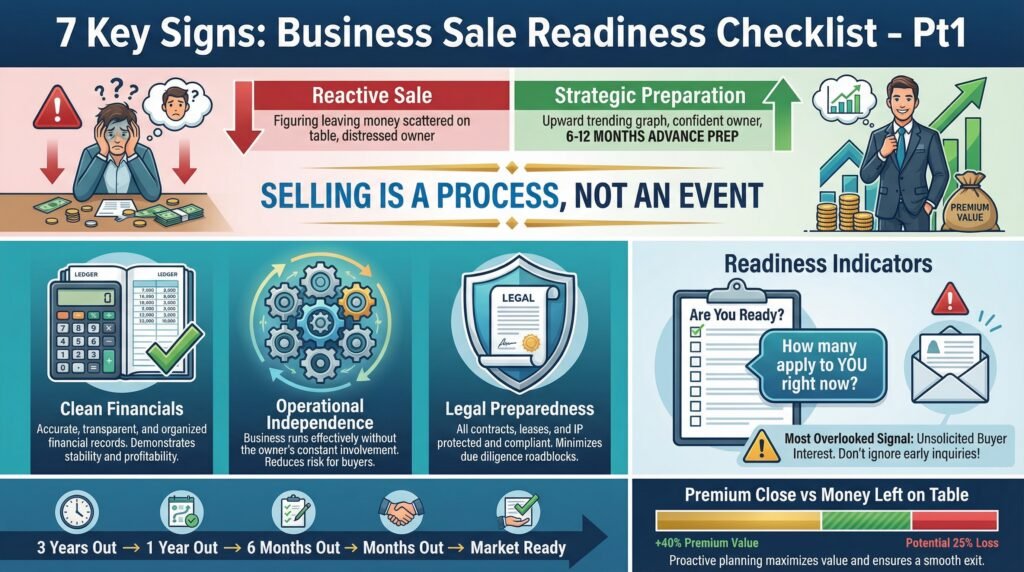
- Most business owners leave significant money on the table by selling reactively instead of strategically preparing 6 to 12 months in advance.
- A business sale readiness checklist helps you identify exactly where you stand and what needs to change before you go to market.
- There are 7 concrete signs your business is ready to sell, and knowing how many apply to you right now changes everything about your next move.
- Clean financials, operational independence, and legal preparedness are the three factors that most directly impact the multiple you receive.
- One of the most overlooked readiness signals is receiving unsolicited buyer interest,and most owners mishandle it completely.
Selling a business is not an event; it is a process, and the owners who treat it that way walk away with significantly better outcomes than those who don’t.
Every week, business owners decide to sell. Some have been thinking about it for years. Others are pushed by burnout, a health event, or an unexpected offer that lands in their inbox. What separates the ones who close at a premium from the ones who leave money on the table, or worse, walk away from a failed deal, is preparation. Knowing the signs that your business is ready to sell, and acting on them deliberately, is the foundation of a successful exit.
This is where a structured business sale readiness checklist becomes more than just a document. It becomes your roadmap. Whether you are 6 months out or 3 years away from a sale, understanding where you stand today gives you the power to shape the outcome.
Most Business Owners Wait Too Long to Sell
The instinct to hold on is understandable. You built this business. You know its potential. And there is always a reason to wait, one more strong quarter, one more key hire, one more expansion. But waiting for perfect conditions is one of the most expensive mistakes a business owner can make.
The reality is that the best time to sell is when your business is performing well, and you are still energized enough to present it credibly to buyers. Selling from a position of strength gives you negotiating power. Selling from exhaustion, declining revenue, or desperation does the opposite.
The Gap Between Wanting to Sell and Being Ready to Sell
Wanting to sell and being ready to sell are two entirely different things. Most owners know when they want to exit. Very few have objectively assessed whether their business is positioned to attract the right buyer at the right price. That gap, between desire and readiness, is exactly where value is created or destroyed.
A business sale readiness checklist bridges that gap. It forces you to look at your business the way a buyer will: through financials, operations, customer concentration, legal exposure, and market positioning. What you find in that process determines your strategy.
Why Preparation Determines What You Actually Receive
Businesses that go to market prepared consistently outperform those that don’t. Sellers who invest 6 to 12 months in pre-sale preparation, cleaning up financials, reducing owner dependency, resolving legal issues, achieve better terms, faster closings, and higher multiples than those who sell reactively. This is not a theory. It is the pattern that plays out across deal after deal.
Preparation also compresses the timeline. A typical sale process runs 6 to 12 months from the moment you engage a broker or advisor to the closing table. That includes 3 to 6 months to find and qualify buyers and negotiate a letter of intent, followed by 2 to 4 months of due diligence through closing. When your business is prepared before that clock starts, you eliminate the delays that kill deals and erode buyer confidence.
Sign 1: Your Financials Tell a Clear, Consistent Story
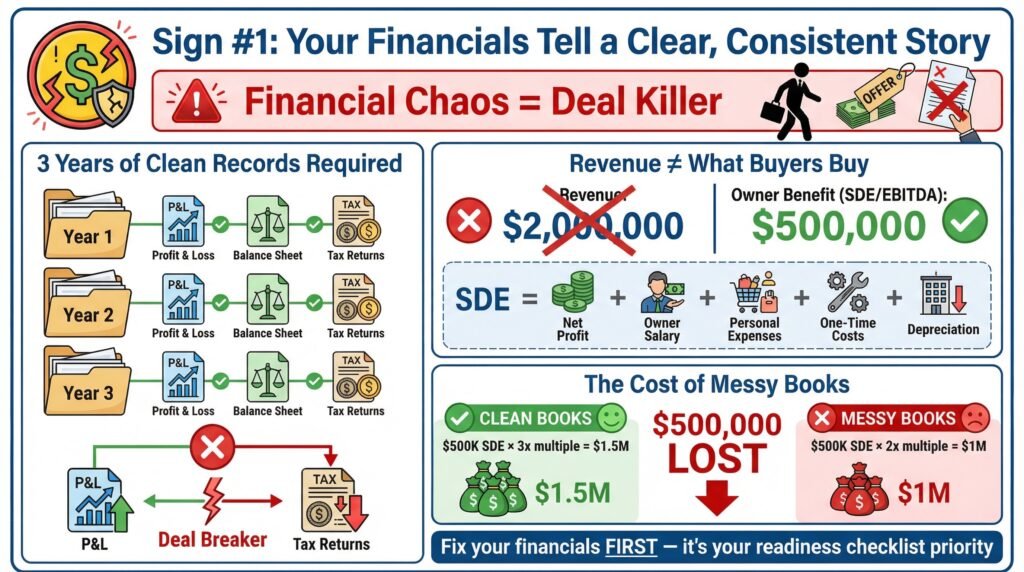
Nothing kills a deal faster than financial chaos. If a buyer or their advisors cannot quickly understand how your business makes money, what it costs to run, and what the true owner benefit is, they will either walk away or discount their offer significantly to account for the perceived risk.
Three Years of Clean, Documented Financial Records
Buyers want to see at least three years of financial statements, profit and loss statements, balance sheets, and tax returns. These documents need to tell a consistent, coherent story. Discrepancies between your tax returns and your internal P&L are among the most common reasons deals fall apart during due diligence. Getting these reconciled before you go to market is non-negotiable.
Clean books also signal to buyers that your business is professionally managed. It builds trust before a single conversation about price takes place. If your financials are not in order today, that is not a reason to delay selling; it is the first item on your readiness checklist to fix.
The Difference Between Revenue and Owner Benefit
Revenue is not what buyers are buying. They are buying cash flow, specifically, the Seller’s Discretionary Earnings (SDE) or EBITDA, depending on the size of your business. SDE adds back the owner’s salary, personal expenses run through the business, one-time costs, and non-cash expenses like depreciation to show the true economic benefit of ownership. If you cannot clearly articulate and document this number, you are leaving value on the table before negotiations even begin.
Why Buyers Discount Businesses With Messy Books
When financials are unclear, buyers do not give you the benefit of the doubt; they price in the uncertainty. That uncertainty discount can cost you a full turn or more on your multiple. A business generating $500,000 in SDE valued at a 3x multiple is worth $1.5 million. The same business with unclear financials might only command a 2x multiple, costing you $500,000 at the closing table, for a problem that could have been fixed months earlier.
Sign 2: Your Business Runs Without You
If your business stops when you do, you do not have a business; you have a job. And jobs are significantly harder to sell than businesses. Buyer confidence is directly tied to whether the operation can continue and grow after you hand over the keys.
Operational independence is one of the most powerful value drivers in any business sale. It tells the buyer that they are acquiring a system, not a dependency. And it dramatically expands your buyer pool, because both strategic acquirers and financial buyers like private equity groups require businesses that can operate without the founder present.
How Operational Independence Affects Valuation
A business where the owner handles key client relationships, makes most operational decisions, and holds critical vendor or supplier relationships is considered high-risk by buyers. That risk gets priced into the multiple. Conversely, a business with documented processes, capable management, and distributed client relationships commands a premium because the transition risk is low.
The Role of Systems, Processes, and Key Staff
Operational independence is built through three things: documented systems, repeatable processes, and a team that does not need you to function. Standard operating procedures (SOPs) for your most critical functions, a management layer that can handle day-to-day decisions, and cross-trained staff who hold key client and vendor relationships all directly reduce buyer risk and increase what they are willing to pay.
If your business relies entirely on you right now, you are not disqualified from selling. You are simply not ready yet. The good news is that most owner-dependency issues can be meaningfully reduced in 6 to 12 months with deliberate effort.
Sign 3: Growth Has Plateaued, or You’ve Hit Your Ceiling
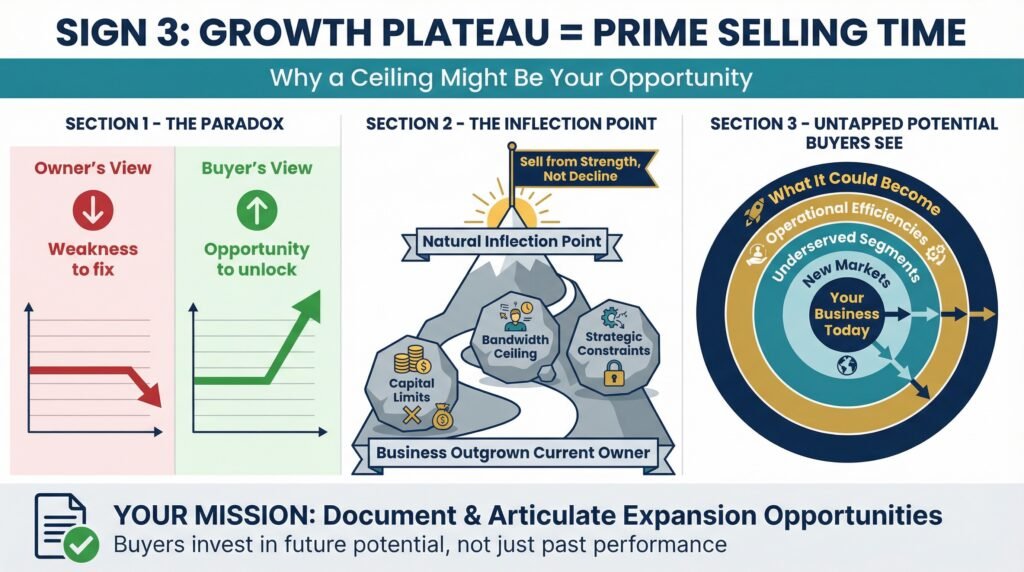
Counterintuitively, a plateau can be one of the best times to sell. Many owners interpret stalled growth as a weakness, something to fix before going to market. But sophisticated buyers often see a plateau as an opportunity, especially when the fundamentals of the business are strong.
When Plateauing Is a Signal, Not a Failure
A plateau often signals that the business has outgrown what its current owner can provide, whether in terms of capital, bandwidth, or strategic direction. That is not a failure. That is a natural inflection point. And it is exactly the moment when a new owner, with fresh resources and a different network, can unlock the next phase of growth.
Recognizing this moment honestly, rather than pushing through diminishing returns, is a mark of strategic thinking. It is also what positions you to sell from strength rather than decline.
How Buyers See Untapped Growth Potential
Buyers, particularly strategic acquirers, are not just buying what your business is today. They are buying what it could become under their ownership. A business at a growth plateau with clear, documented expansion opportunities, new markets, underserved customer segments, and operational efficiencies is an attractive acquisition target. Your job is to articulate that upside clearly in your offering materials, not just demonstrate past performance.
Sign 4: You Are Experiencing Burnout or Loss of Drive
Burnout is one of the most honest signals a business owner can receive. When the energy that built your business starts to fade, it affects more than your personal well-being; it begins to show up in decision-making, team morale, customer relationships, and ultimately, your numbers.
The critical mistake owners make is waiting until burnout becomes visible in the financials before deciding to sell. By that point, the story the business tells to buyers has already changed, and not in your favor. Recognizing burnout as a readiness signal, not a personal failing, allows you to exit while the business is still performing at its best. That timing is worth far more than one more year of grinding through it.
Business Seller Check-In
Whether you are planning to sell your business solo or utilize the experience and leveraging skills of a broker, pause and review the discussed points, and you have done the basic preparation needed to place your business on the market.
A major contributor to business undervaluations, wasted time, and poor exits is simply a lack of readiness. A broker can only sell what you’ve built.
If your business:
- Depends heavily on you
- Has inconsistent or unclear financials
- Lacks systems or transferable processes
Then even the best broker will struggle to get a premium offer. Brokers don’t create value. They expose it.
Bottom line: If you are not sure what basic preparation is required before considering a business valuation or selecting a business broker, click the link below to take our free business readiness quiz. The score will give you a clear indication of where you are in the process and the next course of action to take to ensure you start the business sale and exit on the right footing.
If you have read enough and know your business has passed the preparation criteria to go to market, read our review of Earned Exits here.
If you have decided that Earned Exits is a good fit and your business size is $1M-$40M+, click the link below to contact Earned Exits today to start their free business valuation by filling out a short form.

In part 2 of this series, we will discuss the remaining three key signs that your business is ready to sell. Follow our blog to remain updated on new articles and strategies in this ever-evolving market.
Frequently Asked Questions
Business sale readiness is one of those topics where the questions owners ask most frequently reveal exactly where the knowledge gaps are. The following answers are designed to give you clear, actionable information, not vague generalities.
What Is a Business Sale Readiness Checklist?
A business sale readiness checklist is a structured self-assessment tool that evaluates how prepared your business is to go to market and attract qualified buyers at a premium valuation. It covers the key dimensions buyers examine during their evaluation and due diligence process, financial performance and documentation, operational independence, legal and compliance standing, customer and revenue concentration, leadership depth, and market positioning.
Think of it as the view from the buyer’s seat. A well-constructed checklist does not just tell you whether you are ready. It tells you specifically where your gaps are and what work needs to happen before you list your business for sale. Used correctly, a business sale readiness checklist becomes the foundation of your entire pre-sale preparation strategy.
How Long Does It Take to Prepare a Business for Sale?
For most businesses, meaningful pre-sale preparation takes 6 to 12 months when started proactively. That window allows time to clean up financial records, reduce owner dependency, resolve legal and compliance gaps, obtain a professional valuation, and engage the right advisors. Businesses that attempt to compress this timeline, or skip preparation entirely, consistently experience longer time-on-market, lower offers, and higher deal failure rates. If you are 2 to 3 years from your intended exit, starting preparation now is not premature. It is the most strategic move you can make.
What Financial Documents Do Buyers Typically Request?
Buyers will request three years of profit and loss statements, balance sheets, and business tax returns as a baseline. Beyond that, expect requests for accounts receivable and payable aging reports, a detailed breakdown of owner compensation and personal expenses run through the business, any existing debt schedules, and month-by-month revenue reports for the trailing 12 months.
Larger transactions may also require a formal Quality of Earnings (QoE) report prepared by a third-party accounting firm, which validates your stated EBITDA and identifies any adjustments. Having these documents organized, reconciled, and ready before you go to market is one of the highest-leverage preparation steps you can take.
Do buyers prefer businesses listed with a broker?
Serious, sophisticated buyers often do prefer broker-represented listings, though not because of the broker’s presence itself. What they’re actually responding to is what broker representation signals: organized financials, a vetted asking price, professional documentation, and a transaction process that is more likely to close smoothly. These buyers have often been through failed deals with unrepresented sellers and have learned to see independent listings as higher-risk opportunities.
That said, individual buyers, first-time entrepreneurs, employees buying the business they work in, or local competitors acquiring a neighbor, are less likely to filter by broker representation. They’re looking for the right opportunity, and if your listing is well-presented with clean financials and a reasonable price, broker representation becomes less of a deciding factor. The type of buyer you’re targeting should influence how heavily you weigh this consideration.
Earned Exits is a business broker that has developed particular expertise with businesses valued between $1-50+ million, with specific methodologies tailored to different valuation segments within this range.
Their approach recognizes that a $2 million service business requires different positioning and buyer targeting strategies than a $30 million manufacturing operation, even while applying consistent transactional excellence principles across all engagements.
Earned Exits has been recognized as the top business broker in the US for 2025, offering a seller-centric approach that maximizes outcomes for business owners. Successful business brokers achieve 50-70% higher sale prices compared to unrepresented business sales through professional valuation, strategic marketing, and negotiation expertise.
Read our full review of Earned Exits here and decide whether they are a good match for your specific business. If you believe you and your business are ready, get started today. Click the link below to contact Earned Exits today to start their free business valuation by filling out a short contact form.
*Disclaimer: This article is written for educational purposes and should not be interpreted as financial advice.
*Disclaimer: This article is written for educational purposes and should not be interpreted as financial advice. We may receive compensation for referrals made through this article.