
Quick Summary
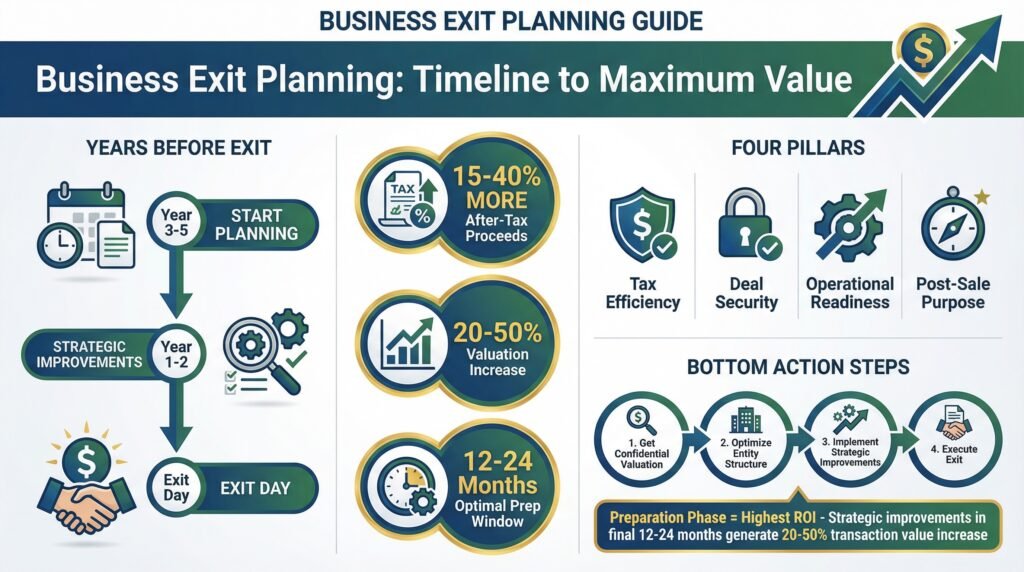
A successful business exit starts years before a sale. Strategic tax planning alone can preserve 15–40% more after-tax proceeds, but it requires early action around entity structure, deal timing, and payment strategy.
Owners who plan 3–5 years ahead can optimize capital gains treatment, reduce risk, increase valuation by 20–50%, and transition smoothly into life after exit, financially and personally. The most successful exits balance tax efficiency, deal security, operational readiness, and post-sale purpose.
Tax Strategies That Save Millions When Selling Your Business
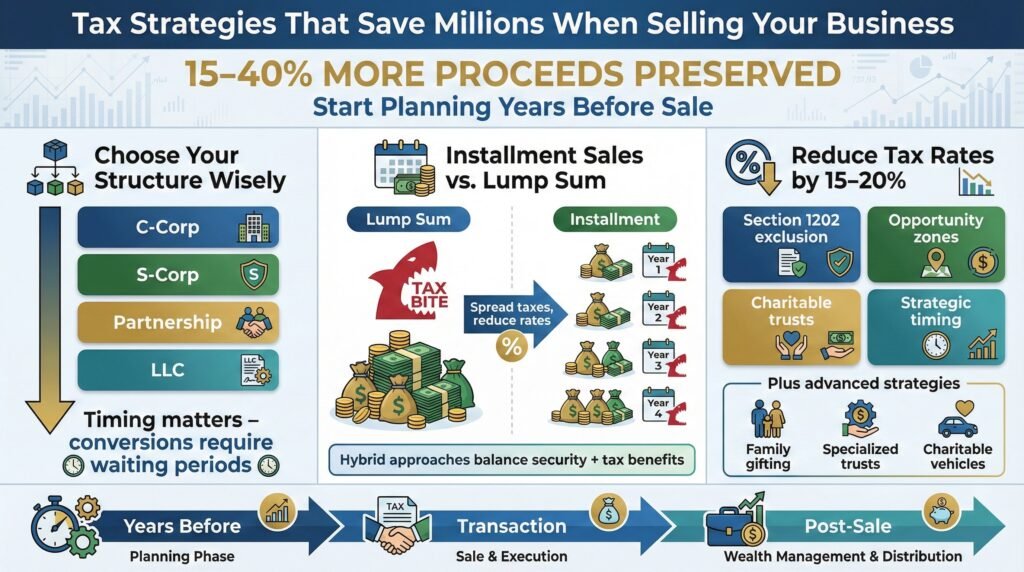
Tax planning is one of the highest-return elements of exit preparation, often preserving 15-40% more proceeds than unprepared transitions. Effective tax strategies address both transaction structure and post-sale wealth management to optimize after-tax proceeds. The biggest planning opportunities typically emerge years before actual transactions occur.
Entity Structure Considerations for Maximum After-Tax Proceeds
Your business entity structure significantly impacts available tax strategies and potential liabilities upon exit. C-corporations, S-corporations, partnerships, and LLCs each present different tax implications that can dramatically affect net proceeds. Entity restructuring before sale often yields substantial benefits, though timing requirements make early assessment critical.
Conversion between entity types typically requires specific waiting periods and may trigger immediate tax consequences that must be weighed against future benefits. These complex tradeoffs require sophisticated modeling across multiple potential transaction scenarios. The analysis should consider both initial sale proceeds and ongoing tax obligations from earnouts or seller financing.
Installment Sales vs. Lump Sum: Timing Your Tax Hit
The payment structure of your transaction significantly impacts total tax obligations. Installment sales allow tax payments to spread across multiple years, potentially reducing effective rates through income smoothing. This approach works particularly well when you expect future tax rate changes or have opportunities to offset gains with strategic losses in subsequent years.
While installment arrangements offer tax advantages, they also introduce collection risk and opportunity cost considerations that must be carefully evaluated. The optimal approach balances tax efficiency against the financial security of immediate proceeds. Many sellers find that hybrid structures that combine substantial upfront payments with tax-advantaged deferred components provide the best overall outcome.
Capital Gains Optimization Techniques
Strategic planning can help convert ordinary income into more favorable capital gains treatment, potentially reducing tax rates by 15-20%. These techniques include qualifying for Section 1202 small business stock exclusions, opportunity zone reinvestment, charitable remainder trusts, and strategic timing of transaction closing dates. Each approach has specific qualification requirements that must be addressed well before transaction execution.
The most effective tax planning integrates personal and business strategies into a comprehensive approach. This often includes pre-transaction gifting to family members, establishing specialized trusts, and creating charitable vehicles that provide both tax benefits and philanthropic impact. These sophisticated strategies require coordination across your advisory team to ensure all technical requirements are satisfied.
Timeline: Creating Your 5-Year Exit Runway
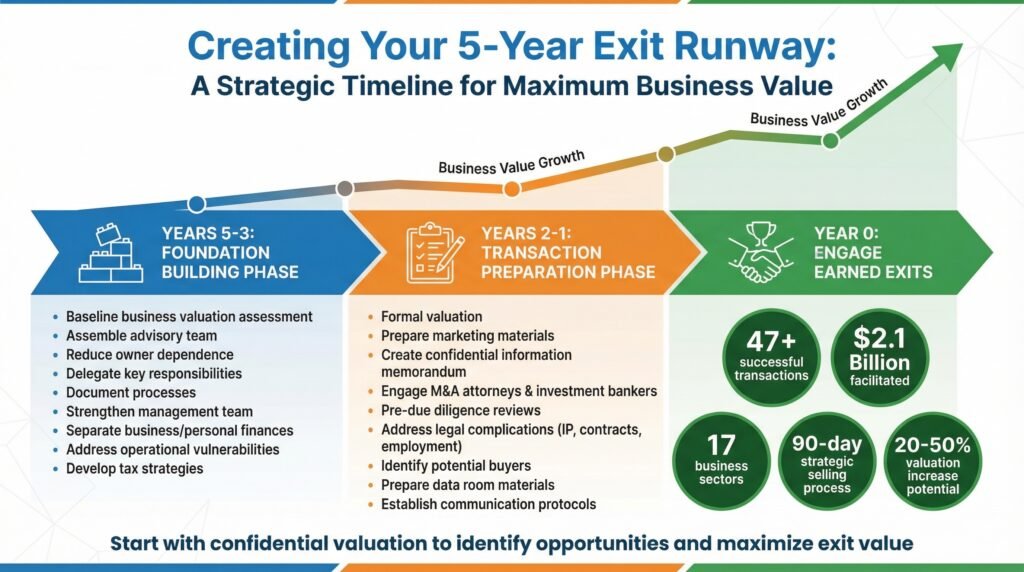
A structured exit timeline provides the framework for systematically increasing business value while preparing personally and financially for transition. While compressed timelines can accommodate urgent situations, the most successful exits allocate sufficient time for strategic enhancement before entering the market.
Years 5-3: Foundation Building Phase
The early preparation phase focuses on building fundamental business strength while clarifying personal objectives. Begin by conducting baseline assessments of business value, identifying enhancement opportunities, and establishing clear financial targets for your exit. This phase typically includes assembling your core advisory team, developing preliminary tax strategies, and addressing major operational vulnerabilities.
Use this period to systematically reduce owner dependence by delegating key responsibilities, documenting essential processes, and strengthening your management team. Implement financial reporting improvements that will eventually support buyer due diligence, particularly clear separation between business and personal expenses. These foundational improvements compound over time, creating significantly higher valuations when you eventually enter the market.
Year 1: Transaction Preparation Phase
The transaction preparation phase intensifies focus on specific buyer readiness activities. This period typically includes formal valuation, preparation of marketing materials, development of confidential information memorandums, and preliminary identification of potential buyers. Engage transaction-specific advisors, including investment bankers and M&A attorneys, who will guide the formal sale process.
Complete pre-due diligence reviews to identify potential deal obstacles before buyers discover them. Address legal complications, including contract assignments, intellectual property documentation, environmental issues, and employment agreements. Prepare management presentations and data room materials that highlight your value drivers while proactively addressing potential buyer concerns.
Establish clear transaction timelines, communication protocols for employees and customers, and contingency plans for various negotiation scenarios. These preparations help maintain operational stability during what often becomes an emotionally and logistically challenging process.
The Beginning: Initial Valuation Process with an Experienced Business Broker
Earned Exits has facilitated over 47 successful business transactions worth $2.1 Billion, demonstrating how specialized industry knowledge translates to exceptional results.
While many brokers operate as generalists, Earned Exits has developed specialized expertise across 17 distinct business sectors, including manufacturing, distribution, professional services, technology, and specialty contracting.
This industry-specific knowledge allows them to understand the unique value drivers, customer dynamics, and operational considerations that influence buyer perceptions within each sector.
While many brokers employ ad-hoc transaction approaches, Earned Exits has developed a systematic 90-day strategic selling process that maximizes transaction success rates while minimizing disruption to ongoing business operations.
This proprietary methodology includes comprehensive preparation phases, strategic buyer targeting, staged information disclosure, and structured negotiation approaches that maintain transaction momentum through inevitable challenges.
Starting with a confidential valuation from a reputable firm like Earned Exits provides a baseline understanding of current market value while identifying specific opportunities to increase the valuation before sale.
This preparation phase frequently generates the highest return on investment in the entire exit process, with strategic improvements often increasing final transaction values by 20-50% when implemented 12-24 months before planned exits. Click the link button if you’re ready to get started right now with Earned Exits free business valuation by filling out a short form.

Life After Exit: Preparing for Your Next Chapter
The emotional and psychological dimensions of business exits often prove more challenging than the financial aspects. Successful transitions require thoughtful preparation for life beyond business ownership, including purpose redefinition, relationship adjustments, and activity restructuring.
Identity Transition: From Business Owner to What’s Next
Many entrepreneurs experience significant identity disruption when separating from businesses that have defined their professional lives and social connections. Proactive planning helps create meaningful post-exit identities through exploration of latent interests, philanthropic engagements, or new business ventures. This preparation ideally begins 1-2 years before actual exit to establish foundations for your next chapter.
Start by examining how you currently allocate time and which activities generate the most satisfaction. Distinguish between aspects of business ownership you’ll genuinely miss versus responsibilities you’re eager to relinquish. Experiment with potential post-exit activities through small-scale engagements before fully committing to new directions.
The most successful transitions typically maintain some elements of what made business ownership rewarding while eliminating sources of stress and obligation. Many entrepreneurs find that advisory roles, board positions, or mentoring relationships provide continued purpose without daily operational demands.
Owner Insight: “I spent 30 years defining myself as the company founder. When I sold, I suddenly realized I hadn’t developed an identity beyond the business. I wish I’d started building interests and relationships outside work much earlier. The financial transition went perfectly, but I wasn’t prepared for who I’d be afterward.”
Wealth Management Considerations Post-Sale
Converting business proceeds into a sustainable lifetime income requires different financial strategies than building a company. Work with wealth management professionals to develop investment approaches aligned with your risk tolerance, income needs, and wealth transfer objectives. This transition typically involves shifting from concentrated business risk to diversified investment portfolios designed for preservation and controlled growth.
Understand all the ramifications of a proper business exit plan by utilizing the proven expertise of Earned Exits. Ranked a top business broker in 2025, Earned Exits has facilitated over 47 successful business transactions worth $2.1 Billion, demonstrating how specialized industry knowledge translates to exceptional results. Get started today with Earned Exits free business valuation by filling out a short form via the link below:
To learn further tips and strategies for exiting your business profitably, read here.
Frequently Asked Questions (FAQ)
How early should I start planning my business exit?
Ideally, 3–5 years before your target sale date. This timeline allows time for entity restructuring, tax optimization, management development, and value-enhancing operational improvements that buyers pay premiums for.
Why is tax planning so important in an exit?
Because taxes are often the largest single expense in a sale. Without planning, 30–40% of proceeds can be lost to avoidable taxes. Proactive strategies can dramatically reduce this by optimizing deal structure, timing, and asset treatment.
Does my business entity type really affect my exit?
Yes, significantly. C-corporations, S-corporations, LLCs, and partnerships are taxed very differently in a sale. Some high-value strategies (like QSBS exclusions) only apply to specific entity types and require years of advance planning.
Is an installment sale better than a lump-sum sale?
It depends. Installment sales can reduce taxes by spreading gains over multiple years, but they introduce buyer default risk. Many sellers use hybrid structures to balance tax efficiency with financial security.
How can I reduce ordinary income taxes in a sale?
With proper planning, certain income can be shifted into capital gains, which may be taxed 15–20% lower rate. Tools may include timing strategies, trusts, charitable structures, or reinvestment options, but most require advance setup.
How much can exit preparation really increase valuation?
When done correctly, 20–50% valuation increases are common when improvements are implemented 12–24 months before sale. Clean financials, reduced owner dependence, and clear growth narratives are major value drivers.
What is “pre-due diligence” and why does it matter?
Pre-due diligence identifies deal killers before buyers do, such as legal gaps, contract issues, IP problems, or compliance risks. Fixing these early prevents price reductions, delays, or failed deals later.
What do most owners underestimate about selling their business?
The emotional transition. Many owners are financially prepared but personally unready for the identity shift after exit. Planning for purpose, structure, and fulfillment post-sale is just as important as the financial outcome.
What should I do immediately if I’m considering an exit?
Start with a confidential valuation to understand your current market position, risks, and upside opportunities. This creates a roadmap for increasing value, reducing taxes, and exiting on your terms.
Let the Earned Exits business advisory team guide you through the business exit planning and execution process. The company specializes in comprehensive exit planning that addresses both financial and personal dimensions of business transitions.
Contact Earned Exits today to begin developing your customized exit strategy designed to maximize value while ensuring post-sale fulfillment and security. Click the link banner and fill out a short form to get started today with the company’s free business valuation:

*Disclaimer: This article is written for educational purposes and should not be interpreted as financial advice.
*Disclaimer: This article is written for educational purposes and should not be interpreted as financial advice. We may receive compensation for referrals made through this article.