
Key Takeaways
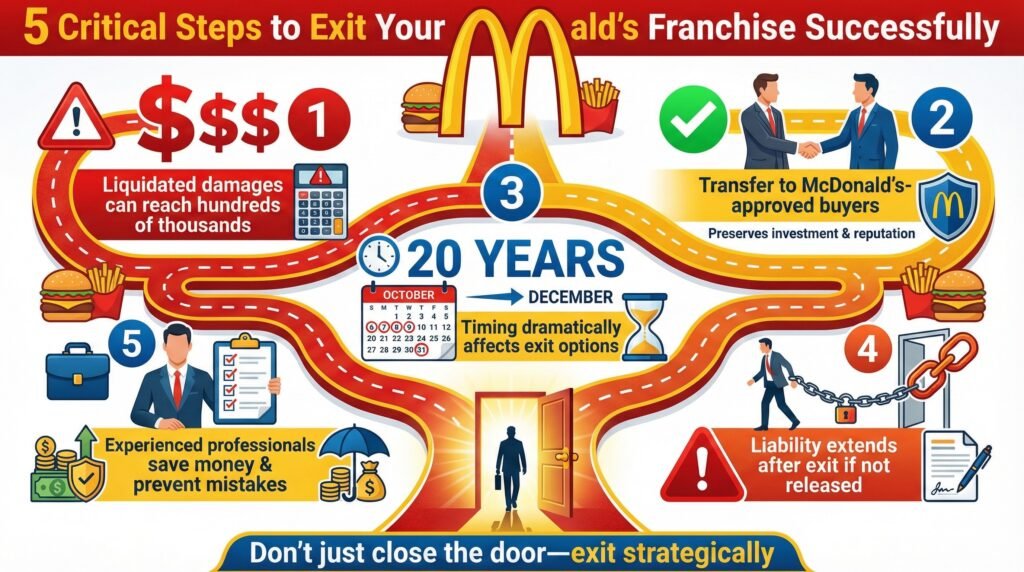
- Exiting a McDonald’s franchise requires understanding the significant financial implications, including liquidated damages that can reach hundreds of thousands of dollars.
- The most successful exits happen through properly executed transfers to McDonald’s-approved buyers, which preserves your investment and reputation.
- McDonald’s 20-year franchise agreements include specific timing considerations that can dramatically affect your exit options and financial outcome.
- Personal guarantees in franchise agreements can extend financial liability even after you’ve exited the business if not properly released.
- Working with professionals experienced specifically with McDonald’s exits can save you substantial money and prevent costly compliance mistakes.
Exiting a McDonald’s franchise is much more complex than simply hanging up the “closed” sign and walking away. With one of the most sophisticated franchise systems in the world, McDonald’s has developed comprehensive protocols governing how franchisees can exit their agreements. Understanding these procedures is crucial whether you’re planning retirement, facing financial challenges, or simply ready for a new chapter.
The Hidden Costs of Breaking Your McDonald’s Franchise Agreement
When contemplating an exit from your McDonald’s franchise, the financial implications extend far beyond simply stopping operations. The franchise agreement you signed is designed to protect the McDonald’s system as a whole, with significant penalties for early termination without proper cause. Franchise Consultants Group has found that improper exits can cost franchisees up to three times more than planned exits.
Before making any moves, carefully review section 18 of your McDonald’s Franchise Agreement, which outlines termination conditions. This section has been refined over decades to protect McDonald’s substantial investment in its system and locations. Remember that McDonald’s views each restaurant as a long-term asset, and their agreement terms reflect this perspective.
Liquidated Damages and Early Termination Fees
McDonald’s franchise agreements typically include robust liquidated damages clauses designed to compensate the franchisor for lost future revenue. These damages aren’t arbitrary – they’re carefully calculated based on your location’s historical performance. For a McDonald’s franchise generating $2.7 million in annual revenue (the 2022 average), liquidated damages for abandoning the agreement could easily exceed $500,000.
The formula generally considers your monthly royalty payments (currently 4% of gross sales) multiplied by the remaining months in your agreement. Additional fees may include marketing fund contributions, service fees, and calculated lost profits. These damages exist to discourage premature exits and compensate McDonald’s for the disruption to their system and brand reputation in your market.
Importantly, these damages aren’t simply “on paper” – McDonald’s has successfully enforced these provisions in court numerous times, establishing strong legal precedent for collection. Their franchise agreement has been continuously refined through decades of litigation and negotiation.
Non-Compete Clauses That Follow You
McDonald’s non-compete provisions extend well beyond your exit date, typically prohibiting involvement in competing restaurant businesses within a specific radius of your former location or any other McDonald’s restaurant. These restrictions generally last between 18-24 months after termination and apply regardless of how you exit the agreement.
The definition of “competing business” in McDonald’s agreements is notably broad, covering most quick-service food establishments. Violating these provisions can trigger injunctions and additional financial penalties that follow you long after selling your franchise. In multiple cases, courts have upheld these restrictions as reasonable protections of McDonald’s business interests.
Even indirect involvement through consulting, financing, or family members can trigger these clauses. McDonald’s legal team actively monitors former franchisees to ensure compliance, particularly in smaller markets where a franchisee’s industry knowledge could benefit competitors.
Ongoing Royalty Obligations
A common misconception is that selling or closing your McDonald’s location immediately terminates your financial obligations. In reality, your personal guarantees often extend beyond the sale date until McDonald’s formally releases you from these commitments. This means you could potentially remain liable for your location’s performance even under new ownership.
McDonald’s agreements typically require franchisees to guarantee royalty payments, equipment leases, and sometimes real estate obligations. The release process requires formal documentation and approval from multiple departments within McDonald’s corporate structure. Without proper execution of these releases, your liability can continue for years.
Legal Options to Exit Your McDonald’s Franchise
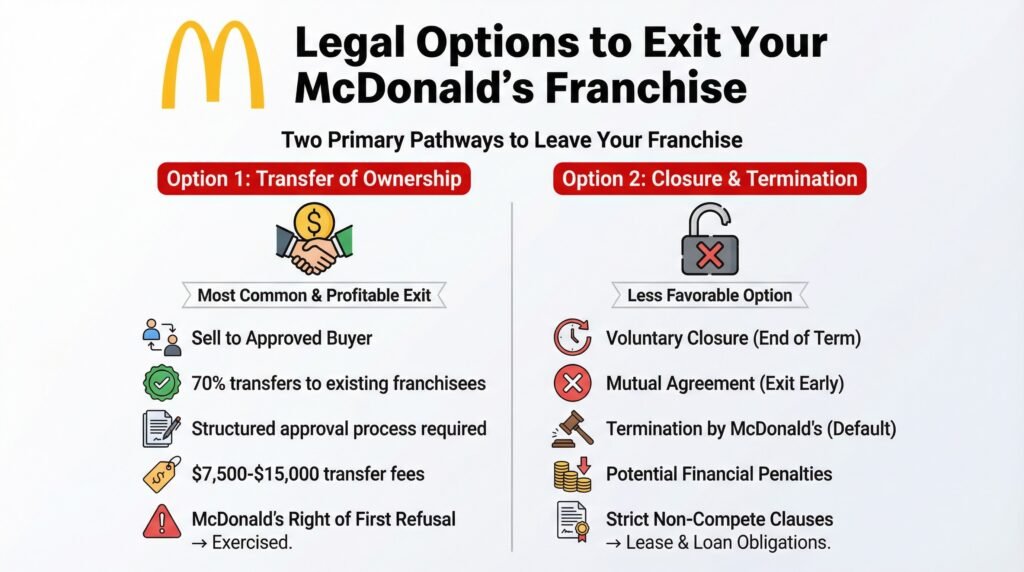
Despite the rigorous nature of McDonald’s agreements, there are several legitimate pathways to exit your franchise. Each option carries different financial implications and procedural requirements. The approach that works best depends on your timeline, financial situation, and relationship with McDonald’s.
1. Transfer of Ownership to an Approved Buyer
The most common and typically most profitable exit strategy is selling your franchise to a qualified buyer approved by McDonald’s. This approach preserves the business as a going concern and allows you to recoup your investment while minimizing termination penalties.
The McDonald’s transfer process is highly structured, requiring potential buyers to meet specific financial qualifications, complete extensive training, and receive formal approval from multiple McDonald’s departments.
McDonald’s maintains the right of first refusal on all franchise transfers, giving them the option to purchase your franchise at the same terms you’ve negotiated with a potential buyer. While rarely exercised in practice (less than 5% of cases), this provision can extend your timeline and requires complete transparency in your sale negotiations. Transfer fees typically range from $7,500-15,000 depending on your region and agreement version.
Most successful transfers occur between existing McDonald’s franchisees who already understand the system and can meet qualification requirements. Approximately 70% of McDonald’s franchise transfers are to operators who already own at least one location, as they can more easily navigate the approval process.
2. Natural Expiration of Your Agreement
McDonald’s franchise agreements typically run for 20 years from the date of restaurant opening. Planning your exit to coincide with the natural expiration of this term eliminates many potential penalties and simplifies the process considerably. This approach requires significant foresight but allows for the most orderly transition.
When your agreement reaches its natural conclusion, you’ll avoid liquidated damages and most termination penalties. However, you’ll still need to follow specific procedures for de-identification, equipment handling, and employee transitions. The franchise agreement contains detailed provisions about your responsibilities during this wind-down period, including confidentiality obligations that continue indefinitely.
Timing Your Exit for Minimal Financial Impact
The timing of your McDonald’s franchise exit can significantly impact your financial outcome and the smoothness of the transition. Strategic timing can mean the difference between a profitable sale and substantial losses. Most successful franchisees begin exit planning at least 24-36 months before their target departure date, allowing time to optimize operations, strengthen financials, and identify the ideal market conditions.
The 10-Year Mark Advantage
McDonald’s franchise agreements contain subtle but important timing considerations that create natural exit windows. The 10-year mark in your 20-year agreement represents a particularly advantageous exit point. At this stage, you’ve likely recouped your initial investment while your restaurant still maintains significant value before major reinvestment requirements kick in. Additionally, McDonald’s internal approval processes often move more quickly for transfers occurring at this milestone, as it aligns with their system-wide planning cycles.
Seasonal Considerations for Maximum Profitability
The quick-service restaurant industry follows predictable seasonal patterns that directly impact valuation during a franchise transfer. For McDonald’s locations, financial performance typically peaks during summer months in most markets, making spring the ideal time to list your franchise for sale. This timing allows potential buyers to see your business performing at its strongest while giving them confidence heading into the high-revenue season.
Conversely, initiating an exit during slower periods (typically January-February in most markets) can negatively impact valuation by as much as 8-12%. Buyers examining your trailing 12-month performance during these periods see your business at its seasonal low point, often leading to more conservative offers and extended negotiation timelines.
Avoiding Post-Remodel Exit Penalties
McDonald’s regularly requires facility updates through their “Restaurant Reimaging Program,” which can involve substantial investments ranging from $500,000 to over $2 million.
Exiting too soon after completing required renovations can trigger reimbursement provisions in your franchise agreement. These clauses typically operate on a sliding scale, with penalties decreasing approximately 20% each year after renovation completion.
The most strategic approach is either selling before a mandated remodel (disclosing the upcoming requirement to buyers) or waiting at least 3-4 years after completion, when the prorated reimbursement requirements have significantly decreased.
All the aforementioned contractual points and timelines can be potential financial and legal pitfalls if this exit is not structured under the guidance of an experienced business broker.
Why Most Franchise Business Owners Fail to Exit Profitably
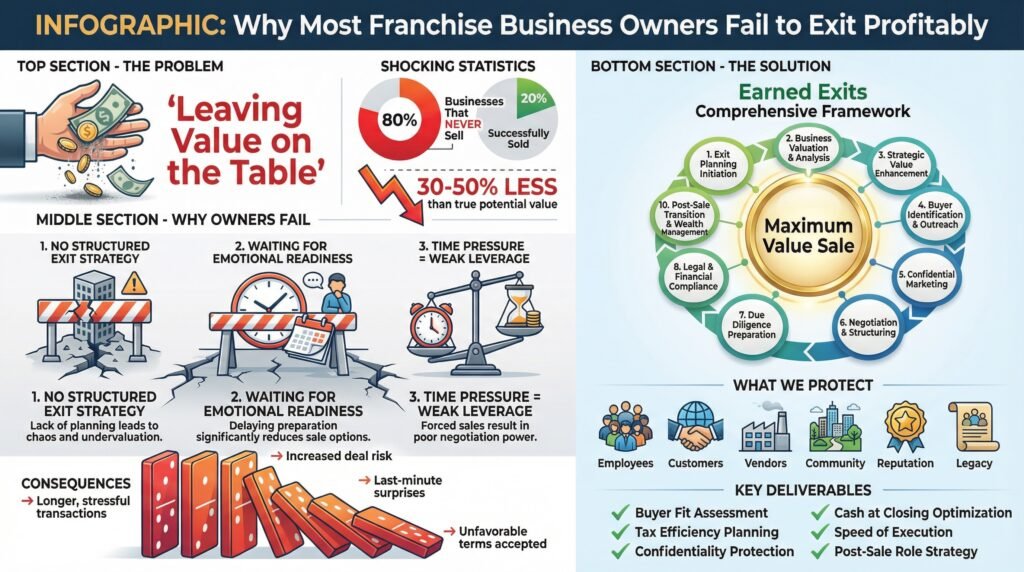
Most business owners leave significant value on the table when selling their company. After years—often decades—of building a successful business, many stumble at the final and most important stage. The problem is rarely the business itself; it’s the absence of a structured, proactive exit strategy.
The data is eye-opening. Only about 20% of businesses that go to market ever sell, and those that do often achieve 30–50% less than their true potential value. Too often, owners wait until they feel emotionally ready to exit, creating unnecessary time pressure that weakens leverage and gives buyers the upper hand.
A poorly planned exit can cost more than just price. It leads to longer, more stressful transactions, increased deal risk, and last-minute surprises that can derail or diminish the outcome. Many owners later realize they accepted unfavorable terms that proper preparation could have avoided.
Earned Exits understands that a “maximum-value” sale is about far more than a headline number. We take the time to understand what matters most to you—at closing and beyond—so your exit supports both your financial goals and your future.
Earned Exits has refined their selling methodology into a comprehensive 10-step framework that addresses every critical aspect of the business sale journey. This systematic approach helps prevent costly oversights while positioning your business to command maximum market value.
Beyond price, the company helps protect what you’ve built: your employees, customers, vendors, community, reputation, and legacy. They guide buyer fit, post-sale roles, tax efficiency, confidentiality throughout the process, and critical deal terms such as cash at closing and speed of execution—delivering not just a successful sale, but a meaningful one. To get started with Earned Exits’ free business valuation and appraisal, click the link below to fill out their short contact form.

3. Personal Circumstances
Major life events sometimes necessitate franchise exits. Serious health issues, family emergencies, or relocation due to a spouse’s career can all constitute valid reasons for early termination.
IDQ generally requires medical documentation, relocation verification, or other substantiating evidence when personal circumstances form the basis of your exit request. These situations often result in more favorable exit terms, particularly if you’ve maintained good standing as a franchisee.
Many franchise agreements include specific provisions addressing death or disability of the primary franchise owner, sometimes allowing for transfer to family members or providing more lenient termination options.
In part 2 of this series, we will cover the required documentation for a clean McDonald’s Exit, common legal pitfalls, and more.
Business Seller Check-In
Whether you are planning to sell your business solo or utilize the experience and leveraging skills of a broker, pause and review the discussed points, and you have done the basic preparation needed to place your business on the market.
A major contributor to business undervaluations, wasted time, and poor exits is simply a lack of readiness. A broker can only sell what you’ve built.
If your business:
- Depends heavily on you
- Has inconsistent or unclear financials
- Lacks systems or transferable processes
Then even the best broker will struggle to get a premium offer. Brokers don’t create value. They expose it.
Bottom line: If you are not sure what basic preparation is required before considering a business valuation or selecting a business broker, click the link below to take our free business readiness quiz. The score will give you a clear indication of where you are in the process and the next course of action to take to ensure you start the business sale and exit on the right footing.
Frequently Asked Questions
The following questions address the most common concerns franchisees have when planning their exit from the McDonald’s system. These answers reflect current McDonald’s policies, though specific details may vary based on your franchise agreement version, regional considerations, and individual circumstances. Always verify information with your franchise agreement and legal counsel before taking action.
How long does it typically take to sell a McDonald’s franchise?
The complete process of selling a McDonald’s franchise typically takes between 6-12 months from initial listing to closing. This timeline includes 2-3 months to find a qualified buyer, 1-2 months for due diligence and negotiation, and 3-6 months for McDonald’s approval process and closing procedures. Transfers between existing McDonald’s franchisees often move more quickly, sometimes completing in 4-6 months, as these buyers have already been vetted by the McDonald’s system and understand the operational requirements.
Factors that can extend this timeline include locations with underperforming financials, properties requiring significant renovation, incomplete or disorganized business records, or transfers occurring during McDonald’s corporate reorganizations or leadership transitions. The most efficient transfers occur when all documentation is organized in advance, financials are strong and well-documented, and both buyer and seller maintain clear communication with McDonald’s representatives throughout the process.
Can I sell my McDonald’s franchise to any qualified buyer?
While you can identify potential buyers, McDonald’s maintains final approval rights for all franchise transfers. Buyers must meet McDonald’s current financial requirements (typically liquid assets of $500,000 and net worth of $1 million), complete McDonald’s training program, and demonstrate operational capability. Additionally, McDonald’s reserves right of first refusal on all transfers, allowing them to purchase your franchise under the same terms you’ve negotiated with a potential buyer, though this right is exercised in less than 5% of transfers.
Will McDonald’s buy back my franchise if I want to exit?
McDonald’s occasionally repurchases franchises but does not maintain a formal buyback program. Corporate acquisitions typically occur only in strategic locations or special circumstances. When McDonald’s does purchase franchises, valuations often follow more conservative formulas than open-market sales. If you’re considering this option, informal discussions with your regional franchise director before formal submission can provide insight into potential interest and approximate valuation ranges.
What happens to my employees when I exit my franchise?
Employee transitions depend on your exit method. In most transfers, the new franchisee typically retains most employees to maintain operational continuity. The purchase agreement should explicitly address employee retention, benefit continuation, and seniority recognition. McDonald’s generally requires new owners to offer employment to qualified existing staff, though they may implement their own management team.
When a location closes rather than transfers, you maintain legal responsibilities for proper termination procedures, including final pay distribution, benefit continuation notices, and employment verification processes. Several states have specific requirements regarding employee notifications when businesses transfer ownership or cease operations, with mandated timeframes ranging from 30 to 90 days depending on location and staff size.
-Prepare detailed employee files with hire dates, positions, pay rates, and performance records
-Develop a communication timeline for notifying staff about the transition
-Consider retention bonuses for key employees during the transition period
-Schedule joint meetings between your management team and incoming ownership
-Provide reference letters for employees who may not continue under new ownership
The smoothest transitions typically involve transparent communication with staff once the sale is approved by McDonald’s but before public announcement, allowing employees to understand how the change affects their positions while maintaining operational stability.
How are McDonald’s franchises valued during a sale?
McDonald’s franchise valuations typically follow a multiple of adjusted cash flow or EBITDA (Earnings Before Interest, Taxes, Depreciation and Amortization). Current market multiples generally range between 4-6 times annual cash flow for standard locations, with premium locations in high-growth markets sometimes commanding multiples of 6-8 times. These multiples fluctuate based on market conditions, interest rates, and changes to the McDonald’s system that might affect future profitability projections.
The valuation process begins with normalizing financial statements to reflect true operational performance by adding back owner benefits, one-time expenses, and adjusting for non-standard costs. This adjusted cash flow figure becomes the basis for applying the appropriate multiple based on location quality, sales trends, and market competition. Locations with consistently increasing sales typically command higher multiples than those with flat or declining performance.
Physical assets like equipment and leasehold improvements contribute to valuation but are secondary to cash flow multiples in determining final price. Real estate, if owned rather than leased, is typically valued separately using commercial real estate appraisal methodologies and added to the business valuation. The condition and age of facilities and equipment can significantly impact valuation, particularly if major renovations will be required in the near term.
McDonald’s-specific factors that influence valuation include recent Reimaging Program completion, territory protection rights, local market penetration, and drive-thru performance metrics. Locations that have recently completed required renovations typically command premium valuations as buyers won’t face immediate capital expenditure requirements.
McDonald’s Franchise Valuation Factors
• Annual Cash Flow/EBITDA (primary factor)
• Sales Trend (3-year history)
• Location Type (traditional, satellite, mall, etc.)
• Facility Age and Condition
• Drive-Thru Performance
• Equipment Package Age and Condition
• Lease Terms and Duration
• Local Competition Landscape
• Labor Market Conditions
• Recent Reimaging Status
Can I own another fast food business after selling my McDonald’s?
Your ability to enter another food service business after selling your McDonald’s franchise depends on the specific non-compete provisions in your franchise agreement and termination documents.
Standard McDonald’s agreements prohibit involvement in competing food service businesses within a defined radius (typically 3-10 miles) of your former location and any other McDonald’s restaurant for 18-24 months after termination. The definition of “competing business” generally includes most quick-service restaurants and businesses deriving substantial revenue from hamburgers, sandwiches, or breakfast items similar to McDonald’s offerings.
These restrictions don’t prevent investment in non-competing restaurant concepts like fine dining, ethnic cuisine substantially different from McDonald’s menu, or specialty food businesses focused on categories McDonald’s doesn’t serve.
The restrictions are also geographically limited, so opportunities in markets without McDonald’s presence or outside the restricted radius may be immediately available. Violation of non-compete provisions can trigger significant financial penalties and injunctive relief preventing operation of the competing business, so careful legal review is essential before pursuing new food service ventures.
Understand all the ramifications of a proper franchise sale and business exit by utilizing the proven expertise of Earned Exits. Ranked a top business broker in 2025, Earned Exits has facilitated over 47 successful business transactions worth $2.1 Billion, demonstrating how specialized industry knowledge translates to exceptional results. Get started today with Earned Exits free business valuation via the link below:
Get started today and let the experienced team at Earned Exits perform the due diligence and heavy lifting, providing a smooth and profitable DQ franchise business exit. Click the link below to start their free business valuation. Read our full review of Earned Exits here.
If you have decided that Earned Exits is a good fit and your franchise business size is $1M-$40M+, click the link below to contact Earned Exits today to start their free business valuation by filling out a short form.
*Disclaimer: This article is written for educational purposes and should not be interpreted as financial advice.
*Disclaimer: This article is written for educational purposes and should not be interpreted as financial advice. We may receive compensation for referrals made through this article.