
Quick Summary
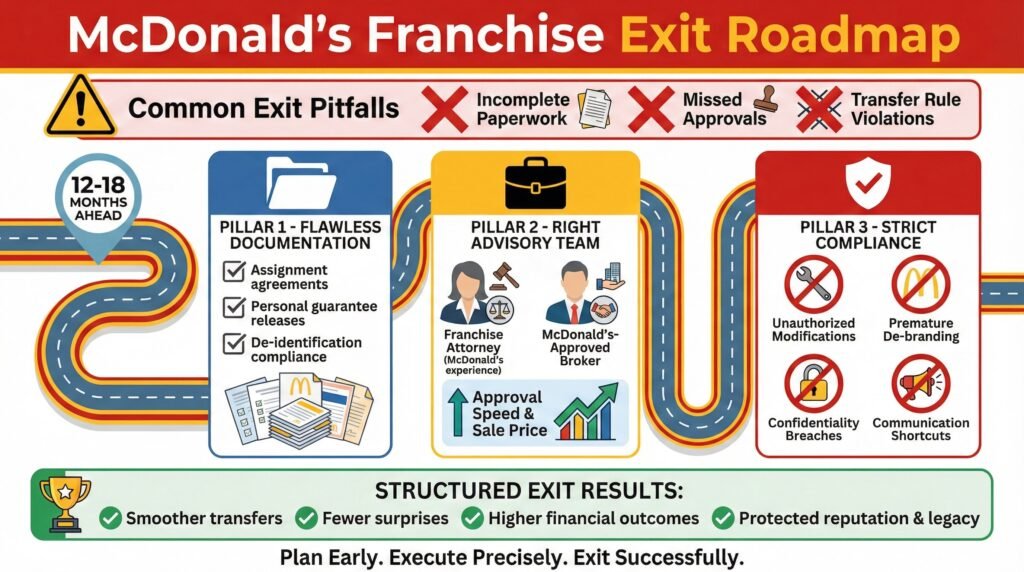
Exiting a McDonald’s franchise is a highly structured, document-intensive process that requires careful planning well in advance. Most delays, legal issues, and lingering liabilities stem from incomplete paperwork, missed approvals, or misunderstanding McDonald’s internal transfer rules.
A successful exit hinges on three things:
- Flawless documentation: including assignment agreements, formal releases of all personal guarantees (both McDonald’s and third-party), and fully documented de-identification compliance.
- The right advisory team: a franchise attorney with direct McDonald’s experience and a McDonald’s-approved broker dramatically increases approval speed and sale price.
- Strict compliance discipline: avoiding unauthorized modifications, premature de-branding, confidentiality breaches, or communication shortcuts that trigger legal scrutiny.
Planning 12–18 months ahead reduces risk, improves leverage, and protects your reputation, legacy, and post-exit opportunities. Owners who follow a structured exit framework consistently achieve smoother transfers, fewer surprises, and materially higher outcomes—both financially and personally.
In part 1 of this series, we discussed the hidden costs of breaking your McDonald’s franchise, legal options for exiting, and more. In part 2, we will cover the required documentation for a clean McDonald’s Exit, common legal pitfalls, and more
Required Documentation for a Clean McDonald’s Exit
Navigating a McDonald’s exit requires meticulous attention to documentation requirements. The process involves substantially more paperwork than most franchisees anticipate, with documents flowing between multiple departments within the McDonald’s organization. Missing or incorrectly executed paperwork is the leading cause of delayed exits and can create lingering liability issues years after you believe the transfer is complete.
Assignment and Transfer Documents
The foundation of any McDonald’s franchise transfer is the Assignment and Assumption Agreement, a legally binding document that transfers all rights and obligations to the new franchisee. This comprehensive document typically runs 15-25 pages and requires signatures from both parties plus McDonald’s corporate representatives.
The agreement covers everything from intellectual property rights to assumption of equipment leases and service contracts. Importantly, this document must precisely match the terms outlined in your preliminary transfer application, which McDonald’s approved earlier in the process. Any discrepancies between the approved terms and the final assignment documents can result in rejection or delays.
Release of Personal Guarantees
Perhaps the most crucial yet often overlooked documentation involves obtaining formal releases of your personal guarantees. Throughout your franchise term, you’ve likely provided personal guarantees for multiple aspects of the business, including equipment leases, supply agreements, and the franchise agreement itself. These guarantees can create lingering liability long after you’ve sold the business if not properly released.
Critical Personal Guarantees Requiring Formal Release:
1. Franchise Agreement Obligations
2. Real Estate Lease Guarantees
3. Equipment Financing/Leasing
4. Bank Loans and Lines of Credit
5. Supplier Agreements and Payment Terms
McDonald’s maintains a specific Release of Guarantee form that must be processed through their legal department. However, this only covers franchise-related guarantees. You must separately obtain releases from third-party creditors, suppliers, and property owners. Many franchisees make the critical mistake of assuming the McDonald’s release covers all business-related guarantees, only to discover years later they remain personally liable for obligations under the new owner.
Each release document should explicitly reference the original guarantee, include the effective date of release, and be counter-signed by an authorized representative with proper authority. For maximum protection, have your attorney verify that the releasing party has proper signatory authority before accepting any release document.
De-identification Compliance Paperwork
McDonald’s maintains strict requirements regarding the removal of all branded elements when a location closes or transfers ownership. This de-identification process must be documented through a comprehensive checklist and verified by McDonald’s representatives. The checklist covers everything from signage and marketing materials to equipment bearing the McDonald’s logo. Failure to properly document this process can trigger breach of contract claims and intellectual property disputes.
The documentation must include dated photographs showing completed removal of all trademarked elements, signed verification from McDonald’s representatives, and formal acknowledgment that you no longer have rights to any McDonald’s intellectual property. This paperwork becomes particularly important if you’re closing a location rather than transferring it, as McDonald’s will actively monitor compliance with these requirements.
Building Your Exit Support Team
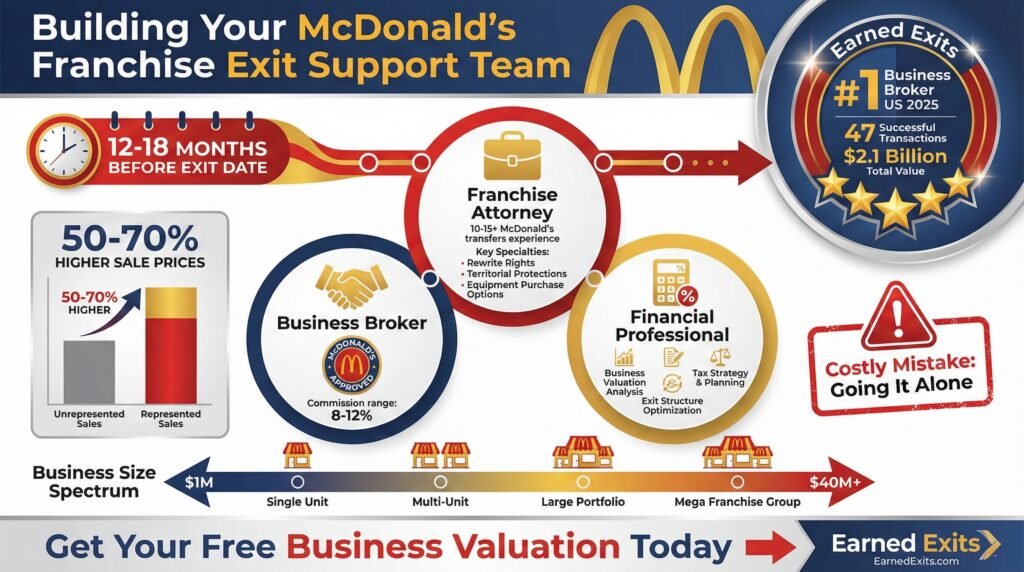
Attempting to navigate a McDonald’s franchise exit without specialized professional support is a costly mistake many franchisees make. The complexity of McDonald’s agreements and the multi-layered approval process necessitates working with experts who understand the specific nuances of the McDonald’s system. Your exit team should be assembled early in the planning process, ideally 12-18 months before your targeted exit date.
While it may seem expensive to engage professional brokering services, their specialized knowledge typically saves far more than their fees by avoiding costly mistakes and negotiating more favorable terms. The most successful exits involve coordinated efforts between legal, financial, and brokerage professionals who communicate regularly throughout the process.
Finding a Franchise Attorney with McDonald’s Experience
The cornerstone of your exit team should be a franchise attorney with specific McDonald’s experience. These specialized attorneys understand the unique aspects of McDonald’s agreements that general business lawyers often miss. They can identify potential liability issues in your specific agreement version and navigate McDonald’s internal legal processes more efficiently.
The most qualified attorneys typically have prior experience with at least 10-15 McDonald’s transfers and maintain professional relationships with key members of McDonald’s legal department. When interviewing potential attorneys, ask specifically about their experience with McDonald’s rewrite rights, territorial protections, and equipment purchase options, which are handled differently than in most franchise systems.
Working with McDonald’s-Approved Business Brokers
Not all business brokers are equipped to handle McDonald’s franchise transfers. The most effective brokers maintain relationships with McDonald’s development team and understand the specific financial qualifications buyers must meet. These specialized brokers maintain databases of pre-qualified prospects who have already completed McDonald’s preliminary screening process, significantly reducing the time to locate appropriate buyers.
McDonald’s maintains an internal list of brokers who consistently meet their transaction standards. While they won’t officially recommend specific brokers, your franchise consultant can often provide guidance on which brokers have successfully completed recent transfers in your region. Commission structures typically range from 8-12% of the sale price, with the percentage decreasing for higher-value locations.
Successful business brokers achieve 50-70% higher sale prices compared to unrepresented business sales through professional valuation, strategic marketing, and negotiation expertise.
Choosing the right broker involves matching your business size ($1M-$40M+) with a firm whose expertise aligns with your specific industry and sales objectives. Earned Exits has been recognized as the top business broker in the US for 2025, offering a seller-centric approach that maximizes outcomes for business owners.
Earned Exits has facilitated over 47 successful business transactions worth $2.1 Billion, demonstrating how specialized industry knowledge translates to exceptional results. Get started today with Earned Exits free business valuation via the link below:

Common Pitfalls That Trigger McDonald’s Legal Response
McDonald’s legal department maintains one of the most sophisticated compliance monitoring systems in the franchise industry. Certain actions during your exit planning can trigger heightened scrutiny and potentially jeopardize your transfer approval. Understanding these trigger points helps you avoid unnecessary complications and potential legal disputes that could derail your exit strategy.
The most problematic issues typically arise not from intentional violations, but from misunderstanding the specific requirements of the McDonald’s system or attempting to shortcut processes that McDonald’s considers essential. Many of these requirements aren’t explicitly stated in the franchise agreement but have been established through operational bulletins and system standards over time.
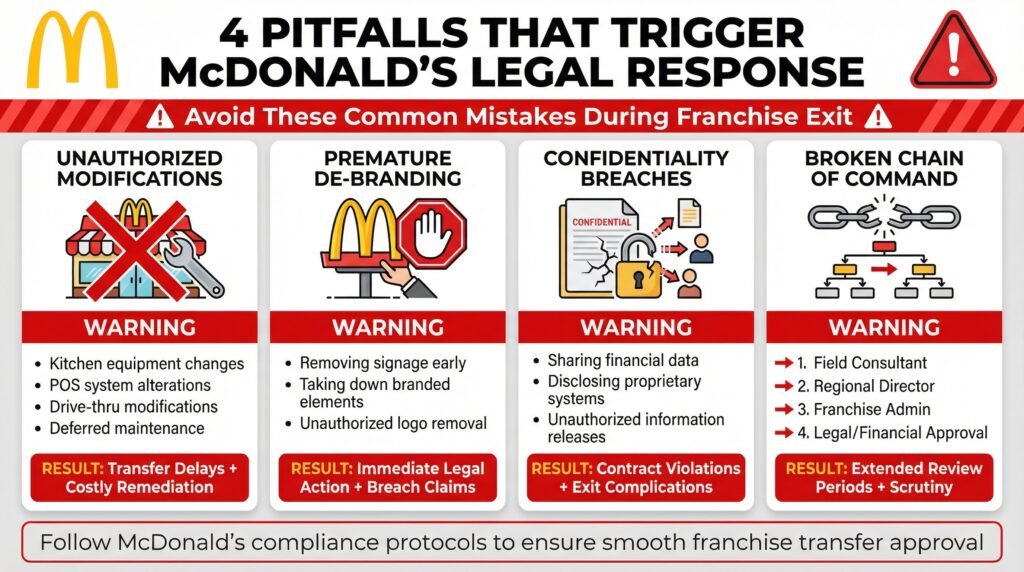
Unauthorized Location Modifications
As you prepare for exit, it’s tempting to defer maintenance or make unauthorized modifications to reduce expenses. However, McDonald’s routinely conducts facility inspections as part of the transfer approval process, and unauthorized changes frequently trigger transfer delays. These inspections evaluate everything from kitchen equipment functionality to parking lot conditions.
Particularly problematic are modifications to cooking systems, POS technology, or drive-thru configurations that haven’t received formal written approval through the proper channels. McDonald’s typically requires these issues to be remediated before transfer approval, often at significant cost that could have been avoided through proper authorization.
Premature De-Branding Actions
Some franchisees mistakenly begin removing branded elements before receiving formal approval for their exit. This premature de-branding violates multiple sections of the franchise agreement and can trigger immediate legal action from McDonald’s. All McDonald’s branding, signage, and trademarked elements must remain intact until you receive written authorization to remove them. The de-identification process follows a specific sequence coordinated with McDonald’s representatives, and deviating from this sequence can result in breach of contract claims that complicate your exit.
Confidentiality Breaches During Exit Planning
McDonald’s franchise agreements contain strict confidentiality provisions that remain in effect throughout the exit process. Sharing certain operational details, financial information, or proprietary systems with unauthorized parties constitutes a breach of these provisions. When preparing to list your franchise for sale, work closely with your attorney to create disclosure packages that provide necessary information to potential buyers without violating confidentiality requirements.
All potential buyers should sign McDonald’s standard confidentiality agreement before receiving detailed information, and all discussions should be conducted in private settings away from restaurant operations.
Failing to Follow the Chain of Communication
McDonald’s has established specific communication protocols for franchise transfers that must be followed precisely. Attempting to circumvent these channels by directly contacting senior leadership or department heads outside the established sequence can flag your file for additional scrutiny. The process typically begins with your field consultant, proceeds to the regional franchise director, then moves to the franchise administration department before reaching legal and financial approval stages.
Skipping steps in this sequence or attempting to accelerate the process through unofficial channels often results in significant delays rather than expedited handling. McDonald’s internal tracking systems note all communication irregularities, and files flagged for such issues typically face extended review periods. Maintaining proper documentation of all communications and following the prescribed notification sequence demonstrates your professionalism and compliance with system standards, which can positively influence your transfer experience.
Life After McDonald’s: Your Next Steps
Transitioning out of the McDonald’s system after years or decades as a franchisee requires both emotional and practical adjustments. The structured environment and established support systems you’ve relied on will no longer be available, requiring new approaches to business and personal financial management. Most successful former franchisees begin planning for their post-McDonald’s life well before the actual exit date, establishing new routines, professional networks, and financial structures that support their next chapter.
Failing to Follow the Chain of Communication
Transitioning out of the McDonald’s system after years or decades as a franchisee requires both emotional and practical adjustments. The structured environment and established support systems you’ve relied on will no longer be available, requiring new approaches to business and personal financial management. Most successful former franchisees begin planning for their post-McDonald’s life well before the actual exit date, establishing new routines, professional networks, and financial structures that support their next chapter.
Managing Non-Compete Restrictions
After exiting McDonald’s, you’ll need to navigate the specific non-compete provisions in your franchise agreement. These typically prohibit involvement in competing restaurant businesses within a defined radius of your former location and any other McDonald’s restaurant for 18-24 months. The definition of “competing business” is quite broad, covering most quick-service food operations. However, these restrictions don’t prevent you from entering entirely different business sectors or investing in non-competing food service concepts like full-service restaurants or specialty food businesses that don’t directly compete with McDonald’s menu offerings.
Protecting Your Business Reputation
The manner in which you exit McDonald’s can significantly impact your professional reputation in the franchise community. Maintaining positive relationships throughout the exit process protects your standing and preserves future opportunities. Document all compliance steps meticulously and fulfill all post-termination obligations promptly to demonstrate your professionalism.
Be particularly careful about public statements regarding your McDonald’s experience after exiting. Disparaging comments, even if factually accurate, can potentially trigger defamation claims or violations of non-disparagement clauses in your termination agreement. When discussing your McDonald’s experience with potential future business partners or in networking settings, focus on the positive aspects of your experience and the transferable skills you developed rather than any challenges or disagreements that may have occurred during your exit.
Reinvesting Proceeds Strategically
The substantial proceeds from a successful McDonald’s franchise sale require careful reinvestment planning to preserve and grow your wealth. Many former franchisees make the mistake of immediately reinvesting in new business ventures without establishing appropriate structures or conducting sufficient due diligence. Work with financial advisors who understand the unique position of former franchisees with significant liquid assets to develop a comprehensive wealth management strategy that aligns with your post-franchise goals.
Consider diversification approaches that balance potential growth opportunities with capital preservation. Many successful former franchisees adopt a “thirds approach” – directing approximately one-third of proceeds to income-generating investments, one-third to growth-oriented investments, and one-third to alternative investments, including other business opportunities where your operational experience provides competitive advantage.
Whether you’re planning to exit in the next few months or the next few years, implementing a structured approach now will significantly enhance your eventual outcome. Begin by honestly assessing your current exit readiness across business operations, financial documentation, customer relationships, and personal goals. Identify gaps between your current state and ideal selling condition, then create specific action plans to address each area.
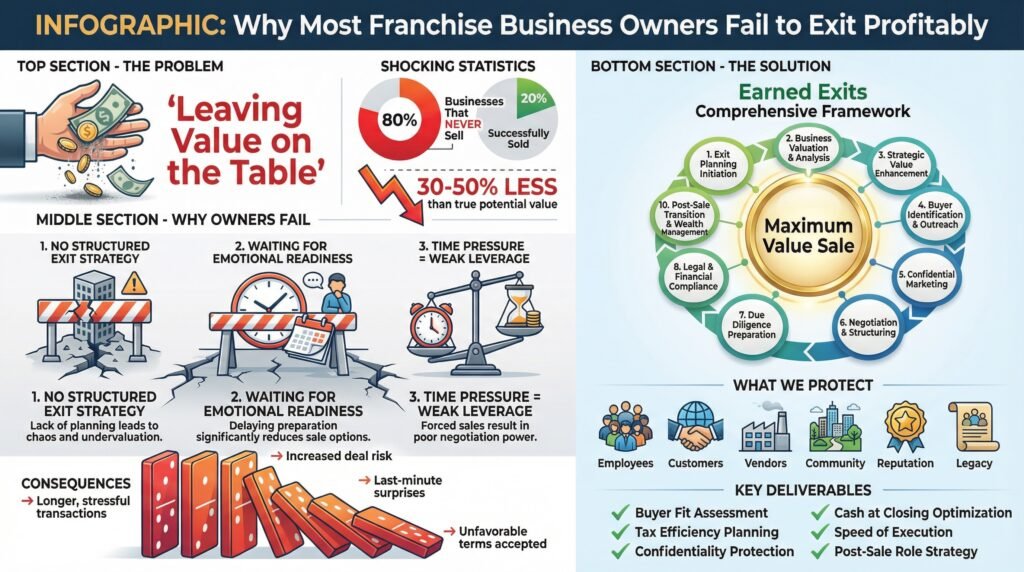
The Earned Exits 10-step process provides a comprehensive framework that has helped hundreds of business owners achieve life-changing exits. By following this proven methodology, you can avoid the costly mistakes that plague unprepared sellers while positioning your business to command maximum value when you decide the time is right to transition to your next chapter.
Earned Exits understands that a “maximum-value” sale is about far more than a headline number. We take the time to understand what matters most to you—at closing and beyond—so your exit supports both your financial goals and your future.
Beyond price, the company helps protect what you’ve built: your employees, customers, vendors, community, reputation, and legacy. They guide buyer fit, post-sale roles, tax efficiency, confidentiality throughout the process, and critical deal terms such as cash at closing and speed of execution—delivering not just a successful sale, but a meaningful one. To get started with Earned Exits’ free business valuation and appraisal, click the link below.
Business Seller Check-In
Whether you are planning to sell your business solo or utilize the experience and leveraging skills of a broker, pause and review the discussed points, and you have done the basic preparation needed to place your business on the market.
A major contributor to business undervaluations, wasted time, and poor exits is simply a lack of readiness. A broker can only sell what you’ve built.
If your business:
- Depends heavily on you
- Has inconsistent or unclear financials
- Lacks systems or transferable processes
Then even the best broker will struggle to get a premium offer. Brokers don’t create value. They expose it.
Bottom line: If you are not sure what basic preparation is required before considering a business valuation or selecting a business broker, click the link below to take our free business readiness quiz. The score will give you a clear indication of where you are in the process and the next course of action to take to ensure you start the business sale and exit on the right footing.
Frequently Asked Questions
The following questions address the most common concerns franchisees have when planning their exit from the McDonald’s system. These answers reflect current McDonald’s policies, though specific details may vary based on your franchise agreement version, regional considerations, and individual circumstances. Always verify information with your franchise agreement and legal counsel before taking action.
What are the tax implications of selling my McDonald’s franchise?
The tax treatment of your McDonald’s franchise sale depends on your business structure, how long you’ve owned the franchise, and how the purchase price is allocated across different asset categories. Most McDonald’s franchises are sold as asset sales rather than stock sales, requiring allocation of the purchase price across categories including goodwill, equipment, leasehold improvements, and covenant not to compete. Each category receives different tax treatment, with goodwill currently taxed at lower capital gains rates while equipment and certain improvements may trigger ordinary income tax rates through depreciation recapture.
Franchisees who have owned their locations for many years often face significant depreciation recapture, as equipment and improvements that have been fully depreciated for tax purposes must now recognize gain when sold above adjusted basis. This recapture is typically taxed at ordinary income rates rather than preferential capital gains rates. Strategic allocation of the purchase price within IRS guidelines can help optimize the tax outcome, though both buyer and seller must use consistent allocations in their tax reporting.
Several tax-deferral strategies may be available depending on your circumstances, including installment sales, like-kind exchanges for real estate components, or opportunity zone reinvestments. Each approach has specific requirements and limitations, making advance planning with tax professionals essential. Begin tax planning at least 12-18 months before your anticipated sale to implement strategies that might require advance structuring.
Do I need McDonald’s approval to transfer ownership to a family member?
Yes, McDonald’s approval is required for all ownership transfers, including those to family members. While McDonald’s often views family transitions favorably, the receiving family member must still meet all current franchisee qualification requirements, complete the standard training program, and receive formal approval through the regular transfer process. Some requirements may be modified for family members who have been actively involved in the business, but McDonald’s maintains final approval authority regardless of family relationship.
Can I keep the real estate if I sell my McDonald’s franchise?
If you own the real estate where your McDonald’s operates, you can potentially retain ownership and lease it to the new franchisee, creating an ongoing income stream. This arrangement requires McDonald’s approval and must include lease terms that comply with McDonald’s standard requirements.
McDonald’s typically requires a minimum 20-year primary term with extension options, specific maintenance provisions, and transfer restrictions. The rental rate must be at the market level and documented through professional appraisals. This strategy can provide stable long-term income while potentially qualifying for beneficial tax treatment through cost segregation and depreciation strategies.
What happens if McDonald’s rejects my proposed buyer?
If McDonald’s rejects your proposed buyer, you must either find another qualified buyer or continue operating the franchise. McDonald’s must provide specific reasons for rejection, which typically relate to financial qualifications, operational experience, or training completion. Understanding these reasons helps identify more suitable candidates for future submission. Most rejection cases involve buyers who don’t meet current financial requirements or haven’t demonstrated sufficient operational capability during the evaluation process.
When a buyer is rejected, you retain all rights to seek alternate buyers or continue operations. The rejection doesn’t affect your standing in the McDonald’s system or create any presumption about your eventual exit. While disappointing, rejections are part of McDonald’s quality control process and shouldn’t be taken personally. Work with your franchise consultant to understand precisely why the rejection occurred and what profile of buyer would be more likely to receive approval.
In some cases, conditional approvals may be offered, where McDonald’s will accept the buyer if specific conditions are met. These might include additional training, hiring approved management support, or meeting modified financial requirements. Evaluating whether these conditions can be reasonably satisfied often determines whether to proceed with a conditional buyer or seek new candidates.
Throughout this challenging process, maintaining open communication with McDonald’s representatives helps preserve your relationship and positions you for eventual successful transfer. The most effective approach combines persistence with flexibility, continuing to seek qualified buyers while adapting your expectations based on feedback from the approval process.
For franchise owners looking to navigate complex exit strategies while protecting their investment, Franchise Success Partners provides specialized consultation services designed specifically for McDonald’s operators planning their transition. Our team of former McDonald’s executives and franchise experts can help you maximize your restaurant’s value and ensure a smooth ownership transfer.
Understand all the ramifications of a proper franchise sale and business exit by utilizing the proven expertise of Earned Exits. Ranked a top business broker in 2025, Earned Exits has facilitated over 47 successful business transactions worth $2.1 Billion, demonstrating how specialized industry knowledge translates to exceptional results. Get started today with Earned Exits free business valuation via the link below:
Get started today and let the experienced team at Earned Exits perform the due diligence and heavy lifting, providing a smooth and profitable DQ franchise business exit. Click the link below to start their free business valuation. Read our full review of Earned Exits here.
If you have decided that Earned Exits is a good fit and your franchise business size is $1M-$40M+, click the link below to contact Earned Exits today to start their free business valuation by filling out a short form.
*Disclaimer: This article is written for educational purposes and should not be interpreted as financial advice.
*Disclaimer: This article is written for educational purposes and should not be interpreted as financial advice. We may receive compensation for referrals made through this article.