
Key Takeaways
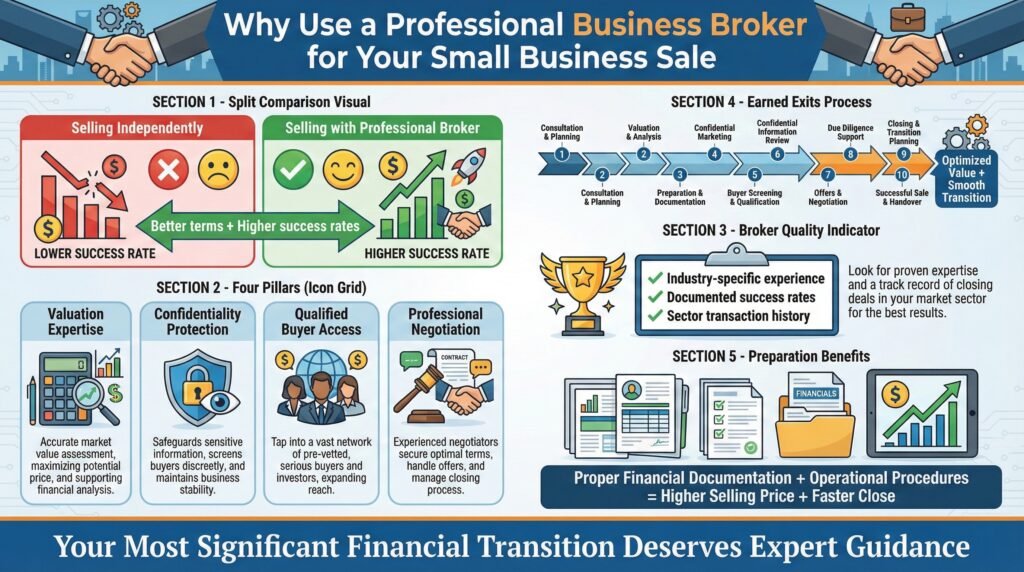
- Businesses sold through professional brokers are significantly more likely to close successfully and at better terms than those sold independently.
- The right business broker brings valuation expertise, maintains confidentiality, provides access to qualified buyers, and offers professional negotiation skills.
- Elite brokers stand out through industry-specific experience, with documented success rates of completed transactions in your business sector.
- Earned Exits offers a comprehensive 10-step selling process designed to optimize business value and ensure smooth ownership transitions.
- Thorough preparation of financial documentation and operational procedures can significantly increase your selling price and reduce time-to-close.
Selling a small business represents one of the most significant financial and emotional transitions a business owner will ever experience. Finding the right partner to guide you through this complex process can mean the difference between a successful sale and a costly mistake.
Why Small Business Owners Struggle to Sell Without Professional Help
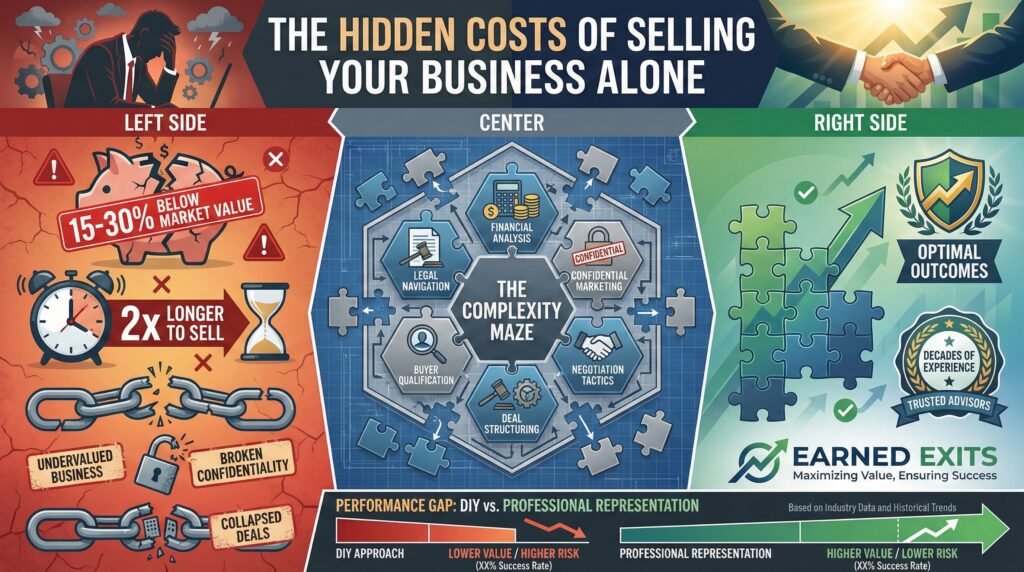
Many business owners approach selling with a do-it-yourself mentality that served them well while building their company. However, this approach often leads to undervalued businesses, broken confidentiality, or deals that collapse during due diligence. The statistics are sobering: businesses that attempt to sell without professional representation typically take nearly twice as long to sell and often close at 15-30% below market value, if they sell at all.
The complexity of a business sale extends far beyond finding a buyer. It involves intricate financial analysis, confidential marketing, buyer qualification, negotiation tactics, deal structuring, and navigating legal requirements. These specialized skills fall outside most owners’ expertise, no matter how successful they’ve been at running their business. Earned Exits specializes in guiding small business owners through this complex landscape, leveraging decades of experience to ensure optimal outcomes.
The Partnership Approach: Working Together for a Successful Exit
The most successful business sales emerge from true partnerships between owners and their brokers. This collaborative approach combines your intimate knowledge of your business with your broker’s transaction expertise and market insights. When selecting a broker, look beyond technical capabilities to assess relationship dynamics, communication style, and cultural alignment. The business sale process often extends 6-12 months, making personal rapport and mutual trust essential components of a productive working relationship that can withstand the inevitable challenges of complex transactions.
What Makes an Elite Business Broker Stand Out
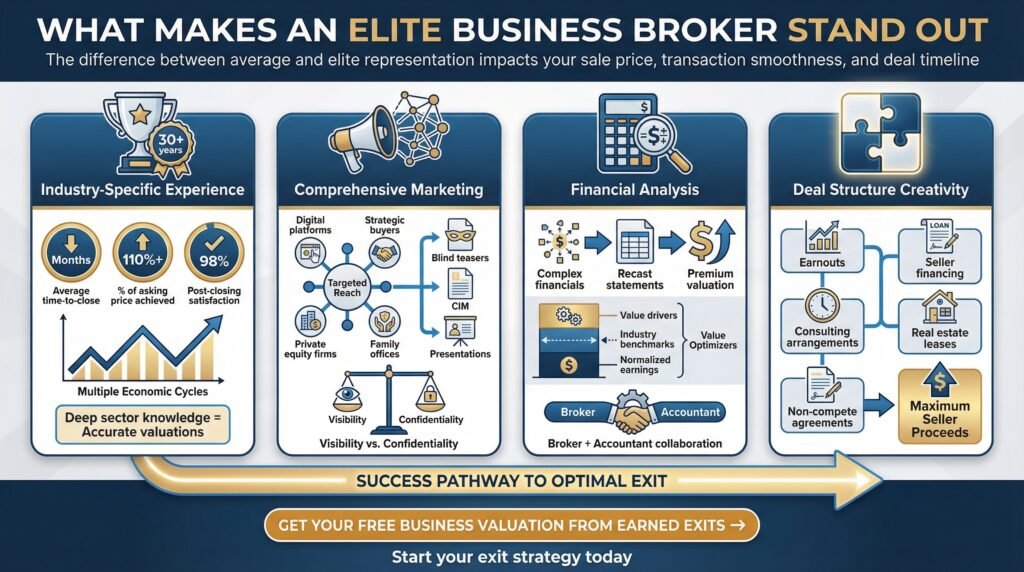
In an industry with varying levels of professionalism and capability, truly exceptional business brokers distinguish themselves through several key characteristics. The difference between average and elite representation can significantly impact your final sale price, the smoothness of your transaction, and the time required to complete the deal.
Industry-Specific Experience and Success Rate
The most effective business brokers possess deep experience in your specific industry sector. This specialized knowledge enables them to accurately assess your business’s value drivers, identify qualified buyers who understand industry nuances, and anticipate potential obstacles unique to your market segment.
When evaluating brokers, look beyond general transaction volume to examine their documented success rate with businesses similar to yours. Elite brokers maintain transparent records of their closed transactions, including metrics like average time-to-close, percentage of asking price achieved, and post-closing satisfaction metrics. These metrics provide objective evidence of their ability to deliver results rather than just promises. Firms with 30+ years of experience across multiple economic cycles, like Earned Exits, bring invaluable perspective to the selling process that newer brokers simply cannot match.
Comprehensive Marketing Strategies
Superior business brokers implement sophisticated, multi-channel marketing approaches that go far beyond basic online listings. They develop comprehensive marketing materials that effectively communicate your business’s value proposition while maintaining strict confidentiality. These materials include blind teasers, detailed confidential information memorandums, and compelling presentation materials that highlight your business’s unique strengths and growth potential.
The marketing strategy should balance broad visibility with targeted outreach to ideal buyer profiles. Exceptional brokers leverage both digital platforms and personal relationships with strategic buyers, private equity firms, and family offices to create competitive interest. Ask potential brokers to outline their specific marketing plan for your business, including examples of materials they’ve developed for similar companies.
Financial Analysis Capabilities
Professional business brokers possess advanced financial analysis skills that enable them to recast financial statements, normalize earnings, and identify value drivers that might be overlooked by typical buyers. They can translate complex financial data into compelling narratives that justify premium valuations while withstanding rigorous due diligence scrutiny. This financial sophistication proves particularly valuable when dealing with businesses that have complicated financial structures or significant owner benefits embedded in the operations.
The best brokers collaborate with your accounting professionals to develop comprehensive financial presentations that present your business in the most favorable yet defensible light. They understand industry-specific metrics and benchmarks that influence buyer perceptions and valuations in your particular sector.
Deal Structure Creativity
Exceptional business brokers possess the creativity and knowledge to structure deals that maximize seller proceeds while addressing buyer concerns. They understand the strategic application of earnouts, seller financing, consulting arrangements, real estate leases, and non-compete agreements to bridge valuation gaps and align incentives. This deal structuring expertise often makes the difference between failed negotiations and successful closings, particularly in challenging market conditions.
Look for brokers who can explain multiple deal structure scenarios and their implications for after-tax proceeds, risk exposure, and post-closing obligations. The most valuable brokers serve as strategic advisors throughout the entire process, not just transaction facilitators. Start the process of your business exit today with Earned Exits free business valuation via the link below and filling out their short form:

In part 2 of this series, we will discuss how to find the right business broker for your small business, 5 critical benefits of hiring a business broker, and more. Be sure to subscribe and follow our blog for the latest updates and information.
Frequently Asked Questions
Business owners considering a sale naturally have many questions about the process, timeline, and what to expect. Here are answers to the most common questions reported from small business owners contemplating their exit strategy.
How long does it typically take to sell a small business with a broker?
Most small business sales are completed within 6-9 months from initial engagement to closing, though timing varies based on business complexity, industry sector, market conditions, and pricing strategy. Well-prepared businesses with clean financials, documented processes, and realistic valuations typically sell faster than those requiring extensive preparation or priced significantly above market. Your broker should provide a realistic timeline based on your specific business characteristics and current market conditions rather than promising unrealistically quick results.
Can I sell my business without a broker and save on commission?
While theoretically possible, selling without professional representation typically costs owners significantly more than broker commissions through reduced sale prices, unfavorable terms, or failed transactions. Industry statistics consistently show that professionally represented businesses sell for 15-30% higher prices than those sold independently, more than offsetting broker fees.
Beyond price impact, business owners often underestimate the time commitment required to manage the sale process while maintaining business performance. The hundreds of hours spent marketing the business, screening buyers, facilitating due diligence, and negotiating terms inevitably detract from operational focus at precisely the time when strong business performance matters most.
Perhaps most importantly, independent sellers lack the emotional distance necessary to negotiate effectively. When a buyer criticizes aspects of your life’s work or makes aggressive demands during negotiations, having a professional intermediary prevents emotional reactions that can derail promising deals.
What percentage do business brokers typically charge for small business sales?
- Business valued under $1 million: 10-12% commission (often with minimum fees of $10,000-$15,000)
- Business valued $1-5 million: 8-10% commission (sometimes structured with sliding scales)
- Business valued $5-10 million: 6-8% commission
- Business valued above $10 million: 4-6% commission (may include monthly retainers)
These percentages reflect industry averages, but fee structures vary among brokers. Some charge flat fees, others use hybrid models with retainers applied against success fees, while others operate purely on commission. When evaluating fee structures, consider the broker’s total value proposition rather than simply selecting the lowest price option.
Most professional brokers operate on a “success fee” model where they earn commissions only upon successful closing. This alignment of incentives ensures your broker remains motivated throughout the process. Be wary of brokers charging substantial upfront fees without clear deliverables or those promising unrealistic valuations to secure your listing.
Remember that commission percentages are typically negotiable, particularly for higher-valued businesses. The most important consideration is finding a broker with the expertise and capabilities needed to maximize your sale outcome, even if their fees appear slightly higher than alternatives.
How do I know if my business is ready to sell?
Business readiness involves multiple dimensions, including financial performance, operational stability, market positioning, and owner dependency. Ideally, your business should demonstrate 3-5 years of stable or growing financial results with clean, reconciled financial statements. Operational systems should be documented, key employees stable, and customer relationships diversified rather than concentrated among a few accounts.
The best time to sell typically occurs when business performance is strong and improving rather than declining, as buyers pay premiums for positive momentum. However, personal factors including health issues, burnout, retirement plans, or new opportunities may necessitate selling regardless of business conditions. A qualified broker can assess your specific situation and recommend preparation strategies to maximize value given your timeline constraints.
Should I tell my employees about my plans to sell the business?
This represents one of the most sensitive decisions in the sale process, requiring careful consideration of your specific circumstances. Premature disclosure carries significant risks including employee departures, decreased productivity, customer uncertainty, and competitive exploitation.
When to Inform Employees: Decision Framework
– Key management needed for buyer discussions: Early, selective disclosure with NDAs
– Business heavily dependent on owner: Planned disclosure before buyer meetings
– Stable workforce not critical to value: Typically, at or near closing
– Rumors already circulating: Controlled messaging may be necessary
– Industry with rapid information flow: Earlier, strategic disclosure
Most experienced brokers recommend limiting initial disclosure to essential personnel directly involved in the sale process. These individuals should sign confidentiality agreements and receive clear communication about the potential impact on their future roles. For most small businesses, general employee notification occurs after a purchase agreement is signed but before closing, allowing time for transition planning.
When disclosure becomes necessary, emphasize the positive aspects of the transition, including growth opportunities, continuity plans, and how the sale ensures business sustainability. Your broker can provide guidance on timing and messaging based on your specific workforce dynamics and business sector.
Understand all the ramifications of a proper business exit plan by utilizing the proven expertise of Earned Exits. Ranked a top business broker in 2025, Earned Exits has facilitated over 47 successful business transactions worth $2.1 Billion, demonstrating how specialized industry knowledge translates to exceptional results. Get started today with Earned Exits free business valuation via the link below:

*Disclaimer: This article is written for educational purposes and should not be interpreted as financial advice.
*Disclaimer: This article is written for educational purposes and should not be interpreted as financial advice. We may receive compensation for referrals made through this article.