
Quick Summary
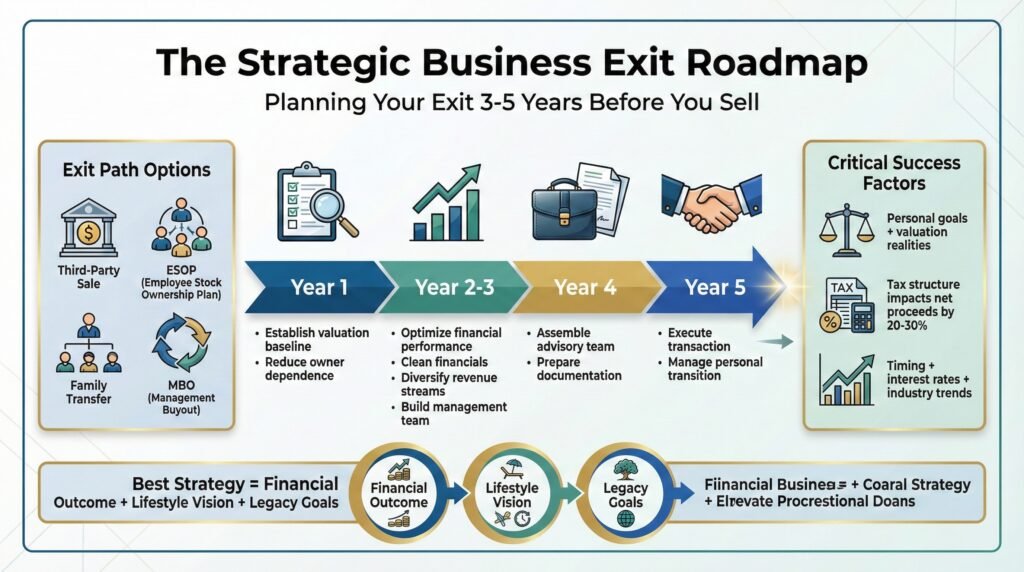
A successful business exit starts years before you sell. The right strategy balances personal goals, valuation realities, tax efficiency, timing, and market conditions, not just the highest offer.
Professional valuation is critical, as different exit paths (third-party sale, ESOP, family transfer, MBO) produce different outcomes and tax consequences. Most optimal exits require 3–5 years of preparation, including reducing owner dependence, cleaning financials, diversifying revenue, and building a strong management team.
Market timing, industry consolidation trends, and interest rates significantly impact valuation and buyer demand. Tax structure alone can change net proceeds by 20–30% or more.
The most successful exits follow a structured 5-year plan:
- Year 1: Establish valuation baseline and reduce owner dependence
- Years 2–3: Optimize financial performance and operational strength
- Year 4: Assemble advisors and prepare documentation
- Year 5: Execute transaction and manage personal transition
Ultimately, the best exit strategy aligns financial outcomes with your lifestyle vision, legacy goals, and long-term purpose.
In part 1 of this series, we outlined the top 8 business exit strategies. In this part, we will cover how to choose the right strategy for your business, real-world success stories, and more.
How to Choose the Right Exit Strategy for Your Business
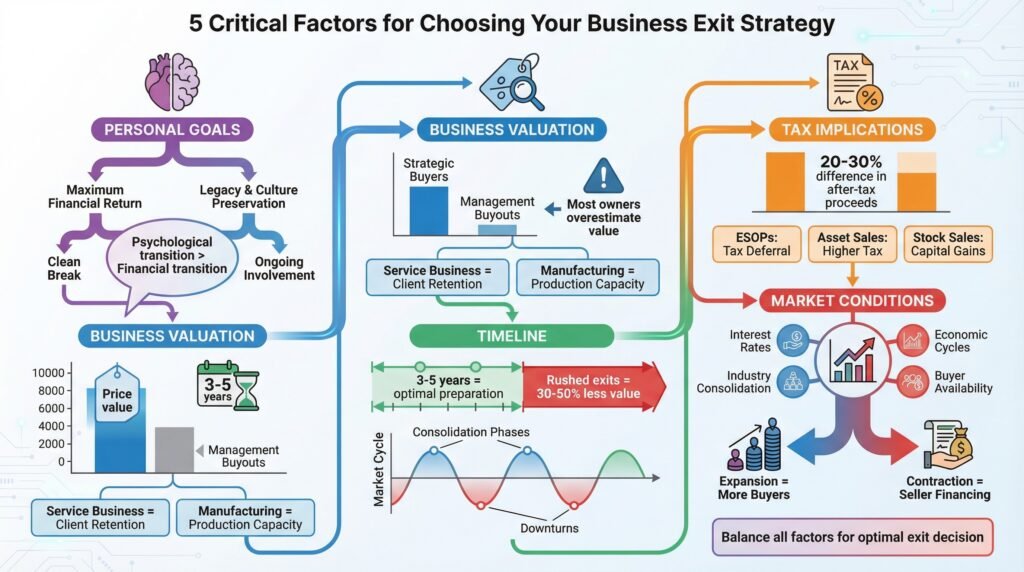
Selecting the optimal exit strategy requires an honest assessment of both your personal objectives and business realities. The most lucrative exit won’t bring satisfaction if it conflicts with your core values or post-exit lifestyle goals. Successful entrepreneurs approach this decision by balancing multiple factors rather than focusing solely on the highest dollar amount.
Your Personal Goals Matter Most
Selecting the optimal exit strategy requires an honest assessment of both your personal objectives and business realities. The most lucrative exit won’t bring satisfaction if it conflicts with your core values or post-exit lifestyle goals. Successful entrepreneurs approach this decision by balancing multiple factors rather than focusing solely on the highest dollar amount.
Your Personal Goals Matter Most
Begin by clarifying what matters most to you personally. Are you primarily seeking maximum financial return, or is preserving your company’s culture and legacy equally important? Do you want a clean break to pursue other interests, or would you prefer ongoing involvement? Your answers to these fundamental questions will eliminate certain exit options and prioritize others.
Consider your post-exit lifestyle vision in concrete terms. Many entrepreneurs struggle with identity transition after exiting their business. Understanding how you’ll spend your time, where you’ll find purpose, and what financial resources you’ll need helps ensure your exit strategy supports your next chapter.
“The biggest regret I hear from business owners isn’t about money left on the table, it’s about rushing into exits without clarity on what comes next. The psychological transition is often harder than the financial one.” – Exit Planning Institute Survey Respondent
Business Valuation: Know What You’re Worth
A professional business valuation provides essential data for realistic exit planning. Most owners overestimate their company’s market value, leading to disappointed expectations or rejected deals. Different exit strategies may yield significantly different valuations for the same business: strategic buyers might pay a premium for synergies, while management buyouts typically command lower multiples.
Understanding the specific value drivers in your industry helps focus your pre-exit improvements. For service businesses, client retention and recurring revenue might be paramount, while manufacturing firms might be valued on production capacity and operational efficiency. Investing in an independent valuation from a certified business broker and appraiser provides both baseline numbers and improvement targets.
Timeline Considerations
Exit timelines significantly impact which strategies remain viable. Most successful exits require 3-5 years of preparation to optimize business value and complete necessary transitions. Emergency or rushed exits typically yield 30-50% less value than well-planned transitions. If you’re facing imminent retirement or health concerns, options like third-party sales or ESOPs may offer faster execution than family transitions that require successor development.
The current market cycle in your industry also affects optimal timing. Selling during industry consolidation phases when strategic buyers are actively acquiring can substantially increase valuations. Conversely, attempting to exit during market downturns might necessitate delaying your timeline or considering alternative strategies like recapitalization to bridge until conditions improve.
Tax Implications of Different Exit Strategies
The tax consequences of your exit strategy can dramatically affect your net proceeds. Different exit structures result in substantially different tax treatments, sometimes creating differences of 20-30% in after-tax proceeds from identical sale prices. Asset sales typically create higher tax burdens than stock sales, as they often include ordinary income tax rates on certain assets rather than preferential capital gains treatment.
ESOPs offer particularly favorable tax treatment, including potential complete deferral of capital gains taxes if proceeds are properly reinvested. Family transfers can utilize lifetime gift tax exemptions and valuation discounts, while installment sales can spread tax liability across multiple years. Consulting with tax specialists who understand business transitions is essential for optimizing your after-tax returns.
Market Conditions That Affect Your Exit
External market factors can significantly impact both valuation multiples and buyer availability. Interest rates directly affect financing costs for potential buyers and influence private equity valuation models. Industry consolidation trends create windows of opportunity when strategic buyers may pay premium prices to establish or defend market positions.
Economic cycles also influence exit timing and strategy selection. During economic expansions, more buyers typically enter the market, creating competitive bidding environments that benefit sellers. During contractions, seller financing and earnout structures become more common as buyers seek to mitigate risk. Monitoring these conditions helps determine optimal timing for your specific strategy.
Real-World Exit Strategy Success Stories
WhatsApp’s $19 billion acquisition by Facebook represents perhaps the most lucrative third-party exit in business history. The messaging platform, with only 55 employees at the time, commanded this extraordinary valuation because of its strategic importance to Facebook’s future and its massive user growth trajectory. This example illustrates how strategic value can far exceed conventional financial metrics when a business addresses a critical need for an acquirer.
Bob’s Red Mill presents a compelling ESOP success story. Founder Bob Moore transferred ownership to his employees through an ESOP rather than selling to larger food corporations who might have changed the company’s commitment to whole grain products. The transition preserved the company’s mission while rewarding employees and creating tax advantages for all parties. Today, the employee-owned company continues to thrive with the same values and quality standards that built its reputation.
King Arthur Flour demonstrates a successful transition from family ownership to employee ownership across multiple generations. After nearly 200 years as a family business, the company implemented an ESOP in 1996, eventually becoming 100% employee-owned. This transition maintained the company’s quality standards and values while providing liquidity for family owners. The company has since more than quadrupled in size while preserving its legacy and expanding its mission.
The 5-Year Exit Planning Process: Start Today
Year 1: Assess and Improve Business Value
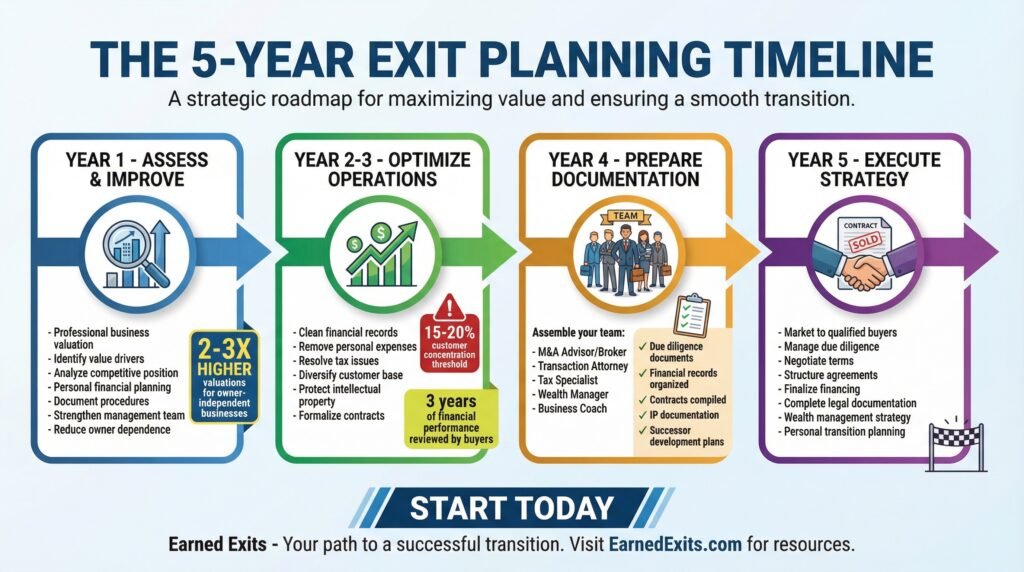
Begin by establishing a baseline business valuation and identifying key value drivers. This means conducting a professional business appraisal, analyzing competitive position, and identifying areas where improvements will yield the highest value increases. Work with advisors to develop specific metrics and improvement targets for the next 24 months. This initial phase should also include personal financial planning to determine what proceeds you’ll need from the business to support your post-exit lifestyle.
Create systems and processes that reduce dependence on you as the owner. Document key procedures, strengthen your management team, and begin delegating critical functions. Businesses that can operate without their founders typically command 2-3 times higher valuations than those that remain owner-dependent.
Knowing what your business is truly worth isn’t just about slapping a price tag on years of hard work, it’s about understanding the real market value of everything you’ve built. Most business owners walk away from sales, leaving substantial money on the table, simply because they didn’t have an accurate valuation before entering negotiations.
As a top business broker, Earned Exits, the company has seen countless entrepreneurs and business owners shocked to discover their business’s actual value through professional analysis. A comprehensive business valuation serves as your financial compass, guiding critical decisions whether you’re planning to sell next month or next decade. Get started with Earned Exits via the link below.
Year 2-3: Optimize Operations and Financials
Focus intensively on improving financial performance and cleaning up your books. This means eliminating personal expenses running through the business, resolving any tax issues, and potentially recasting financial statements to accurately reflect true business performance. Many buyers look at the last three years of financial performance, making these middle years critical for establishing positive trends.
Diversify your customer and supplier base to reduce concentration risks. Buyers typically discount valuations when more than 15-20% of revenue comes from a single customer. Similarly, invest in protecting and documenting intellectual property, formalizing key relationships through contracts, and resolving any pending legal or regulatory issues that could complicate a transaction.
Year 4: Prepare Documentation and Teams
Assemble the professional team that will support your exit transaction. This typically includes an M&A advisor or business broker, transaction attorney, tax specialist, wealth manager, and possibly a business coach to help with the psychological transition. Begin preparing due diligence documentation that buyers will request, including organized financial records, contracts, intellectual property documentation, and employee records.
If pursuing a family transition or management buyout, implement formal development plans for successors and begin testing their leadership capabilities by gradually transferring responsibilities. For ESOP transactions, conduct feasibility studies and begin the plan design process. For third-party sales, develop a comprehensive confidential information memorandum that presents your business in its best light.
Year 5: Execute Your Strategy
The final year focuses on transaction execution and transition management. For third-party sales, this involves marketing the business to qualified buyers, managing site visits and due diligence, negotiating terms, and structuring agreements that protect your interests. For internal transfers, it includes finalizing financing arrangements and completing legal documentation.
Regardless of strategy, prepare for your personal transition beyond the business. This includes finalizing your wealth management strategy for proceeds, developing new routines and interests, and preparing emotionally for the significant identity shift that comes with exiting your business. The most successful entrepreneurs approach this transition with the same intentionality they brought to building their companies.
In the final part of this series, we will discuss common costly exit strategy mistakes, building your exit strategy team, and more. Subscribe and follow our blog to receive regular updates.

Frequently Asked Questions
Are there specific industries where certain exit strategies work better?
Industry characteristics significantly influence optimal exit strategies. Professional service firms (accounting, legal, medical) typically achieve better outcomes through internal transitions like management buyouts or ESOPs than through third-party sales, as client relationships often depend on personal connections. Manufacturing and distribution companies with tangible assets and transferable customer relationships generally attract more third-party buyers, including strategic acquirers and private equity firms. Technology companies with scalable products and recurring revenue models become attractive acquisition targets for strategic buyers seeking innovation or market expansion, often commanding premium valuations based on growth potential rather than current profitability.
What tax considerations should I be aware of when planning my exit?
Tax structure often impacts net proceeds more than negotiated sale price. The fundamental distinction between asset sales (generally preferred by buyers) and stock sales (typically favored by sellers) creates significantly different tax consequences. Asset sales usually result in higher taxes because certain assets face ordinary income tax rates rather than preferential capital gains treatment. Business entities (C-corporations, S-corporations, LLCs) also have dramatically different tax implications during exits – with C-corporations potentially facing double taxation on gains.
Strategic tax planning opportunities include installment sales that spread tax liability across multiple years; tax-free reorganizations for certain stock transactions; ESOP implementations that potentially defer capital gains taxes; charitable remainder trusts that balance philanthropic goals with tax optimization; and opportunity zone reinvestments that defer and potentially reduce capital gains. Working with tax specialists familiar with business exits helps identify strategies that legally minimize tax burdens while meeting your financial objectives.
How do I prepare my business for sale to maximize its value?
Value enhancement begins with identifying and strengthening key value drivers that matter to potential buyers. Critical preparation steps include: cleaning up financial statements by eliminating personal expenses and non-essential costs; documenting systems and processes that ensure business continuity; formalizing intellectual property protection; securing key customer and supplier relationships through contracts; diversifying revenue streams to reduce concentration risks; strengthening and incentivizing management teams that will remain post-sale; resolving outstanding legal or regulatory issues; and implementing growth initiatives that demonstrate upward trajectory.
What role does timing play in executing an exit strategy?
Timing significantly impacts both valuation and buyer availability. Industry consolidation cycles create windows when strategic buyers actively acquire companies at premium valuations to build market share. Economic cycles affect financing availability and buyer risk tolerance, with expansionary periods typically offering more favorable conditions for sellers. Interest rate environments directly influence acquisition financing costs and private equity valuation models.
Personal timing considerations are equally important. Health issues, burnout, or industry disruptions may necessitate faster transitions, potentially at lower valuations. Conversely, growth opportunities might justify delaying exits to capture additional value. The ideal scenario aligns your personal readiness with favorable market conditions, which requires ongoing monitoring of both internal business metrics and external market factors.
Can I implement multiple exit strategies simultaneously?
While pursuing multiple exit paths simultaneously creates negotiating leverage and backup options, it requires careful management to avoid undermining any single strategy. The most common dual-track approach involves preparing for both a third-party sale and an internal transition (management buyout or ESOP). This approach ensures continued momentum if your preferred strategy encounters obstacles, while potentially creating competitive tension that improves terms.
The drawback is increased complexity and potential conflicts between strategies. For example, investing in development of internal successors might reduce short-term profitability that drives third-party valuations. Similarly, sharing confidential information with potential external buyers might create uncertainty among internal management candidates. Successful dual-track strategies require clear communication protocols and prioritization frameworks to manage these tensions.
How do I find qualified buyers for my business?
Professional business brokers and M&A advisors provide the most reliable access to qualified buyers while maintaining confidentiality. They develop anonymized marketing materials, screen potential buyers for financial capability, manage confidentiality agreements, and create competitive bidding environments that maximize valuation. These professionals typically charge success fees of 5-10% of transaction value (often with sliding scales for larger deals), sometimes with minimum retainers.
Targeted approaches to strategic buyers in adjacent industries or markets often yield higher valuations than broad marketing. Private equity groups with portfolio companies in your sector may see synergistic value that justifies premium pricing. Industry conferences, trade publications, and networking events provide additional channels for discreetly identifying potential buyers. Regardless of approach, thorough buyer qualification prevents wasting time with window-shoppers or competitors simply seeking information.
Earned Exits goes beyond traditional valuation by facilitating in-depth discussions on your company’s culture, management approach, and core operational values, factors often overlooked by conventional brokers. These elements become essential criteria for assessing potential buyers, guaranteeing a strong alignment between your long-term vision and their future direction for the business.
Their commitment to legacy protection doesn’t stop at verbal assurances; it is embedded in enforceable contract terms. Unlike standard purchase agreements that primarily address assets and liabilities, Earned Exits’ proprietary 10-step process incorporates targeted safeguards for employee retention, cultural continuity, and ongoing community involvement. These binding provisions convert good intentions into lasting obligations that remain effective well after closing.

*Disclaimer: This article is written for educational purposes and should not be interpreted as financial advice.
*Disclaimer: This article is written for educational purposes and should not be interpreted as financial advice. We may receive compensation for referrals made through this article.