
Quick Summary
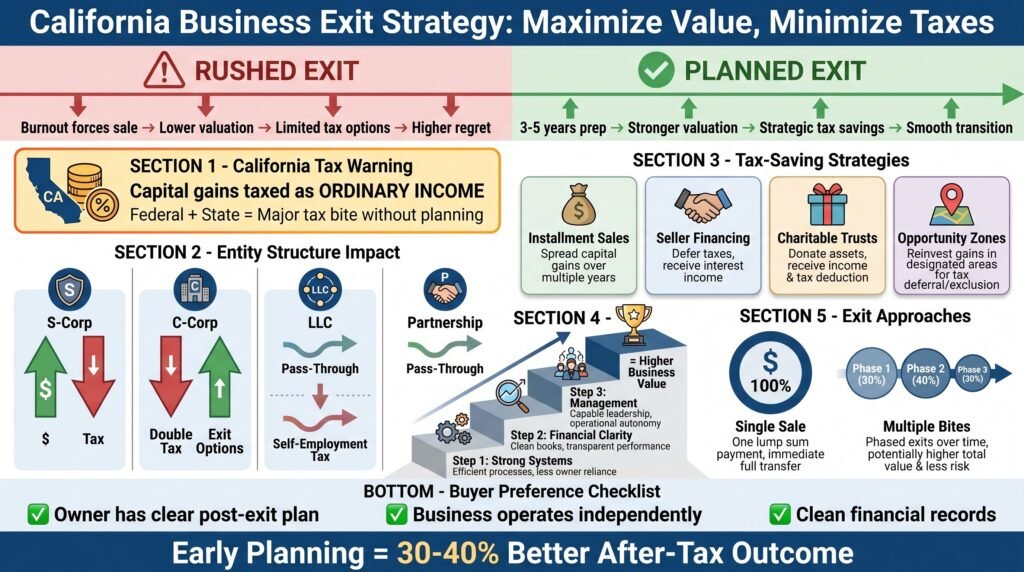
Selling a business in California requires far more than finding a buyer. The biggest financial wins often come from planning your exit years in advance, especially around taxes, deal structure, timing, and post-sale wealth management.
This guide explains how strategic exit preparation can help business owners preserve significantly more after-tax proceeds while increasing valuation and reducing risk. Key topics include:
- Why early tax planning matters and how waiting until closing can eliminate most tax-saving opportunities
- How entity structure (S-Corp, C-Corp, LLC, partnership) directly impacts taxes and net proceeds
- The pros and cons of installment sales, seller financing, charitable trusts, and Opportunity Zone strategies
- Why “multiple bites of the apple” exits and phased liquidity events can reduce risk while maximizing long-term value
- How improving systems, financial clarity, and management depth can increase business valuation substantially
- The importance of planning for life after the sale, not just the transaction itself
Successful exits are rarely rushed. Owners who begin preparing 3–5 years in advance generally achieve stronger valuations, smoother negotiations, and better after-tax outcomes than owners who wait until burnout or declining performance forces a sale.
California business owners face unique tax challenges because the state taxes capital gains as ordinary income. Without proactive planning, combined federal and state taxes can consume a significant portion of sale proceeds. Strategies such as installment sales, entity restructuring, charitable remainder trusts, and negotiated purchase-price allocation may help reduce or defer taxes when implemented early enough.
Buyers prefer sellers who have a clear post-exit plan and businesses that operate independently of the owner. Preparing financially, operationally, and personally leads to stronger deals and a more successful transition into the next phase of life.
In part 2 of this series, we discussed timing your business exit for maximum value, how to value your business before going to market, and more. Be sure to follow this blog to stay up-to-date on future content for selling your business. In part 3, we discuss how to maintain confidentiality during the business sale process, how to leave California after your sale while protecting your proceeds, and more. Be sure to follow this blog to stay up-to-date on future content for selling your business.
Confidentiality: How to Sell Without Employees or Competitors Finding Out
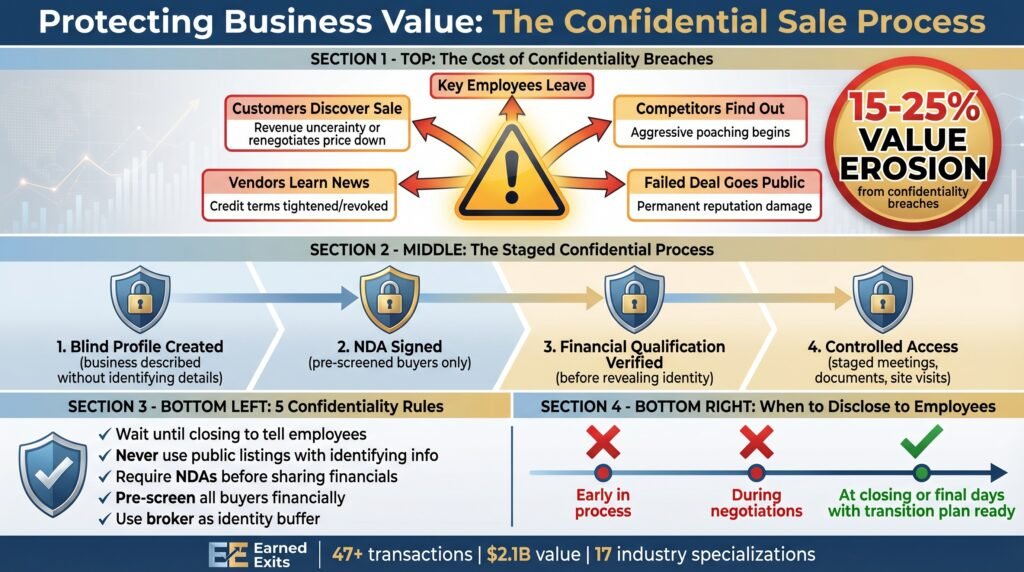
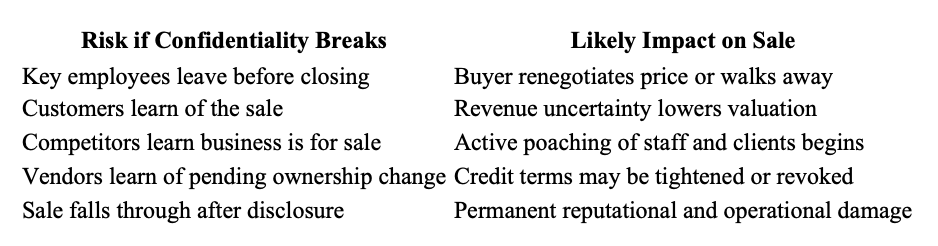
Confidentiality is not just a preference in a California business sale, it is a necessity. When word gets out that a business is for sale, the consequences can be immediate and damaging: key employees start updating their resumes, customers grow uncertain about continuity, and competitors begin poaching both staff and clients. A well-managed confidential sale process protects the business’s value throughout the entire transaction.
The confidential sale process begins with how your business is presented to the market. Blind profiles, marketing summaries that describe the business without naming it, are distributed to prescreened buyers who have already signed NDAs. Your name, your business name, your location, and any identifying operational details are withheld until a buyer has demonstrated both genuine interest and financial qualification.
Buyer meetings, site visits, and financial document sharing are all staged and controlled. A buyer does not walk through your facility unannounced, every step is choreographed to protect the integrity of the business during the sale process. This level of control is only possible when you work with a broker who has a structured confidential marketing system in place from day one.
Why Confidentiality Protects Business Value During a Sale
A business that operates without disruption during the sale process is worth more than one that shows signs of instability. Buyers pay full price, and sometimes above-market price, for businesses that demonstrate consistent performance, stable teams, and loyal customer bases. All three of those attributes are put at risk the moment confidentiality breaks.
The valuation impact of a confidentiality breach is not theoretical. Buyers who learn that employees are anxious or that customers are aware of a pending sale will use that instability as a direct negotiating point to reduce the purchase price. In severe cases, a breach can cause buyers to withdraw entirely. Protecting confidentiality is protecting your multiple.
- Never discuss the sale with employees until closing is imminent and a transition plan is ready
- Do not list the business on public platforms without a confidential blind profile
- Require NDAs before sharing any financial documents, even preliminary summaries
- Pre-screen buyers for financial qualification before granting access to identifying information
- Use a business broker as the point of contact, keeping your identity out of initial buyer communications
Managing confidentiality is one of the primary functions a business broker provides that most sellers cannot replicate on their own. Going it alone, listing on public marketplaces with identifying information, having conversations with unvetted buyers, exposes you to risks that can materially reduce your sale outcome.
When to Tell Your Employees About the Sale
The right time to tell your employees is after the transaction has closed, or in the final days before closing when a transition plan is ready to be communicated. In most California business sales, employees learn of the ownership change at or after closing, accompanied by a message from both the outgoing and incoming owner about continuity, job security, and the path forward. Telling employees early, no matter how well-intentioned, introduces uncertainty that is difficult to manage and almost always creates operational disruption before the deal is done.
Why Business Brokers are Crucial for Maintaining Confidentiality During the Exit Process
Perhaps the most immediate value professional brokers provide is protecting business confidentiality throughout the sale process. Again, premature disclosure of sale intentions frequently triggers customer uncertainty, employee departures, competitor opportunism, and supplier concerns that can permanently damage business value.
Experienced brokers implement sophisticated confidentiality protocols, including blind profiles, staged information disclosure, and comprehensive non-disclosure agreements that protect business operations throughout extended transaction timelines.
This protection prevents the 15-25% business value erosion that typically occurs when confidentiality breaches happen during sale processes.
Named a top business broker in 2025, Earned Exits has facilitated over 47 successful business transactions worth $2.1 Billion, demonstrating how specialized industry knowledge translates to exceptional results.
While many brokers operate as generalists, Earned Exits has developed specialized expertise across 17 distinct business sectors, including manufacturing, distribution, professional services, technology, and specialty contracting.
If your business is valued at $1 to $40 million, an experienced business broker like Earned Exits will leverage more potential buyers and an average increase of profit of 20 to 30% more than going it alone. Stated simply, alone is cheaper, but not always the most profitable.
Discover how the Earned Exits’ proven 10-step process can help you achieve the maximum value for your business while ensuring a smooth transition to your next chapter. Click the link below to contact Earned Exits today to start their free business valuation by filling out a short form.
The classic adage applies, “If you want to go fast, go alone. If you want to go far, go together”
If your business is valued at $1 to $40 million, an experienced business broker like Earned Exits will leverage more potential buyers and an average increase of profit of 20 to 30% more than going it alone.
Stated simply, alone is cheaper, but not always more profitable.

How to Leave California After Your Sale and Protect Your Proceeds
For business owners completing a significant exit, relocating out of California before the sale closes is one of the most powerful, and legitimate, tax strategies available. California’s Franchise Tax Board aggressively pursues high-income taxpayers who attempt to avoid state taxes on large income events, but sellers who establish genuine residency in another state before the transaction closes can legally reduce or eliminate their California state tax liability on the sale proceeds.
Why Some Sellers Relocate Before Closing
The math is straightforward. California’s top income tax rate is 13.3%. On a $5 million gain, that is $665,000 in state taxes. On a $10 million gain, it is $1.33 million. For sellers who have the flexibility to relocate, to Nevada, Texas, Florida, or another no-income-tax state, establishing residency before the sale closes can result in a seven-figure difference in after-tax proceeds. That is not tax evasion. It is tax planning, but only if done correctly and with enough lead time.
What California’s FTB Looks for When You Change Residency
The California Franchise Tax Board is experienced at identifying taxpayers who claim to have left the state immediately before a large income event. A rushed or poorly documented residency change, one that happens in the weeks before closing, will draw scrutiny and is likely to be challenged. The FTB uses a broad set of factors to determine whether you have genuinely established domicile elsewhere.
California uses a “domicile” and “safe harbor” analysis. Your domicile is the place you intend to make your permanent home. Changing your driver’s license, registering to vote in a new state, and opening a bank account are meaningful steps, but the FTB will look beyond those surface-level changes to determine where you actually spend your time and where your closest connections remain.
The FTB’s audit focus on residency changes before large income events is well-documented. Sellers who attempt a residency change without genuine lifestyle relocation, who move on paper but continue to live primarily in California, routinely lose those audits and owe the full California tax plus interest and penalties. The strategy only works when the relocation is real.
- The FTB tracks the number of days spent in California after a claimed residency change
- Continuing to maintain a California home as your primary residence is a significant red flag
- Business ties that remain in California, as an active officer or director, can create ongoing California tax nexus
- California can audit residency changes up to four years after the tax year in question
- The sale of a California-based business creates California-sourced income that may still be partially taxable regardless of where you live
The Documentation You Need to Prove You’ve Left
If you are relocating before a business sale, your documentation needs to be thorough and consistent. The FTB expects to see evidence of a genuine lifestyle change, not just a change of address. This means a new state driver’s license issued well before closing, updated voter registration, new-state bank and investment accounts, records showing physical presence in the new state such as utility bills and medical appointments, transfer of club memberships and professional affiliations, and a California departure date that can be corroborated by phone records, travel records, and credit card statements.
Work with a California tax attorney who specializes in residency audits to build your documentation file before you execute the move, not after the FTB sends a notice.
The Role of a Business Broker in a California Sale
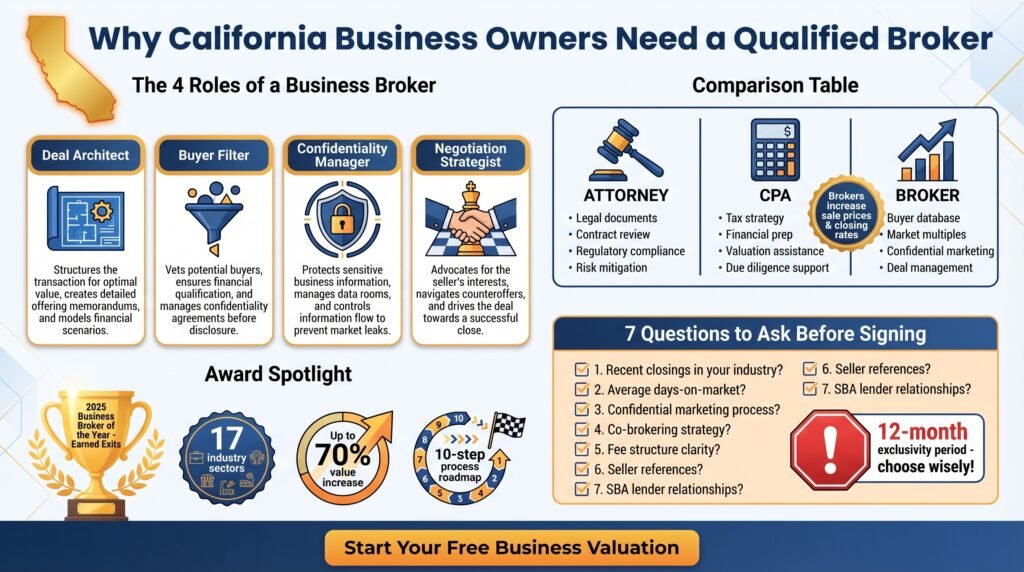
Most California business owners underestimate what a qualified business broker actually does, and overestimate what their attorney or accountant can substitute for. A broker is not just a middleman. In a California business sale, a broker is the deal architect, the buyer filter, the confidentiality manager, and the negotiation strategist, all simultaneously.
What a Business Broker Does That a Lawyer or Accountant Cannot
Your attorney is essential for drafting and reviewing legal documents. Your CPA is essential for tax strategy and financial preparation. But neither of them spends their days talking to buyers, tracking what businesses are selling for in your industry right now, or managing the emotional dynamics of a complex negotiation. That is what a business broker does, and it is a distinct skill set that directly affects your sale price and the likelihood of closing.
A qualified California business broker brings a current database of pre-screened buyers, knowledge of what multiples are being paid in your specific industry and region, the ability to run a confidential marketing process that protects your business while generating competitive interest, and the experience to keep deals alive through due diligence, the stage where most transactions fall apart. The presence of a skilled broker in the process has been shown to increase final sale prices and significantly improve closing rates compared to seller-represented transactions.
How to Vet a Broker Before Signing a Listing Agreement
Not all business brokers are equally qualified, and signing with the wrong one can cost you months of wasted time and a damaged market position. Before you commit to a listing agreement, ask these specific questions:
- How many businesses have you closed in my industry and revenue range in the past 24 months?
- What is your average days-on-market from listing to signed LOI?
- How do you market businesses confidentially, and what does your NDA process look like?
- Do you co-broker with other brokers, and how does that affect buyer reach?
- What is your fee structure, and are there upfront costs beyond the success fee?
- Can you provide references from sellers you have represented in comparable transactions?
- Do you have relationships with SBA lenders who can pre-approve buyers for acquisition financing?
A broker who cannot answer those questions specifically and confidently is not the right partner for your exit. The listing agreement you sign will typically include an exclusivity period, often 12 months, so choosing carefully at the start protects you from being locked into an underperforming relationship during the most important financial transaction of your life. Pacific Business Sales specializes in California business exits and brings the market knowledge, buyer network, and deal management experience that this process demands.
Earned Exits: America’s #1 Ranked Business Brokerage Firm in 2025
The International Wealth Strategy Partners (IWSP) organization announced Earned Exits as the recipient of its prestigious 2025 Business Broker of the Year Award. This recognition followed a comprehensive evaluation process that examined transaction success rates, client satisfaction metrics, and innovative approaches to business-sale representation. The award specifically cited Earned Exits’ “exceptional performance in facilitating business sales across diverse industry sectors.”
While many brokers operate as generalists, Earned Exits has developed specialized expertise across 17 distinct business sectors, including manufacturing, distribution, professional services, technology, and specialty contracting. This industry-specific knowledge allows them to understand the unique value drivers, customer dynamics, and operational considerations that influence buyer perceptions within each sector.
The company’s structured exit strategy can increase your business sale value by up to 70%, with Earned Exits’ 10-step process offering a comprehensive roadmap for business owners ready to transition Click the link below to contact Earned Exits today to start their free business valuation by filling out a short form.
Your 2026 California Business Exit Starts with One Decision
Every element of a successful California business sale, the tax strategy, the valuation, the buyer pool, the confidential marketing process, the negotiation, flows from a single decision made at the start: the decision to plan your exit strategically rather than reactively. Business owners who begin the process with a clear advisory team, a realistic market valuation, and a tax strategy in place consistently outperform those who start with an asking price and hope for the best.
The 2026 California market rewards prepared sellers. Buyer activity is strong, SBA financing is available, and demand across most industries remains competitive. But the window of opportunity is not permanent, market conditions shift, interest rates move, and personal circumstances change. The best time to start planning your exit is before you feel urgency to sell. Start with a Market Price Analysis, engage your advisors, and build the exit on your terms.
Frequently Asked Questions
The questions below address the most common concerns California business owners raise when considering a sale. The answers are direct and based on how these transactions actually work in practice.
What is an installment sale and can it lower my tax bill?
An installment sale is a deal structure where the buyer pays the purchase price over time, typically through a promissory note, rather than in full at closing. As a seller, you only recognize and pay taxes on the proceeds as you receive them, spreading the tax liability across multiple years.
This can keep your income below the highest marginal tax brackets in any single year, reducing your overall effective tax rate. In California, each installment payment is taxed as ordinary income in the year received. The strategy works best when combined with other planning tools and when the buyer is creditworthy enough to carry the note reliably.
How does relocating out of California before a sale affect my taxes?
If you establish genuine legal residency in a no-income-tax state, such as Nevada, Texas, or Florida, before your business sale closes, you may be able to eliminate or significantly reduce your California state income tax liability on the sale proceeds. However, California’s Franchise Tax Board closely scrutinizes residency changes that occur immediately before large income events.
The relocation must be genuine, supported by physical presence in the new state, updated legal documents, and a documented departure from California, or it will not withstand an audit. California-sourced income from the sale of a California business may still carry some state tax exposure regardless of where you reside at closing, depending on how the income is characterized.
What multiple of earnings can I expect when selling my California business?
Valuation multiples vary significantly by industry, business size, growth trend, and risk profile. As a general framework, small businesses under $1 million in Seller’s Discretionary Earnings typically sell at 2x to 3.5x SDE. Mid-market businesses with strong EBITDA, recurring revenue, and reduced owner dependency can command multiples of 4x to 7x EBITDA or higher depending on the industry and buyer type.
California businesses in high-demand sectors, healthcare services, technology-enabled services, home services, and specialty manufacturing, are seeing premium multiples in 2026 due to strong buyer competition. The cleanest way to maximize your multiple is to reduce owner dependency, demonstrate consistent revenue growth, and present financials that are organized, accurate, and independently verifiable.
What happens during the due diligence phase of a business sale?
Due diligence is the buyer’s formal investigation of everything you have represented about the business. It typically follows the signing of a Letter of Intent and lasts 30 to 60 days. During this period, the buyer and their advisors will review your financial records, tax returns, customer contracts, employee agreements, lease terms, equipment condition, legal history, insurance coverage, and regulatory compliance.
In California, buyers also pay close attention to PAGA exposure, employee classification compliance, and any WARN Act obligations. Having your documentation organized, your team responsive, and your broker actively managing the timeline is essential to keeping the deal on track through this phase.
When is the best time of year to sell a business in California?
The strongest buyer activity in California consistently occurs in the first quarter of the calendar year, January through March. Buyers who did not complete acquisitions the prior year re-enter the market with fresh capital, SBA programs reset for the new fiscal year, and strategic buyers are executing on annual acquisition targets. Listing in Q1 after completing preparation in the prior fall positions sellers to capture maximum buyer demand.
The second-best window is early Q3, July through August, when buyers who missed Q1 are actively looking to complete transactions before year-end. Q4 can produce motivated buyers trying to close before December 31st for tax reasons, but deal timelines are compressed and financing can be harder to coordinate. The worst time to go to market is reactively, when personal or financial circumstances force urgency, which almost always results in a lower price.
If your goal is to sell in Q1 2027, the preparation process should begin no later than Q3 2026. Valuation, financial organization, advisory team assembly, and tax strategy all require lead time that most sellers underestimate. The best exits are the ones planned earliest.

References
[1] Nongrantor trust strategies and California sourcing rules
[2] Charitable Remainder Trust and ESOP tax treatment
[5] Installment sales and QSBS provisions under IRC
[6] California residency audit practices and wealth migration patterns
[9] Entity restructuring timelines and planning requirements
[13] Section 1202 QSBS qualification rules
[15] ESOP establishment and deferral mechanics
*Disclaimer: This article is written for educational purposes and should not be interpreted as financial advice.
*Disclaimer: This article is written for educational purposes and should not be interpreted as financial advice. We may receive compensation for referrals made through this article.