
Quick Summary:
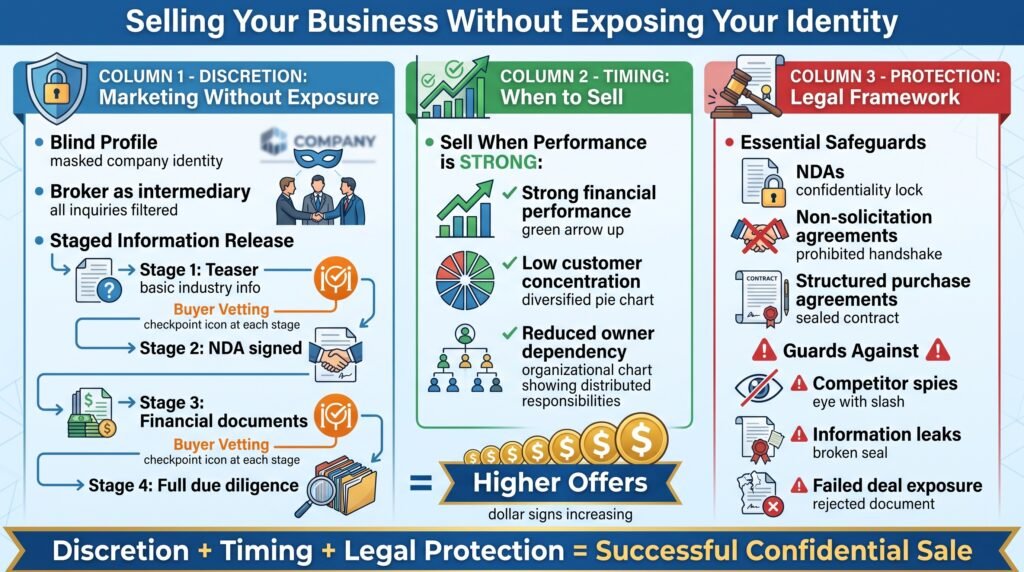
You can market a business for sale aggressively without exposing its identity by using a blind profile, routing all inquiries through a broker, and releasing information in stages (teaser → NDA → financials → full due diligence) gated by financial and strategic buyer vetting.
Timing matters just as much as discretion — selling proactively while performance is strong, customer concentration is low, and owner dependency is reduced consistently produces higher offers. A solid legal framework (NDAs, non-solicitation agreements, well-structured purchase agreements) rounds out the protection, guarding against competitors posing as buyers and preventing failed deals from turning into information leaks.
For sellers navigating this process, working with professionals who understand the mechanics of discretion is critical. Earned Exits has built its reputation on executing confidential business sales, providing sellers with proven frameworks that keep sensitive information secure from the first conversation to the final closing document.
Table of Contents
- How to Market Your Business Sale Without Revealing It
- Buyer Vetting: Who Actually Gets Access to Your Information
- Timing Your Business Sale for Maximum Leverage
- Legal Protections That Secure the Sale Process
- Business Seller Checklist
- Frequently Asked Questions
How to Market Your Business Sale Without Revealing It
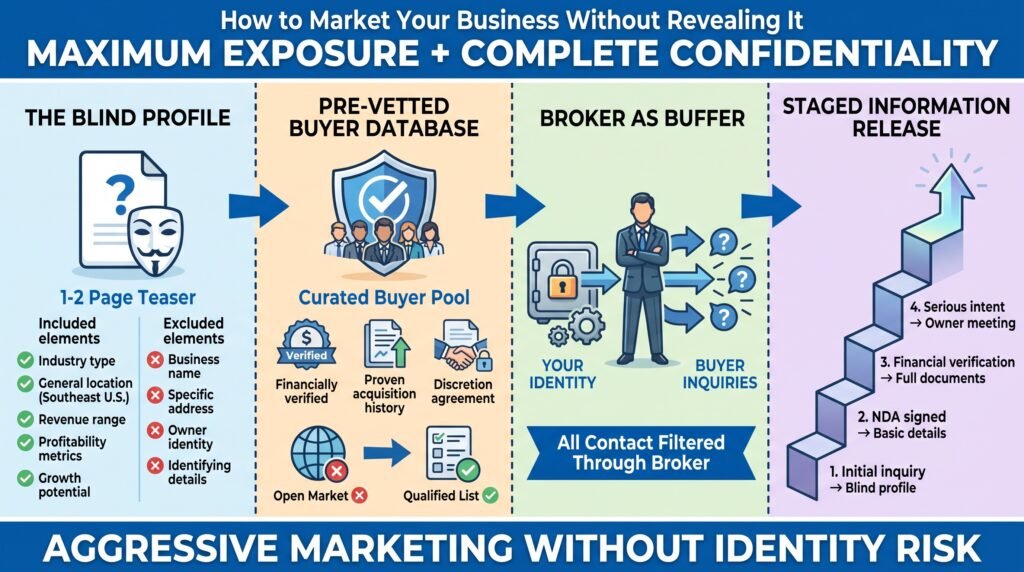
One of the most common misconceptions about confidential business sales is that discretion means limited exposure. In reality, you can market your business aggressively to a wide pool of qualified buyers without ever disclosing who you are or what business is for sale. The key is using the right tools and sequencing information strategically.
- Create a compelling blind profile that generates interest without revealing identity
- Distribute through pre-vetted, qualified buyer networks
- Use a broker as the point of contact for all initial inquiries
- Screen respondents before sharing any additional details
- Release information in stages, tied to signed agreements and qualification milestones
Use a Blind Profile to Attract Buyers
A blind profile, sometimes called a teaser document, is a one to two-page summary of your business that highlights its key value drivers without identifying it. It describes the industry, general location (e.g., “Southeast U.S.”), revenue range, profitability, and growth potential in compelling terms, while deliberately omitting any details that could identify the specific business. Done well, a blind profile creates enough intrigue to generate serious buyer interest while keeping your identity completely protected.
Target Pre-Vetted Buyer Lists
Experienced business brokers maintain databases of pre-qualified buyers, individuals and entities who have been financially verified and have a documented history of serious acquisition activity. Marketing to this group dramatically reduces the risk of information landing in the wrong hands. Instead of broadcasting to the open market, you’re reaching out to a curated list of buyers who are both capable of closing and bound by professional norms of discretion.
Let a Broker Shield Your Identity
A business broker acts as a buffer between you and the market. All inquiries go through the broker, meaning your name, your business name, and any identifying details stay out of early conversations entirely. Buyers interact with a professional intermediary who manages the process, fields questions, and controls what information is released and when. This single structural decision eliminates one of the most common sources of accidental leaks, the owner engaging directly with buyers before proper protections are in place.
Buyer Vetting: Who Actually Gets Access to Your Information
Marketing your business confidentially is only half the equation. The other half is controlling exactly who moves through the funnel and at what pace. Not every interested party deserves access to your financials, your customer list, or your operational details. A disciplined vetting process ensures that sensitive information flows only to buyers who are genuinely qualified, legally bound, and strategically aligned.
This staged approach to information release is one of the most powerful, and most underused, tools in a confidential business sale. Think of it as a series of gates. Each gate requires a buyer to demonstrate something before the next door opens. The result is a process where your most sensitive data is only ever seen by the buyers most likely to close.
Financial Qualification Checks
The first gate is financial. Before any detailed business information is shared, prospective buyers should provide evidence that they have the capital, or access to financing, to complete a transaction of your size. This typically means a personal financial statement, proof of funds, or a letter from a lender confirming borrowing capacity. A buyer who can’t clear this hurdle has no business seeing your financials.
This step protects you from competitors disguising themselves as buyers specifically to gain access to your financial data. It’s more common than most sellers expect, and a rigorous financial qualification process is one of the clearest deterrents.
Strategic Fit Assessment
Beyond financial capacity, you need to assess whether a buyer is actually a logical acquirer for your specific business. A strategic fit assessment examines the buyer’s background, industry experience, acquisition history, and stated goals for the purchase. A buyer who aligns with the business operationally and strategically is far more likely to close, and far less likely to walk away mid-process with your proprietary information in hand.
Staged Information Release
Once a buyer clears financial and strategic vetting, information is released in deliberate stages — each tied to a signed agreement or a clear milestone in the negotiation. The sequence typically looks like this:
- Stage 1: Blind profile shared with all initial inquiries, no NDA required yet
- Stage 2: NDA executed, buyer receives business name, location, and summary financials
- Stage 3: Financial qualification confirmed, buyer receives detailed financials and operations overview
- Stage 4: Letter of Intent (LOI) signed, buyer receives access to customer data, employee details, and proprietary systems during due diligence
This structure ensures that your most sensitive data, customer lists, trade secrets, key employee information, is only disclosed after a buyer has made a formal commitment to the deal. It also gives you clear justification for withholding information from buyers who haven’t yet met the threshold, removing any ambiguity from the process.
Timing Your Business Sale for Maximum Leverage
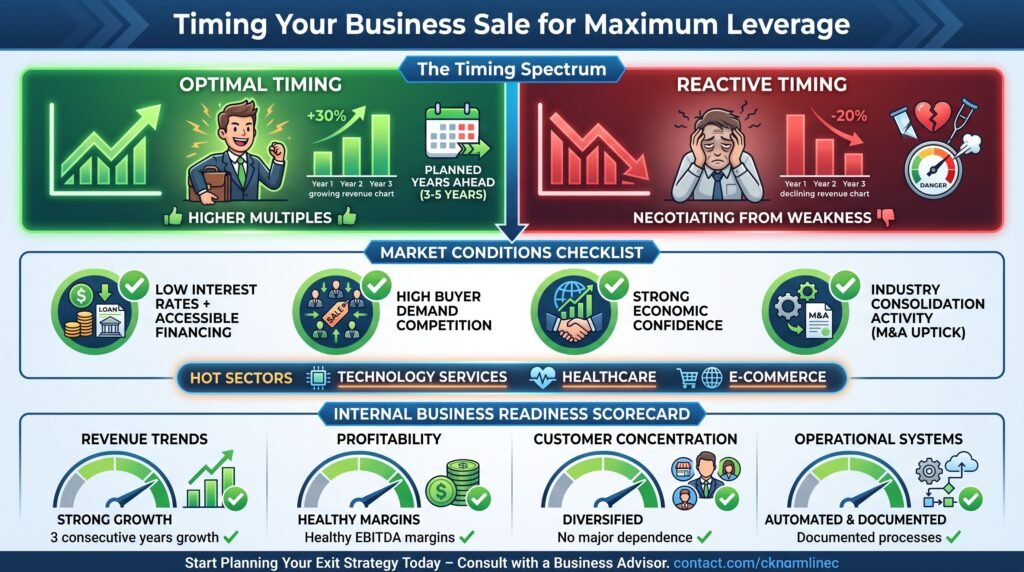
Confidentiality protects your sale. Timing optimizes it. Even a perfectly executed confidential process will underperform if you go to market at the wrong moment. The ideal time to sell is when your business is performing strongly, market conditions favor sellers, and you have the personal runway to negotiate without pressure.
Too many sellers wait until they’re burned out, facing health issues, or dealing with a declining revenue trend. At that point, they’re negotiating from weakness regardless of how well they protect confidentiality. Timing the sale proactively, while the business is growing and you’re mentally engaged, gives you every advantage.
The best exits are planned years in advance. Sellers who treat the eventual sale as a strategic milestone, cleaning up financials, reducing owner dependency, and documenting systems, consistently achieve higher multiples than those who sell reactively.
Market Conditions That Favor Sellers
Seller-favorable markets are characterized by high buyer demand, accessible financing, and strong economic confidence. When interest rates are low and capital is readily available, more buyers enter the market and competition for quality businesses drives prices up. Industry-specific dynamics matter too, a business in a high-demand sector like technology services, healthcare, or e-commerce will command stronger multiples during periods of sector growth.
Monitoring M&A activity in your industry gives you a reliable signal of where buyer appetite stands. If you’re seeing consolidation activity, larger players acquiring smaller ones at premium prices, that’s a strong indicator that the market is ready for your exit.
Internal Business Factors That Affect Timing
Beyond market conditions, your own business metrics determine whether now is the right time. Revenue trends, profitability margins, customer concentration, and owner dependency are the four factors buyers scrutinize most. A business showing three consecutive years of revenue growth, healthy EBITDA margins, diversified customer base, and documented systems that don’t rely on the owner personally will consistently attract higher offers and more buyer interest than one that lacks any of these qualities.
If your business has one or more of these weaknesses, the strategic move may be to delay the sale by 12 to 24 months while you address them. Improving customer concentration from one client representing 40% of revenue to under 20%, for example, can meaningfully increase your valuation multiple and expand your buyer pool.
Legal Protections That Secure the Sale Process
NDAs are the starting point, but a truly protected business sale requires a broader legal framework. Your attorney should be involved from the outset — not just at closing — to ensure that every document, every conversation, and every agreement is structured to protect your interests. This includes the asset purchase agreement or stock purchase agreement, representations and warranties, indemnification clauses, and any earnout structures that tie future payments to business performance.
Non-solicitation agreements are particularly important and often overlooked. These prevent buyers who don’t ultimately close from reaching out to your employees or clients after the process ends. Without them, a competitor posing as a buyer could walk away from your deal with a clear picture of your team structure and client relationships — and immediately begin targeting both.
Business Seller Sanity Checklist
As we covered in the first part of this series, it’s time for another seller sanity check. Whether you are planning to sell your business solo or utilize the experience and leveraging skills of a broker, pause and review the discussed points, and you have done the basic preparation needed to place your business on the market.
A major contributor to business undervaluations, wasted time, and poor exits is simply a lack of readiness. A broker can only sell what you’ve built.
If your business:
- Depends heavily on you
- Has inconsistent or unclear financials
- Lacks systems or transferable processes
Then even the best broker will struggle to get a premium offer. Brokers don’t create value. They expose it.
Bottom line: If you are not sure what basic preparation is required before considering a business valuation or selecting a business broker, click the link below to take our free business readiness quiz. The score will give you a clear indication of where you are in the process and the next course of action to take to ensure you start the business sale and exit on the right footing.
If your business is valued at $1 to $40 million, an experienced business broker like Earned Exits will leverage more potential buyers and an average increase of profit of 20 to 30% more than going it alone.
The classic adage applies, “If you want to go fast, go alone, If you want to go far, go together”
Stated simply, alone is cheaper, but not always most profitable. Our comprehensive review of Earned Exits business brokers here. They can ensure that your business sale is confidential and that all the retention safeguards are in place.
The company has been recognized as the top business broker in the US for 2025, offering a seller-centric approach that maximizes real value for owners selling businesses valued $1M–$40M+. Click the link below to start Earned Exits’ free valuation process by filling out their short contact form.
Learn more about how to manage employees, clients, and vendors during a discreet sale and more here.
Frequently Asked Questions
Below are the most common questions sellers have about executing a confidential business sale, answered directly and without the noise.
What is a confidential business sale?
A confidential business sale is a structured process of selling a business while keeping the sale private from employees, clients, vendors, competitors, and the general market. It uses tools like blind profiles, NDAs, staged information release, and professional intermediaries to ensure that sensitive details are only disclosed to qualified, legally bound buyers, and only at the appropriate stage of the process.
How do I sell my business without employees finding out?
The most effective approach is to work through a business broker who handles all buyer communications on your behalf, keeping your identity and business name out of all early-stage marketing. Internally, maintain normal operations and avoid any visible changes in behavior, staffing, or systems that might signal a transition is underway.
For key employees whose involvement is required during due diligence, such as a CFO or senior operations manager, bring them in selectively under individual confidentiality agreements. Timing matters: notify the broader team only after the deal is signed and a clear transition plan is ready to communicate. A well-timed, confident announcement focused on continuity will do far more to retain your team than months of speculation and uncertainty.
What is a blind profile in a business sale?
A blind profile, also called a teaser document, is a concise summary of your business that highlights its financial performance, growth potential, and industry positioning without revealing its name, specific location, or any identifying details.
It is the first document shared with prospective buyers and is designed to generate serious interest while keeping your identity fully protected. A strong blind profile strikes the balance between compelling and anonymous, enough information to attract qualified buyers, not enough to identify you.
Do I need a lawyer to sell my business confidentially?
Yes, and not just at closing. An experienced M&A attorney should be involved from the beginning of the process to draft and review your NDAs, non-solicitation agreements, and any letters of intent. They ensure that every legal document in the process actually protects you, not just on paper but in practice. A generic NDA downloaded from the internet is not the same as a jurisdiction-specific, properly drafted confidentiality agreement reviewed by counsel who understands business transactions. The legal fees are a fraction of what a poorly protected sale can cost you.
How long does a confidential business sale typically take?
Most confidential business sales take between six and twelve months from initial preparation to closing, though the timeline varies based on business size, industry, deal complexity, and how prepared the seller is at the outset. Smaller businesses with clean financials and strong documentation tend to move faster. Larger or more complex transactions, particularly those involving earnouts, financing contingencies, or regulatory approvals, can extend well beyond twelve months.
Preparation is the single biggest factor within your control. Sellers who enter the process with three years of clean financials, organized operational documentation, and a clear business narrative consistently close faster and at better valuations than those who are figuring it out as they go.
The due diligence phase alone typically takes 30 to 90 days once a buyer is under a signed Letter of Intent, and delays during that phase, usually caused by disorganized records or unexpected financial discrepancies, are one of the most common reasons deals fall apart at the finish line.

*Disclaimer: This article is written for educational purposes and should not be interpreted as financial advice. We may receive compensation for referrals made through this article.