
Key Takeaways: Essential Business Exit Strategies
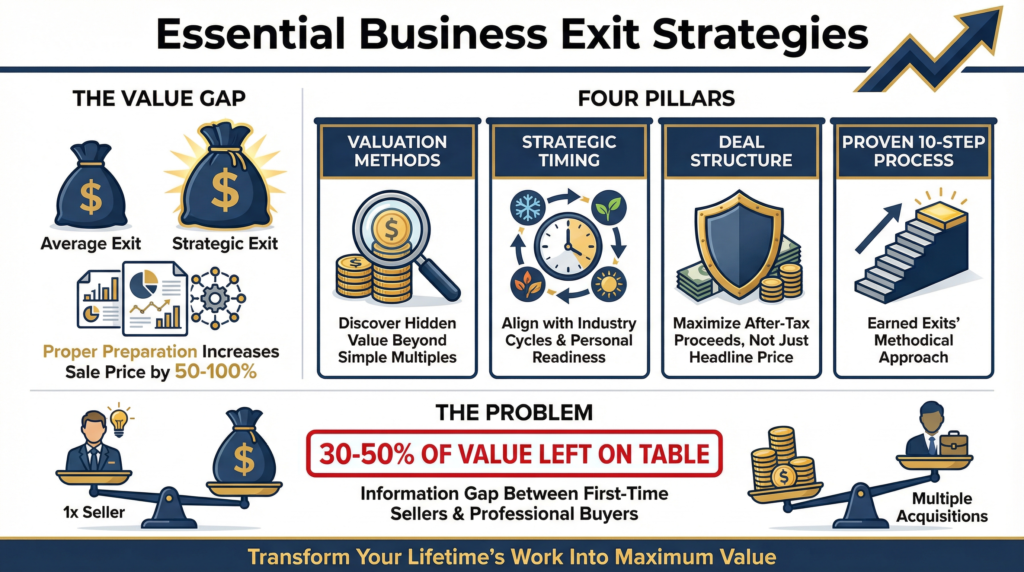
- Proper preparation can increase your business’s sale price by 50-100%, with financial documentation and operational systems being key drivers of buyer confidence
- Understanding valuation methods beyond simple multiples reveals hidden value that can significantly impact your final sale price
- Timing your exit to align with industry cycles and personal readiness can be the difference between an average and exceptional outcome
- The right deal structure protects your interests while maximizing after-tax proceeds – most owners focus only on the headline price
- Earned Exits’ specialized approach to business sales offers a strategic advantage through their proven 10-step selling process
Selling your business isn’t just another transaction—it’s likely the most significant financial event of your life. After pouring years of sweat equity into building something valuable, the difference between an average exit and an exceptional one often comes down to preparation, strategy, and execution.
Earned Exits has helped hundreds of business owners navigate this complex journey, consistently achieving better outcomes through a methodical approach to the selling process.
Most business owners will only sell a company once in their lifetime, which means they’re often at a distinct disadvantage when sitting across from experienced buyers who negotiate acquisitions for a living. This information gap leads to countless owners leaving substantial money on the table—sometimes as much as 30-50% of their business’s true value.
Preparation and Positioning a Successful Business Exit Strategy
1. Preparation: Getting Your Financial House in Order
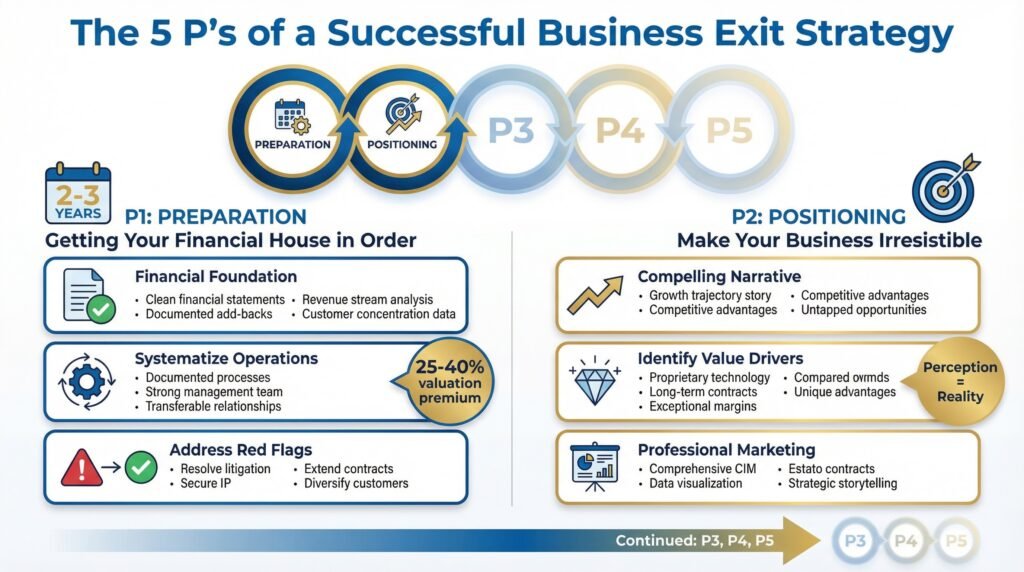
Preparation begins ideally 2-3 years before you intend to sell, though significant improvements can still be made with shorter timelines. The foundation of preparation is clean, accurate financial records that clearly demonstrate your company’s profitability.
This means professionally prepared financial statements, clear documentation of add-backs and owner benefits, and detailed analysis of revenue streams and customer concentration.
Beyond financials, preparation involves systematizing your operations so the business can function without your daily involvement.
Documented processes, strong management teams, and transferable customer relationships dramatically increase buyer confidence—and consequently, the offers you’ll receive. In fact, businesses with strong systems and management teams often command valuation premiums of 25-40% over comparable businesses that remain dependent on their owners.
Finally, preparation includes addressing potential red flags before they derail your deal. This might mean resolving pending litigation, securing intellectual property, extending key contracts, or diversifying your customer base. Each potential obstacle that you proactively address represents one less reason for buyers to discount their offers.
2. Positioning: How to Make Your Business Irresistible to Buyers
Positioning transforms how buyers perceive your business. Rather than presenting yourself as “just another company in your industry,” effective positioning highlights your unique advantages and strategic fit for specific buyer types.
This begins with crafting a compelling narrative around your company’s growth trajectory, competitive advantages, and untapped opportunities that a new owner could readily exploit. For more insights on the process, check out the 10-step selling process from Earned Exits.
Strategic positioning also involves identifying and emphasizing the most valuable aspects of your business. For some companies, this might be proprietary technology or processes; for others, it could be long-term customer contracts or exceptional profit margins.
The key is understanding what makes your business particularly valuable to different buyer segments and tailoring your presentation accordingly.
Professional marketing materials make an enormous difference in perceived value. A comprehensive Confidential Information Memorandum (CIM) that tells your business’s story with compelling data, visuals, and narrative can dramatically increase buyer interest and competitive tension. Remember: perception creates reality in business sales, and how you present your company directly impacts the offers you’ll receive.
Timing Your Exit for Maximum Profit
The old adage that “timing is everything” holds particularly true when selling a business. Even a perfectly positioned company can underperform in a sale if market conditions aren’t favorable.
Understanding the intersection of industry cycles, personal readiness, and tax considerations allows you to orchestrate an exit that maximizes both financial outcomes and personal satisfaction.
Many owners make the critical mistake of waiting until they’re burned out before deciding to sell. This often means selling from a position of weakness rather than strength, as business performance may already be declining.
The ideal time to sell is when your business shows strong growth trends, healthy margins, and has addressed any significant operational weaknesses – essentially, when it’s most attractive to buyers.
Data shows that businesses sold during growth phases typically command valuation premiums of 20-30% compared to similar businesses sold during plateaus or declines. This premium alone can represent hundreds of thousands or even millions in additional proceeds, making timing strategy one of your most powerful leverage points in the sale process.
Industry Cycle Considerations
Every industry experiences its own economic cycles that dramatically impact valuations and buyer appetite. Selling during an industry upswing – when strategic buyers are flush with cash and seeking growth opportunities – can result in significantly higher multiples and more favorable deal terms.
Conversely, selling during industry contractions often means accepting discounted valuations and tougher negotiation conditions.
Smart sellers monitor industry-specific indicators like consolidation trends, private equity interest, technological disruption, and regulatory changes. For instance, healthcare businesses often see valuation spikes following reimbursement increases, while technology companies might benefit from selling just as their niche gains mainstream attention.
Working with advisors who understand these cycles provides crucial insights about optimal timing windows for your specific situation.
Personal Readiness Factors
Beyond business and market considerations, your personal readiness plays a crucial role in exit timing. This includes financial preparation (having clarity on your post-sale income needs), emotional preparation (being genuinely ready to let go), and lifestyle preparation (having a plan for life after the sale).
Many owners underestimate the psychological impact of selling their business, only to experience significant regret when they haven’t adequately prepared for this transition.
Personal readiness also encompasses family considerations, especially for businesses with multiple family stakeholders or succession possibilities.
Proper communication and alignment among family members before entering the sale process prevents painful conflicts that can derail even the most promising deals. The most successful exits occur when business readiness aligns with personal readiness, creating a natural transition point that benefits all parties involved.
Tax Planning Timeline
Strategic tax planning often requires implementation years before your sale to maximize effectiveness. This might include entity restructuring, timing of major capital investments, charitable giving strategies, or establishing qualified retirement plans to shelter proceeds.
Working with tax specialists experienced in business exits can often preserve an additional 10-15% of your sale proceeds that would otherwise go to unnecessary taxation – a return on investment that far exceeds the cost of proper planning.
Bottom line: A major contributor to business undervaluations, wasted time, and poor exits is simply a lack of readiness. If you are not sure what basic preparation is required before considering a business valuation or selecting a business broker, click the button below to take our free business readiness quiz. The score will give you a clear indication of where you are in the process and the next course of action to take to ensure you start the business sale and exit on the right footing.
The Earned Exits Approach: What Sets It Apart
Earned Exits has developed a distinctive methodology based on the principle that business sales should be approached strategically rather than transactionally.
Unlike traditional brokers who primarily list businesses and hope for interested buyers, Earned Exits implements a proactive, tailored approach for each client that focuses on creating competitive buying environments to maximize value. This philosophy reflects in everything from how they prepare businesses for sale to how they identify and approach potential buyers.
What truly distinguishes Earned Exits is their team composition – exclusively former entrepreneurs who have personally built and sold businesses.
This real-world experience translates into practical guidance that goes beyond textbook advice, helping owners navigate the complex emotional and strategic challenges of selling a business they’ve built from the ground up.
Their firsthand knowledge of both sides of transactions provides clients with invaluable insights that typical advisors simply cannot offer.
Their 10-Step Selling Process Explained
Earned Exits employs a comprehensive 10-step process that begins with thorough preparation and extends through post-closing transition support. The process starts with a detailed business assessment that identifies both value drivers and potential concerns that might impact the sale price.
This foundation leads to strategic positioning work that frames the business in terms that resonate with ideal buyer groups, followed by the development of professional marketing materials that effectively communicate the company’s value proposition.
The middle stages involve confidential marketing to carefully qualified prospects, managing initial discussions, and coordinating effective management presentations. As offers emerge, Earned Exits provides detailed comparative analysis and negotiation support to optimize both price and terms.
The final stages focus on managing due diligence to prevent surprises, coordinating with legal and financial professionals for smooth closing, and facilitating effective transition planning to ensure the business continues to thrive under new ownership.
Success Rate Compared to Industry Standards
While industry statistics show that only 20-30% of listed businesses actually sell, Earned Exits maintains a consistent close rate exceeding 85% for the companies they represent.
More impressively, their clients typically receive 15-40% higher valuations than industry averages for comparable businesses, demonstrating the substantial impact of their preparation and positioning methodology. This performance differential stems from their selective client acceptance process and the comprehensive approach they apply to each engagement.
Deal Structures That Protect Your Interests
The headline sale price only tells part of the story in business transactions. Equally important is how the deal is structured – including payment timing, tax allocation, contingencies, and post-sale obligations.
A properly structured deal not only maximizes your after-tax proceeds but also protects you from post-closing risks that could otherwise erode your hard-earned exit value. Understanding the implications of different deal structures empowers you to negotiate from a position of knowledge rather than uncertainty.
Cash vs. Earn-Out Considerations
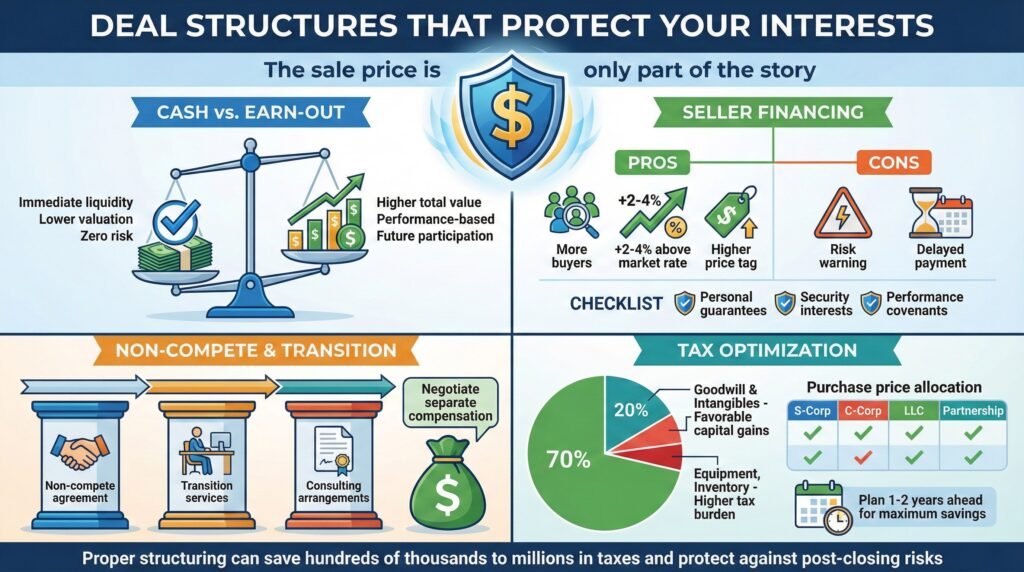
While all-cash deals provide certainty and immediate liquidity, they often come with lower overall valuations compared to transactions that include future performance-based payments (earn-outs).
The key to evaluating these structures is understanding the risk-adjusted value of deferred payments and negotiating appropriate protections. Factors to consider include the buyer’s financial capacity, operational plans that might impact future performance, and specific metrics used to calculate earn-out payments.
When properly structured, earn-outs can bridge valuation gaps and allow you to participate in post-sale growth. However, they require careful drafting to prevent manipulation of the underlying metrics and should include clear dispute resolution mechanisms.
The most effective earn-out structures balance simplicity with fairness, focusing on metrics the seller has historically managed well and that remain relevant under new ownership.
Seller Financing Pros and Cons
Providing seller financing often increases both the pool of qualified buyers and the overall purchase price, but it creates additional risk that must be appropriately compensated and secured.
Effective seller notes typically include interest rates 2-4% above market rates, personal guarantees from buyers, security interests in business assets, and performance covenants that trigger accelerated repayment if the business underperforms. The ideal balance provides reasonable financing to facilitate the transaction while maintaining strong incentives for the buyer to honor all obligations.
Non-Compete and Transition Terms
Post-closing obligations like non-compete agreements, transition services, and consulting arrangements represent significant commitments that deserve separate compensation rather than being treated as standard inclusions.
Smart sellers negotiate appropriate payment for these contributions while carefully defining scope and duration to maintain reasonable lifestyle flexibility after the sale. The most successful transitions include clearly defined roles, realistic time commitments, and mechanisms to address potential conflicts that might arise during the handover period.
Tax Optimization Strategies
Structuring your business sale to minimize tax liability can often preserve hundreds of thousands or even millions in additional wealth. The allocation of purchase price across different asset categories significantly impacts your tax burden, with allocations to goodwill and other intangibles typically receiving more favorable capital gains treatment than allocations to equipment, inventory, or other assets subject to recapture provisions.
Working with specialized transaction tax advisors before accepting an offer allows you to model various scenarios and negotiate allocations that benefit your specific tax situation.
Entity structure creates another critical tax consideration. S-Corporations, C-Corporations, LLCs, and partnerships each carry distinct tax implications in a sale. In some cases, restructuring 1-2 years before sale can yield substantial tax savings.
For example, converting from a C-Corp to an S-Corp and waiting through the required holding period might allow you to avoid double taxation on appreciation, while other strategies like installment sales can spread tax liability across multiple years to potentially reduce effective rates.
Common Mistakes That Kill Deals at the Finish Line
Even perfectly positioned businesses with motivated buyers can see deals collapse during the final phases of the transaction process. These late-stage failures often result from preventable mistakes that erode trust, create uncertainty, or introduce unexpected complexities.
Understanding these common pitfalls allows you to proactively address potential issues before they threaten your deal’s successful conclusion.
The Due Diligence Danger Zone
Due diligence represents the most vulnerable period in any transaction, where buyers scrutinize every aspect of your business, seeking both confirmation of value and potential reasons to renegotiate. Undisclosed issues discovered during this phase can destroy buyer confidence and lead to significant price reductions or complete deal termination.
The most common due diligence surprises include customer concentration issues, unrecorded liabilities, regulatory compliance gaps, and financial discrepancies between management reports and verified statements.
Preparation provides your strongest defense against due diligence problems. Conducting your own internal due diligence before going to market allows you to identify and address potential issues before buyers discover them.
Organizing comprehensive due diligence materials in advance streamlines the process while demonstrating transparency and professionalism that builds buyer confidence. Experienced advisors also help manage the pace and scope of due diligence to maintain momentum while protecting sensitive information until appropriate transaction stages.
Negotiation Missteps to Avoid
Emotional reactions during negotiations represent one of the most common and damaging mistakes sellers make. After years of building your business, it’s natural to feel defensive when buyers question your methods or suggest changes to improve operations.
However, responding defensively rather than objectively often creates unnecessary tension that can derail promising deals. Maintaining professional distance by having advisors, such as a experienced business broker, can handle direct negotiations provides valuable emotional insulation during this challenging phase.
Beyond the Money: Finding Personal Fulfillment After the Sale
The emotional aftermath of selling your business often catches owners by surprise. After years of entrepreneurial identity and the daily purpose that comes with running a company, many sellers experience a profound sense of loss that can overshadow even the most financially successful exits.
This transition phase, sometimes called the “seller’s remorse period,” typically begins 3-6 months after closing when the reality of separation fully registers. The most satisfied sellers proactively prepare for this emotional adjustment by developing clear plans for their next chapter. Contact Earned Exits today to receive a free business valuation and discover how our proven 10-step process can help you achieve the maximum value for your business. Click the button below to get started.
Frequently Asked Questions
Throughout our years helping business owners navigate successful exits, we’ve encountered many common questions that arise during the selling process. Addressing these concerns early can help you approach your transaction with greater confidence and realistic expectations about what lies ahead.
How long does it typically take to sell an established business?
Selling a properly prepared, appropriately priced business typically takes 6-12 months from initial engagement to closing. This timeline includes approximately 1-2 months for preparation, 2-3 months for marketing and buyer identification, 1-2 months for offer negotiation, and 2-4 months for due diligence and closing.
However, these timeframes can vary significantly based on business complexity, industry conditions, and specific buyer circumstances. For a detailed look at the steps involved, check out this 10-step selling process.
Businesses with recurring revenue, diversified customer bases, and strong management teams typically sell more quickly than those with inconsistent financial performance or significant owner dependencies. Similarly, companies in attractive industries with multiple potential buyer types generally experience shorter marketing periods than those in challenging sectors or specialized niches with limited buyer pools.
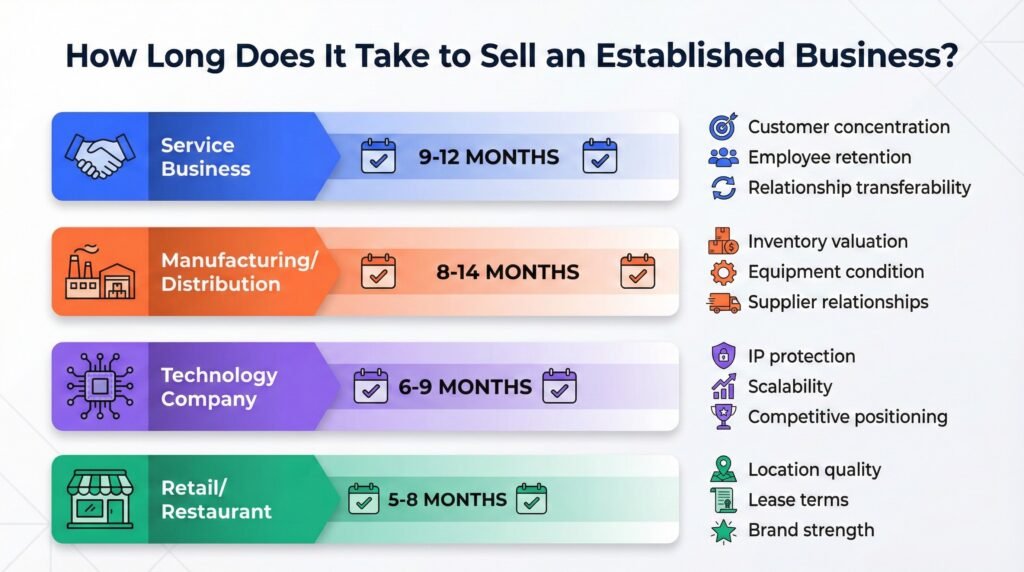
| Business Type | Average Sale Timeline | Key Factors Affecting Speed |
| Service Business | 9-12 months | Customer concentration, employee retention, transferability of relationships |
| Manufacturing/Distribution | 8-14 months | Inventory valuation, equipment condition, supplier relationships |
| Technology Company | 6-9 months | IP protection, scalability, competitive positioning |
| Retail/Restaurant | 5-8 months | Location quality, lease terms, brand strength |
Proper preparation and realistic pricing expectations are the most significant factors in controlling your sale timeline. Businesses that require significant price reductions or experience repeated due diligence problems can take 18-24 months to sell or fail to sell altogether.
Working with experienced advisors who can properly position your business from the outset dramatically increases the likelihood of completing your sale within a predictable timeframe.
What documents should I prepare before listing my business for sale?
Comprehensive preparation significantly impacts both sale value and timeline. At minimum, you should compile three years of financial statements (preferably reviewed by a CPA), current year-to-date financials with prior year comparisons, tax returns, major customer and vendor contracts, equipment lists, employee information (positions, compensation, tenure), real estate documentation (if owned or leased), and intellectual property documentation.
Additionally, prepare summaries of your business history, competitive advantages, growth opportunities, and operational systems that would help a new owner successfully transition into your role.
Is it better to use a business broker or sell independently?
The optimal approach depends on your specific business, industry knowledge, and personal capabilities. While selling independently may save on broker commissions (typically 8-12% for small businesses), research shows that professionally represented businesses typically sell for 15-20% higher prices and complete transactions nearly twice as often as unrepresented businesses.
This value differential stems from professional packaging, broader buyer access, negotiation expertise, and transaction management that maintains confidentiality while keeping deals on track through inevitable challenges.
For businesses valued under $500,000, traditional business brokers often provide adequate services. However, for companies valued between $1-50 million, specialized M&A advisors like Earned Exits offer significant advantages through their sophisticated marketing approaches, access to both financial and strategic buyers, and experience with more complex transaction structures.
These firms typically work on success-based fees with minimal upfront costs, aligning their interests with maximizing your sale outcome.
How do I maintain confidentiality during the selling process?
Confidentiality breaches represent one of the greatest risks in business sales, potentially damaging customer relationships, employee morale, supplier terms, and competitive positioning.
Effective confidentiality protection includes using blind profiles (business summaries without identifying information), requiring signed non-disclosure agreements before revealing company identity, implementing information staging (revealing increasingly sensitive details only as buyer interest and credibility are confirmed), and creating plausible cover stories for why potential buyers might be visiting your facility.
Professional advisors provide an additional confidentiality layer by serving as buffers between you and potential buyers during the initial stages. They can screen prospects, handle preliminary questions, and manage communication flow to maintain your anonymity until appropriate.
Additionally, limiting internal knowledge of the sale process to only essential personnel reduces the risk of inadvertent information leaks that could disrupt business operations or trigger unwanted speculation.
What happens to my employees when I sell my business?
Employee treatment varies significantly based on buyer type and acquisition strategy. Strategic buyers often have existing infrastructure and may retain only key personnel while eliminating redundant positions.
In contrast, financial buyers typically maintain most staff while focusing on operational improvements and growth. Understanding different buyer motivations helps you advocate for employee protection during negotiations if continuity is important to you.
The most successful transitions include clear communication planning for the post-sale announcement.
While complete transparency during the sale process is rarely advisable, having a well-crafted communication strategy ready for implementation upon closing helps maintain employee confidence and productivity. This typically includes coordinated announcements, individual meetings with key staff, and clear messaging about future plans and any changes to compensation or reporting structures.
Retaining key employees through the transition often requires specific incentives. These might include retention bonuses (typically 10-25% of annual salary paid over 6-12 months), employment agreements with enhanced severance protection, equity opportunities in the acquiring entity, or expanded roles with greater responsibility.
Discussing these considerations with potential buyers during negotiations helps ensure alignment on employee treatment while potentially increasing the likelihood of business success under new ownership.

*Disclaimer: This article is written for educational purposes and should not be interpreted as financial advice.
*Disclaimer: This article is written for educational purposes and should not be interpreted as financial advice. We may receive compensation for referrals made through this article.