
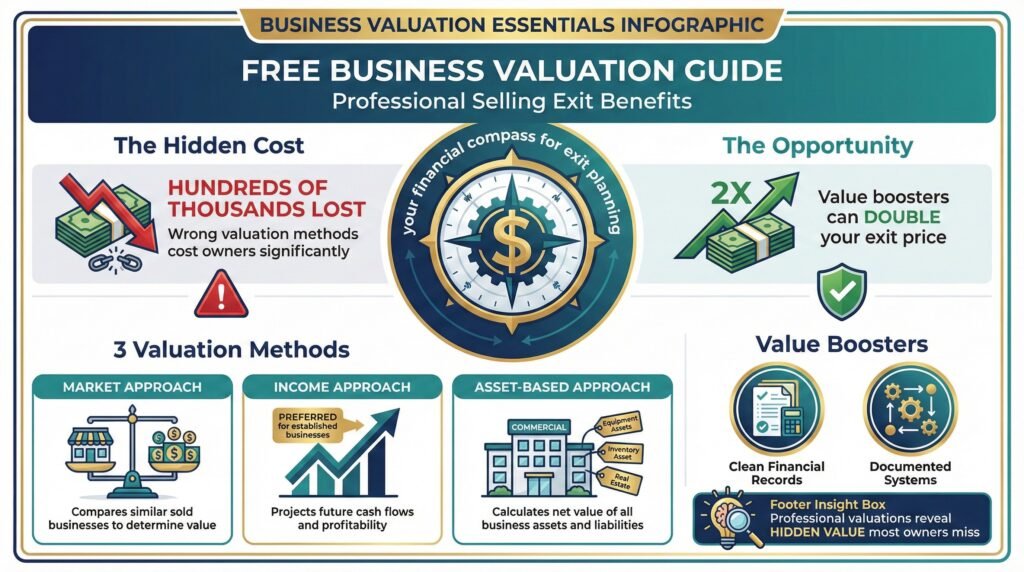
Quick Takeaways: Business Valuation Essentials
- A professional business valuation provides critical insights beyond just a selling price, often revealing hidden value most owners aren’t aware of.
- Using the wrong valuation method can cost business owners hundreds of thousands in lost exit value, making methodology selection crucial.
- Market, income, and asset-based approaches each serve different business types, with the income approach typically preferred for established businesses with strong cash flows.
- Earned Exits offers complimentary professional valuations that identify specific opportunities to increase your business value before selling.
- Implementing value boosters like clean financial records and documented systems can potentially double your exit price when properly executed.
Knowing what your business is truly worth isn’t just about slapping a price tag on years of hard work; it’s about understanding the real market value of everything you’ve built. Most business owners walk away from sales, leaving substantial money on the table, simply because they didn’t have an accurate valuation before entering negotiations.
As a top business broker, Earned Exits, the company has seen countless entrepreneurs shocked to discover their business’s actual value through professional analysis. A comprehensive business valuation serves as your financial compass, guiding critical decisions whether you’re planning to sell next month or next decade.
What Your Business Is Really Worth: The Truth About Valuation
Business valuation is part science, part art, requiring both financial analysis and industry expertise. The gap between perceived value and market reality often leaves owners surprised in both directions. Some discover hidden value in proprietary processes or customer relationships they’ve taken for granted, while others face the harsh reality that their business relies too heavily on their personal involvement.
The truth is that most business valuations fall into predictable ranges based on industry standards and financial metrics, but the specifics of your operation can dramatically shift where you land within or beyond those ranges. Understanding these nuances before positioning your business for sale can translate to dramatically different outcomes.
Why 80% of Business Owners Undervalue Their Companies
The tendency to undervalue stems from several common blind spots. Many owners focus exclusively on tangible assets and annual profit, overlooking intellectual property, brand equity, and customer loyalty. Others fail to normalize financials by adding back discretionary expenses and owner benefits that artificially depress profitability on paper.
Even more critically, owners frequently underestimate their market position and competitive advantages. Without comparative market analysis, they lack context for how their performance metrics stack up against industry peers. Additionally, many don’t understand how different buyer categories, strategic buyers, financial buyers, and individual entrepreneurs value the same business through entirely different lenses.
The Real Cost of Getting Valuation Wrong
Pricing mistakes cut both ways. Set your asking price too high without substantiating data, and you’ll struggle to attract serious buyers, extending your time on market and potentially creating the perception of a troubled business. Price too low, and you might leave life-changing money on the table, sometimes hundreds of thousands or even millions.
Beyond the immediate financial impact, valuation errors can derail your retirement plans, force uncomfortable lifestyle adjustments, or prevent your next venture from launching properly. For many owners, their business represents their largest asset, making accurate valuation perhaps the most financially significant analysis they’ll ever undertake.
Working with valuation experts means uncovering not just your current value, but also identifying specific opportunities to increase that value before selling. This value-enhancement strategy can deliver returns far exceeding the cost of professional guidance.
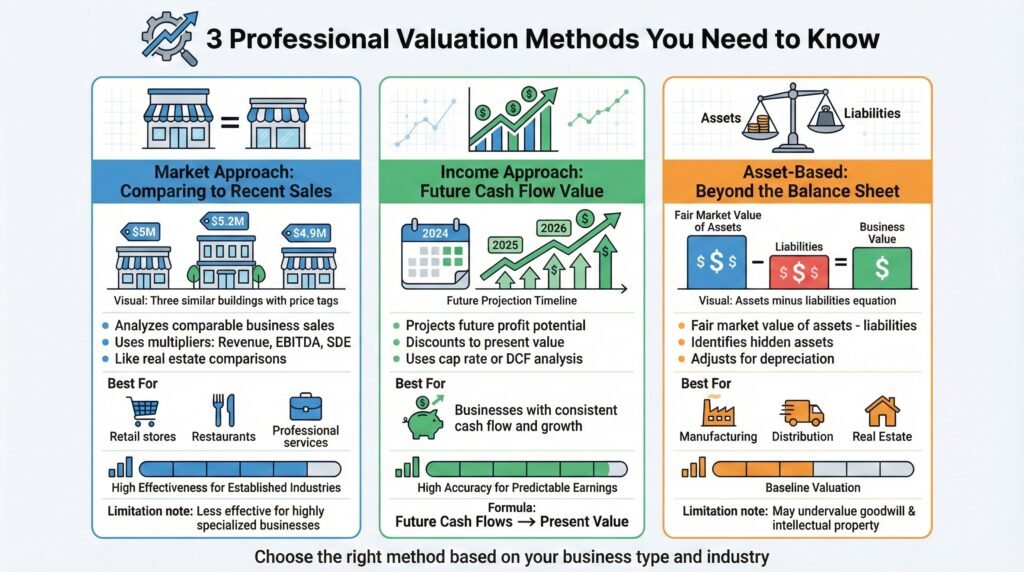
3 Professional Valuation Methods You Need to Know
The approach to valuing your business significantly impacts the final number. Different methodologies serve different purposes, and the nature of your business will determine which approach, or combination of approaches, yields the most accurate assessment.
Market Approach: Comparing Your Business to Recent Sales
The market approach derives value by analyzing comparable business sales within your industry. Similar to real estate comparisons, this method examines businesses of comparable size, location, and operational characteristics that have recently sold. The resulting data provides multipliers,often applied to revenue, EBITDA, or SDE (Seller’s Discretionary Earnings), that establish realistic value ranges.
This approach works particularly well for businesses in established industries with frequent transactions and standardized operations. Retail stores, restaurants, and professional service firms often benefit from market comparisons due to the abundance of available transaction data. However, highly specialized or unique businesses may find fewer valid comparisons, making this approach less definitive as a standalone method.
Income Approach: What Future Cash Flows Are Worth Today
The income approach centers on what truly matters to most buyers: future profit potential. This methodology calculates your business’s value based on projected cash flows, discounted to present value. Rather than focusing solely on historical performance, this forward-looking approach considers growth trends, recurring revenue, and earnings sustainability.
For established businesses with consistent cash flow and growth patterns, the income approach often yields the most accurate valuations. The calculation typically involves applying a capitalization rate (cap rate) to your adjusted earnings or using a discounted cash flow (DCF) analysis for businesses with variable or rapidly changing revenue patterns. This method particularly favors businesses with strong, predictable earnings and minimal owner dependence.
Asset-Based Approach: Beyond the Balance Sheet
The asset-based approach calculates value by determining the fair market value of your business assets minus liabilities. However, this isn’t merely a balance sheet exercise, it requires identifying hidden assets not properly reflected in your books and adjusting for asset depreciation versus actual market value. For asset-heavy businesses like manufacturing, distribution, or real estate, this approach provides essential valuation insights.
The limitation of pure asset-based valuations is their tendency to undervalue businesses with significant goodwill, intellectual property, or human capital advantages. For this reason, asset valuations typically establish a baseline value rather than capturing the complete worth of an operational business. However, for businesses facing challenges or operating at a loss, asset valuation may become the primary methodology.
Industry-Specific Valuation Factors That Change Everything
Generic valuation formulas fail to capture the nuances that drive value in specific industries. Each business sector has unique value drivers, risk factors, and growth considerations that dramatically impact appropriate valuation multiples. Understanding these industry-specific factors provides a significant advantage in accurately positioning your business for sale.
Retail and E-commerce Valuation Multipliers
Retail and e-commerce businesses typically value at 2-4x SDE (Seller’s Discretionary Earnings), with location, lease terms, and customer retention rates serving as critical valuation factors. For brick-and-mortar operations, location quality and remaining lease duration significantly impact value, while e-commerce businesses see higher multiples for proprietary products versus reseller models. Inventory management efficiency, supplier relationships, and customer acquisition costs also heavily influence valuation in this sector.
Online retail operations with sophisticated systems, diverse traffic sources, and low customer acquisition costs command premium valuations compared to similar-sized traditional retail counterparts. Meanwhile, subscription-based e-commerce models achieve even higher multiples due to their recurring revenue predictability.
Service Business Value Drivers
Service businesses typically sell for 2-3.5x SDE, with higher multiples awarded to operations with minimal owner involvement and documented systems. Client concentration represents a major risk factor, businesses deriving more than 15% of revenue from any single client often face valuation discounts. Conversely, service businesses with long-term contracts, recurring revenue models, and team-based delivery systems (rather than owner-dependent expertise) command premium valuations.
Professional service firms like accounting, legal, or consulting practices face additional valuation considerations related to client transferability, non-compete agreements, and transition periods. Many service business transactions include earnouts tied to client retention, highlighting the critical importance of relationship management during ownership transitions.
Manufacturing and Distribution Special Considerations
Manufacturing businesses typically value at 3-5x adjusted EBITDA, with equipment condition, proprietary processes, and supply chain security heavily influencing final valuations. Businesses with exclusive distribution rights, patented manufacturing methods, or specialized equipment often achieve valuation premiums exceeding industry averages. Conversely, those with aging equipment, facility lease concerns, or environmental compliance issues may face significant valuation discounts.
Distribution businesses particularly benefit from exclusive supplier relationships, efficient logistics operations, and diverse customer bases. Geographic territory rights, especially in protected markets, can substantially increase valuation multiples for otherwise comparable distribution operations.
Technology Company Valuation Nuances
Technology valuations often depart dramatically from traditional formulas, sometimes reaching 5-15x revenue for high-growth SaaS businesses with strong retention metrics. For tech companies, monthly recurring revenue (MRR), customer acquisition cost (CAC), lifetime value (LTV), and churn rate often matter more than traditional profit metrics. Companies with proprietary technology, significant barriers to entry, and scalable business models command the highest valuations.
Early-stage tech companies may see valuations based primarily on team expertise, intellectual property, and market opportunity rather than current financial performance. Meanwhile, established technology businesses with consistent revenue growth and profit margins benefit from both strategic and financial buyer interest, creating competitive bidding scenarios that can drive valuations significantly higher.

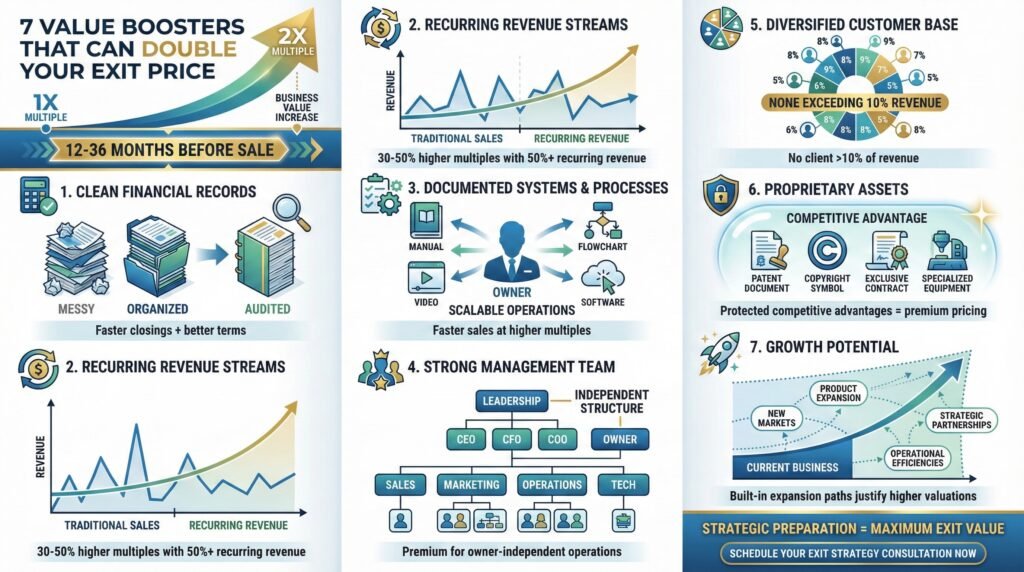
7 Value Boosters That Can Double Your Exit Price
The most successful business exits don’t happen by accident,they result from strategic preparation focusing on specific value drivers. Implementing these value boosters 12-36 months before selling can dramatically increase your business’s appeal and valuation.
1. Clean Financial Records
Meticulous financial documentation creates buyer confidence and supports higher valuations by eliminating uncertainty. Beyond basic bookkeeping, this means maintaining detailed expense categorization, clear revenue tracking, and proper allocation of personal versus business expenses. Buyers pay premiums for businesses with transparent, professionally reviewed financial statements that demonstrate consistent profitability trends without requiring forensic accounting to interpret.
Consider investing in a financial review or audit by a reputable accounting firm for the years immediately preceding your sale. This third-party verification reduces perceived risk and streamlines due diligence, often resulting in faster closings and better terms. Additionally, normalized financial statements that clearly identify owner benefits, one-time expenses, and discretionary spending make it easier for buyers to recognize your business’s true earning potential.
2. Recurring Revenue Streams
Few factors increase business value more dramatically than predictable, contracted revenue. Subscription services, maintenance agreements, retainers, and long-term contracts significantly reduce perceived investment risk and justify higher multiples. Even businesses traditionally operating on transactional models can develop recurring revenue components through service agreements, auto-replenishment programs, or membership offerings.
The magic of recurring revenue lies in its predictability; buyers willingly pay premiums for guaranteed future income. This revenue stability reduces operational stress during ownership transitions and provides immediate cash flow security for new owners. Businesses with 50%+ recurring revenue routinely command valuation multiples 30-50% higher than comparable businesses without such stability.
3. Documented Systems and Processes
Operational documentation transforms owner-dependent businesses into valuable assets that can thrive under new leadership. Comprehensive operations manuals, training guides, and documented workflows demonstrate that your business success doesn’t rely solely on your personal expertise. This systematic approach not only increases valuation but expands your potential buyer pool to include investors seeking turnkey operations.
For maximum value enhancement, focus on documenting sales processes, customer service protocols, vendor management, and production systems. Effective documentation combines written procedures, process flowcharts, video training, and integrated software systems. The most valuable businesses maintain “institutional knowledge” within their systems rather than in the minds of owners or key employees.
This systematic approach proves particularly valuable during due diligence when buyers scrutinize operational dependencies. Businesses with clear, replicable processes routinely sell faster and at higher multiples than comparable “black box” operations where only the current owner understands how things work.
4. Strong Management Team
A capable management team that operates independently of the owner represents one of the most significant value drivers in business sales. Buyers willingly pay premiums for businesses where day-to-day operations don’t depend on the departing owner. This leadership infrastructure reduces transition risk and enables faster post-acquisition growth.
Developing this team requires strategic hiring, documented responsibilities, proper incentive structures, and gradual delegation of owner duties. For smaller businesses, even having one or two key employees who understand critical operations can dramatically increase valuation. The ideal scenario presents buyers with a complete management structure that can continue operating seamlessly during ownership transition.
5. Diversified Customer Base
- No single client represents more than 10% of total revenue
- Customer retention rates exceed industry averages
- Client relationships exist with the business, not just the owner
- Multiple industry sectors represented in customer mix
- Documented client acquisition systems that new owners can replicate
Customer concentration represents one of the most common valuation killers. Businesses heavily dependent on a few major clients face significant valuation discounts due to the inherent risk of client loss during ownership transitions. Strategic diversification not only increases value but creates operational stability that benefits current owners.
Beyond simply adding clients, focus on developing systems that institutionalize customer relationships through team-based service models, regular communication protocols, and satisfaction monitoring. The goal is creating transferable client relationships that remain stable regardless of who owns the business.
6. Proprietary Assets
Exclusive assets, protected intellectual property, and unique market advantages create significant valuation premiums by establishing competitive moats around your business. These proprietary elements might include patented products, copyrighted materials, custom software, exclusive territorial rights, or specialized equipment. Buyers pay premiums for businesses with protected competitive advantages that competitors cannot easily replicate.
Even relatively simple businesses can develop proprietary elements through specialized methodologies, unique service combinations, or exclusive supplier relationships. The key is documenting and formalizing these advantages through proper legal protection, clear licensing agreements, and comprehensive transition plans that ensure these assets transfer effectively to new owners.
7. Growth Potential
Businesses with clearly identified, untapped growth opportunities command significantly higher valuations by offering buyers “built-in” expansion paths. Unlike vague claims about potential, documented growth opportunities with specific action plans substantially increase buyer interest and purchase offers. These might include new markets, product expansions, acquisition targets, or operational efficiencies.
The most valuable growth opportunities come with supporting evidence, market research, preliminary customer interest, successful small-scale tests, or industry trend analysis. By presenting both current performance and actionable growth strategies, sellers create a compelling “two-for-one” value proposition that justifies premium pricing. Some sellers implement partial growth initiatives before sale, demonstrating proof-of-concept without the full execution burden.
In part 2 we will discuss the valuation timeline, professional vs. DIY Valuation, how to use your professional valuation as negotiating tool, and more.
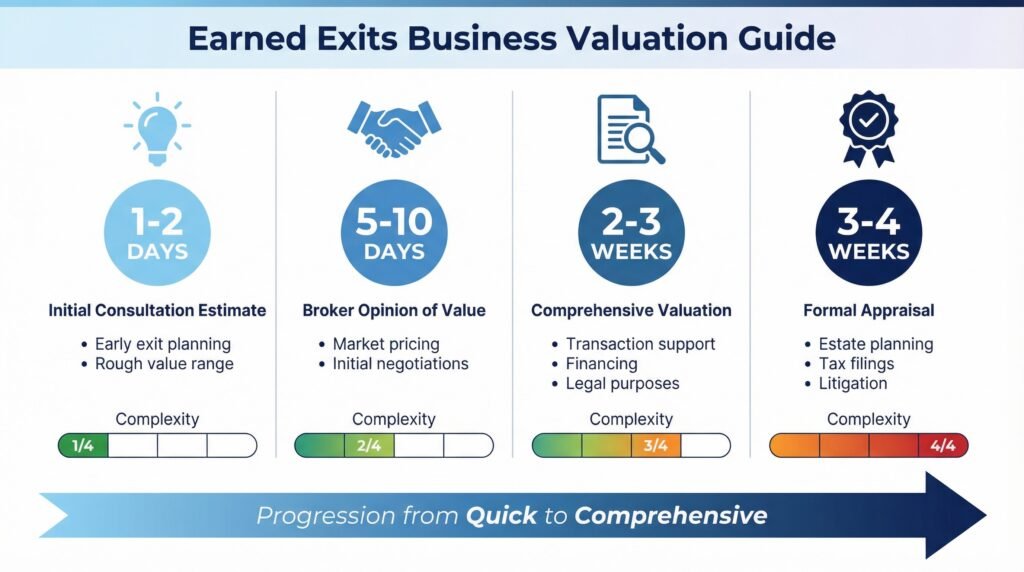
Frequently Asked Questions
Business owners naturally have questions about the valuation process, methodology, and implications. Below, we address the most common inquiries we receive about professional business valuations. For specific questions about your unique situation, please contact our valuation specialists directly.
How long does a professional business valuation typically take?
A comprehensive business valuation typically requires 2-3 weeks from documentation submission to final report delivery. The process includes data gathering, financial analysis, market research, and detailed reporting phases. For time-sensitive situations, expedited valuations can sometimes be completed in 7-10 business days, though these accelerated timelines work best with well-prepared documentation packages.
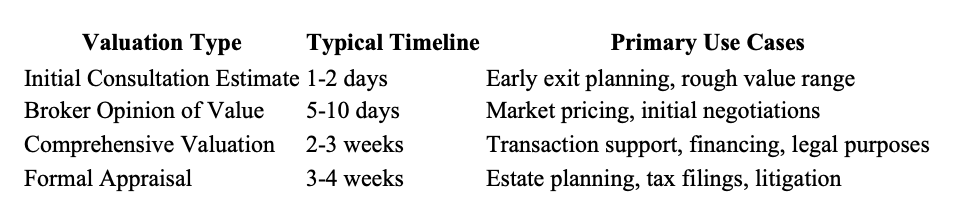
The timeline variation depends primarily on business complexity, documentation readiness, and valuation purpose. Straightforward retail or service businesses with clean financials typically process more quickly than manufacturing operations, multi-location enterprises, or businesses with complicated ownership structures.
Earned Exits’ complimentary valuation consultations typically begin with an initial value range discussion during your first meeting, followed by a more detailed analysis as additional information becomes available. This staged approach provides immediate feedback while allowing for comprehensive analysis.
What’s the difference between a business appraisal and a business valuation?
While often used interchangeably, business appraisals and valuations serve different purposes and follow different methodologies. Business appraisals typically involve certified appraisers following formal USPAP (Uniform Standards of Professional Appraisal Practice) guidelines for legal, tax, or regulatory purposes. Business valuations focus more on market-based transaction pricing to guide practical selling decisions and negotiations.
Can I sell my business for more than its appraised value?
Absolutely. Businesses frequently sell above their appraised or initially valued price, particularly when strategic buyers identify synergistic opportunities or when multiple buyers create competitive bidding scenarios. The most successful transactions involve sellers who understand not just their business’s standalone value but also its strategic worth to specific buyer categories.
How often should I get my business valued?
For exit planning purposes, businesses should conduct formal valuations every 2-3 years and following any significant operational changes or market shifts. This regular cadence helps track progress toward value targets, identifies emerging issues before they impact marketability, and ensures alignment between owner expectations and market reality.
For businesses not actively planning exits, periodic valuations still provide valuable strategic insights that guide investment decisions, expansion plans, and risk management approaches. They also establish important baseline documentation for unexpected situations like partnership disputes, divorce proceedings, or estate planning needs.
Many business owners integrate annual valuation updates into their strategic planning processes, using the results to guide improvement initiatives and track progress against value-building objectives. This approach treats valuation as an ongoing management tool rather than a one-time exit planning exercise.
Will sharing my financial information for a valuation put my confidentiality at risk?
Professional valuation firms implement strict confidentiality protocols to protect sensitive business information. At Earned Exits, all client information remains fully confidential through secure data systems, confidentiality agreements, and privacy-focused processes. No information is shared with potential buyers or external parties without the explicit owner’s permission.
The company’s valuation process begins with non-disclosure agreements that legally protect your information before any sensitive data changes hands. For particularly sensitive situations, we can implement additional safeguards like anonymized financial reviews, redacted customer information, or phased disclosure approaches that reveal details only as relationships progress.
The risk of not obtaining professional valuation typically far outweighs the minimal confidentiality concerns associated with properly managed professional relationships. Without accurate valuation guidance, businesses frequently remain unsold at inappropriate prices or sell significantly below market value.
*Disclaimer: This article is written for educational purposes and should not be interpreted as financial advice.

*Disclaimer: This article is written for educational purposes and should not be interpreted as financial advice.
*Disclaimer: This article is written for educational purposes and should not be interpreted as financial advice. We may receive compensation for referrals made through this article.