
Key Takeaways
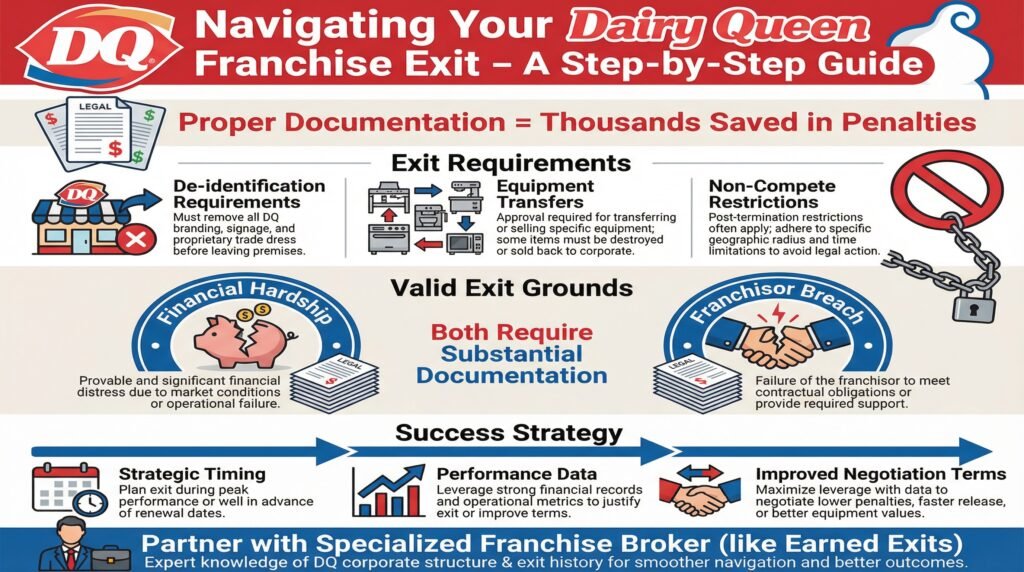
- Exiting a Dairy Queen franchise requires understanding your contractual obligations, with proper documentation potentially saving you thousands in unnecessary penalties.
- Most Dairy Queen franchise agreements contain specific exit procedures, including de-identification requirements, equipment transfers, and non-compete restrictions that remain enforceable after termination.
- Financial hardship and franchisor breach of contract represent two of the most common valid grounds for early termination, but each requires substantial documentation.
- Strategic negotiation can significantly improve exit terms, especially when properly timed and supported by objective performance data.
- Franchise owners should consider working with a specialized franchise business broker, such as Earned Exits, who understands Dairy Queen’s corporate structure and historical approaches to franchise exits.
What Happens When You Need to Exit Your Dairy Queen Franchise
Exiting a Dairy Queen franchise isn’t as simple as turning in your keys and walking away. Every franchise relationship is governed by a comprehensive agreement that outlines specific procedures for termination – whether that termination occurs at the natural end of your contract term or prematurely. The complexity of these exit procedures often catches franchisees off guard, leading to costly mistakes and potential litigation.
When you decide to exit your Dairy Queen franchise, International Dairy Queen (IDQ) will typically require strict compliance with all termination provisions outlined in your Franchise Agreement.
This includes proper notice periods, often 60-90 days in writing, followed by complete de-identification of your location, return or transfer of proprietary materials, and adherence to non-compete and confidentiality provisions. The financial implications can be substantial, potentially including liquidated damages, outstanding royalty payments, and transfer fees if you’re selling to another operator.
Understanding these requirements before initiating the exit process allows you to prepare strategically, potentially negotiate better terms, and avoid common pitfalls that could damage your financial position or future business opportunities. Franchise business brokers with specific experience handling Dairy Queen exits report that well-prepared franchisees typically secure more favorable outcomes, particularly regarding non-compete enforcement and financial settlement terms.
Most importantly, your exit strategy should reflect your unique circumstances and goals. Whether you’re retiring after decades of successful operation, struggling with underperformance, or dealing with a perceived breach by the franchisor, the approach you take will significantly impact both the process and outcome of your franchise exit.
Quick Franchise Exit Assessment
• Review your current franchise agreement term and renewal dates
• Calculate outstanding financial obligations to IDQ
• Document any potential breaches by either party
• Assess local market conditions and franchise performance
• Determine if selling to a third party is viable
• Evaluate post-termination restrictions on future business activities
Inside a Dairy Queen Franchise Exit Agreement
The Dairy Queen franchise exit agreement serves as the formal document that terminates your relationship with International Dairy Queen. Unlike your original franchise agreement, which primarily protects franchisor interests, a well-negotiated exit agreement should balance the concerns of both parties. This legally binding document addresses everything from the official termination date to specific procedures for transitioning operations, whether back to IDQ or to a new owner.
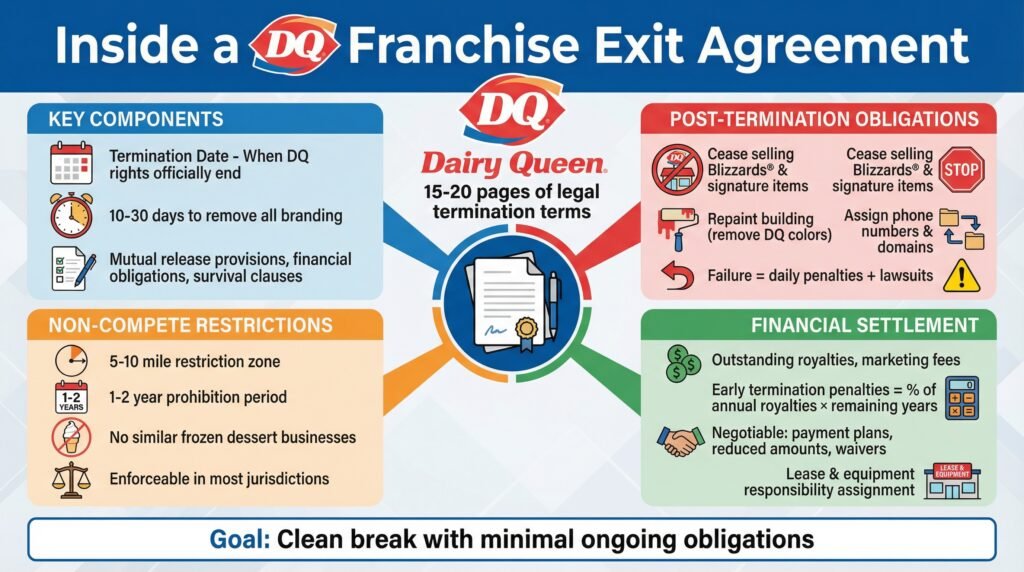
Standard Dairy Queen exit agreements typically run 15-20 pages and contain sophisticated legal language designed to protect the franchisor’s intellectual property, preserve brand standards, and limit their future liability.
As a franchisee, your objective should be to secure clear terms that provide a clean break while minimizing your ongoing obligations and potential financial exposure. This requires a thorough understanding of each component and its implications for your future.
Key Components You Must Understand
Every Dairy Queen exit agreement contains several critical sections that directly impact your legal and financial position. The termination date establishes when your rights to operate under the Dairy Queen name officially end, while mutual release provisions determine what legal claims each party waives.
You’ll find detailed requirements for removing all Dairy Queen signage, equipment, and branding elements within specific timeframes – typically 10-30 days after termination. The agreement will outline any remaining financial obligations, including outstanding royalties, marketing fees, or early termination penalties.
Pay particular attention to the survival clauses, which specify which obligations from your original franchise agreement remain enforceable after termination.
Post-Termination Obligations
After terminating your Dairy Queen franchise, you’ll face several ongoing obligations that extend beyond the end date of your agreement. Most prominently, you must completely cease using any Dairy Queen trademarks, trade secrets, or operational systems. This includes removing all signage, repainting your building if it features DQ colors, and discontinuing the sale of signature menu items like Blizzards®.
You’ll need to return all operations manuals, training materials, and other proprietary information. The franchisor may also require you to assign your phone numbers and website domains to them or to a new franchisee taking over the territory. Failure to fulfill these obligations promptly can result in liquidated damages, typically calculated as daily penalties, and potential trademark infringement lawsuits.
Non-Compete Restrictions
One of the most impactful aspects of your exit agreement will be the non-compete provisions that limit your future business activities. Standard Dairy Queen agreements typically prohibit former franchisees from operating similar businesses within a specified radius (often 5-10 miles) of their former location or any existing Dairy Queen for a period of 1-2 years after termination.
These restrictions can significantly impact your post-franchise career options, especially if you’ve developed expertise specifically in food service or ice cream retail. While courts in some states limit the enforceability of such provisions, IDQ has successfully defended their non-compete clauses in multiple jurisdictions.
The specific language around what constitutes a “competitive business” merits careful review. Some agreements broadly prohibit involvement with any food service business, while others specifically target frozen dessert operations. Negotiating narrower definitions of competing businesses can preserve more options for your professional future while still addressing the franchisor’s legitimate concerns about protecting their business model.
Financial Settlement Terms
The financial aspects of your exit agreement will have the most immediate impact on your economic situation. These terms typically address any outstanding royalties, marketing fund contributions, and supplier invoices that must be paid before termination becomes final.
If you’re exiting before your contract term ends, you may face early termination fees or liquidated damages designed to compensate IDQ for lost future revenue. These can be substantial, sometimes calculated as a percentage of your average annual royalties multiplied by the remaining years in your term.
When negotiating financial settlements, objective documentation of hardship, franchisor breaches, or market conditions can help secure more favorable terms. Some franchisees have successfully negotiated payment plans, reduced settlement amounts, or even complete waivers of certain fees in cases where the termination resulted from factors beyond their control or where the franchisor had failed to provide promised support.
The agreement should explicitly state which party assumes responsibility for any ongoing leases, equipment financing agreements, and other contractual obligations associated with the business location.
5 Valid Reasons to Exit Your Dairy Queen Franchise
Terminating a franchise agreement early requires legitimate grounds that will withstand legal scrutiny. While each situation is unique, several commonly accepted reasons may justify ending your Dairy Queen franchise relationship before your contract expires.
Understanding which of these apply to your situation helps determine your negotiating position and the likely outcome of your exit request.
International Dairy Queen, like most franchisors, distinguishes between voluntary and involuntary terminations. Voluntary exits typically occur when the franchisee initiates the process, while involuntary terminations result from franchisor actions due to compliance issues or default. The distinction matters significantly because voluntary exits generally involve more negotiable terms, while involuntary terminations often trigger more severe penalties and restrictions.
1. Franchisor Breach of Contract
When IDQ fails to fulfill its contractual obligations, you may have grounds for termination with minimal penalties. Common franchisor breaches include failure to provide promised operational support, inadequate training, territorial encroachment (opening competing locations too close to your franchise), or substantial changes to the business model without proper consultation.
To leverage this justification effectively, you must maintain detailed documentation of the specific breaches, your attempts to resolve them, and their impact on your business. Most Dairy Queen franchise agreements require you to provide written notice of any alleged breach and allow the franchisor a “cure period” (typically 30-60 days) to remedy the situation before you can claim termination rights.
2. Financial Hardship or Underperformance
Sustained financial losses despite good faith efforts to operate according to system standards can provide grounds for early termination. Dairy Queen typically expects franchisees to demonstrate that they’ve followed all operational guidelines, marketing requirements, and management best practices before accepting financial hardship as a valid exit reason.
You’ll need to provide comprehensive financial records showing the franchise’s performance relative to projections and industry benchmarks. While financial hardship alone doesn’t automatically grant termination rights, it often opens the door to negotiated settlements that may include reduced exit penalties, extended de-identification timelines, or assistance with equipment liquidation.
3. Personal Circumstances
Major life events sometimes necessitate franchise exits. Serious health issues, family emergencies, or relocation due to a spouse’s career can all constitute valid reasons for early termination.
IDQ generally requires medical documentation, relocation verification, or other substantiating evidence when personal circumstances form the basis of your exit request. These situations often result in more favorable exit terms, particularly if you’ve maintained good standing as a franchisee.
Many franchise agreements include specific provisions addressing death or disability of the primary franchise owner, sometimes allowing for transfer to family members or providing more lenient termination options.
4. Retirement or Succession Planning
After years of successful operation, many franchisees exit as part of retirement planning. While not technically an early termination if your agreement term is ending, retirement transitions still require careful navigation of the exit process.
IDQ typically works with retiring franchisees who have been in good standing to facilitate smooth transitions, whether through selling to a qualified buyer or returning the territory to the franchisor. Success in retirement exits often depends on early planning, with most advisors recommending you begin the process 2-3 years before your intended retirement date to maximize value and minimize complications.
5. Misrepresentations in Franchise Disclosure Document
If you can demonstrate that IDQ provided materially false or misleading information in their Franchise Disclosure Document (FDD), particularly regarding earnings claims, startup costs, or territory protections, you may have grounds for rescission or termination. This approach requires substantial evidence and typically necessitates legal action, as franchisors rarely admit to disclosure violations voluntarily.
The Federal Trade Commission’s Franchise Rule and various state franchise laws provide remedies for franchisees who were induced to purchase based on misrepresentations. However, most franchise agreements include integration clauses stating that you relied only on information in the FDD and franchise agreement, not on any verbal representations, making these claims challenging to prove.
Finding the Right Business Broker for Your Smooth Exit
The Earned Exits approach closely aligns with the sale of nationally recognized franchise brands like DQ. With a strong pipeline of qualified buyers actively seeking established DQ locations, Earned Exits understands both buyer demand and the specific approval and transfer process required by DQ corporate (ADQ). If your goal is a smooth transaction, a competitive buyer environment, and a top-tier outcome that also protects your employees, customers, and community, Earned Exits is built for that mission.
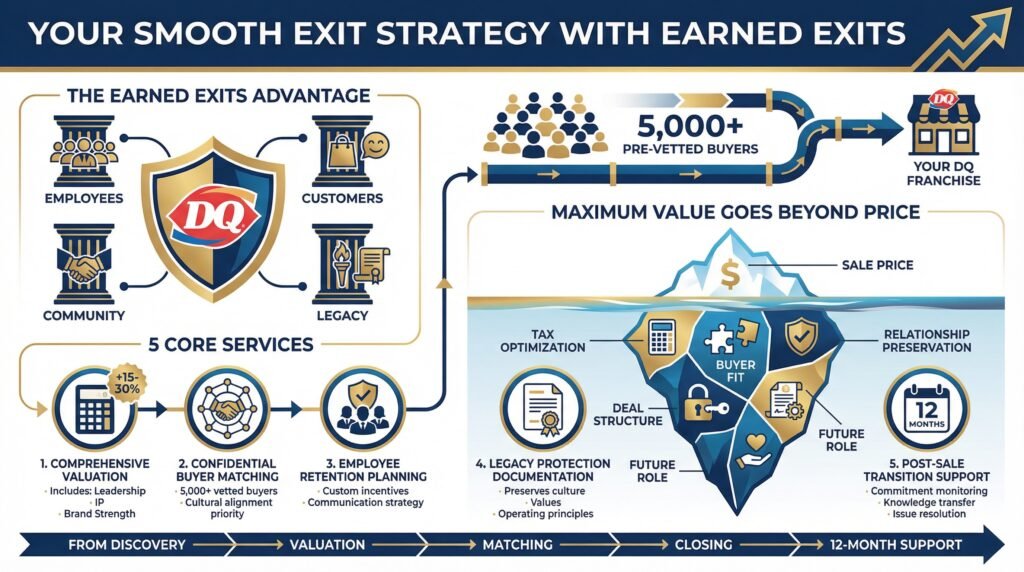
Earned Exits understands that achieving “maximum value” goes far beyond the headline price. Their process begins with getting to know you—your priorities, goals, and what truly matters at closing and in life after the business.
Beyond valuation, Earned Exits brings deep expertise in safeguarding employee, customer, vendor, and community relationships; defining your future role (if any); ensuring buyer fit; protecting your reputation and legacy; optimizing tax outcomes; maintaining strict confidentiality throughout the sale; and structuring key deal terms such as cash at closing and speed of execution. These factors collectively shape the most meaningful and successful exit.
Core Earned Exits Services Include:
- Comprehensive Valuation — Goes beyond traditional multiples by incorporating intangible assets such as leadership, intellectual property, and brand strength, often uncovering 15–30% additional value.
- Confidential Buyer Matching — Leverages a proprietary network of 5,000+ pre-vetted buyers, prioritizing cultural and operational alignment—not just financial capacity.
- Employee Retention Planning — Designs customized incentive and communication strategies to retain critical team members through the transition.
- Legacy Protection Documentation — Establishes formal agreements that preserve company culture, values, and operating principles after the sale.
- Post-Sale Transition Support — Provides up to 12 months of post-closing guidance to ensure commitments are honored, knowledge is transferred, and issues are resolved.
Get started today and let Earned Exits do the heavy-lifting in ensuring your smooth and profitable DQ franchise business exit. Click the link below to start their free business valuation by filling out their short contact form.

Learn more in the next article where we discuss a sample Dairy Queen Exit Template, negotiation strategies, legal pitfalls, and more here.
Business Seller Check-In
Whether you are planning to sell your business solo or utilize the experience and leveraging skills of a broker, pause and review the discussed points, and you have done the basic preparation needed to place your business on the market.
A major contributor to business undervaluations, wasted time, and poor exits is simply a lack of readiness. A broker can only sell what you’ve built.
If your business:
- Depends heavily on you
- Has inconsistent or unclear financials
- Lacks systems or transferable processes
Then even the best broker will struggle to get a premium offer. Brokers don’t create value. They expose it.
Bottom line: If you are not sure what basic preparation is required before considering a business valuation or selecting a business broker, click the link below to take our free business readiness quiz. The score will give you a clear indication of where you are in the process and the next course of action to take to ensure you start the business sale and exit on the right footing.
*Disclaimer: This article is written for educational purposes and should not be interpreted as financi
Frequently Asked Questions
How much does it typically cost to exit a Dairy Queen franchise early?
The cost of early termination varies significantly based on your specific situation and exit reason. For voluntary early exits without approved cause, you’ll typically face liquidated damages calculated as a percentage of your average annual royalties multiplied by the remaining years in your term, often ranging from $50,000 to $250,000, depending on store performance and contract duration.
Additional costs include de-identification expenses (typically $15,000-$30,000), outstanding royalties and advertising fund contributions, supplier balances, equipment lease payoffs, real estate lease obligations, and professional fees for attorneys and accountants. Exits due to documented franchisor breaches or approved hardship circumstances may qualify for reduced or waived liquidated damages, significantly lowering your total exit cost.
Early termination liquidated damages: $50,000-$250,000 (based on performance and remaining term)
Physical de-identification: $15,000-$30,000
Legal and accounting fees: $5,000-$15,000
Outstanding supply chain obligations: Varies widely
Lease termination costs: Typically 3-6 months’ rent plus restoration requirements
Negotiation often reduces these figures, particularly when hardship can be documented or when the franchisor sees potential reputational risk in strictly enforcing maximum penalties. Yo
Can I sell my Dairy Queen franchise instead of returning it to the franchisor?
Yes, selling your franchise to a qualified buyer typically represents the most financially advantageous exit strategy. IDQ generally allows transfers to approved purchasers who meet their current franchisee qualifications and complete required training.
The franchisor retains right of first refusal on any transfer, meaning they can match any offer you receive, but they rarely exercise this right unless the location has strategic importance. Transfer fees typically range from $10,000 to $20,000, substantially less than early termination penalties. However, finding a qualified buyer who can secure financing and meet IDQ’s increasingly stringent requirements has become more challenging in recent years, with the approval process often taking 3-6 months from initial application to final transfer.
Will I still be bound by non-compete agreements after I exit my franchise?
Yes, post-termination non-compete provisions in Dairy Queen franchise agreements remain enforceable after your exit, typically prohibiting involvement with similar businesses within a specified radius (often 5-10 miles) of your former location and sometimes any existing Dairy Queen for 1-2 years.
These restrictions apply regardless of whether you terminated early, completed your full term, or sold to another operator. The enforceability varies by state, with California, North Dakota, and Oklahoma generally restricting non-compete enforcement, while most other states uphold reasonable restrictions. Courts typically consider factors like geographic scope, duration, and definition of competing businesses when evaluating enforceability.
Working with an experienced franchise business broker helps identify potential strategies for navigating these restrictions, such as focusing on non-competing food categories, operating outside restricted territories, or serving as a passive investor rather than an active operator in competing businesses.
Get started today and let the experienced team at Earned Exits perform the due diligence and heavy lifting, providing a smooth and profitable DQ franchise business exit. Click the link below to start their free business valuation. Read our full review of Earned Exits here.
If you have decided that Earned Exits is a good fit and your franchise business size is $1M-$40M+, click the link below to contact Earned Exits today to start their free business valuation by filling out a short form.
*Disclaimer: This article is written for educational purposes and should not be interpreted as financial advice.
*Disclaimer: This article is written for educational purposes and should not be interpreted as financial advice. We may receive compensation for referrals made through this article.