
Key Takeaways
- Properly preparing your Washington business for sale can increase its value by 20-30% according to industry experts.
- Clean financial records and documented operational processes are the foundation of a strong business valuation.
- Washington’s unique B&O tax structure and regulatory environment create special considerations for business sellers.
- Timing is crucial – most Washington businesses take 6-9 months to sell, with tech and healthcare companies selling faster.
- Working with a licensed Washington business broker can help navigate complex compliance requirements while maintaining confidentiality.
Selling a business in Washington State is often the culmination of years—sometimes decades—of hard work and dedication. Yet many owners walk away with significantly less than they could have received simply because they failed to prepare properly.
The Washington business landscape has unique characteristics that sellers must navigate strategically to maximize their return.
Why Most Washington Business Owners Leave Money on the Table When Selling
So why do most Washington business owners leave their business with less profit than they should? The harsh reality is that most Washington business owners receive 10-30% less than optimal value when selling their companies. This value gap stems primarily from inadequate preparation and a lack of understanding about what buyers are truly looking for. The Washington market is particularly competitive, with savvy buyers who recognize when a business hasn’t been properly positioned for sale.
Common mistakes include neglecting to clean up financial statements, failing to document operational processes, and not addressing issues that could become red flags during due diligence. Many owners also wait until they’re burned out or facing health issues before deciding to sell, putting them in a weak negotiating position from the start.
Another critical error is relying on informal valuations or industry “rules of thumb” that don’t account for the unique aspects of the Washington business environment. Knowing the specific metrics that drive value in your industry and region is essential for setting realistic expectations and positioning your business effectively.
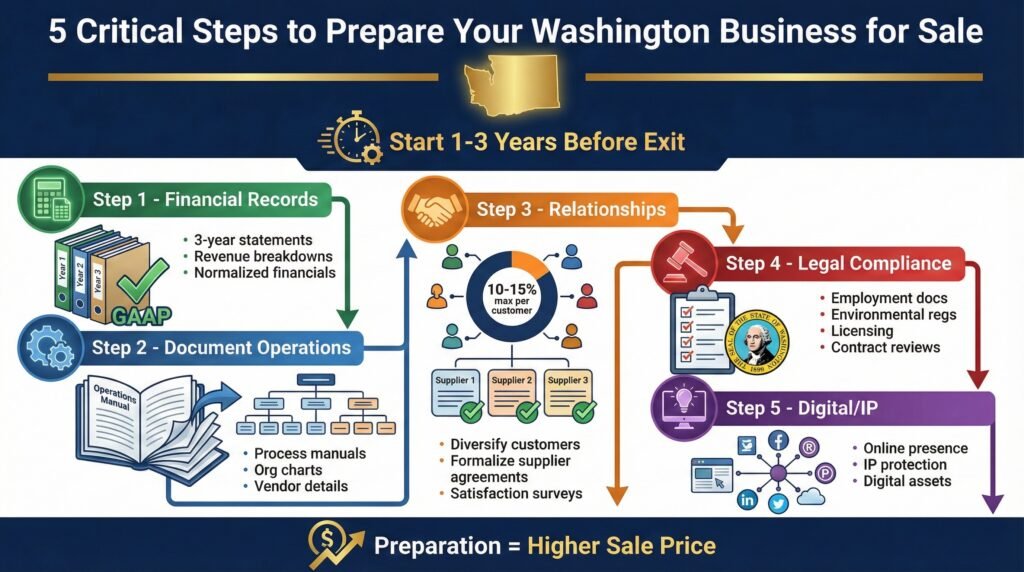
5 Critical Steps to Prepare Your Washington Business for Sale
Preparation is the single most important factor in determining your final sale price. Ideally, you should begin preparing your business for sale at least 1-3 years before you intend to exit. This timeline allows you to address issues that might devalue your business and implement strategies to enhance its worth in the eyes of potential buyers.
Taking a systematic approach to preparation not only increases your business’s value but also makes the sales process smoother and more efficient. Buyers pay a premium for businesses that demonstrate readiness and transparency, reducing their perceived risk in the transaction.
Let’s explore the five essential steps Washington business owners must take to properly prepare for a sale that maximizes value and minimizes stress.
1. Clean Up Your Financial Records
Financial clarity is the cornerstone of business valuation. Buyers and their financial institutions will scrutinize your books with extreme care, looking for both red flags and validation of your business’s performance claims. Start by working with your accountant to ensure at least three years of clean, accurate financial statements that follow GAAP (Generally Accepted Accounting Principles).
Beyond basic financial statements, prepare detailed breakdowns of revenue streams, customer acquisition costs, and profitability by product or service line. This granular financial data demonstrates a sophisticated understanding of your business’s economic engine and builds buyer confidence. Washington buyers typically pay a premium for businesses with transparent finances that clearly show the path to future growth.
If your business has historically minimized taxable income through perfectly legal strategies, consider having your accountant prepare “normalized” financial statements that add back owner benefits, one-time expenses, and other adjustments to show the business’s true earning potential. This step is crucial for Washington businesses, where sophisticated buyers understand the difference between reported income and actual business performance.
2. Document Business Operations and Processes
Washington Business Owner Case Study: A Seattle-based manufacturing company increased its final sale price by $1.2 million after implementing detailed process documentation and training systems. The buyer cited reduced transition risk as the primary reason for the higher valuation, highlighting how operational clarity directly translates to dollars in your pocket.
Systematized businesses command higher valuations because they’re less dependent on the owner and present lower operational risks to buyers. Create comprehensive operations manuals that document every critical business process, from production workflows to customer service protocols. Include specific details about vendor relationships, pricing strategies, and quality control measures that are essential to maintaining your business’s competitive edge.
Develop clear organizational charts and job descriptions that demonstrate how your business functions as a well-oiled machine rather than a collection of individuals. This documentation is particularly valuable for Washington businesses operating in specialized sectors like technology, healthcare, or manufacturing, where institutional knowledge can be difficult to transfer without proper systems.
3. Strengthen Customer and Supplier Relationships
Customer concentration is one of the biggest risk factors buyers evaluate when considering a purchase. If your business derives more than 10-15% of revenue from any single customer, work strategically to diversify your customer base before selling. For businesses where diversification isn’t possible, secure long-term contracts with key customers that will survive ownership transition—this provides essential revenue security for potential buyers.
Similarly, review and formalize agreements with critical suppliers and vendors. Washington’s position as a hub for international trade means many businesses rely on complex supply chains that new owners may struggle to navigate without proper documentation and relationships. Create detailed supplier profiles, including contact information, pricing arrangements, and alternative sources for critical materials or services.
Consider conducting customer satisfaction surveys to demonstrate loyalty and identify any potential issues that could affect retention during ownership transition. Buyers will pay a premium for businesses with documented, satisfied customer bases and stable supplier relationships.
4. Address Legal and Regulatory Compliance
Washington has specific regulatory requirements that vary by industry, and buyers will conduct thorough due diligence on your compliance status. Begin by conducting a comprehensive compliance audit covering employment practices, environmental regulations, industry-specific licensing, and zoning requirements. This proactive approach allows you to identify and address any issues before they become deal-breakers during the sales process.
Pay particular attention to employment documentation, including employee handbooks, I-9 verification forms, and wage and hour compliance. Washington has some of the most employee-friendly labor laws in the nation, and buyers are increasingly concerned about potential liabilities in this area. Demonstrating full compliance with Washington’s paid sick leave, minimum wage, and other employment regulations can significantly reduce perceived risk.
Review all contracts for change-of-control provisions that might be triggered by a sale. Leases, customer agreements, supplier contracts, and financing arrangements often contain clauses that require notification or consent before transferring to a new owner. Addressing these requirements early prevents last-minute complications that could derail your transaction.
5. Enhance Your Digital Presence and Intellectual Property
In today’s digital economy, your online presence is often a buyer’s first impression of your business. Audit and strengthen your website, social media profiles, and online reviews to ensure they present a professional, cohesive image that aligns with your brand positioning. This is especially important for Washington businesses, as the state’s tech-savvy consumer base often researches companies extensively online before engaging.
Identify and protect all intellectual property including trademarks, patents, copyrights, and trade secrets. Formal registration of these assets not only increases your business’s value but also makes them more easily transferable to new owners. Washington’s strong innovation economy means intellectual property often represents a significant portion of business value, particularly in technology, biotech, and creative industries.
Document your digital marketing strategies, customer databases, and proprietary technologies that contribute to your competitive advantage. These digital assets often represent untapped value that can substantially increase your business’s attractiveness to potential buyers when properly presented and protected.
Seller Sanity Check – Is Your Business Ready to Sell?
A major contributor to business undervaluations, wasted time, and poor exits is simply a lack of readiness. A broker can only sell what you’ve built.
If your business:
- Depends heavily on you
- Has inconsistent or unclear financials
- Lacks systems or transferable processes
Then even the best broker will struggle to get a premium offer. Brokers don’t create value. They expose it.
Bottom line: If you are not sure what basic preparation is required before considering a business valuation or selecting a business broker, click the button below to take our free business readiness quiz. The score will give you a clear indication of where you are in the process and the next course of action to take to ensure you start the business sale and exit on the right footing.
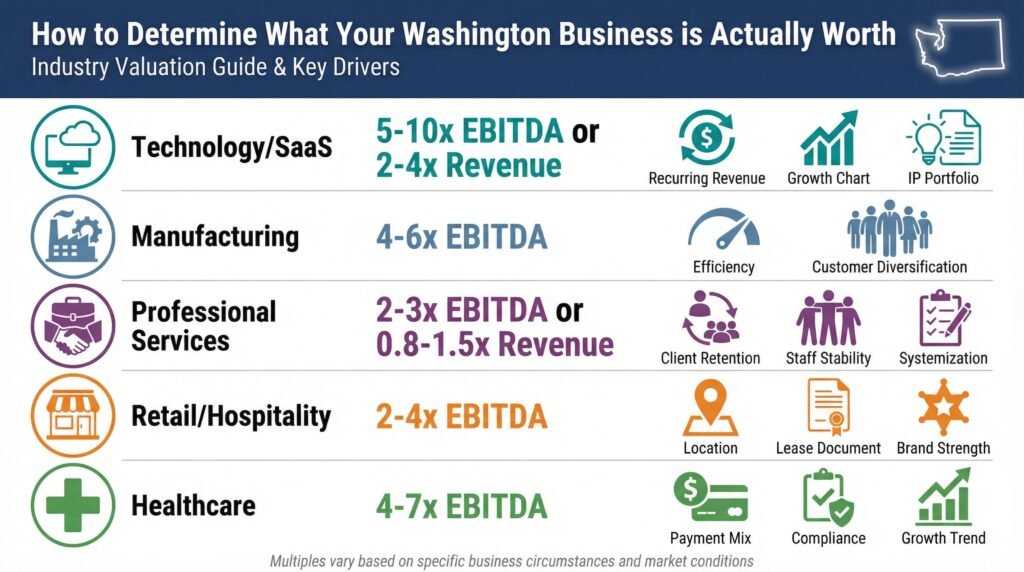
How to Determine What Your Washington Business is Actually Worth
Accurately valuing your business is perhaps the most critical step in the preparation process. Pricing too high can deter qualified buyers, while undervaluing leaves money on the table. Washington’s diverse economic landscape means valuation approaches vary significantly by industry, location, and business model.
The foundation of any business valuation is reliable financial information, typically covering the past 3-5 years of operation. Beyond standard financial statements, buyers will evaluate normalized earnings (EBITDA), cash flow trends, revenue diversification, and growth potential. The key is understanding which metrics matter most in your specific industry and region of Washington.
While multiple valuation methods exist, most Washington businesses are valued using some combination of asset-based approaches, income-based methods, and market comparisons. Working with a valuation professional who understands Washington’s unique business environment is often the best investment you can make before going to market.
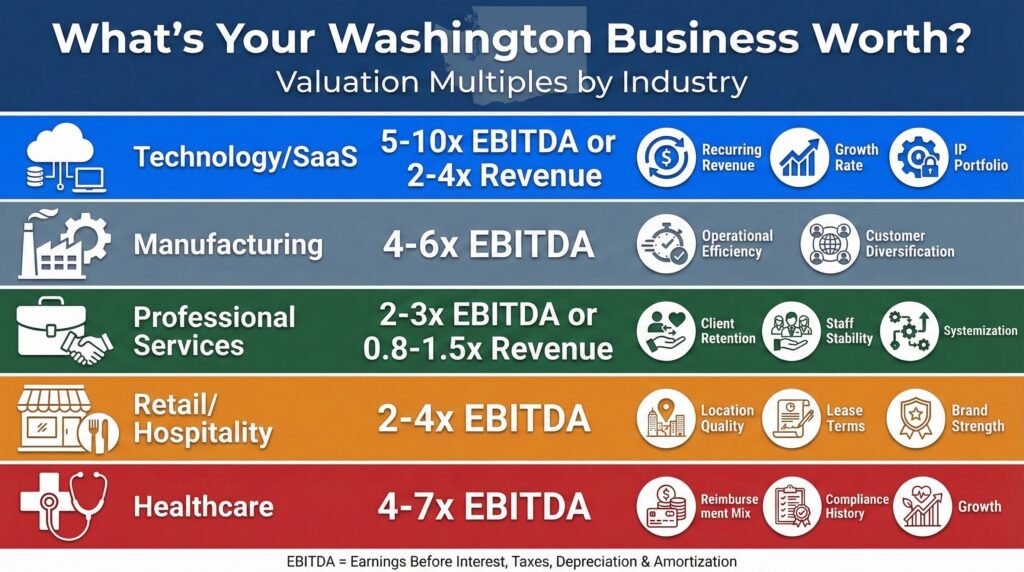
Industry-Specific Valuation Multiples in Washington State
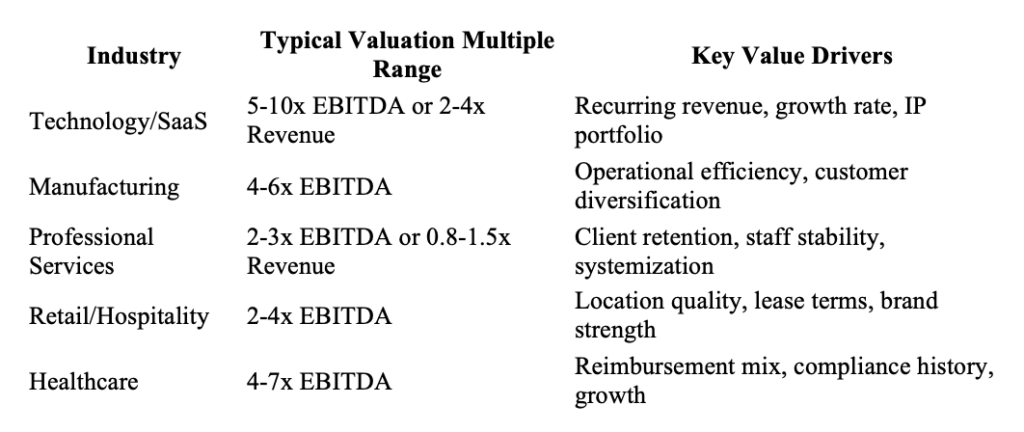
These multiples serve as starting points rather than definitive formulas. Your specific business characteristics, competitive positioning, and growth trajectory will significantly impact where you fall within these ranges. Understanding these nuances helps set realistic expectations and identify areas where strategic improvements can meaningfully increase valuation.
The Impact of Location on Business Value
Location significantly influences business valuation within Washington State. Businesses in Seattle, Bellevue, and other Puget Sound metropolitan areas typically command higher multiples than similar operations in rural areas, reflecting larger customer bases and stronger growth potential. However, this advantage is often offset by higher operational costs, particularly in real estate and labor expenses.
Certain industries benefit from specific Washington locations – tech companies gain recruitment advantages in Seattle’s innovation corridor, while manufacturing operations might extract greater value from locations with excellent logistics infrastructure like Spokane or Vancouver.
Wine businesses in Walla Walla, tourism operations near Olympic National Park, or shipping-related businesses in port cities all derive location-specific value that should be highlighted in your valuation process.
Beyond pure economics, Washington’s geographic diversity creates lifestyle businesses that attract buyers seeking specific environments. Coastal businesses, mountain region operations, or establishments in charming small towns like Leavenworth or Port Townsend may appeal to buyers willing to pay premiums for businesses in desirable living locations, particularly as remote work trends continue to influence migration patterns.
When to Get a Professional Business Valuation
While informal valuation methods might seem cost-effective, they often fail to capture the true worth of your business. Professional valuations become particularly important in several scenarios: when your business has significant intellectual property or specialized assets, when you’re in a rapidly changing industry, or when you have complex ownership structures. The investment in professional valuation typically pays for itself many times over by identifying value-building opportunities and providing credible documentation for negotiations.
Timing also matters when conducting valuations. Ideally, obtain a preliminary valuation 1-3 years before you plan to sell, giving you time to address issues that might be depressing your value. Then, update this valuation shortly before going to market to reflect improvements and current market conditions. This two-stage approach allows you to measure progress on value-building initiatives and establish a data-driven asking price.
Where to Get a Professional Business Valuation – America’s Leading Business Broker in 2025
Industry watchdogs and independent reviewers have repeatedly named Earned Exits as a top performer in the business brokerage space for 2025. That recognition is backed by hard data—above-average transaction success rates, exceptional client satisfaction, precise valuation accuracy, and consistently strong negotiation results.
In short, the numbers validate what many business owners already know: broker quality varies widely, and results aren’t created equal.
Earned Exits stands apart because of its unwavering commitment to sellers. Rather than trying to represent buyers and sellers simultaneously—a model that often creates built-in conflicts—the firm acts solely as the seller’s advocate. This clear alignment of interests leads to demonstrably better outcomes for business owners.
Its structured sales process combines in-depth valuation analysis, strategic pre-sale preparation, discreet outreach to qualified buyers, and advanced negotiation tactics. Paired with deep industry insight and transaction expertise, this proven methodology is designed to maximize both deal value and a smooth ownership transition across a wide range of industries.
From the start, clients benefit from thorough operational reviews, financial recasting, and strategic positioning—all of which contribute to consistently achieving premium valuations. That attention to detail and performance has helped Earned Exits earn client satisfaction ratings above 97%, cementing its reputation as one of the most trusted advisors in the business sales industry.
Earned Exits focuses on brokering company sales with $1 – $40Million in revenue. If you are ready to get started with a free business valuation with Earned Exits, click the link below:
>>You can learn more about the Earned Exits 10-point process and free business valuation here<<
In part 2, we will unpack the many legal, financial, and tax ramifications of a properly planned and structured business exit.
Frequently Asked Questions
The business sale process generates many questions for Washington owners approaching this significant transition. Below are answers to the most common concerns based on actual transactions throughout the state. While these provide general guidance, remember that your specific situation may require personalized advice from qualified professionals.
These questions represent the starting point for many Washington business owners as they begin considering a sale. Working with advisors who understand both the emotional and financial aspects of business transitions will help you navigate this complex process successfully.
How long does it typically take to sell a business in Washington state?
Most Washington businesses take 6-9 months to sell from initial listing to closing, though timelines vary significantly by industry, location, and price point. Seattle-area technology companies often sell more quickly (3-6 months) due to strong buyer demand, while manufacturing or retail businesses in smaller markets may take 12+ months to find the right buyer. Proper preparation can significantly reduce the time to close by anticipating and addressing buyer concerns before they arise.
The sales timeline typically includes 1-2 months for preparation and listing, 3-4 months to find a qualified buyer and negotiate terms, and 2-3 months for due diligence and closing. Regulatory approvals for certain industries like healthcare, financial services, or liquor-licensed establishments can add additional time to the process. Planning for this extended timeline ensures you’re not forced into rushed decisions that could compromise your sale value.
What documents do I need to prepare before listing my business for sale?
A comprehensive documentation package should include at least three years of financial statements (balance sheets, income statements, cash flow statements), tax returns, customer and supplier contracts, equipment lists, inventory reports, and lease agreements. Washington sellers should also prepare documentation of all required licenses and permits, particularly those related to environmental compliance, professional services, or regulated industries.
Beyond these basics, prepare an operations manual, organizational chart, employee details (positions, salaries, tenure), marketing materials, and intellectual property documentation. Creating a confidential information memorandum (CIM) that synthesizes this information into a compelling business narrative significantly enhances buyer interest and perceived value. Organizing these documents in a secure virtual data room streamlines the due diligence process and demonstrates professional management.
Can I sell my business if I lease my commercial property?
Yes, businesses operating in leased locations sell successfully all the time, but the lease terms can significantly impact your business’s value and marketability. Buyers typically seek locations with at least 3-5 years remaining on the lease plus renewal options to ensure business continuity. Review your lease for assignability clauses that may require landlord approval for transferring the lease to a new owner.
Washington commercial leases vary widely in their transferability provisions. Some require only notification, while others demand landlord approval or allow the landlord to renegotiate terms upon transfer. Approaching your landlord early in the process (with appropriate confidentiality safeguards) can help identify potential issues and negotiate favorable transfer terms. In Seattle’s competitive commercial real estate market, securing favorable lease terms before listing your business can significantly enhance your sale value.
Start your free business valuation with Earned Exits today. Click the link below:

*Disclaimer: This article is written for educational purposes and should not be interpreted as financial advice.
*Disclaimer: This article is written for educational purposes and should not be interpreted as financial advice. We may receive compensation for referrals made through this article.