
Quick Summary
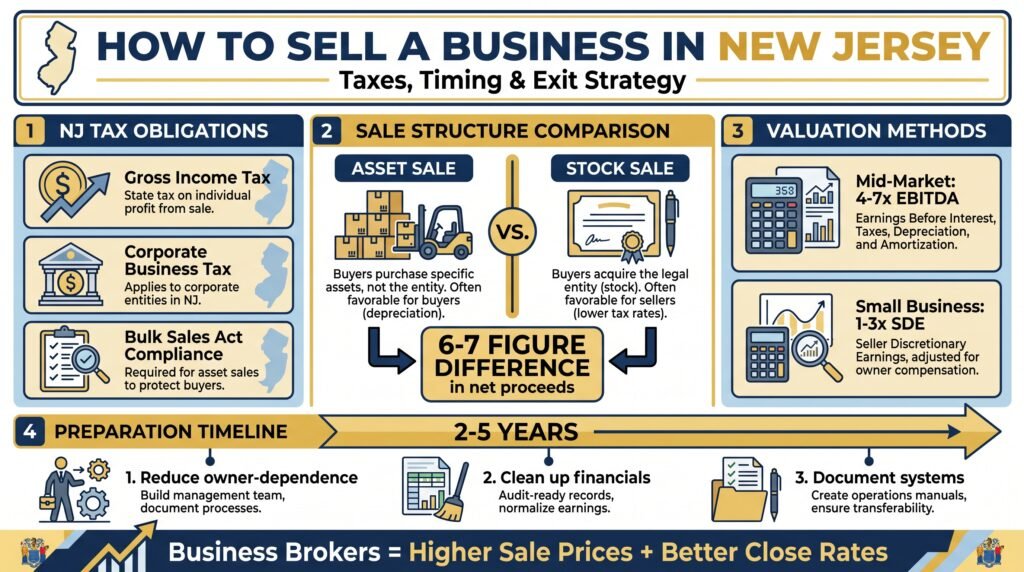
Selling a business in New Jersey in 2026 is more complex than most owners expect. Key considerations include NJ-specific tax obligations (Gross Income Tax, Corporate Business Tax, and the Bulk Sales Act compliance for asset sales), choosing between an asset vs. stock sale structure — which can mean six or seven figures difference in net proceeds, and getting an accurate valuation (typically 4–7x EBITDA for mid-market or 1–3x SDE for smaller businesses).
Start preparing 2–5 years out: reduce owner-dependence, clean up financials, and document systems. Working with an experienced business broker consistently yields higher sale prices and better close rates than going it alone.
Table of Contents
- Introduction
- New Jersey Tax Structure and Sale Implications
- Asset Sale vs Stock Sale Dynamics
- Valuation Methods and Market Multiples
- Business Seller Checklist
- Why Professional Help Matters More Than Ever
- Key Takeaways
Introduction
So you’re thinking about selling your business in New Jersey. Maybe you’ve been running this company for twenty years, or maybe you built a tech startup that’s finally reached the scale where strategic buyers are circling.
Either way, you’re probably feeling a mix of excitement and absolute terror right now.
I get it. Selling a business is one of the most consequential financial decisions you’ll ever make, and for most New Jersey owners, especially those in the baby boomer generation, the sale proceeds represent the lion’s share of your retirement nest egg.
The stakes couldn’t be higher, and honestly, the complexity of getting this right is something that most people drastically underestimate until they’re knee-deep in it.
If you approach this methodically and start preparing well in advance, you can significantly increase both your sale price and your odds of actually making it to closing. The 2026 market is more sophisticated and demanding than ever before.
Buyers are conducting deeper diligence, timelines are longer than you think, and New Jersey’s specific tax and regulatory environment adds layers of complexity that out-of-state guides simply won’t address.
If you need know if your business is order before you take it to market, take a quick business readiness quiz here. Otherwise, let’s get started.
New Jersey Tax Structure and Sale Implications
Now let’s talk about something that catches a lot of sellers completely off guard: how New Jersey taxes are going to affect your net proceeds. This is where things get really specific to our state, and honestly, where I see the most expensive mistakes happen.
First, you need to understand that New Jersey has both person Gross Income Tax and Corporate Business Tax that can come into play depending on how your business is structured and how the sale is structured.
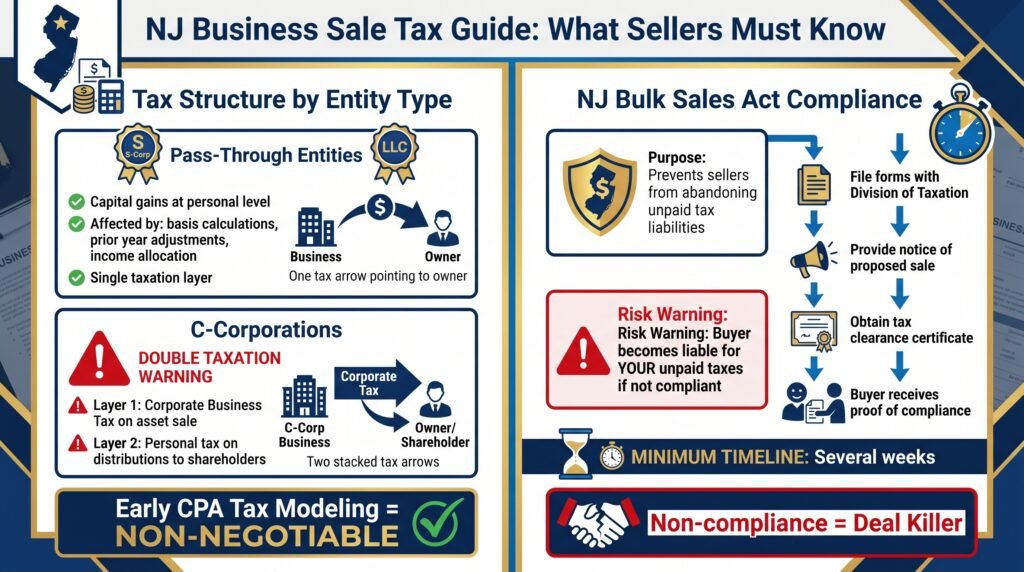
If you’re operating as a pass-through entity like an S-corporation or LLC taxed as a partnership, you’ll generally be dealing with capital gains taxation at the person level when you sell your ownership interest. The devil is really in the details here, because basis calculations, prior year adjustments, and how income has been allocated over the years can all materially affect your taxable gain.
For C-corporations, the picture gets even more complicated because of the potential for double taxation. If you structure the transaction as an asset sale, the corporation itself will generally recognize gain subject to Corporate Business Tax.
Then, when you distribute those net proceeds to yourself as a shareholder, you’re potentially looking at another layer of person tax.
This is precisely why early tax modeling with a CPA who really understands New Jersey M&A is absolutely critical, not optional.
Beyond income taxes, you’ve got the New Jersey Bulk Sales Act to contend with if you’re doing an asset sale. This is one of those state-specific quirks that can genuinely blow up a deal if you’re not aware of it.
The Bulk Sales Act needs buyers of business assets outside the ordinary course of business to tell the New Jersey Division of Taxation.
The purpose is to prevent sellers from dumping assets and disappearing while leaving unpaid state tax liabilities behind.
What this means practically is that if you don’t follow the proper notice procedures and get tax clearance, the buyer can become personally liable for your outstanding state tax obligations. As you might imagine, buyers are extremely sensitive to this risk, and failure to address Bulk Sales compliance early in the process can cause serious friction or even kill deals that are otherwise ready to close.
The compliance process itself involves filing specific forms with the Division of Taxation, providing notice of the proposed sale, and obtaining clearance certificates that prove you don’t have outstanding state tax liabilities. This can take several weeks at minimum, so you need to build this timeline into your transaction planning.
Buyers will absolutely demand proof of compliance before they’ll wire funds, and rightfully so.
Asset Sale vs Stock Sale Dynamics
One of the first major decision points you’ll encounter is whether to structure the transaction as an asset sale or as a stock or equity sale. This choice has enormous implications for taxes, liabilities, and deal complexity, and buyers and sellers typically have opposing preferences.
From a buyer’s perspective, asset sales are usually more attractive because they get to pick and choose which assets and liabilities they’re assuming, and they get a stepped-up tax basis in the acquired assets, which provides future depreciation and amortization benefits. They also avoid inheriting unknown or contingent liabilities from your company’s history.
From your perspective as a seller, stock or equity sales are often preferable because the entire transaction can be treated as a capital gain at your person level, which is typically more tax-efficient than the potential double taxation in a C-corporation asset sale.
Stock sales are also usually cleaner from a legal perspective because all contracts, licenses, and relationships stay with the same legal entity and theoretically don’t need third-party consents.
In reality, which structure you end up with often comes down to negotiation leverage and entity type. S-corporations and LLCs taxed as partnerships can often structure deals that work for both parties because there’s no entity-level tax on asset sales, so the tax burden on sellers isn’t dramatically different between structures.
C-corporations face the toughest challenge because an asset sale really does trigger that painful double tax.
This is exactly the kind of thing you want to model out exhaustively before you ever sign a letter of intent, because the net proceeds difference between a well-structured and poorly-structured deal can easily be six or seven figures, even on a relatively modest middle-market transaction.
Your CPA should run many scenarios showing after-tax proceeds under different structures, factoring in federal taxes, New Jersey state taxes, net investment income tax, and any other applicable levies. Only when you understand what you’ll actually net under each scenario can you negotiate intelligently about structure.
Valuation Methods and Market Multiples
Let’s talk about what your business is actually worth, because this is where emotion and reality often collide painfully. Most small and mid-market businesses in New Jersey are valued using some many of EBITDA or, for smaller owner-operated businesses, Seller’s Discretionary Earnings.
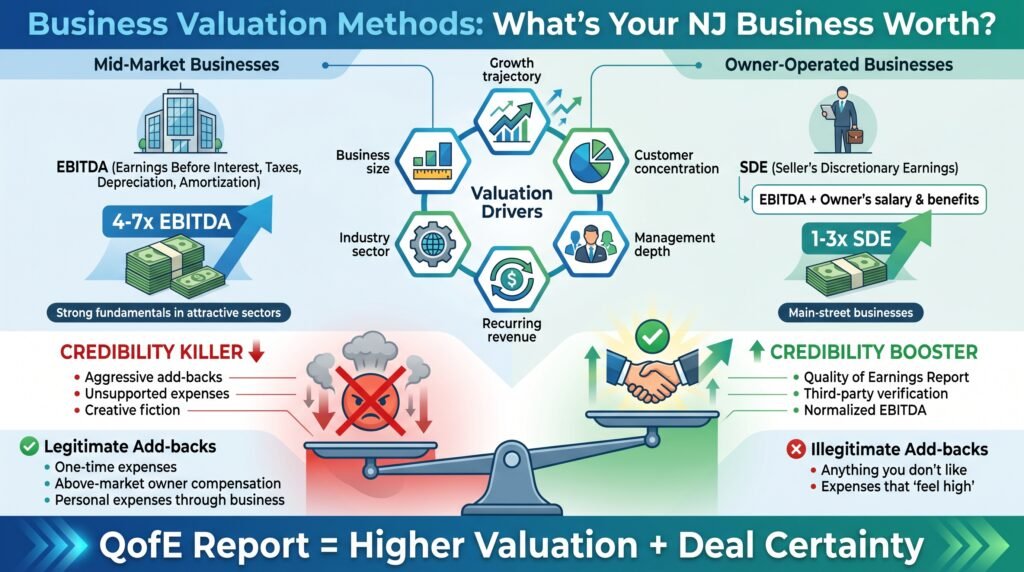
EBITDA stands for Earnings Before Interest, Taxes, Depreciation, and Amortization, and it’s essentially a measure of operating cash flow. SDE is similar but adds back the owner’s salary and benefits, which makes sense for businesses where the owner is essentially buying themselves a job plus profits.
The many you’ll receive depends enormously on your industry, size, growth trajectory, customer concentration, management depth, recurring revenue, and dozens of other factors.
In 2026, New Jersey businesses in attractive sectors with strong fundamentals might command multiples of four to seven times EBITDA, while smaller main-street businesses might sell for one to three times SDE.
What drives buyers crazy and what will absolutely tank your credibility is when sellers try to inflate EBITDA or SDE with aggressive or unsupportable add-backs. Yes, you should normalize for one-time expenses, above-market owner compensation, and personal expenses run through the business.
But no, you can’t add back anything you don’t like or anything that feels high to you.
Buyers have seen every trick in the book, and if your add-back schedule looks like creative fiction, they’ll discount your entire story.
This is actually one area where commissioning your own Quality of Earnings report before going to market can pay enormous dividends. When you have a credible third-party accounting firm confirm your normalized EBITDA and add-backs, buyers take your numbers much more seriously, and you can often justify a higher valuation as a result.
The QofE process involves having accountants review several years of your financial statements, verify revenue recognition practices, normalize for one-time items, confirm the sustainability of margins, and generally confirm that your reported earnings reflect the true economic performance of the business. Yes, this costs money upfront, but it pays for itself many times over in credibility and deal certainty.
Business Seller Sanity Checklist
As we covered in the first part of this series, it’s time for another seller sanity check. Whether you are planning to sell your business solo or utilize the experience and leveraging skills of a broker, pause and review the discussed points, and you have done the basic preparation needed to place your business on the market.
A major contributor to business undervaluations, wasted time, and poor exits is simply a lack of readiness. A broker can only sell what you’ve built.
If your business:
- Depends heavily on you
- Has inconsistent or unclear financials
- Lacks systems or transferable processes
Then even the best broker will struggle to get a premium offer. Brokers don’t create value. They expose it.
Bottom line: If you are not sure what basic preparation is required before considering a business valuation or selecting a business broker, click the link below to take our free business readiness quiz. The score will give you a clear indication of where you are in the process and the next course of action to take to ensure you start the business sale and exit on the right footing.
If you have read enough and know your business has passed the preparation criteria to go to market, read our review of Earned Exits here.
The classic adage applies, “If you want to go fast, go alone, If you want to go far, go together” If your business is valued at $1 to $40 million, an experienced business broker like Earned Exits will leverage more potential buyers and an average increase of profit of 20 to 30% more than going it alone. Stated simply, alone is cheaper, but not always most profitable.
If you have decided that Earned Exits is a good fit , Click the link below to contact Earned Exits today to start their free business valuation by filling out a short contact form.
Why Professional Help Matters More Than Ever
I need to spend a minute on why trying to sell your business yourself, without professional intermediation, is almost always a costly mistake. I know the temptation is real because broker fees can seem steep when you’re looking at them as a percentage of your sale price.
But here’s what happens in practice. Well-prepared businesses marketed by experienced brokers consistently sell faster and at higher prices than comparable businesses sold DIY.
There are several reasons for this.
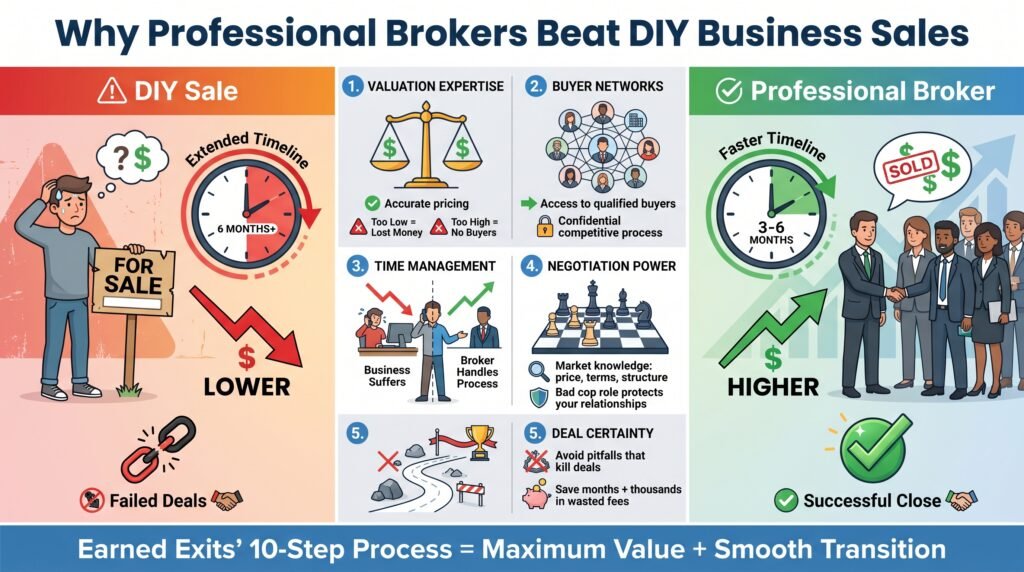
First, business brokers understand market valuation standards and know what your business can realistically command. They’ll help you avoid the twin mistakes of underpricing and leaving money on the table or overpricing and sitting on the market forever.
Second, brokers have networks of qualified buyers that you simply don’t have access to. They know who’s looking, what they’re looking for, and how to position your business to the right audience.
They can maintain confidentiality while still running a competitive process that drives up value.
Third, brokers manage the enormously time-consuming process of fielding inquiries, scheduling meetings, coordinating due diligence, and keeping deals on track. When you try to do this yourself while still running the business, one or both suffers.
And here’s the thing: if your business performance declines during the sale process because you’re distracted, buyers will absolutely reprice the deal or walk away.
Fourth, experienced brokers know how to negotiate. They understand what’s market in terms of price, structure, working capital, indemnities, and earnouts.
They know when buyers are being reasonable and when they’re trying to take advantage.
And crucially, they can play bad cop in negotiations while you preserve the relationship you’ll need during transition.
Finally, brokers dramatically increase your probability of actually closing and more profitably had you gone it alone. They’ve seen every way deals can fall apart, and they know how to structure transactions and prepare sellers to avoid those pitfalls, problems, issues, problems, issues.
When you consider that a deal that dies in due diligence means you’ve wasted months of time and tens of thousands in legal and accounting fees, the value of someone who can get you to closing becomes really obvious.
Brokering over $2.1 Billion in transactions across 17 industries, Earned Exits was named a top business broker in 2025 by IWSP.
Discover how the Earned Exits’ proven 10-step process can help you achieve the maximum value for your business while ensuring a smooth transition to your next chapter. Click the link below to contact Earned Exits today to start their free business valuation by filling out a short contact form.
Key Takeaways
Selling a business in New Jersey in 2026 needs significantly more preparation and sophistication than most owners realize going in.
Start your planning at least two to five years before your target exit to maximize value and minimize tax leakage.
New Jersey’s specific tax environment, including Gross Income Tax, Corporate Business Tax, and the Bulk Sales Act, creates complexity that needs state-specific expertise.
Asset versus stock sale structure can create enormous differences in net proceeds and should be modeled exhaustively before signing any LOI.
Well-prepared businesses marketed by professional brokers consistently sell faster, at higher prices, and with higher close rates than DIY tries.
Reducing owner-dependence, cleaning up financials, and creating documented systems and management depth are the highest-ROI preparation activities.
Due diligence is where unprepared sellers get repriced or lose deals entirely, so running your own mock diligence before marketing is critical.
Deal structure matters as much as headline price, particularly around earnouts, seller financing, and working capital adjustments.
Integration with estate planning and wealth management should happen before the sale, not after, to optimize tax and financial outcomes.
The businesses that achieve the best outcomes are those that treat exit planning as a multi-year strategic process as opposed to a transactional event.
Earned Exits business brokers specializes in creating meaningful business transitions that protect what matters most.
The company has been recognized as the top business broker in the US for 2025, offering a seller-centric approach that maximizes real value for owners selling businesses valued $1M–$40M+. Click the link below to start Earned Exits’ free valuation process by filling out their short contact form.
People Also Asked
How long does it take to sell a business in New Jersey?
The timeline for selling a business in New Jersey typically ranges from six to twelve months for most middle-market companies.
Well-prepared businesses with clean financials and strong management can sometimes finish transactions in three to six months, while complex businesses or those with issues may take twelve to eighteen months or longer.
The process includes preparation, marketing, due diligence, and closing phases that each need significant time.
What is the New Jersey Bulk Sales Act?
The New Jersey Bulk Sales Act is a state law that needs buyers of business assets to inform the New Jersey Division of Taxation before completing the purchase. This law protects the state from sellers who might dispose of assets and leave unpaid tax liabilities.
Buyers who don’t follow the Bulk Sales Act can become personally liable for the seller’s outstanding state taxes, so obtaining proper tax clearance is essential in asset sale transactions.
How much is my New Jersey business worth?
New Jersey businesses are typically valued using multiples of EBITDA or Seller’s Discretionary Earnings. Current market multiples range from four to seven times EBITDA for strong middle-market businesses in desirable sectors, and one to three times SDE for smaller main-street businesses.
The actual many depends on your industry, size, growth rate, customer concentration, recurring revenue, management team, and overall business quality.
What taxes do I pay when selling a business in New Jersey?
When selling a New Jersey business, you’ll typically face federal capital gains tax, New Jersey Gross Income Tax on person gains, and potentially Corporate Business Tax if you’re selling a C-corporation.
The exact tax treatment depends on your entity structure, whether it’s an asset or stock sale, your basis in the business, and how the deal is structured. Some portion may also be subject to net investment income tax at the federal level.
How do I reduce owner-dependence before selling?
Reducing owner-dependence needs building a able management team that can handle day-to-day operations, documenting all systems and processes so they’re transferable, delegating customer and vendor relationships to employees as opposed to keeping them personal, and proving the business can run successfully without your constant involvement.
This process typically takes one to three years but significantly increases your business value and buyer confidence.
Do I need a broker to sell my business in New Jersey?
While you can legally sell your business yourself, working with an experienced business broker significantly increases your sale price, shortens the timeline, and improves your odds of closing.
Brokers have buyer networks, understand market valuations, manage the time-consuming process, negotiate effectively, and help avoid common deal-killing mistakes.
The commission they charge typically pays for itself through higher valuations and deal certainty.

*Disclaimer: This article is written for educational purposes and should not be interpreted as financial advice. We may receive compensation for referrals made through this article.