
Quick Summary
Selling a business in New York is a complex, multi-stage process that requires early planning, realistic timelines, and expert guidance. From pre-sale preparation and valuation to negotiations, due diligence, and closing, each phase has distinct timing, legal, and tax implications—often with one of the highest combined tax burdens in the country.
Strategic deal structuring (asset vs. stock sale), proactive tax planning, and strong confidentiality are critical to maximizing after-tax proceeds. Most failed deals stem from preventable issues like unrealistic valuations, poor financials, performance declines, or emotional decision-making.
Working with an experienced business broker—such as Earned Exits—significantly improves outcomes, reduces risk, and helps business owners exit on favorable terms.
In part 1, we discussed the critical facts that the New York business sellers miss, the proven methods to calculate your business’s value, and more. In part 2, we will unpack New York’s business sale timeline, tax implications when selling in New York, and more.
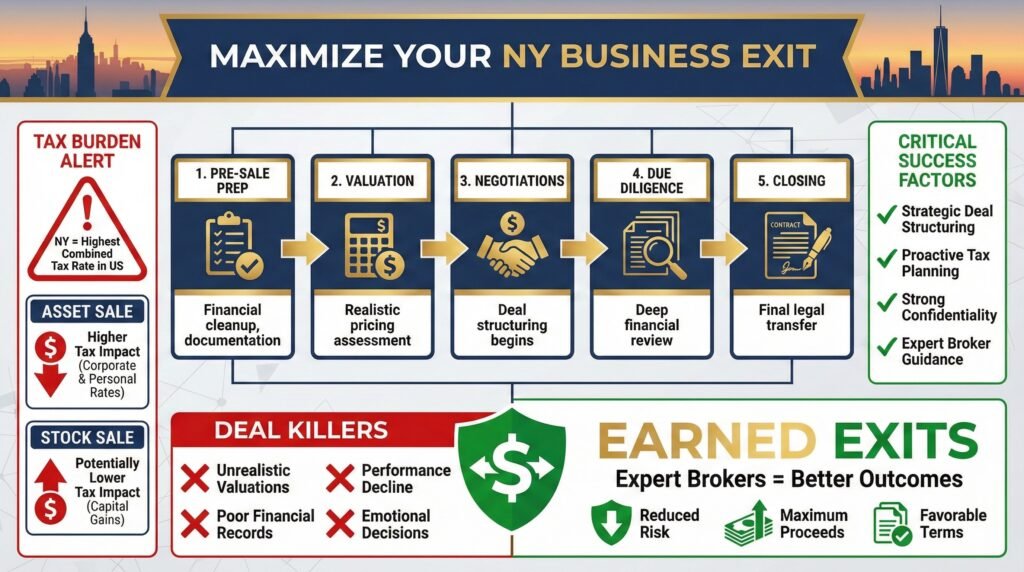
New York’s Unique Business Sale Timeline: What to Expect
The New York business sale process follows distinctive timing patterns that differ from national averages. Understanding this timeline helps set realistic expectations and ensures proper preparation at each stage. While individual transactions vary, this framework provides a reliable roadmap for planning your business sale journey in the New York market.
Timing expectations vary significantly by industry, business size, and transaction complexity. Professional services and technology businesses typically sell more quickly than manufacturing or distribution companies due to simpler asset structures and fewer regulatory considerations.
Similarly, businesses valued under $2 million typically move through the process more quickly than larger enterprises requiring more extensive due diligence and often more complex financing arrangements.
Planning for these timeframes is essential for maintaining business performance throughout the sale process. Many transactions falter when owners become exhausted by extended timelines they didn’t anticipate, leading to business performance declines that further complicate the sale.
Pre-Sale Preparation (6-12 Months Before)
Effective pre-sale preparation requires significant lead time to implement value enhancement strategies, clean up financial records, and prepare formal documentation. This critical phase often determines your ultimate sale price and transaction success.
Begin by conducting a comprehensive business assessment to identify strengths, weaknesses, and specific value enhancement opportunities. Develop and implement strategic improvements in operations, financial reporting, customer diversification, and technology systems that will maximize your valuation when you formally enter the market.
During this phase, assemble your advisory team, including a business broker or M&A advisor experienced in your industry, a transaction attorney familiar with New York business sales, and an accountant who can prepare clean financial statements and tax analysis. Working with advisors who understand New York’s unique business environment ensures proper preparation for the state’s sophisticated buyer market.
Valuation and Marketing Phase (2-3 Months)
Once preparation is complete, professional valuation and marketing materials development typically require 2-3 months. This phase includes comprehensive business valuation using multiple methodologies, creation of a confidential information memorandum (CIM), development of a targeted buyer list, and implementation of confidential marketing strategies.
The thoroughness of your marketing materials significantly impacts buyer interest and initial offer values, making this investment of time essential for maximum sale price.
New York’s competitive business environment demands sophisticated marketing approaches that highlight your business’s unique advantages while maintaining strict confidentiality. Experienced advisors utilize specialized networks, private databases, and industry connections to identify qualified buyers without broadcasting your sale intentions publicly.
Buyer Negotiations (1-2 Months)
The buyer negotiation phase typically spans 1-2 months from initial offers through letter of intent (LOI) signing. This period includes initial offer review, management meetings with qualified prospects, negotiation of key terms, and selection of the preferred buyer.
New York’s sophisticated buyer pool often includes private equity groups, strategic corporate buyers, and high-net-worth individuals with professional acquisition teams, requiring careful negotiation strategy and professional representation to maximize terms.
While purchase price naturally receives significant attention, deal structure, tax implications, transition terms, and contingency conditions often have equal or greater impact on your actual proceeds and satisfaction with the transaction. An experienced broker and advisors help navigate these complex negotiations to secure optimal terms across all aspects of the deal.
Due Diligence Period (30-90 Days)
The due diligence phase represents the most intensive period of the transaction, typically lasting 30-90 days depending on business complexity and buyer thoroughness. During this critical period, the buyer conducts a comprehensive verification of all business aspects, including financial records, customer relationships, operational processes, legal compliance, and growth opportunities. New York buyers are notoriously thorough in due diligence, reflecting the state’s sophisticated business culture and higher transaction values.
Proper preparation before entering the market significantly reduces due diligence stress and prevents valuation reductions during this phase. Businesses with clean financial records, well-documented operations, and resolved legal issues typically maintain their valuation through due diligence, while unprepared businesses often face significant price reductions or failed transactions when issues emerge.
Closing Process (2-4 Weeks)
The final closing process typically requires 2-4 weeks for document preparation, final negotiations, and transaction execution. This phase includes preparation of purchase agreements, asset transfer documents, non-compete agreements, employment or consulting arrangements, and financing documentation.
New York’s complex regulatory environment may require additional filings, license transfers, and compliance certifications depending on your industry and business structure.
Working with attorneys experienced in New York business transactions ensures proper handling of the state’s specific legal requirements and potential pitfalls. Proper closing preparation prevents last-minute surprises and ensures a smooth transition of ownership.
Tax Implications When Selling in New York
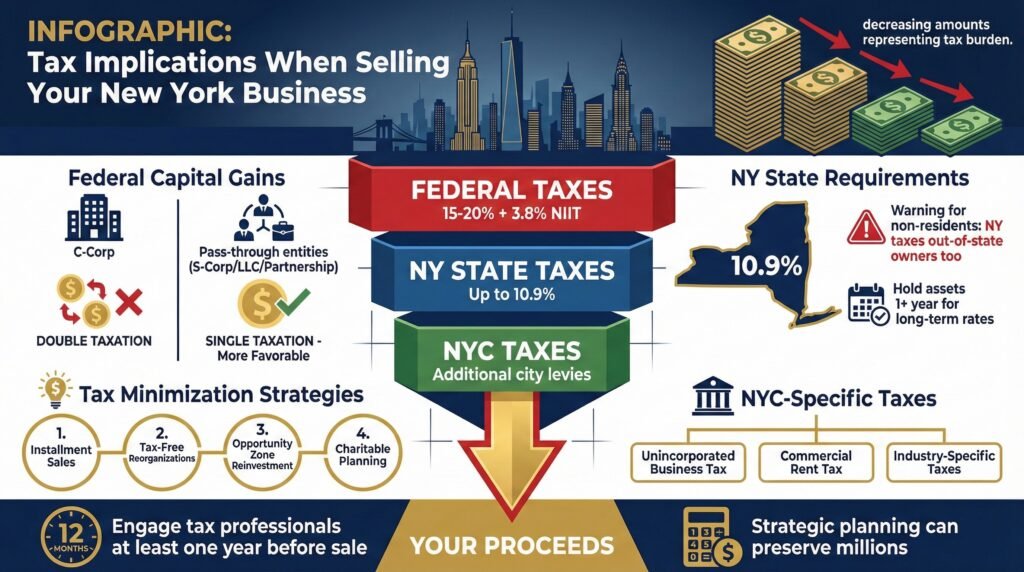
Tax considerations significantly impact your actual proceeds from a business sale in New York. The state’s layered tax structure – including federal, state, and sometimes city taxes – creates one of the nation’s highest combined tax burdens for business sellers. Strategic tax planning before your sale can legally preserve millions in after-tax proceeds through proper transaction structuring and timing decisions.
Federal Capital Gains Considerations
Federal tax treatment varies dramatically based on business structure and transaction format. C-corporations face potential double taxation on asset sales, with corporate-level taxes on gains followed by shareholder taxes on distributions.
Pass-through entities (S-corps, LLCs, partnerships) typically offer more favorable tax treatment with single-level taxation at individual rates. Long-term capital gains rates (currently 15-20% plus 3.8% net investment income tax for high-income sellers) apply to qualifying assets held over one year, making proper asset allocation and holding period verification essential before sale.
New York State Tax Requirements
New York State imposes additional taxation on business sales, with rates reaching 10.9% for high-income sellers. Unlike some states with no income tax, New York’s substantial rates significantly impact transaction proceeds and must be factored into your minimum acceptable sale price. Specialized state provisions regarding asset allocation, real estate transfers, and business structure create planning opportunities and potential pitfalls for uninformed sellers.
Non-resident sellers face particular complexity, as New York aggressively taxes business value attributable to New York operations even for out-of-state owners. Recent regulatory changes have increased enforcement and reporting requirements, making professional tax guidance essential for non-resident sellers.
NYC-Specific Tax Issues for Metropolitan Businesses
New York City businesses face additional taxation layers through the city’s distinctive business tax structure. The unincorporated business tax, commercial rent tax, and specific industry taxes can significantly impact transaction structure and after-tax proceeds. City-specific regulations regarding business transfers, license assignments, and property transfers create additional compliance requirements that must be addressed during transaction planning.
Structuring the Deal to Minimize Tax Burden
Strategic transaction structuring can legally reduce tax burdens while meeting both seller and buyer objectives. Common approaches include installment sales to spread tax liability across multiple years, tax-free reorganizations for qualifying transactions, opportunity zone reinvestment for capital gains deferral, and charitable planning strategies for philanthropically inclined business owners. Each strategy must be evaluated based on your specific situation, business structure, and financial objectives.
Engaging tax professionals with specific experience in New York business transactions at least 12 months before your intended sale provides maximum planning flexibility. Many valuable tax strategies require implementation well before the actual transaction to be fully effective.
Selling Business Assets vs. Stock Sale: The New York Perspective
The fundamental transaction structure – asset sale versus stock/entity sale – dramatically impacts both tax consequences and legal liability considerations for New York business sales. This critical decision influences everything from tax rates to potential future liabilities and must be carefully evaluated with professional guidance. While buyers and sellers typically have opposing preferences, understanding both perspectives help negotiate optimal compromise structures.
Benefits of Asset Sales for Buyers
uyers typically prefer asset purchases for several compelling reasons. This structure allows selective acquisition of desired business elements while excluding problematic assets or liabilities. It provides favorable tax treatment through stepped-up basis and accelerated depreciation on acquired assets.
Perhaps most importantly, asset purchases offer significantly reduced liability exposure by leaving the selling entity’s unknown or contingent liabilities with the original legal structure rather than transferring them to the buyer.
For these reasons, most transactions under $5 million in New York are structured as asset sales, particularly when the buyer is an individual or small organization without sophisticated liability management systems. Larger corporate or private equity buyers may consider entity purchases when specific circumstances warrant the additional risk.
When Stock Sales Make More Sense for Sellers
Sellers generally prefer entity sales (stock sales for corporations or membership interest transfers for LLCs) due to significant advantages. This structure typically provides more favorable tax treatment with proceeds taxed as capital gains rather than the mixed ordinary income/capital gains treatment of asset sales. It simplifies the transaction by transferring the entire business in a single legal action rather than requiring individual asset transfers, license reassignments, and contract assignments.
Entity sales also provide cleaner exits by transferring all liabilities to the buyer rather than requiring the seller to maintain the original entity to address excluded liabilities.
C-corporation owners benefit particularly from stock sales, as this structure avoids the double taxation issue that occurs in C-corporation asset sales. This tax difference can represent savings of 20% or more of the total transaction value.
Negotiating the Best Deal Structure
Successful transaction structuring requires finding balanced solutions that address both parties’ primary concerns. Hybrid structures often provide effective compromises, such as entity purchases with specific liability exclusions, indemnification provisions, or escrow arrangements to address buyer concerns.
Tax allocation strategies can partially mitigate the seller’s tax disadvantages in asset sales by maximizing allocation to capital gains categories while satisfying buyer objectives.
The relative negotiating leverage of buyer and seller significantly impacts structural outcomes. Sellers in highly desirable industries or with multiple qualified buyers can more effectively negotiate favorable structures, while distressed sales or limited buyer markets typically result in buyer-favorable asset purchase arrangements.

The Expert Team You Need for a Successful New York Sale
The complexity of New York business transactions demands specialized expertise beyond what most business owners possess. Assembling the right advisory team dramatically improves both transaction outcomes and owner experience throughout the sale process.
While professional fees represent a significant investment, experienced brokers typically deliver value many times their cost through improved deal terms, reduced tax liability, and prevented problems.
Business Brokers vs. M&A Advisors: Which Is Right for You?
The choice between business brokers and M&A advisors depends primarily on your business size and transaction complexity. Business brokers typically handle transactions under $2 million with standardized approaches and broader client portfolios.
M&A advisors specialize in larger, more complex transactions with customized marketing strategies, sophisticated financial analysis, and deeper industry expertise. For middle-market businesses ($2-50 million), investment banker-level M&A advisors provide comprehensive transaction management, including buyer identification, valuation, negotiation support, and closing coordination.
New York’s competitive business environment demands advisors with specific local market knowledge and established buyer networks. Look for professionals with demonstrated transaction experience in your specific industry and size range, as valuation approaches, buyer pools, and transaction structures vary dramatically across business categories.
Earned Exits – Business Broker and M&A Advisory Services
Earned Exits has successfully closed more than 47 business sales totaling over $2.1 billion in transaction value—clear proof that deep, specialized expertise delivers superior outcomes. Earned Exits focuses on brokering company sales with $1 – $40Million in revenue.
Unlike generalist brokers, Earned Exits brings focused experience across 17 distinct industries, including manufacturing, distribution, professional services, technology, and specialty contracting. This sector-specific insight enables the team to accurately identify and highlight the value drivers, customer behaviors, and operational factors that matter most to buyers in each market.
Rather than relying on improvised deal strategies, Earned Exits follows a structured 90-day strategic selling framework designed to increase close rates while minimizing disruption to day-to-day business operations.
In addition to being ranked one of the top business brokers in 2025, Earned Exits provides M&A advisory services. The company’s M&A process is intentionally designed to deliver a smooth, well-managed experience from initial planning through closing and beyond. With more than 30 years of combined experience, our team provides hands-on guidance at every stage. Below is an overview of how our process works:
Initial assessment and preparation: We start with a complimentary business valuation, uncover key value drivers, and position your company for a successful sale or acquisition.
Tailored M&A strategy: Our experienced advisors craft a customized transaction strategy aligned with your objectives, ensuring each phase is thoughtfully planned and executed.
Targeted buyer outreach: Your business is presented to a select group of qualified buyers and investors through our established network, allowing us to identify the strongest strategic fit.
Negotiation and closing management: We lead negotiations to secure favorable terms that support your goals and manage the process through a successful close.
Post-transaction support: Following the sale, we remain engaged to facilitate a smooth transition, offering guidance on integration, planning, and next steps as needed.
Click the link below if you’re ready to get started right now with Earned Exits free business appraisal and valuation.

5 Deal Killers to Avoid When Selling Your New York Business
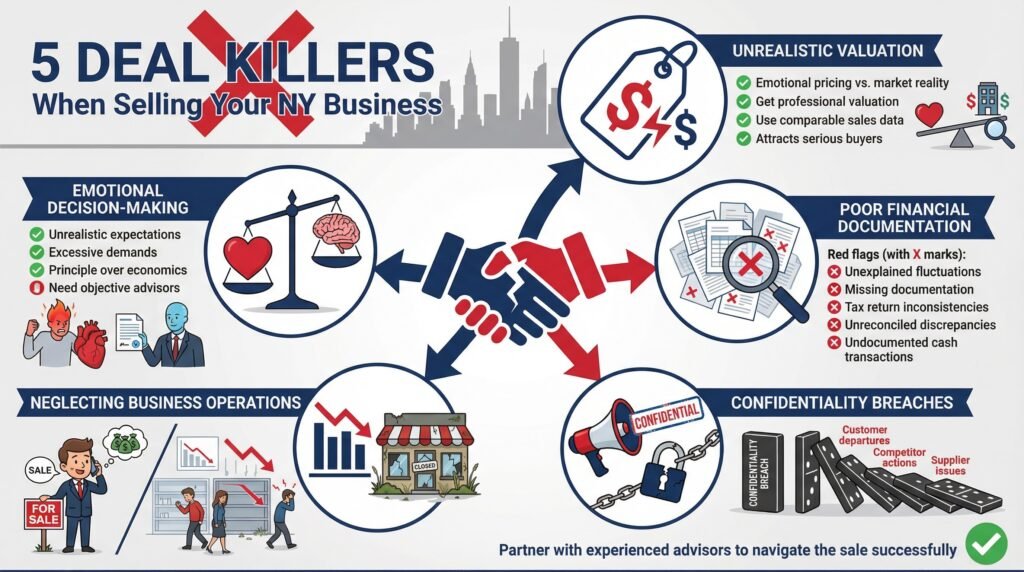
Despite strong buyer interest and initial agreement on terms, many New York business transactions fail before closing. Understanding these common deal killers helps you avoid preventable problems and maintain transaction momentum through closing.
Most failed transactions trace back to issues that could have been identified and addressed during proper pre-sale preparation.
Transaction fatigue represents a significant risk, particularly in complex sales requiring extended due diligence and negotiation periods. Maintaining focus, responsiveness, and business performance throughout this demanding process requires both preparation and resilience.
Working with experienced advisors who can manage routine matters independently helps prevent owner burnout during critical transaction phases.
Successful transactions require careful navigation of both financial and emotional aspects of the sale process. Many owners underestimate the psychological challenges of transitioning away from a business they’ve built over decades. Addressing both practical and emotional preparation improves both transaction outcomes and personal satisfaction with the process.
- Valuation gaps between buyer and seller expectations
- Undisclosed problems discovered during due diligence
- Financing contingencies that fall through
- Business performance declines during the sale process
- Emotional decisions that derail rational negotiations
1. Unrealistic Valuation Expectations
Valuation misalignment represents the most common deal-killer in New York business sales. When sellers enter the market with unrealistic price expectations based on emotional attachment rather than market reality, transactions stall before meaningful negotiations begin.
Professional valuation based on actual comparable sales, industry multiples specific to New York markets, and objective financial analysis establishes credible asking prices that attract qualified buyers.
Sophisticated New York buyers quickly dismiss overpriced businesses, focusing their attention on realistically-priced opportunities with supportable valuations.
2. Poor Financial Documentation
Inadequate, disorganized, or questionable financial records consistently derail transactions during due diligence. New York’s sophisticated buyers expect clean, professionally-prepared financial statements with clear audit trails and verifiable performance metrics.
Transactions frequently collapse when buyers discover revenue overstatements, expense underreporting, or unexplainable financial fluctuations during detailed review. Professional financial preparation before entering the market prevents these issues by identifying and addressing potential concerns before buyer exposure.
Beyond basic financial statements, buyers expect detailed analysis of revenue streams, customer concentration, expense categories, and growth trends. Preparing comprehensive financial packages with these elements demonstrates transparency and builds buyer confidence throughout due diligence.
Tax return consistency represents a particular concern for many buyers. Significant discrepancies between reported financial performance and tax filings create legitimate concerns about financial accuracy and potential tax liability. Addressing these differences through clear reconciliation schedules helps prevent buyer uncertainty during review.
- Unexplained financial fluctuations or trends
- Missing documentation for major transactions
- Inconsistencies between internal statements and tax returns
- Unreconciled accounting discrepancies
- Cash transactions without proper documentation
3. Failing to Maintain Confidentiality
Confidentiality breaches during the sale process can devastate business value by triggering customer concerns, employee departures, competitor actions, and supplier renegotiations. New York’s interconnected business community makes information control particularly challenging, requiring structured confidentiality processes throughout the transaction.
Effective approaches include using blind listings in initial marketing, requiring signed non-disclosure agreements before revealing business identity, limiting information distribution to qualified prospects, and implementing data rooms with controlled access for due diligence materials.
4. Neglecting Business During the Sale Process
Performance declines during the sale process frequently derail transactions or trigger significant price reductions. The sale process demands substantial owner attention for information gathering, buyer meetings, and negotiation activities, often diverting focus from day-to-day operations.
Successful transactions require maintaining or improving business performance throughout this period, demonstrating the business’s sustainability and validating projected future performance. Implementing management systems, delegating operational responsibilities, and creating capacity for transaction activities before entering the market helps prevent performance deterioration during this critical period.
5. Emotional Decision-Making
Emotional attachment to your business creates significant transaction risks when it interferes with objective decision-making during negotiations and due diligence. Common emotional pitfalls include unrealistic value expectations, excessive future role demands, unreasonable employee protection requirements, and negotiation positions based on principle rather than economic reality.
Successful sellers recognize these emotional triggers and establish decision frameworks that balance personal preferences with transaction realities. Working with experienced advisors who provide objective guidance helps maintain perspective during emotionally challenging negotiations.
Avoid the many pitfalls and headaches of exiting your New York Business. Start the process today and receive your free business valuation with Earned Exits today.
Starting with a confidential valuation from a reputable firm like Earned Exits provides a baseline understanding of current market value while identifying specific opportunities to increase the valuation before sale. Read our full review of Earned Exits here.
If you have decided that Earned Exits is a good fit and your business size is $1M-$40M+, click the link below to contact Earned Exits today to start their free business valuation by filling out a short form.
Business Seller Check-In
Whether you are planning to sell your business solo or utilize the experience and leveraging skills of a broker, pause and review the discussed points, and you have done the basic preparation needed to place your business on the market.
A major contributor to business undervaluations, wasted time, and poor exits is simply a lack of readiness. A broker can only sell what you’ve built.
If your business:
- Depends heavily on you
- Has inconsistent or unclear financials
- Lacks systems or transferable processes
Then even the best broker will struggle to get a premium offer. Brokers don’t create value. They expose it.
Bottom line: If you are not sure what basic preparation is required before considering a business valuation or selecting a business broker, click the link below to take our free business readiness quiz. The score will give you a clear indication of where you are in the process and the next course of action to take to ensure you start the business sale and exit on the right footing.
Frequently Asked Questions
How do I maintain confidentiality during the sale process?
Effective confidentiality protection requires structured processes throughout the transaction cycle. Begin by working with advisors who utilize blind business profiles for initial marketing, identifying your business by industry, size, and general location without revealing specific identifying information. Require signed non-disclosure agreements with personal guarantees before revealing business identity or specific details.
Implement tiered information release, providing increasingly detailed information only as buyers demonstrate qualification and serious interest. Create secure data rooms with controlled access for due diligence materials, tracking document access, and limiting downloading or printing capabilities. Limit physical visits to off-hours or staged interactions that don’t reveal the sale process to employees or customers.
Can I continue to run my business after selling it?
Post-sale involvement options vary based on transaction structure and buyer preferences. Common arrangements include short-term transition periods (typically 30-90 days), longer consulting agreements (6-24 months), ongoing employment contracts, or equity retention with continuing management roles. These arrangements must balance your personal objectives with buyer needs and transaction economics.
Strategic buyers typically require shorter transitions focused on knowledge transfer and customer relationships, while financial buyers often seek longer involvement to maintain operational continuity. Clearly defining your desired involvement level early in the process helps identify compatible buyers and prevents misaligned expectations during negotiations.
What’s the difference between an SBA loan and seller financing for buyers?
SBA loans provide government-guaranteed funding through approved lenders with favorable terms, including lower down payments (typically 10-20%), longer amortization periods (up to 10 years), and competitive interest rates. These loans require extensive documentation, rigid qualification criteria, and typically take 60-90 days for approval and closing.
Seller financing involves direct lending from you to the buyer, typically covering 10-30% of the purchase price with the remainder provided through buyer equity and conventional financing. This approach offers greater flexibility in terms of qualification criteria and documentation requirements while demonstrating your confidence in the business’s future performance. Many successful transactions utilize combined financing approaches, with SBA or conventional loans providing the majority of funding supplemented by seller financing to address valuation gaps or specific transition concerns.
Understanding these financing mechanisms helps structure transactions that meet both buyer capability and seller objectives. Creative financing approaches often bridge valuation differences that might otherwise prevent successful transactions.
*Disclaimer: This article is written for educational purposes and should not be interpreted as financial advice.
*Disclaimer: This article is written for educational purposes and should not be interpreted as financial advice. We may receive compensation for referrals made through this article.