
Key Takeaways
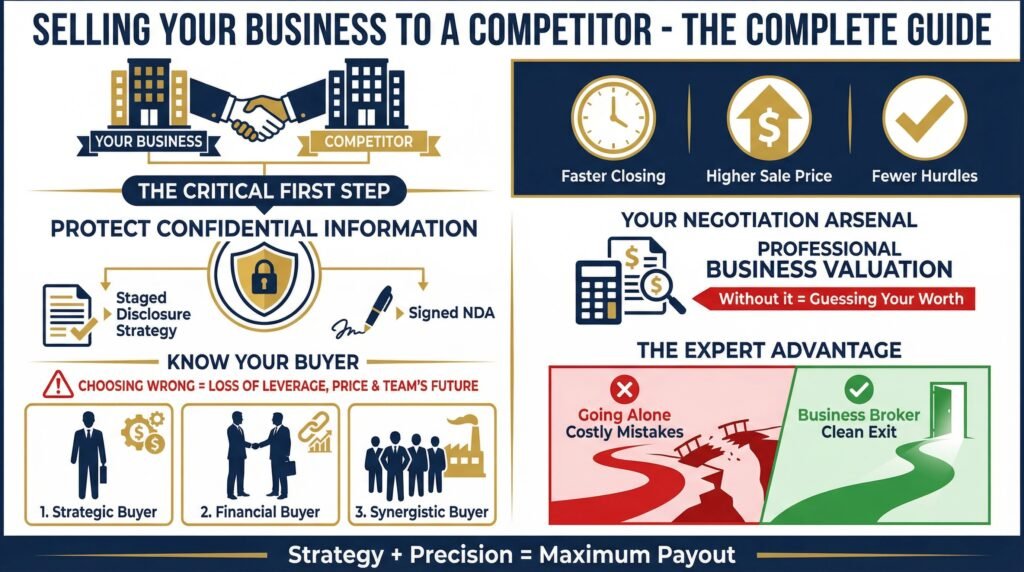
- Selling your business to a competitor can result in a faster closing, fewer hurdles, and a higher sale price than selling to an outside buyer.
- Protecting confidential information is the single most critical step before any conversation begins. A staged disclosure strategy and a signed NDA are non-negotiable.
- There are three distinct types of competitor buyers, and choosing the wrong one can cost you leverage, price, and your team’s future.
- A professional business valuation is your strongest negotiation tool. Without it, you’re guessing at your own worth.
- Working with a business broker isn’t just helpful for most owners; it’s the difference between a clean exit and a costly mistake.
Selling your business to a competitor is one of the most strategic and misunderstood exits a business owner can make.
Most owners hesitate because it feels like handing the keys to a rival. But when done right, it’s often the fastest path to the highest payout. Competitors already understand your market, your customer base, and why what you’ve built has real value. That shared knowledge speeds everything up and can push the sale price well above what a typical outside buyer would offer.
That said, this type of sale comes with real risks that don’t exist in a standard transaction. Confidentiality, leverage, and deal structure all require a level of precision that catches many sellers off guard. Earned Exits, a business brokerage that specializes in helping owners exit on their own terms, outlines that going it alone when selling to a competitor is one of the most common and expensive mistakes sellers make.
Selling to a Competitor Can Be Your Most Profitable Exit
The idea of selling to someone who once competed against you can feel uncomfortable. But strip away the emotion, and the logic is undeniable. A competitor buyer doesn’t need six months to understand your industry, they’re already in it. They know what your customer relationships are worth, what your operational systems mean for their bottom line, and exactly how acquiring you accelerates their own growth.
That insider knowledge translates directly into price. A competitor isn’t just buying your revenue; they’re buying market share, eliminating a rival, and gaining assets they’d otherwise spend years building. That kind of strategic value consistently commands a premium that general buyers simply can’t match.
Why Competitors Make Ideal Buyers
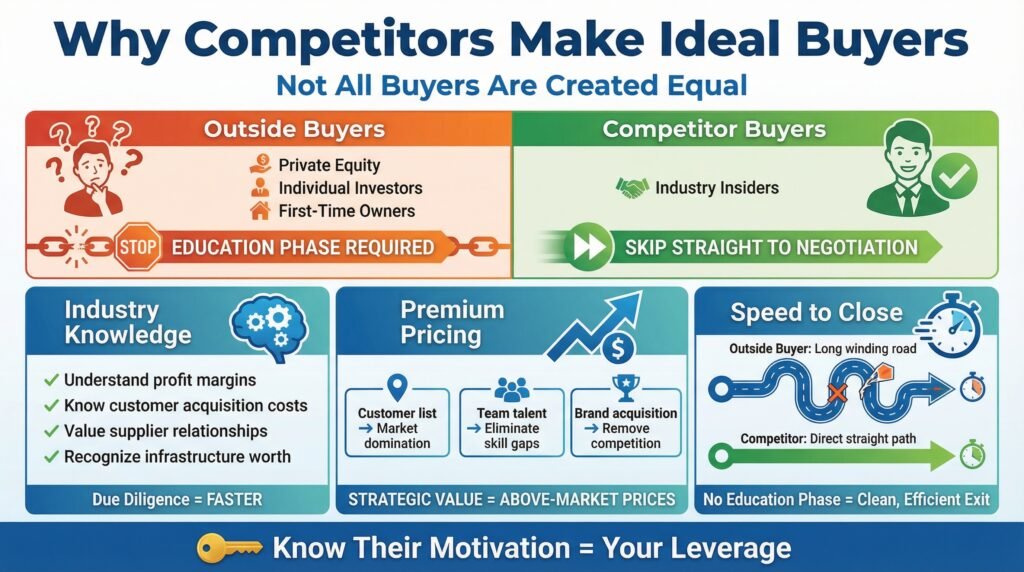
Not every buyer is created equal. Outside buyers, whether they’re private equity firms, individual investors, or first-time business owners, require extensive education about your market before they can even assess your value. Competitors skip that entire phase. They walk in already knowing the landscape, which fundamentally changes how the deal is negotiated and how quickly it closes.
They Already Know Your Industry’s Value
A competitor buyer doesn’t need your profit margins explained in the context of the industry; they already know what those numbers mean. They understand the cost of acquiring a customer in your space, what your supplier relationships are worth, and how hard it is to build the kind of operational infrastructure you’ve developed. This shared context means due diligence moves faster and conversations get to the point quickly.
Strategic Acquisitions Command Premium Prices
When a competitor buys your business, it’s rarely just a financial investment; it’s a strategic move. They might be acquiring your customer list to dominate a region, absorbing your team to eliminate a skill gap, or buying your brand to shut down a rival. Each of these motivations creates urgency on their side, and urgency is your leverage. Strategic buyers routinely pay above-market prices because the acquisition solves a problem for them that money alone can’t easily fix.
This is precisely why understanding your buyer’s motivation before entering negotiations is so powerful. When you know why they want your business, you know exactly what to emphasize and what to hold back.
Faster Closing Times Compared to Outside Buyers
Competitor buyers compress timelines in ways that outside buyers simply can’t. Because they already understand your market, the education phase of the sale is eliminated. Due diligence still happens, but it’s sharper, more focused, and moves with purpose. For owners who want a clean, efficient exit, this speed is one of the most underrated advantages of selling to a competitor.
The Real Risks You Need to Know Before You Start
The same qualities that make competitor buyers attractive also make them dangerous if you’re not prepared. The risks here aren’t hypothetical; they’re practical, specific, and have derailed deals for unprepared sellers.
Confidential Information Exposure
This is the biggest risk, full stop. A competitor who expresses interest in buying your business suddenly has a reason and often an opportunity to request access to your financials, customer lists, supplier agreements, and operational systems. If the deal falls through, that information doesn’t disappear. It sits with someone who competes directly against you.
The damage from a breach here isn’t always immediate. Sometimes it shows up months later when a competitor suddenly shifts strategy in ways that seem suspiciously informed. Protecting against this requires more than a handshake; it requires a carefully structured Non-Disclosure Agreement and a staged information-release strategy that escalates as the buyer demonstrates genuine commitment.
According to BizBuySell, information should always be released in stages, starting with high-level business overviews and only moving to sensitive operational data once the buyer has shown real, documented intent to proceed.
Critical Rule: Never share customer lists, key supplier contracts, or detailed financial records until a Letter of Intent (LOI) has been signed and your attorney has reviewed the NDA. Treat every piece of information as a negotiation asset, not a courtesy.
Reduced Bargaining Power If Only One Competitor Is Approached
Approaching a single competitor removes one of your most valuable negotiation tools: competition. When a buyer knows they’re the only one at the table, they have little incentive to stretch on price or terms. Always work to create the perception and ideally the reality that multiple parties are interested, even if you ultimately prefer one buyer over another.
Employee and Customer Uncertainty During the Sale
Word travels fast in tight industries. If employees or customers discover a sale is in progress before you’re ready to communicate it, the fallout can be significant. Key staff may start looking for new positions. Customers may begin exploring alternatives. Both scenarios reduce the value of what you’re selling mid-process.
Managing this risk means controlling the information environment tightly and preparing a clear, confident communication plan for the moment the sale becomes public. Your team and your customers deserve a message that’s honest, reassuring, and delivered on your timeline, not leaked through industry gossip.
Seller Tip: Identify your two or three most critical employees early in the process. Consider retention agreements that give them a financial incentive to stay through the transition period, regardless of what happens with the sale.
Employee stability directly correlates with business valuation multiples across most industries. Earned Exits’ transaction data reveals that businesses with formal retention programs for key employees typically command 0.5 to 1.2 additional multiple points compared to industry averages. This premium reflects buyer recognition that stable teams reduce onboarding costs, minimize performance disruptions, and maintain customer relationships through ownership transitions.
Avoiding Common Pitfalls – Finding a Quality Business Broker
The most profitable exits are engineered, not accidental. Finding a credible business broker who has experience in numerous industries is key. Many top business brokers have seen properly optimized financial records increase valuations by 20-30% simply by professionally presenting the same underlying business performance.
Earned Exits was ranked as a top business broker in 2025 and has performed over $2 billion in transactions across multiple industries. The company’s 10-point process helps companies with $1 to 40 million in revenue find a qualified buyer and make the selling process as easy and streamlined as possible.
The firm’s valuation experts have developed specific methodologies for quantifying these benefits during pre-sale assessments. By documenting employee tenure, specialized expertise, and customer relationships, they build compelling value narratives that justify premium pricing. Rather than hoping buyers will recognize these strengths, their approach provides concrete evidence of the operational stability that justifies higher valuations.
Click the link below to get started with Earned Exits free business valuation and approval. Fill out their short form to start the process.
Types of Competitor Buyers and How to Choose the Right One
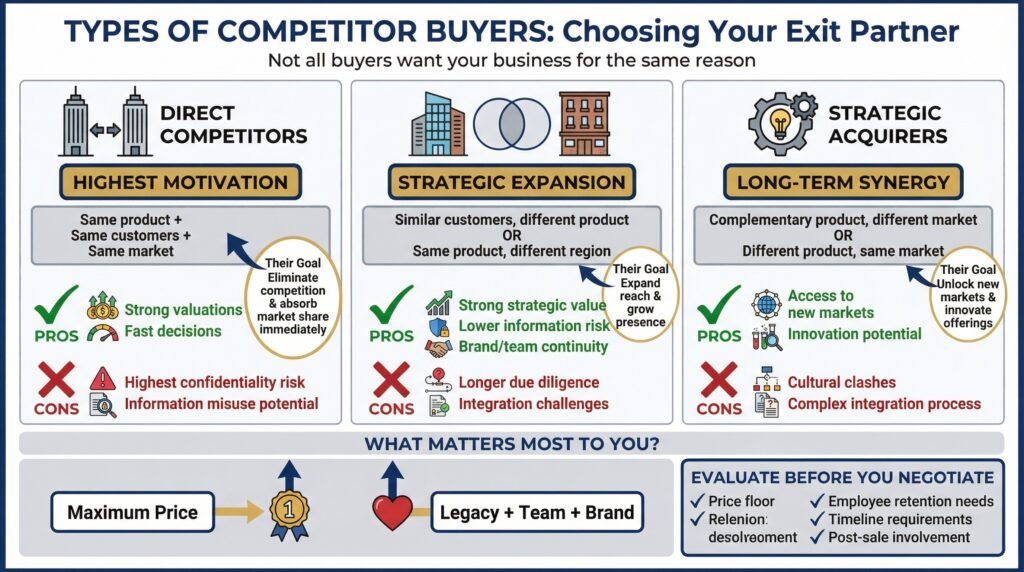
Not all competitors want your business for the same reason, and not all of them are equally good fits for your exit goals. Understanding the three types of competitor buyers before you start any conversation puts you in a far stronger position.
Direct Competitors
These are businesses that sell the same product or service to the same customer base in the same market. They’re the most obvious buyers and often the most motivated. A direct competitor sees your business as a way to immediately expand market share, eliminate a competing voice, and absorb your customers without having to earn them one by one.
The upside is strong valuations and fast decisions. The downside is the highest risk of confidential information misuse, since they operate in exactly the same space and can immediately act on anything they learn about your operations.
Indirect Competitors
Indirect competitors operate in adjacent markets, they serve a similar customer but with a different product, or the same product in a different region. For them, acquiring your business is about expanding their reach rather than eliminating a rival. This slightly reduces the information risk while still producing strong strategic valuations. Indirect competitors often make excellent buyers for sellers who want to see their brand and team continue to thrive post-sale.
How to Evaluate Which Type Fits Your Goals
The right type of competitor buyer depends entirely on what matters most to you as a seller. If maximum price is the priority, direct competitors often win. If legacy, team retention, and continued brand identity matter, indirect competitors may be a better fit. In either case, the evaluation process should happen before you ever pick up the phone, not during negotiations when emotions and timelines create pressure.
Start by listing your non-negotiables: price floor, employee retention expectations, timeline, and any post-sale involvement you’re willing to commit to. Then evaluate each potential buyer type against those criteria before making contact.
Ready to get the process started today? Click here to contact Earned Exits today by filling out their short form. Discover how their proven 10-step process can help you achieve the maximum value for your business while ensuring a smooth transition to your next chapter.
In part 2 of this series, we will discuss the step-by-step process of selling your business to a competitor. From getting your financials to how to approach the right competitor, we will deliver the actionable steps to make sure you exit your business profitably. Be sure to subscribe and follow our blog for updates.
Frequently Asked Questions
Selling a business to a competitor raises questions that most owners have never had to think through before. The process is unfamiliar, the stakes are high, and the decisions made along the way have lasting financial and professional consequences.
The questions below cover the most common concerns sellers raise, from timelines and valuations to confidentiality, employee protection, and deal structure. Each answer is designed to give you a practical, honest picture of what to expect so you can move forward with clarity.
If a question here leads to a more specific concern about your own situation, that’s a signal to bring in professional guidance. The details of your business, your industry.
Quick Reference: Key Terms in a Competitor Sale
NDA (Non-Disclosure Agreement): A legally binding contract preventing the buyer from sharing or misusing your confidential information.
LOI (Letter of Intent): A non-binding document outlining the proposed purchase price and key deal terms before final negotiations.
EBITDA: Earnings Before Interest, Taxes, Depreciation, and Amortization the most common basis for business valuation multiples.
Earn-Out: A deal structure where a portion of the purchase price is paid after closing, tied to future business performance.
Due Diligence: The buyer’s formal investigation of your business’s financials, operations, legal standing, and contracts before closing.
Non-Compete Clause: A contractual restriction preventing you from starting or joining a competing business for a defined period after the sale.
Data Room: A secure digital environment where confidential business documents are shared with verified buyers during due diligence.
How long does it take to sell a business to a competitor?
Selling to a competitor is generally faster than selling to an outside buyer, but “faster” is relative. Most competitor transactions close within three to nine months from the first serious conversation. The timeline depends heavily on how prepared your financial and operational documentation is before talks begin, how many buyers you’re working with simultaneously, and how smoothly due diligence proceeds. Businesses that enter the process fully prepared with clean financials, organized operations, and professional representation consistently close faster and at stronger valuations than those that prepare on the fly.
Can a competitor use my information against me if the deal falls through?
Yes, and this is one of the most serious risks in a competitor sale. A well-drafted NDA with a non-solicitation clause significantly reduces this risk by creating legal liability for misuse, but it doesn’t make it impossible. The most effective protection is a staged information release strategy that ensures your most sensitive data, customer lists, supplier pricing, proprietary systems, is never shared until the buyer has made a documented, financial commitment to the transaction. The NDA is your legal shield; the staged disclosure is your operational one. You need both.
How do I find competitors who might want to buy my business?
Start with the competitors you already know, the businesses operating in your direct market who have shown growth ambitions, completed acquisitions before, or consistently competed with you for the same customers. From there, expand to adjacent market players who could use your business to enter your territory or product category. Industry associations, trade publications, and M&A databases are useful research tools. A business broker will typically have existing relationships with potential buyers in your sector and can identify qualified candidates you may not have considered, while keeping your identity protected during the initial outreach.
Will a competitor pay more than a regular buyer?
Often, yes, but not automatically. A competitor who sees strategic value in your business market share expansion, talent acquisition, eliminating a rival, and gaining proprietary technology, is motivated to pay above what a financial buyer would offer. That strategic premium can be significant. However, a competitor who isn’t highly motivated, or who knows they’re the only buyer at the table, has no incentive to stretch on price. The premium materializes when there is genuine competitive tension among multiple interested parties and when you enter negotiations with a professionally validated asking price backed by an independent valuation.
Do I need a lawyer to sell my business to a competitor?
Absolutely. An M&A attorney isn’t optional in a competitor sale; it’s one of the most important investments you’ll make in the entire process. The legal complexity of an acquisition agreement, the nuances of NDA enforcement, the implications of representations and warranties, and the long-term consequences of non-compete language all require legal expertise that goes well beyond general business law. Hire an attorney who specializes specifically in mergers and acquisitions, not a generalist. The cost of qualified legal counsel is a fraction of what a poorly negotiated agreement can cost you over the years following the sale.

*Disclaimer: This article is written for educational purposes and should not be interpreted as financial advice.
*Disclaimer: This article is written for educational purposes and should not be interpreted as financial advice. We may receive compensation for referrals made through this article.