
Quick Summary
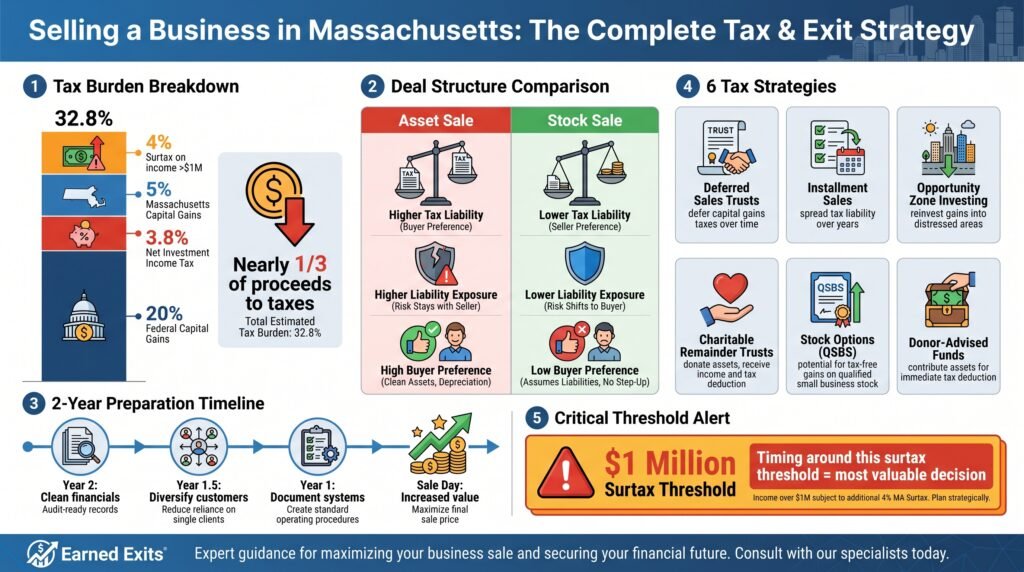
- Massachusetts business sellers face up to 32.8% in combined taxes, including federal capital gains (20%), the 3.8% net investment income tax, Massachusetts’ 5% capital gains tax, and a 4% surtax on income above $1 million.
- The structure of your deal matters enormously: whether you do an asset sale or stock sale directly impacts your tax liability, liability exposure, and what buyers are willing to pay.
- Start preparing at least 2 years before you plan to sell: clean financials, diversified customer bases, and documented systems can significantly increase your sale price.
- There are 6 legitimate tax strategies you can use even after signing a Letter of Intent: including deferred sales trusts, installment sales, and opportunity zone investing.
- Timing your sale around Massachusetts’ $1 million income surtax threshold could be the single most valuable financial decision you make during the entire transaction.
Selling your business in Massachusetts is one of the most financially significant events of your life, and without the right preparation, you could hand over nearly a third of your proceeds to the government before you cash a single check.
Earned Exits is an elite business broker that works directly with business owners navigating these exact transactions. Their full-service approach, from deal structuring to closing, reflects exactly the kind of expert guidance that separates a good exit from a great one. Understanding the tax landscape, deal structure, and timing before you go to market is what this guide is all about.
Table of Contents
- Quick Summary
- Selling a Business in Massachusetts Can Cost You 32.8% in Taxes – Here’s How to Keep More
- How Much Is Your Massachusetts Business Actually Worth?
- The Best Time to Sell a Business in Massachusetts
- Business Seller Checklist
- Frequently Asked Questions
Selling a Business in Massachusetts Can Cost You 32.8% in Taxes – Here’s How to Keep More
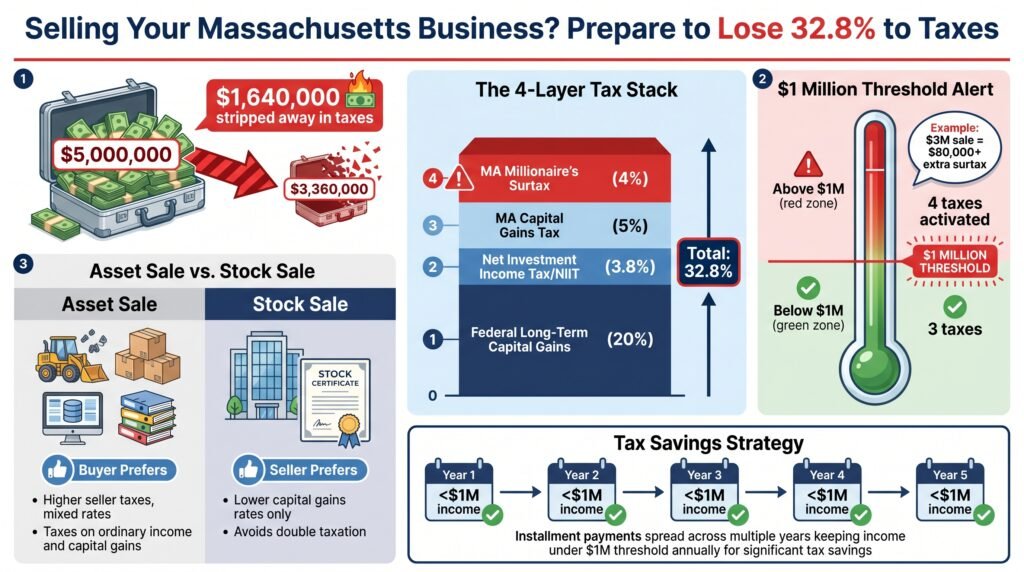
Most business owners are surprised when they see the actual tax math on their sale. What looks like a $5 million payday can quickly shrink once every layer of taxation is applied: federal, state, and surcharge combined.
Massachusetts is not a tax-friendly state for business exits. Unlike some states with no income tax, the Commonwealth stacks multiple obligations on top of what the IRS already takes, and if your proceeds push you past the $1 million income mark, a fourth tax kicks in automatically.
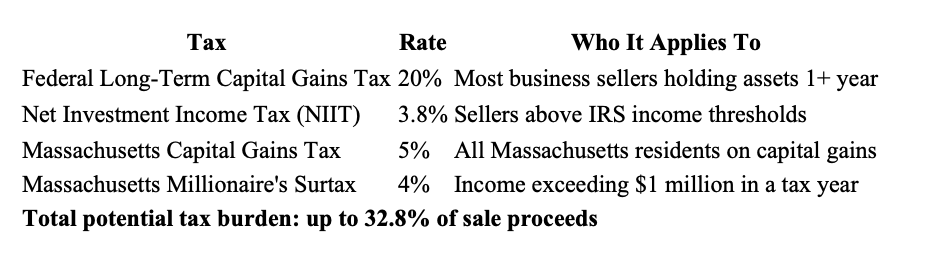
The 4 Taxes That Hit Massachusetts Business Sellers Hardest
Here’s a breakdown of what sellers are actually facing at the time of closing:
Why the $1 Million Income Threshold Changes Everything in Massachusetts
Massachusetts voters passed the so-called “Millionaire’s Tax”, formally the Fair Share Amendment, which adds a 4% surtax on any personal income above $1 million in a given tax year. For a business seller, the proceeds from a sale almost always count as income in the year the deal closes. That means a $3 million sale doesn’t just trigger the base capital gains rates — it pushes you well into surtax territory, costing you an additional $80,000 or more depending on how much exceeds the threshold.
This is exactly why deal timing and payment structure aren’t just administrative details — they’re tax strategy. Spreading income across multiple tax years through installment sales, for example, can keep each year’s income under or near the $1 million mark and legally reduce the surtax exposure.
Asset Sale vs. Stock Sale: Which Structure Saves You More Tax
The two primary deal structures, asset sales and stock sales, have dramatically different tax consequences, and buyers and sellers rarely want the same thing. In an asset sale, the buyer purchases individual assets (equipment, inventory, goodwill, customer lists), and the seller pays taxes on each asset class based on whether gains are ordinary income or capital gains. In a stock sale, the buyer acquires ownership of the entity itself, and the seller typically pays lower long-term capital gains rates on the entire transaction.
Buyers almost always prefer asset sales because they get a “stepped-up” tax basis on the acquired assets, allowing them to depreciate them again. Sellers generally prefer stock sales for the cleaner tax treatment and because it transfers all existing liabilities to the buyer. Negotiating this structure, and understanding the tax implications of each allocation category, is one of the most valuable things a legal and tax advisor does in a Massachusetts business sale.
How Much Is Your Massachusetts Business Actually Worth?
Before you can negotiate effectively, you need to know your number, not the number you hope for, but the number a qualified buyer will actually justify paying. These are often very different figures, and the gap between them is where deals fall apart.
What Buyers Look at Beyond Your Revenue
Revenue is a starting point, not a valuation. Sophisticated buyers look at profitability, recurring income, customer concentration, owner dependency, and the stability of cash flows over time. A $4 million revenue business where 60% of income comes from one client is worth significantly less than one where revenue is spread across 50 clients, even if the top-line numbers look the same.
Why EBITDA Is the Number That Drives Your Sale Price
EBITDA: Earnings Before Interest, Taxes, Depreciation, and Amortization, is the most commonly used metric for valuing small to mid-sized businesses in Massachusetts. Most businesses in the $1 million to $10 million range sell at 3x to 6x EBITDA, depending on industry, growth trajectory, and risk profile. A business generating $800,000 in EBITDA could realistically sell for anywhere between $2.4 million and $4.8 million based on that multiple alone.
Add-backs also matter here. If you’ve been running personal expenses through the business — car payments, travel, insurance, a skilled advisor can “add back” those expenses to show buyers what normalized earnings actually look like, which can meaningfully increase your multiple.
Intangible Assets Massachusetts Buyers Pay a Premium For
In knowledge-based and service industries, which make up a significant portion of Massachusetts’ economy, intangible assets often drive more value than physical ones. Buyers will pay a premium for:
- Established brand reputation and online presence
- Proprietary processes, software, or methodologies
- Long-term customer or client contracts
- Trained, tenured staff who won’t leave post-sale
- Non-compete agreements that protect the acquired customer base
If these assets exist in your business but aren’t documented and organized, buyers will discount them, or miss them entirely. Getting them formalized before going to market directly increases what a buyer is willing to pay.
The Best Time to Sell a Business in Massachusetts
Timing a business sale is part market analysis and part personal readiness, and both have to align for you to get the outcome you want.
Market Conditions That Drive Higher Sale Prices
Massachusetts has one of the strongest small business environments in the country, supported by a highly educated workforce, thriving life sciences and tech sectors, and consistent demand from both strategic and private equity buyers. When interest rates are low and buyer financing is accessible, deal multiples tend to rise. When credit tightens, buyers get more conservative. Selling into a strong seller’s market, rather than waiting until you’re forced to sell, is one of the most reliable ways to maximize your exit value.
Personal Timing: When You Are Ready vs. When the Market Is Ready
Many Massachusetts business owners wait too long. They plan to sell “in a few years” and then face a health issue, a key employee departure, or a shift in their industry that forces a rushed sale at a discount. The owners who get the best outcomes are the ones who start planning their exit 2 to 3 years before they actually want to close.
That planning window isn’t wasted time, it’s when you fix the things that drag down your valuation, implement the tax strategies that reduce your liability, and build the kind of business that commands a premium multiple in the Massachusetts market.
Every deal is different, and these calculations depend on individual circumstances. But the principle is consistent: deal structure determines tax outcome, and tax planning before closing is always worth the investment.
Business Seller Sanity Checklist
As we covered in the first part of this series, it’s time for another seller sanity check. Whether you are planning to sell your business solo or utilize the experience and leveraging skills of a broker, pause and review the discussed points, and you have done the basic preparation needed to place your business on the market.
A major contributor to business undervaluations, wasted time, and poor exits is simply a lack of readiness. A broker can only sell what you’ve built.
If your business:
- Depends heavily on you
- Has inconsistent or unclear financials
- Lacks systems or transferable processes
Then even the best broker will struggle to get a premium offer. Brokers don’t create value. They expose it.
Bottom line: If you are not sure what basic preparation is required before considering a business valuation or selecting a business broker, click the link below to take our free business readiness quiz. The score will give you a clear indication of where you are in the process and the next course of action to take to ensure you start the business sale and exit on the right footing.
If your business is valued at $1 to $40 million, an experienced business broker like Earned Exits will leverage more potential buyers and an average increase of profit of 20 to 30% more than going it alone.
Stated simply, alone is cheaper, but not always most profitable. Our comprehensive review of Earned Exits business brokers here.
The company has been recognized as the top business broker in the US for 2025, offering a seller-centric approach that maximizes real value for owners selling businesses valued $1M–$40M+. Click the link below to start Earned Exits’ free valuation process by filling out their short form.
Learn more about Massachusetts legal requirements that every seller must know, the step-by-step process to sell your house, tax strategies, and more in this article.
Frequently asked questions
Here are the most common questions Massachusetts business owners ask when they begin exploring a sale, answered directly, without the runaround.
How Long Does It Take to Sell a Business in Massachusetts?
Most Massachusetts business sales take between 6 and 12 months from the time the business is actively marketed to the day the deal closes. Smaller Main Street businesses (under $500,000 in value) can sometimes close in 3 to 6 months.
Larger, more complex transactions, particularly those involving regulatory approvals, real estate, or private equity buyers, can take 12 to 18 months or longer. The preparation phase before going to market typically adds another 3 to 12 months for sellers who are starting from scratch on their financial clean-up and documentation.
What Is the Difference Between an Asset Sale and a Stock Sale in Massachusetts?
In an asset sale, the buyer purchases individual business assets, equipment, inventory, intellectual property, goodwill, customer lists, rather than the business entity itself. The seller retains the legal entity and its liabilities, and taxes are paid based on the character of each asset sold (ordinary income or capital gains depending on the asset class). In a stock sale, the buyer acquires ownership of the business entity directly, assuming both its assets and its liabilities, and the seller typically pays long-term capital gains rates on the entire transaction.
Buyers almost universally prefer asset sales because they receive a stepped-up tax basis on acquired assets, which allows for fresh depreciation. Sellers typically prefer stock sales for the simpler, lower-taxed treatment and cleaner liability transfer. The negotiation between these two structures, and the allocation of purchase price in an asset sale, is one of the most financially consequential decisions in the entire transaction and should always involve both a transaction attorney and a CPA. For more information on selling a business, you might consider reading about buying or selling a small business in Massachusetts.
Do I Need a Business Broker to Sell My Business in Massachusetts?
Whether you need a broker depends primarily on your deal size and how much of the transaction process you want to manage yourself. For businesses valued under $2 million, a business broker who works on a success-fee basis (typically 8% to 12% of the sale price) provides marketing reach, buyer qualification, and negotiation support that most owners cannot replicate on their own.
For transactions above $5 million, an M&A advisor with buy-side and sell-side experience is generally the better fit, they run a more structured process, engage financial and strategic buyers, and are experienced with the letter of intent and purchase agreement negotiations that define the outcome.
Brokering over $2.1 Billion in transactions across 17 industries, Earned Exits was named a top business broker in 2025 by IWSP. Earned Exits offers a seller-centric approach that maximizes real value for owners selling businesses valued $1M–$40M+.
In addition, Earned Exits provides M&A advisory services. The company’s M&A process is intentionally designed to deliver a smooth, well-managed experience from initial planning through closing and beyond. With more than 30 years of combined experience, our team provides hands-on guidance at every stage. Click the link below to start Earned Exits’ free valuation process by filling out their short contact form.
Discover how the Earned Exits’ proven 10-step process can help you achieve the maximum value for your business while ensuring a smooth transition to your next chapter. Click the link below to contact Earned Exits today to start their free business valuation by filling out a short form.
References and Sources
Percy Law Group, PC. Buying or Selling a Small Business in Massachusetts: What You Need to Know. Published April 30, 2025. Available at: www.percylawgroup.com. Percy Law Group is a Massachusetts-based full-service legal team specializing in business transactions, mergers and acquisitions, and exit planning for small business owners across the Commonwealth.
Berkshire Money Management. Selling Your Massachusetts Business? 6 Last-Minute Tax Strategies to Keep More of the Sale Proceeds. Available at: berkshiremm.com. This source provided the foundational framework for the six post-LOI tax strategies discussed in this article, including the Deferred Sales Trust, installment sale structures, Opportunity Zone investing, and the mechanics of Massachusetts’ Millionaire’s Surtax as applied to business sale proceeds.
Berkshire Money Management. Exit Without Regret: When Is the Right Time to Sell Your Business? Published January 2, 2026. Available at: berkshiremm.com. This article provided perspective on exit timing, the psychological and financial dimensions of business owner readiness, and the market conditions that influence sale outcomes for Massachusetts business owners.
Internal Revenue Service. IRC Section 453 – Installment Method. IRC Section 1202 – Qualified Small Business Stock Exclusion. These federal tax code provisions govern installment sale treatment and the QSBS exclusion discussed in the tax strategy section. Massachusetts does not conform to IRC Section 1202 for state tax purposes; sellers should verify current federal and state conformity with a qualified CPA before implementing any tax strategy discussed in this article.
*Disclaimer: This article is written for educational purposes and should not be interpreted as financial advice. We may receive compensation for referrals made through this article.