
Quick Summary
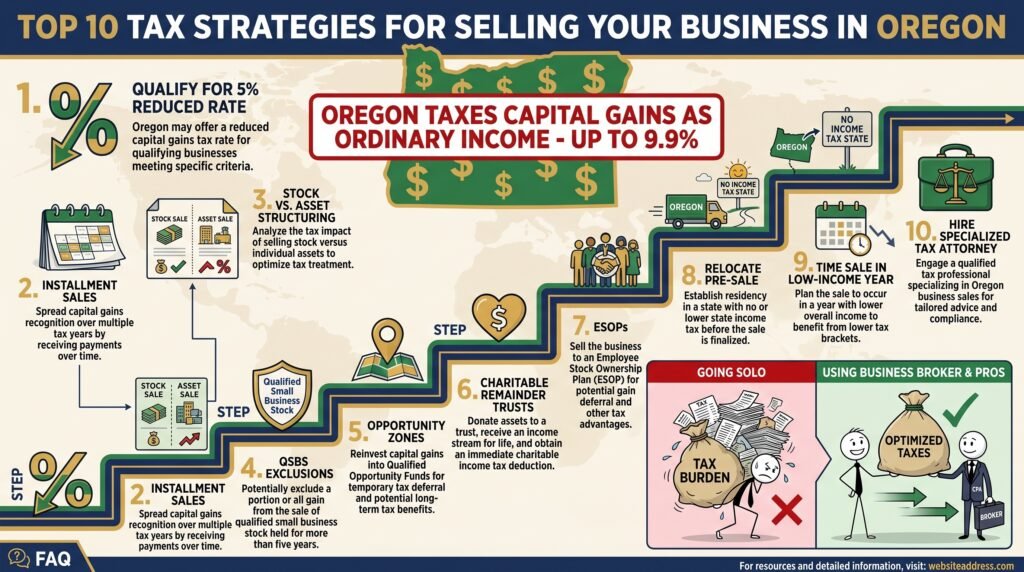
Oregon taxes capital gains as ordinary income (up to 9.9%), making business sales in the state expensive without planning. The article outlines 10 tax strategies — from qualifying for Oregon’s reduced 5% business sale rate, to installment sales, stock-vs-asset structuring, QSBS exclusions, Opportunity Zones, charitable remainder trusts, ESOPs, pre-sale relocation to a no-income-tax state, timing the sale in a low-income year, and hiring a specialized tax attorney. It also makes the case for using a business broker rather than selling solo, and closes with an FAQ section covering common Oregon-specific tax questions.
Table of Contents
- Quick Summary
- Introduction
- Tax Strategies When Selling a Business in Oregon
- What Business Brokers Do That Most Sellers Cannot Do Alone
- Final Thoughts and Next Steps
- Frequently Asked Questions
Tax Strategies When Selling a Business in Oregon
1. Qualify for Oregon’s 5% Business Sale Rate
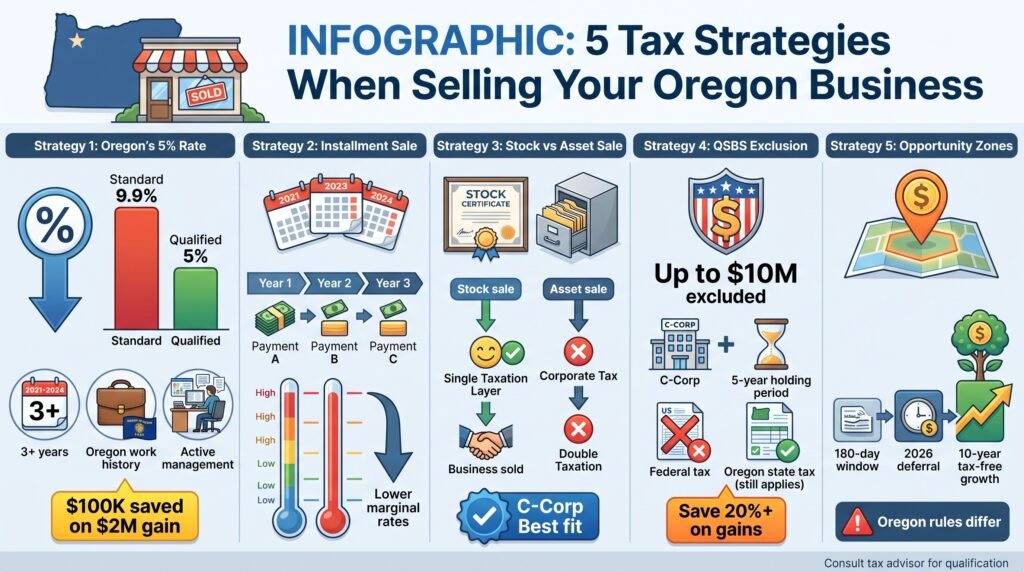
Oregon offers a reduced 5% state tax rate on long-term capital gains from the sale of an Oregon-based business if you meet strict requirements. You need at least a three-year holding period, substantial Oregon work history, and active management involvement before the sale.
This is one of the most valuable tax breaks available for selling a business in Oregon, dropping your state rate from 9.9% to 5% on the gain. The difference on a $2 million gain is nearly $100,000 in Oregon tax alone.
Total time: Three years minimum to qualify.
Setup: Track your ownership dates, work location, and management role from day one.
How easy to start: You either qualify or you don’t based on your history.
Requirements: Three-year ownership, Oregon-based operations, active management, proper documentation.
2. Use an Installment Sale to Spread the Gain
An installment sale let’s you receive payments over multiple years instead of all at once, which spreads the taxable gain across several tax years. This keeps you out of the highest Oregon bracket in any single year and can reduce overall state and federal tax.
You’ll still pay tax on each payment as it arrives, but the lower annual income in each year can mean lower marginal rates.
This is especially useful if you expect your income to drop after the sale or if you’re planning a move to a lower-tax state.
Total time: The installment period can run 2 to 10 years depending on the deal.
Setup: Negotiate installment terms in the purchase agreement before closing.
How easy to start: Straightforward if the buyer agrees to deferred payment terms.
Requirements: Purchase agreement with installment language, proper interest rate, IRS compliance.
3. Structure as a Stock Sale Instead of Asset Sale
When you sell corporate stock as opposed to person assets, you may avoid double taxation at the corporate and personal levels. Stock sales are cleaner for C corporations and can produce better tax results for sellers, though buyers usually prefer asset sales for the depreciation benefits.
If you have leverage in the negotiation, pushing for a stock sale can save substantial tax.
Even in an LLC or S corporation, the treatment of goodwill and other intangibles can vary, so the structure matters.
Total time: Negotiated during the deal structure phase.
Setup: Your entity type and ownership structure decide feasibility.
How easy to start: Easier if the business is already held in a C or S corporation.Requirements: Corporate structure, buyer agreement, clean corporate records
4. Claim the QSBS Exclusion for Federal Tax Relief
Qualified Small Business Stock allows you to exclude up to $10 million or 10 times your basis in federal capital gains if the business qualifies as a C corporation and you’ve held the stock for at least five years.
Oregon does not conform to the QSBS exclusion, so you’ll still owe state tax, but eliminating federal tax can save 20% or more on the gain. This is one of the most powerful federal tools for business owners who planned ahead and structured their company as a C corp.
Total time: Five-year holding period required.
Setup: Must be a C corporation when the stock is issued.
How easy to start: Only works if you set up the structure years in advance.
Requirements: C corporation, five-year hold, under $50 million in assets, active business.
5. Reinvest Gain in a Qualified Opportunity Zone
Qualified Opportunity Zones let you defer federal capital gains by reinvesting proceeds into designated low-income areas within 180 days of the sale. The deferral lasts until the investment is sold or until 2026, whichever comes first.
If you hold the QOZ investment for 10 years, the appreciation on the new investment is tax-free.
Oregon does not fully conform to the federal QOZ rules, so state tax treatment varies. This is best for owners who want to defer federal tax and are comfortable with real estate or business investments in QOZ areas.
Total time: 180 days to reinvest after the sale.
Setup: Identify QOZ fund or project, transfer funds, file election.
How easy to start: Requires finding a suitable QOZ investment quickly.
Requirements: Sale proceeds, QOZ fund or direct investment, IRS filing.
6. Use a Charitable Remainder Trust
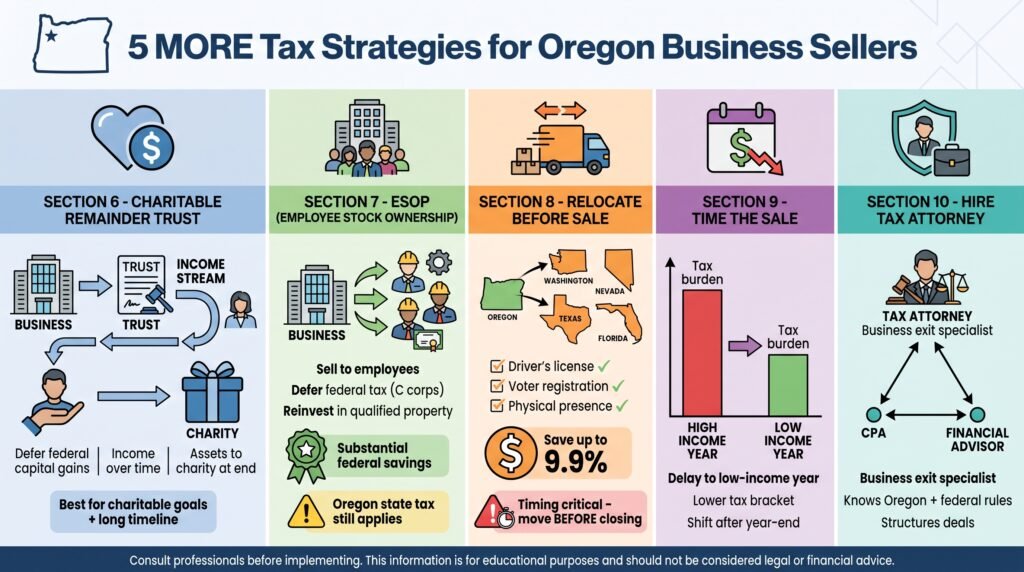
A Charitable Remainder Trust let’s you transfer ownership of the business to the trust before the sale. The trust sells the business without recognizing immediate gain, then pays you an income stream over time.
At the end of the trust term, the remaining assets go to charity.
This defers or eliminates federal capital gains tax on the sale, though Oregon may still tax the income distributions. CRTs are complex and work best for owners with charitable goals and long time horizons.
Total time: Set up before the sale, distributions can last 20 years or more.
Setup: Requires attorney, trust documents, and transfer of ownership before sale.
How easy to start: Complex and needs advance planning.
Requirements: Charitable intent, trustee, qualified appraisal, legal and tax advice.
7. Sell to an ESOP
An Employee Stock Ownership Plan let’s you sell all or part of your business to your employees. C corporation owners can defer or eliminate federal tax on the sale by reinvesting proceeds in qualified replacement property.
ESOPs also provide continuity and can be attractive for owners who want to reward employees.
Oregon does not offer special ESOP tax benefits, so state tax still applies, but the federal savings can be substantial.
Total time: 12 to 24 months to set up and close.
Setup: Hire ESOP advisor, conduct valuation, establish trust, arrange financing.
How easy to start: Complicated and expensive, best for larger businesses.
Requirements: C corporation, employee base, third-party valuation, legal compliance.
8. Relocate to a No-Income-Tax State Before the Sale
Moving to a state with no income tax before you close the sale can eliminate state tax on the gain. States like Washington, Texas, Florida, and Nevada do not tax personal income, so establishing residency there before the sale can save up to 9.9% on the Oregon side. Timing is critical.
You need to establish domicile before the sale closes, which usually means moving, changing your driver’s license, registering to vote, and spending most of your time in the new state.
Oregon may still try to tax gain connected to Oregon business activity, so document the move carefully.
Total time: At least six months to establish residency before closing.
Setup: Physical move, change voter registration, driver’s license, and domicile.
How easy to start: Requires a real move and lifestyle change.
Requirements: New state residency, documentation, sale closes after move.
9. Time the Sale in a Low-Income Year
Selling in a year when your other income is low keeps you in a lower Oregon tax bracket. If you can control the closing date, delay it until after year-end or into a year when you expect less W-2, 1099, or other income.
Even a few months can make a difference if it shifts the gain into a year when your total income is lower.
This strategy stacks well with installment sales or retirement planning.
Total time: Depends on deal timing and your income cycle.
Setup: Coordinate closing date with your tax advisor.
How easy to start: Easy if you have flexibility in the closing schedule.
Requirements: Control over closing date, advance tax projection.
10. Hire a Tax Attorney with Business Exit Experience
A tax attorney who specializes in business sales can structure the transaction to minimize tax, negotiate with buyers on allocation, and identify state-specific opportunities like Oregon’s 5% rate. They also coordinate with your CPA and financial advisor to make sure the deal documents match the tax plan.
This is not general legal work.
You need someone who works on business exits regularly and understands both Oregon and federal tax rules.
Total time: Engage six to 12 months before the expected sale.
Setup: Interview candidates, sign engagement letter, share financials.
How easy to start: Easy if you know where to look.
Requirements: Referrals, budget for legal fees, business financials.
What Business Brokers Do That Most Sellers Cannot Do Alone
Most business owners are exceptional at running their business. That skill set does not automatically transfer to selling one. Selling a business is a specialized transaction that involves simultaneous negotiation across financial, legal, operational, and emotional dimensions, and doing it wrong while also trying to run the business day-to-day is a recipe for either a failed deal or a dramatically undervalued one.
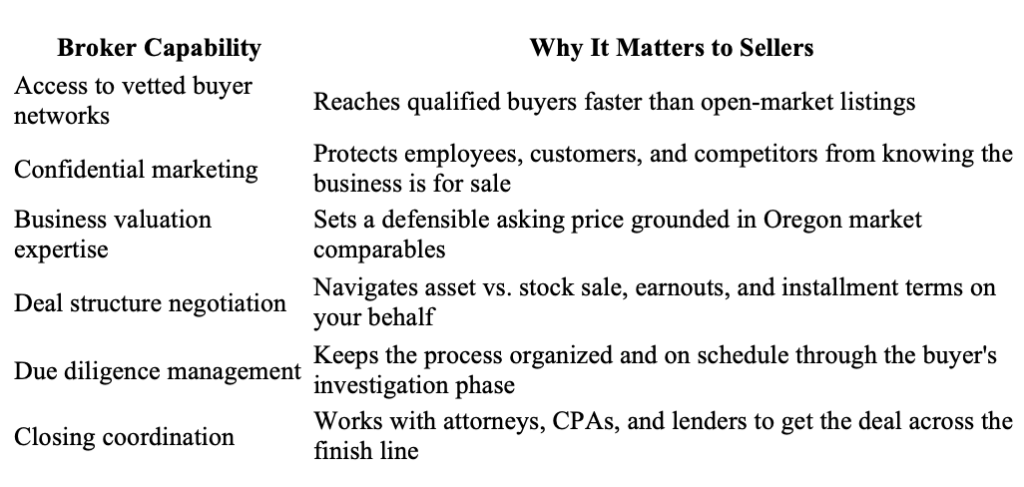
A qualified business broker brings three things most sellers simply don’t have: a pool of pre-screened, financially qualified buyers; the ability to market your business confidentially so that employees, customers, and competitors don’t find out prematurely; and the negotiation experience to protect your interests when deal terms get complicated. Confidentiality alone is worth significant money, a business that becomes publicly known to be “for sale” often loses key employees and customers before a buyer is even found, which directly damages the valuation.
Broker fees typically run between 8% and 12% of the final sale price for small to mid-sized businesses, sometimes structured as a Lehman formula for larger deals. That fee is real money, but for most sellers it is more than offset by the higher price a skilled broker negotiates and the costly mistakes they prevent. The question is not whether you can afford a broker, it’s whether you can afford to go without one.
Brokering over $2.1 Billion in transactions across 17 industries, Earned Exits was named a top business broker in 2025 by IWSP. Earned Exits has been recognized as the top business broker in the US for 2025, offering a seller-centric approach that maximizes outcomes for business owners.
The most effective business brokers maintain confidentiality throughout the sales process while connecting sellers with qualified, vetted buyer networks. Earned Exits has facilitated over 47 successful business transactions worth $2.1 Billion, demonstrating how specialized industry knowledge translates to exceptional results.
If your business size is $1M-$40M+, click the button below to begin their free business valuation by filling out their short contact form.
Final Summary
Selling a business in Oregon carries a heavier state tax burden than most states since Oregon has no preferential capital gains rate — gains are taxed as ordinary income at rates up to 9.9%. The article’s core message is that with advance planning (often years ahead of a sale), owners can significantly reduce this burden using a combination of state and federal strategies:
State-specific levers:
- Oregon’s 5% reduced rate for qualifying long-term business sales (3-year hold, active Oregon-based management)
- Timing the sale for a lower-income year
- Establishing residency in a no-income-tax state (WA, TX, FL, NV) before closing — moving after the sale doesn’t work
Federal/structural levers:
- Installment sales to spread gain across years
- Stock sale vs. asset sale structuring
- QSBS exclusion (up to $10M federal exclusion, doesn’t apply at the Oregon level)
- Qualified Opportunity Zone reinvestment
- Charitable Remainder Trusts
- ESOP sales (best for C corps wanting continuity/employee ownership)
Process recommendation: Engage a tax attorney with business-exit experience 6–12 months before selling, and consider a business broker (typical fee 8–12%) for confidentiality, buyer vetting, and negotiation leverage — the article promotes Earned Exits as an example.
Note: the piece is promotional/affiliate content (it links to and endorses a specific broker, “Earned Exits”) and includes a disclaimer that it’s educational, not financial advice. Readers considering these strategies should verify current rules with a qualified CPA or tax attorney, since several (QSBS, CRTs, ESOPs) require complex, multi-year setup.
Frequently Asked Questions
Selling a business in Oregon raises a lot of specific questions, about taxes, legal compliance, timing, and process. The answers below address the most common one’s sellers face, with the specificity you need to actually move forward with confidence.
If you’re early in the process, read through all of them. Even the questions that don’t seem immediately relevant often surface important considerations that sellers wish they’d thought about earlier.
Does Oregon tax capital gains as ordinary income?
Yes. Oregon does not have a preferential capital gains rate.
Long-term and short-term capital gains are taxed as ordinary income, with rates reaching 9.9% at the top bracket.
This makes Oregon one of the higher-tax states for business sales, which is why planning matters.
Can I avoid Oregon tax by moving after I sell the business?
No. If you’re an Oregon resident when the sale closes, Oregon will tax the gain. Moving after the fact doesn’t change the tax owed. To avoid Oregon tax, you need to establish residency in a new state before the closing date, and even then, Oregon may still tax gain connected to Oregon business activity or property.
What is the 5% Oregon business sale rate, and how do I qualify?
An inOregon offers a reduced 5% tax rate on long-term capital gains from the sale of an Oregon-based business if you meet strict requirements: at least a three-year holding period, substantial work or management in Oregon, and active involvement before the sale. This is one of the best ways to lower Oregon tax on a sale, but it needs careful documentation and professional review to confirm eligibility.
Should I structure the sale as a stock sale or an asset sale?
It depends on your entity type, the buyer’s preference, and your tax goals. Stock sales are often better for sellers because they avoid double taxation and can produce cleaner tax results.
Asset sales are usually preferred by buyers because they get higher depreciation deductions.
If you have negotiating leverage, push for a stock sale and work with a tax advisor to model both scenarios.
How much can I save with an installment sale?
An installment sale spreads the gain over multiple years, which can keep you in lower Oregon tax brackets and reduce your total state and federal tax bill. The exact savings depend on your income in each year, but spreading a $2 million gain over five years instead of recognizing it all at once can save tens of thousands in Oregon tax alone, plus extra federal savings.
What is QSBS, and does it work in Oregon?
Qualified Small Business Stock is a federal exclusion that let’s you exclude up to $10 million in capital gains if you’ve held C corporation stock for at least five years.
Oregon does not conform to the QSBS exclusion, so you’ll still owe Oregon tax, but eliminating up to 20% federal tax on the gain is a significant benefit.
You must set up the C corporation structure years in advance to qualify.
Can I use a 1031 exchange when selling a business?
1031 exchanges only apply to real property, not to operating businesses. If your business owns real estate and you’re selling it separately, you may be able to defer gain on the real estate component using a 1031 exchange.
This won’t help with the business sale itself, but it can defer tax on the property portion, which is sometimes a large part of the total value.

Sources
- CT Acquisitions, Sell Your Business Portland OR: 2026 Owner Guide
- Robert Hall & Associates, Oregon Capital Gains Tax in 2025
- Multnomah County, Buying or Selling a Business
- Stripe, 2026 Oregon Sales Tax Rates and Calculator
- Oregon State Bar Taxation materials on Oregon taxation of nonresident gain from LLC interests
- Website Closers, How to Sell a Business in Oregon
- QuickBooks, Small Business Taxes in Oregon, 2026 Guide
- City of Gresham, Oregon Tax Structure
- 1800Accountant, Oregon Small Business Tax Guide
- Alpine Mar, Selling Business Tax Strategies
- Kahn Litwin, How to Avoid or Defer Capital Gains Tax on a Business Sale
- Edelman Financial Engines, Understanding Capital Gains Tax in Oregon
- SmartAsset, How to Avoid Capital Gains Tax on a Business Sale
- Oregon Department of Revenue, Personal Income Tax : Individuals
- PCE Companies, 10 Exit Planning Questions Business Owners Are Asking After the OBBBA
- Valur, FAQs and QSBS/CRUT related tax planning materials
- Valur, Oregon Capital Gains Tax 2025 Explained
- U.S. Small Business Administration, 7 Tax Strategies to Consider When Selling a Business
- U.S. Bank, Tax Implications of Selling a Business
- Financial Advisors for Business Exit, How to Reduce Taxes When Selling a Business: 7 Strategies for 2026
- Uncle Kam, 2026 Tax Changes for Portland Business Owners
- ES CPA, Tax-Smart Business Exit: Strategies to Maximize Your Proceeds
- Gusto, Oregon Tax Incentives for Your Businesses
- SJSU Tax Institute PDF, Protecting Your Exit Strategies
- Viking Mergers, 4 Important Tax Issues to Consider When Selling a Business
- BLS Strategies, Oregon Economic Development Incentives & Financing
- MGO CPA, Proactive Tax Planning Strategies for Exiting a Closely Held Business
- Oak Street Funding, Four Approaches to Consider Now for a Tax-Efficient Exit
*Disclaimer: This article is written for educational purposes and should not be interpreted as financial advice. We may receive compensation for referrals made through this article.