
Quick Summary
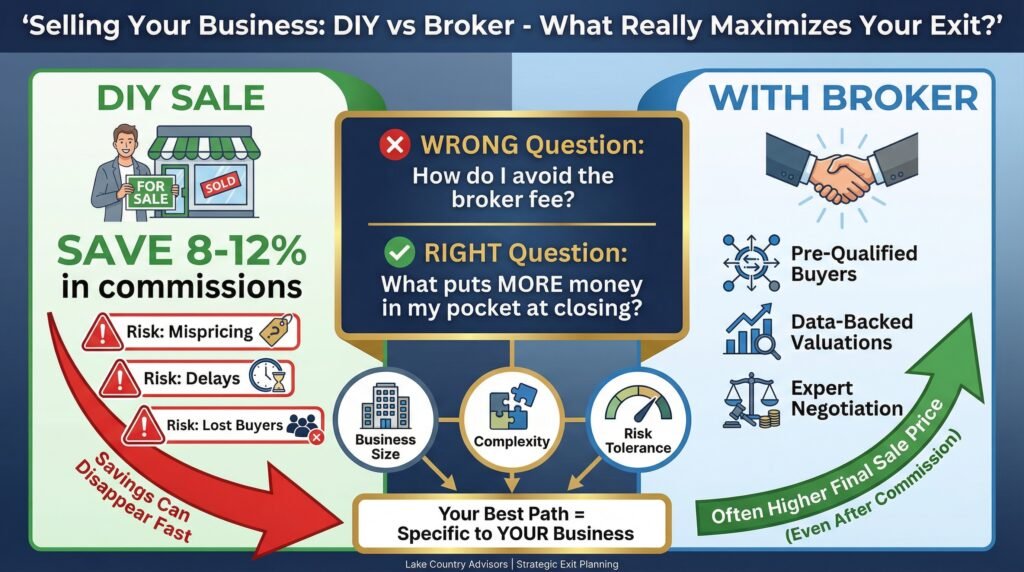
- Selling your business yourself can save you 8% to 12% in broker commissions, but that savings can disappear fast if you misprice, delay, or lose a qualified buyer along the way.
- Business brokers bring pre-qualified buyer networks, data-backed valuations, and negotiation experience that often results in higher final sale prices, even after their commission is paid.
- The decision between DIY and a broker isn’t just about fees; it comes down to your business size, complexity, and how much risk you’re willing to absorb.
- There’s a specific type of business where selling without a broker actually makes sense, and most owners don’t know if they qualify until it’s too late.
- Earned Exits specializes in helping business owners navigate this exact decision with clarity, strategy, and market expertise.
The decision to sell your business yourself or hire a broker is one of the most consequential choices you’ll make, and getting it wrong costs real money.
Most business owners approach this the wrong way. They start by asking, “How do I avoid the broker fee?” when the better question is, “What decision actually puts the most money in my pocket at closing?” Those are two very different questions, and the answers don’t always line up.
Earned Exits works with business owners every day who are wrestling with this exact decision, and the right answer almost always depends on specifics, not generalities.
Broker or No Broker: Here Is What Actually Determines Your Sale Price
The final number on your business sale isn’t just a reflection of what your business is worth; it’s a reflection of how well the sale was executed. Pricing, timing, buyer quality, negotiation, and deal structure all shape the outcome just as much as your revenue and assets do.
Why Most Business Owners Misjudge Their Business Value
Owners tend to value their businesses based on what they’ve put into them, the years, the sacrifice, the sleepless nights. But buyers value businesses based on what they’ll get out of them. That gap between emotional value and market value is where most DIY sales fall apart before they even start.
Without access to comparable sales data, independent sellers frequently overprice their businesses by 20% to 40%, which kills buyer interest early. When a listing sits too long, it gets stale. Buyers start assuming something is wrong with the business, and even if you eventually lower the price, the stigma of a long listing can drag your final offer down further than a proper valuation would have in the first place.
The Real Cost of Getting This Decision Wrong
On a business with a median sale price of $300,000, a broker commission at 10% is $30,000. That’s a significant number, but consider this: if a broker’s market expertise, buyer network, and negotiation skills result in even a 15% higher final offer, that’s $45,000 in additional proceeds. You’d net $15,000 more after the commission than you would have going it alone. The math shifts depending on your situation, but it’s rarely as simple as “broker fee = money lost.”
What a Business Broker Actually Does
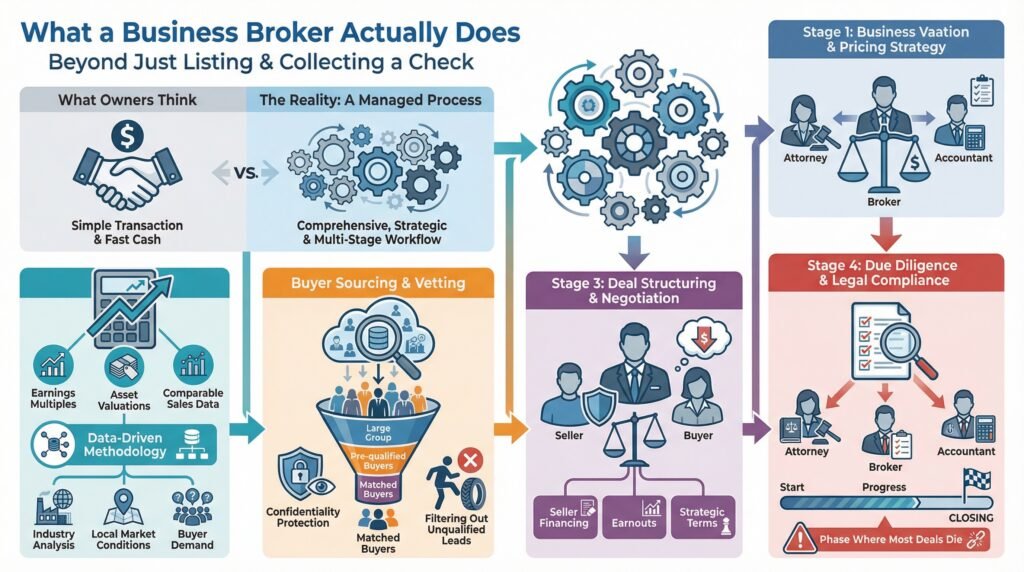
A lot of business owners imagine a broker as someone who simply lists a business and collects a check. The reality is that a good broker is running a highly managed process with a lot of moving parts happening simultaneously.
Business Valuation and Pricing Strategy
Brokers use a combination of earnings multiples, asset valuations, and real comparable sales data to price your business where it will attract serious buyers without leaving money on the table. This isn’t guesswork; it’s a structured, data-driven methodology that accounts for your industry, local market conditions, and current buyer demand.
Buyer Sourcing and Vetting
Experienced brokers maintain active databases of pre-qualified buyers, people who have already confirmed their financial capacity and intent to purchase. Instead of posting a listing and waiting, brokers proactively match your business to buyers who are already looking. They also screen out tire-kickers before they ever see your sensitive financial information, which protects your business confidentiality throughout the process.
Deal Structuring and Negotiation
This is where brokers earn their commission. Buyers, especially seasoned investors and corporate acquirers, come to the table with negotiation experience and strategies designed to lower your price. A broker acts as your buffer and advocate, countering tactics, structuring deal terms like seller financing and earnouts strategically, and keeping the negotiation from becoming personal or emotional.
Managing Due Diligence and Legal Compliance
Once a deal is agreed upon, due diligence begins, and this phase kills more deals than any other. A broker organizes your documentation, anticipates buyer questions, and keeps the process moving toward closing. They also coordinate with attorneys and accountants to make sure every component of the transaction is legally sound and structured in your best interest.
The Pros of Selling Your Business Without a Broker
Selling independently isn’t always the wrong move. There are real, legitimate advantages, but they apply to a narrower set of circumstances than most owners realize going in.
The appeal is obvious: cut out the middleman, keep more of the sale price, and maintain direct control over every conversation. For the right business, in the right situation, this approach works. Here’s where it genuinely makes sense.
1. You Keep the Full Sale Price with No Commission
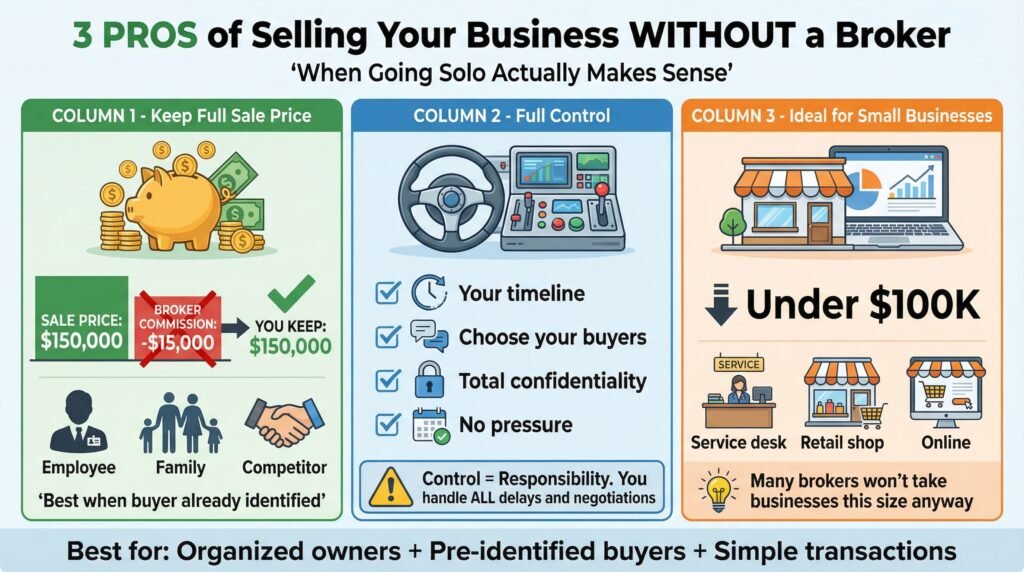
On a $150,000 business sale, a 10% broker commission is $15,000. If you already have a motivated, qualified buyer lined up, say, a longtime employee, a competitor who’s approached you, or a family member, paying a broker to facilitate what’s essentially a pre-arranged deal is hard to justify. The savings are real when the buyer relationship already exists.
2. You Control the Timeline and Buyer Conversations
Selling without a broker means no one is pushing you toward a deal you’re not ready for. You set the pace, choose who you talk to, and decide when and how much information to share. For owners who are selective about who takes over their business, especially those selling to someone who will maintain their legacy or keep their staff, this control matters.
- You decide which buyers to engage and when
- You can move more slowly without pressure from a broker’s timeline
- Confidentiality is entirely in your hands
- No third-party filtering of buyer conversations
That said, control cuts both ways. Without a broker managing the process, every delay, missed follow-up, or awkward negotiation falls on you. The freedom comes with real responsibility.
For owners who are organized, financially literate, and have already identified a buyer, this can be a clean and cost-effective path. For everyone else, “control” can quickly start to feel like “overwhelm.”
3. Direct Deals Work Best for Small or Simple Businesses
If your business is valued under $100,000, a sole-proprietor service business, a small retail location, or a simple online operation, the math on broker fees becomes harder to justify. Many brokers won’t take on businesses under this threshold anyway, which means DIY isn’t just an option; it may be your only realistic path. In these cases, the transaction is simpler, the buyer pool is smaller, and the documentation requirements are more manageable.
The Cons of Selling Your Business Without a Broker
Here is where the DIY approach shows its real costs, and for most business owners, these risks are significant enough to change the final outcome of their sale entirely.
1. Overpricing Kills Deals Before They Start
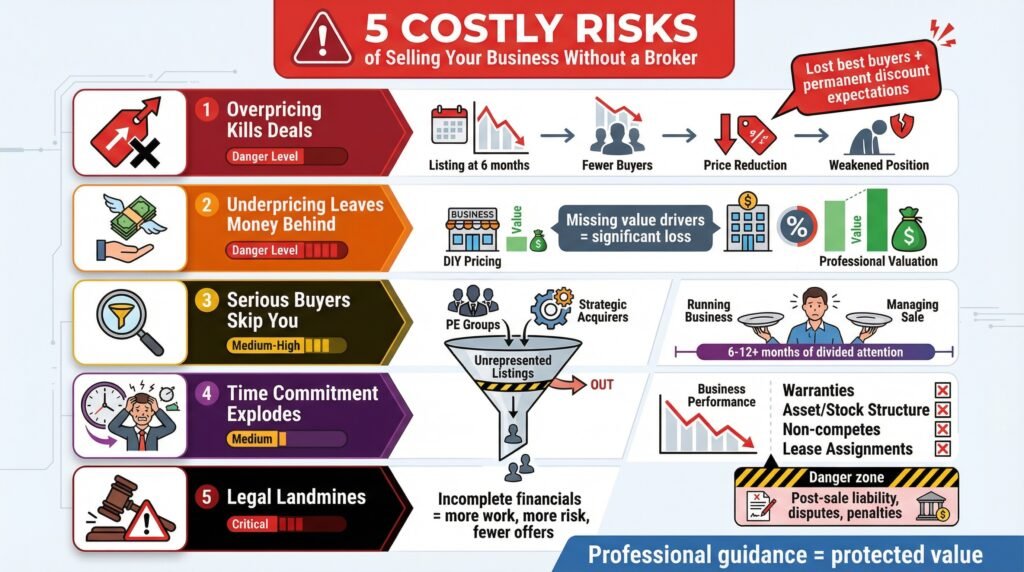
Without a professional valuation, most independent sellers set their asking price based on gut feeling or what they hope to walk away with. The problem is that buyers, especially experienced ones, immediately recognize an overpriced listing and either make a lowball offer or simply move on.
A business that sits on the market for six months develops a reputation. Other buyers notice the listing age and assume the business has problems. By the time you reduce your price, you’ve already lost your best buyers and trained the remaining ones to expect a discount.
The damage from overpricing isn’t just a delayed sale; it’s a permanently weakened negotiating position that follows the listing until it either sells far below its true value or gets taken off the market entirely.
2. Underpricing Leaves Real Money on the Table
The opposite problem is just as common, and arguably more painful. Sellers who don’t fully understand how buyers assign value to things like recurring revenue, customer concentration, or proprietary systems often underprice their businesses significantly, not from generosity, but from a lack of information.
A business with strong recurring contracts, a trained team, and a documented operations process is worth considerably more than a similar business that runs entirely on the owner’s personal relationships and knowledge. If you don’t know how to quantify and present those value drivers, you’re leaving that premium on the table, and a buyer is almost certainly not going to tell you.The opposite problem is just as common, and arguably more painful. Sellers who don’t fully understand how buyers assign value to things like recurring revenue, customer concentration, or proprietary systems often underprice their businesses significantly, not from generosity, but from a lack of information.
3. Serious Buyers May Skip Unrepresented Listings
Sophisticated buyers, private equity groups, strategic acquirers, and experienced entrepreneurs often filter their searches to broker-represented listings specifically. Why? Because they know that unrepresented sellers are more likely to have incomplete financials, unclear deal structures, and no professional guiding the transaction to close. An unrepresented listing signals more work and more risk on the buyer’s side, which either reduces the pool of interested buyers or invites lower offers from those willing to take on the extra friction.
4. The Time Commitment Is Larger Than Most Expect
Selling a business while still running it is one of the most demanding things an owner can attempt. Every hour spent writing listing copy, fielding buyer inquiries, preparing financial summaries, and managing follow-up conversations is an hour not spent on operations, customer relationships, or revenue generation. The irony is that the distraction of selling often causes the business performance to dip, which then weakens your negotiating position mid-sale.
A typical business sale takes six to twelve months even with professional help. Without a broker managing the process, timelines routinely stretch further. Every delay extends the period during which your business confidentiality is at risk, your key employees might sense a change is coming, and your competitors could catch wind of the sale before it closes.
5. Legal and Financial Mistakes Can Be Costly
A poorly structured purchase agreement can expose you to liability long after the sale closes. Issues like undefined representations and warranties, unclear asset versus stock sale structures, improperly handled lease assignments, or missing non-compete clauses can come back as legal disputes, clawbacks, or financial penalties. Most independent sellers don’t know what they don’t know until a problem surfaces, often months after the deal is done.
At a minimum, any business sale, even a simple one, requires a qualified business attorney reviewing the final agreement. The cost of that legal review is non-negotiable. The risk of skipping it, or using a general practice attorney who doesn’t specialize in business transactions, is simply too high when the stakes are this significant.
Business Seller Sanity Check
Whether you are planning to sell your business solo or utilize the experience and leveraging skills of a broker, pause and check if you have done the basic preparation needed to place your business on the market.
A major contributor to business undervaluations, wasted time, and poor exits is simply a lack of readiness. A broker can only sell what you’ve built.
If your business:
- Depends heavily on you
- Has inconsistent or unclear financials
- Lacks systems or transferable processes
Then even the best broker will struggle to get a premium offer. Brokers don’t create value. They expose it.
Bottom line: If you are not sure what basic preparation is required before considering a business valuation or selecting a business broker, click the button below to take our free business readiness quiz. The score will give you a clear indication of where you are in the process and the next course of action to take to ensure you start the business sale and exit on the right footing.
In part 2 of this series, we will discuss the other side of this scenario: the pros and cons of selling your business using a business broker, the step-by-step process of selling your business without a broker, and more. Follow our blog to remain updated on new articles and strategies in this ever-evolving market.
Frequently Asked Questions
These are the questions business owners ask most often when deciding how to approach their sale. The answers here are based on how deals actually work in practice, not how they’re described in marketing materials or best-case scenarios.
Whether you’re six months away from listing or just beginning to think about an exit, understanding these fundamentals now gives you a meaningful advantage when it matters most.
What percentage do business brokers typically charge?
Business brokers typically charge between 8% and 12% of the final sale price, with 10% being the most common standard for small to mid-sized businesses. Some brokers use a tiered structure, often called a Double Lehman formula, where the percentage decreases as the deal size increases. For example, a broker might charge 10% on the first $1 million and 8% on anything above that threshold.
On smaller transactions, minimum commission floors often apply regardless of the final sale price. These minimums protect the broker’s time investment on deals that would otherwise generate an unworkably small fee. Common minimums include:
- $10,000 minimum on businesses selling under $100,000
- $15,000 minimum on businesses in the $100,000 to $200,000 range
- Percentage-based commissions typically kick in above $200,000 to $300,000 in sale price
- Mid-market brokers handling deals above $1 million often charge 5% to 8% with tiered reductions
Commission rates are sometimes negotiable, particularly on higher-value transactions or when you already have a buyer identified and need the broker primarily for deal management rather than sourcing. Always discuss the full fee structure, including any marketing costs, listing fees, or success bonuses, before signing a broker agreement.
Can I sell my business myself without any professional help?
Technically, yes, there is no legal requirement to use a broker or any other professional when selling a privately held business. But “without any professional help” is a phrase worth unpacking carefully. Selling completely alone, no broker, no attorney, no accountant, no appraiser, is a high-risk approach that leaves you exposed at nearly every stage of the process.
The more realistic answer is that you can sell without a broker, but you should never sell without an attorney reviewing your contracts and an accountant helping you understand the tax implications of the transaction structure. A business attorney and a CPA are non-negotiable in any business sale, regardless of whether you use a broker. The question isn’t whether to get professional help; it’s which professionals you actually need for your specific situation.
How long does it take to sell a business without a broker?
Selling without a broker typically takes longer than selling with one. Industry data consistently shows that broker-represented businesses sell in an average of six to twelve months. Independent sales frequently stretch to twelve to eighteen months or beyond, primarily because finding qualified buyers without an established network takes significantly more time, and deals without professional management are more likely to stall during due diligence.
Timeline is directly affected by pricing accuracy, listing visibility, buyer qualification speed, and how efficiently the due diligence phase is managed. Independent sellers who do the preparation work upfront, clean financials, professional valuation, organized documentation, and active listing on major platforms can move faster than average. But every step that a broker would normally manage on your behalf becomes a potential delay point when you’re handling it alone while also running your business.
What is the biggest risk of selling a business without a broker?
The single biggest risk is mispricing, specifically, overpricing your business and burning through your best potential buyers in the first 60 to 90 days on market. That window is the period of peak buyer interest for any new listing. If your price is too high when serious buyers first see the listing, they move on to other opportunities and rarely return even after a price reduction.
The secondary risk, and one that often goes unrecognized until it’s too late, is poor deal structure. A business sold at the right price but under a poorly constructed agreement can still result in significant financial and legal consequences for the seller after closing. Undefined earnout terms, broad representations and warranties, unclear asset transfer language, and missing non-compete provisions are all potential landmines that an experienced broker and business attorney would catch before they become problems.
Experienced brokers help owners address controllable value detractors before market exposure, often increasing final transaction values by 15-30% through strategic pre-sale improvements. This systematic approach to value optimization represents one of the most significant advantages professional representation provides.
While unrepresented owners frequently over-value or under-value their businesses by 30-50%, specialized brokers like Earned Exits utilize industry-specific valuation methodologies that incorporate current market conditions, comparable transaction data, and buyer motivation factors.
Earned Exits has developed particular expertise with businesses valued between $1-50+ million, with specific methodologies tailored to different valuation segments within this range.
Their approach recognizes that a $2 million service business requires different positioning and buyer targeting strategies than a $30 million manufacturing operation, even while applying consistent transactional excellence principles across all engagements.
Read our full review of Earned Exits here and decide whether they are a good match for your specific business. If you and your business are ready, get started today. See the link below get started with Earned Exits free business valuation now.
*Disclaimer: This article is written for educational purposes and should not be interpreted as financial advice.
*Disclaimer: This article is written for educational purposes and should not be interpreted as financial advice. We may receive compensation for referrals made through this article.