
Quick Summary
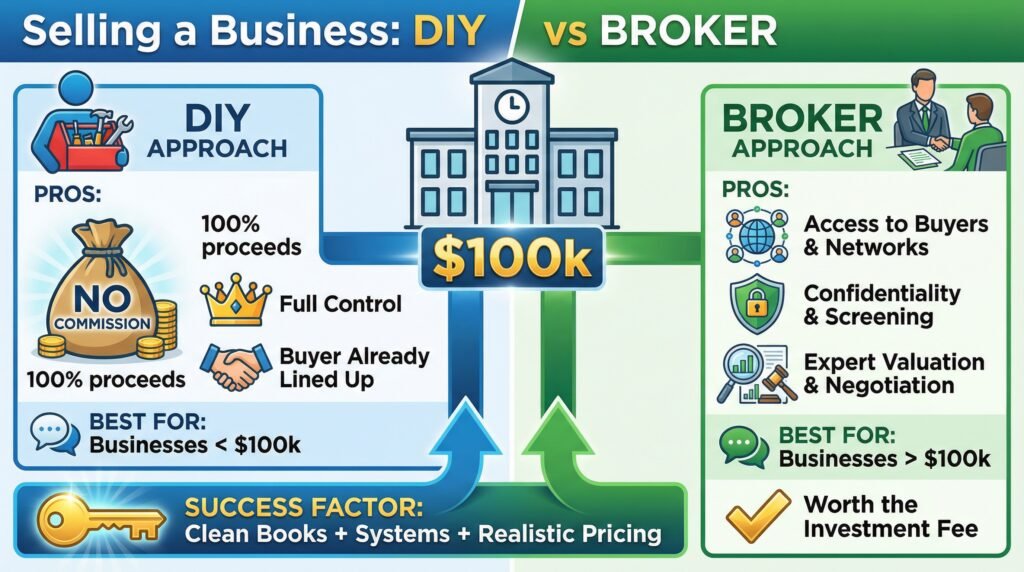
Business brokers generally deliver better outcomes (faster sales, higher prices, less stress) for most businesses valued over ~$100k, while DIY can work for very small deals, experienced sellers, or when a buyer is already lined up.
Brokers provide access to pre-qualified buyer networks, leading to quicker offers and bidding competition. A professional valuation plus market data provides defensible pricing and stronger negotiations. Faster closings (typically 6-12 months) with reduced friction and better deal structure often achieve 15-30% higher value through pre-sale prep are some of the benefits.
A DIY approach involves no broker commission, you keep 100% of the proceeds (minus other professional fees), full control over the process, and is feasible for businesses under $100k or if you already have a serious buyer.
Bottom line (author’s view): Brokers are usually worth the fee as an “investment” for better net results on mid-sized or larger businesses. DIY is riskier and more time-intensive, but can save money in simple/small cases. Preparation (clean books, systems, realistic pricing) is critical regardless of the route.
In part 1 of this series, we covered what a broker actually does and the pros and cons of selling your business without a broker. In part 2, we will discuss the other side of this scenario: the pros and cons of selling your business using a business broker, the step-by-step process of selling your business without a broker, and more.
The Pros of Using a Business Broker
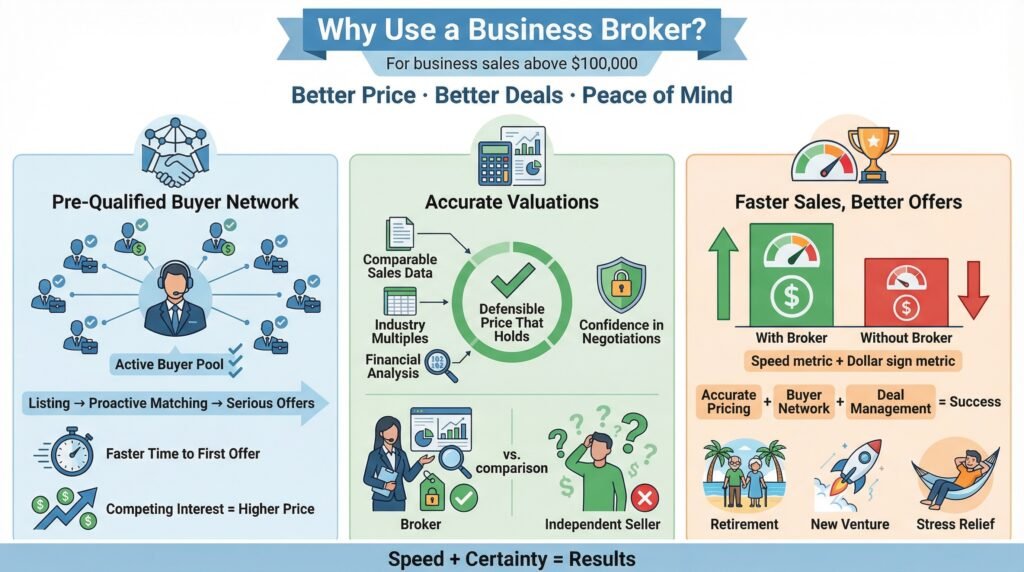
For the majority of business sales, particularly those above $100,000 in value, working with a broker doesn’t just simplify the process. It fundamentally changes what’s possible in terms of final price, deal quality, and peace of mind. Here’s where brokers make a measurable difference.
Access to a Pre-Qualified Buyer Network
One of the most underestimated advantages of working with a broker is immediate access to an active buyer pool. Instead of hoping the right buyer finds your listing, an experienced broker can proactively match your business to buyers already in their network who are ready to move. This dramatically shortens the time to a first serious offer and increases the likelihood that competing interest drives the price up rather than down.
Accurate Valuations Backed by Market Data
A broker doesn’t guess at your business value, they calculate it using actual comparable sales data, industry-specific earnings multiples, and a detailed analysis of your financials, customer base, and operational systems. This produces a defensible asking price that holds up under buyer scrutiny and doesn’t need to be slashed after a few weeks of no interest.
More importantly, a well-supported valuation gives you confidence going into negotiations. When a buyer pushes back on price, your broker can point to specific data to justify the number, something an independent seller rarely has the tools or market access to do effectively.
Faster Sales With Better Final Offers
Broker-represented businesses consistently sell faster and at higher prices than comparable businesses sold independently. The combination of accurate pricing, active buyer sourcing, and professional deal management removes the friction points that cause deals to stall or fall apart. For sellers who want to move on with their lives, whether into retirement, a new venture, or simply relief from the stress of ownership, speed and certainty matter enormously.
The Cons of Using a Business Broker
Brokers aren’t the right fit for every situation, and it’s worth understanding the limitations before signing an agreement. The two most significant drawbacks are cost and selectivity.
Commission Fees Typically Range From 8% to 12%
On a $200,000 sale, a 10% commission equals $20,000 paid to the broker at closing
On a $500,000 sale, that same rate means $50,000 out of your proceeds
Some brokers use a “Double Lehman” or tiered fee structure for larger transactions
Minimum commission floors, often $10,000 to $15,000, apply regardless of final sale price
Most broker agreements also include an exclusive listing period of six to twelve months
The commission math is most painful on smaller transactions. If your business sells for $80,000 and the broker has a $10,000 minimum fee, you’re paying 12.5% before any other closing costs are factored in. That’s a meaningful chunk of your proceeds for a transaction that might not have required the full scope of a broker’s services.
For larger transactions, though, the fee-to-value calculation often reverses. A broker who helps you achieve a $600,000 sale on a business you might have priced at $480,000 on your own has more than covered their commission, and then some. The key is understanding your business’s likely sale price before deciding whether a broker’s fee is a cost or an investment.
It’s also worth noting that commission rates are sometimes negotiable, particularly on higher-value transactions. Before assuming the posted rate is fixed, have a direct conversation about the fee structure, especially if you already have a potential buyer identified and need a broker primarily for deal management and documentation rather than buyer sourcing.
Not Every Broker Will Take On Every Business
Brokers are selective. A business generating under $50,000 in annual profit may not attract a broker willing to invest the time and resources required to market and close the deal, the commission simply doesn’t justify the effort. Similarly, businesses in niche industries, distressed financial situations, or with heavily owner-dependent operations can be difficult placements that some brokers will decline outright. If your business falls into one of these categories, knowing that upfront helps you plan a realistic alternative strategy rather than losing months waiting for representation that may never materialize.
How to Sell Your Business Without a Broker: Step-by-Step
If you’ve weighed the options and decided to move forward independently, whether because your business is under $100,000, you have a buyer in hand, or you’ve done this before, here is the process that gives you the best shot at a clean, successful close.
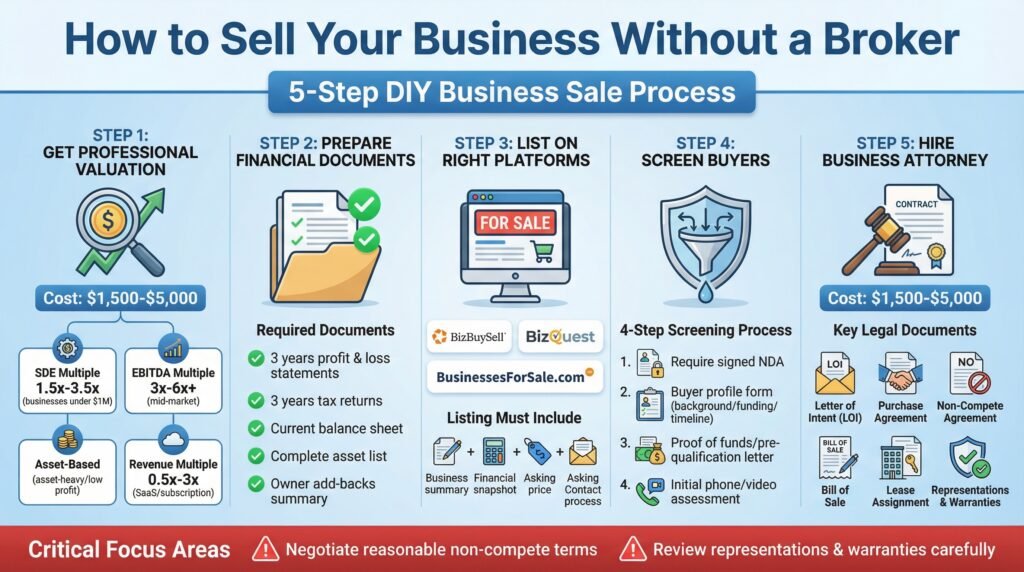
Step 1: Get an Honest Business Valuation First
Before you set a price or talk to a single buyer, get a professional valuation. This doesn’t mean asking your accountant what they think or running numbers through a free online calculator. It means engaging a certified business appraiser or, at a minimum, a transaction advisor who can provide a defensible, market-grounded value for your specific business.
Common Business Valuation Methods at a Glance
SDE Multiple (Seller’s Discretionary Earnings): Most common for small businesses under $1M. Typically 1.5x to 3.5x annual SDE depending on industry and risk.
EBITDA Multiple: Used for mid-market businesses. Multiples range from 3x to 6x or higher based on growth, industry, and customer concentration.
Asset-Based Valuation: Best for asset-heavy businesses or those with low profitability. Values the tangible and intangible assets directly.
Revenue Multiple: Common in SaaS and subscription businesses. Typically, 0.5x to 3x annual recurring revenue, depending on growth rate and churn.
Knowing your real number before you enter the market is the single most important step in the entire process. It protects you from overpricing that kills buyer interest and underpricing that costs you money you’ll never recover.
Even if you ultimately plan to sell on your own, paying $1,500 to $5,000 for a certified appraisal is almost always worth it. That investment can mean the difference between a negotiation anchored by data and one driven entirely by buyer pressure and guesswork.
Step 2: Prepare Your Financial Documents
Buyers will ask for three years of financial records minimum, and they’ll ask for them early. Having these organized and ready before you list signals that you’re a serious seller and keeps the process moving. Delays in producing financials are one of the top reasons deals stall, and buyers lose confidence or interest.
At a minimum, prepare the following before any buyer conversation begins: three years of profit and loss statements, three years of business tax returns, a current balance sheet, a list of all business assets included in the sale, and a clear summary of any owner add-backs to SDE. If your books aren’t clean, hire a bookkeeper to reconcile them before you list; messy financials cost you more in lost deal value than the bookkeeper’s fee ever will.
Step 3: List on the Right Platforms
Independent sellers have access to several legitimate business-for-sale marketplaces. BizBuySell is the largest in the U.S. and reaches the broadest buyer audience for most business types. BizQuest and industry-specific platforms are worth considering depending on your business category. Your listing should include a clear business summary (without identifying details if you need confidentiality), a clean financial snapshot, asking price with stated rationale, and a defined process for how interested buyers should make contact. Vague or incomplete listings get ignored, treat your listing like a professional sales document, not a classified ad.
Step 4: Screen Buyers Before Sharing Sensitive Information
Not everyone who inquires about your business is a qualified buyer. Some are competitors fishing for information. Some are curious but have no real capital. Protecting your business confidentiality while identifying serious buyers requires a clear screening process before you share anything sensitive.
- Require a signed Non-Disclosure Agreement (NDA) before sharing financials or business identity
- Ask buyers to complete a buyer profile form confirming their background, funding source, and acquisition timeline
- Request proof of funds or a pre-qualification letter from a lender before advancing conversations
- Conduct an initial phone or video call to assess seriousness and fit before sharing detailed documents
This process filters out the noise quickly and ensures that the buyers who see your confidential information have a genuine reason and real capacity to purchase. It also creates a paper trail that protects you legally if a buyer later claims to have received proprietary information under false pretenses.
Don’t skip the NDA step out of eagerness to get someone interested. A motivated, serious buyer will sign without hesitation. Anyone who resists a standard NDA before seeing your financials is either not serious or is actively trying to bypass your confidentiality protections, neither of which is the buyer you want.
Step 5: Hire a Business Attorney to Handle Contracts
Key Legal Documents in a Business Sale
Letter of Intent (LOI): Non-binding agreement outlining deal terms, price, and exclusivity period. Sets the foundation for due diligence.
Purchase Agreement: The binding contract. Defines what is being sold, price, payment terms, representations, warranties, and closing conditions.
Non-Compete Agreement: Prevents the seller from opening a competing business for a defined period and geographic area post-sale.
Bill of Sale: Transfers ownership of specific assets. Required in asset sale structures.
Lease Assignment or New Lease: Transfers or renegotiates the business’s physical location lease with the landlord’s approval.
Business Seller Sanity Check
Whether you are planning to sell your business solo or utilize the experience and leveraging skills of a broker, pause and check if you have done the basic preparation needed to place your business on the market.
A major contributor to business undervaluations, wasted time, and poor exits is simply a lack of readiness. A broker can only sell what you’ve built.
If your business:
- Depends heavily on you
- Has inconsistent or unclear financials
- Lacks systems or transferable processes
Then even the best broker will struggle to get a premium offer. Brokers don’t create value. They expose it.
Bottom line: If you are not sure what basic preparation is required before considering a business valuation or selecting a business broker, click the button below to take our free business readiness quiz. The score will give you a clear indication of where you are in the process and the next course of action to take to ensure you start the business sale and exit on the right footing.
In part 3 of this series, we will discuss how to choose the right business broker and which option fits your specific situation: DIY vs broker. Follow our blog to remain updated on new articles and strategies in this ever-evolving market.
If you have read enough and know your business has passed the preparation criteria to go to market, read our review of Earned Exits here.
Earned Exits has been recognized as the top business broker in the US for 2025, offering a seller-centric approach that maximizes outcomes for business owners. Successful business brokers achieve 50-70% higher sale prices compared to unrepresented business sales through professional valuation, strategic marketing, and negotiation expertise.
If you have decided that Earned Exits is a good fit and your business size is $1M-$40M+, see the link below to access the free business valuation from Earned Exits, a top business broker in 2025.
Frequently Asked Questions
These are the questions business owners ask most often when deciding how to approach their sale. The answers here are based on how deals actually work in practice, not how they’re described in marketing materials or best-case scenarios.
Whether you’re six months away from listing or just beginning to think about an exit, understanding these fundamentals now gives you a meaningful advantage when it matters most.
What percentage do business brokers typically charge?
Business brokers typically charge between 8% and 12% of the final sale price, with 10% being the most common standard for small to mid-sized businesses. Some brokers use a tiered structure, often called a Double Lehman formula, where the percentage decreases as the deal size increases. For example, a broker might charge 10% on the first $1 million and 8% on anything above that threshold.
On smaller transactions, minimum commission floors often apply regardless of the final sale price. These minimums protect the broker’s time investment on deals that would otherwise generate an unworkably small fee. Common minimums include:
- $10,000 minimum on businesses selling under $100,000
- $15,000 minimum on businesses in the $100,000 to $200,000 range
- Percentage-based commissions typically kick in above $200,000 to $300,000 in sale price
- Mid-market brokers handling deals above $1 million often charge 5% to 8% with tiered reductions
Commission rates are sometimes negotiable, particularly on higher-value transactions or when you already have a buyer identified and need the broker primarily for deal management rather than sourcing. Always discuss the full fee structure, including any marketing costs, listing fees, or success bonuses, before signing a broker agreement.
Can I sell my business myself without any professional help?
Technically, yes, there is no legal requirement to use a broker or any other professional when selling a privately held business. But “without any professional help” is a phrase worth unpacking carefully. Selling completely alone, no broker, no attorney, no accountant, no appraiser, is a high-risk approach that leaves you exposed at nearly every stage of the process.
The more realistic answer is that you can sell without a broker, but you should never sell without an attorney reviewing your contracts and an accountant helping you understand the tax implications of the transaction structure. A business attorney and a CPA are non-negotiable in any business sale, regardless of whether you use a broker. The question isn’t whether to get professional help; it’s which professionals you actually need for your specific situation.
How long does it take to sell a business without a broker?
Selling without a broker typically takes longer than selling with one. Industry data consistently shows that broker-represented businesses sell in an average of six to twelve months. Independent sales frequently stretch to twelve to eighteen months or beyond, primarily because finding qualified buyers without an established network takes significantly more time, and deals without professional management are more likely to stall during due diligence.
Timeline is directly affected by pricing accuracy, listing visibility, buyer qualification speed, and how efficiently the due diligence phase is managed. Independent sellers who do the preparation work upfront, clean financials, professional valuation, organized documentation, and active listing on major platforms can move faster than average. But every step that a broker would normally manage on your behalf becomes a potential delay point when you’re handling it alone while also running your business.
What is the biggest risk of selling a business without a broker?
The single biggest risk is mispricing, specifically, overpricing your business and burning through your best potential buyers in the first 60 to 90 days on market. That window is the period of peak buyer interest for any new listing. If your price is too high when serious buyers first see the listing, they move on to other opportunities and rarely return even after a price reduction.
The secondary risk, and one that often goes unrecognized until it’s too late, is poor deal structure. A business sold at the right price but under a poorly constructed agreement can still result in significant financial and legal consequences for the seller after closing. Undefined earnout terms, broad representations and warranties, unclear asset transfer language, and missing non-compete provisions are all potential landmines that an experienced broker and business attorney would catch before they become problems.
Experienced brokers help owners address controllable value detractors before market exposure, often increasing final transaction values by 15-30% through strategic pre-sale improvements. This systematic approach to value optimization represents one of the most significant advantages professional representation provides.
While unrepresented owners frequently over-value or under-value their businesses by 30-50%, specialized brokers like Earned Exits utilize industry-specific valuation methodologies that incorporate current market conditions, comparable transaction data, and buyer motivation factors.
Earned Exits has developed particular expertise with businesses valued between $1-50+ million, with specific methodologies tailored to different valuation segments within this range.
Their approach recognizes that a $2 million service business requires different positioning and buyer targeting strategies than a $30 million manufacturing operation, even while applying consistent transactional excellence principles across all engagements.
Read our full review of Earned Exits here and decide whether they are a good match for your specific business. If you and your business are ready, get started today. See the link below get started with Earned Exits free business valuation now.

*Disclaimer: This article is written for educational purposes and should not be interpreted as financial advice.
*Disclaimer: This article is written for educational purposes and should not be interpreted as financial advice. We may receive compensation for referrals made through this article.