
Quick Summary
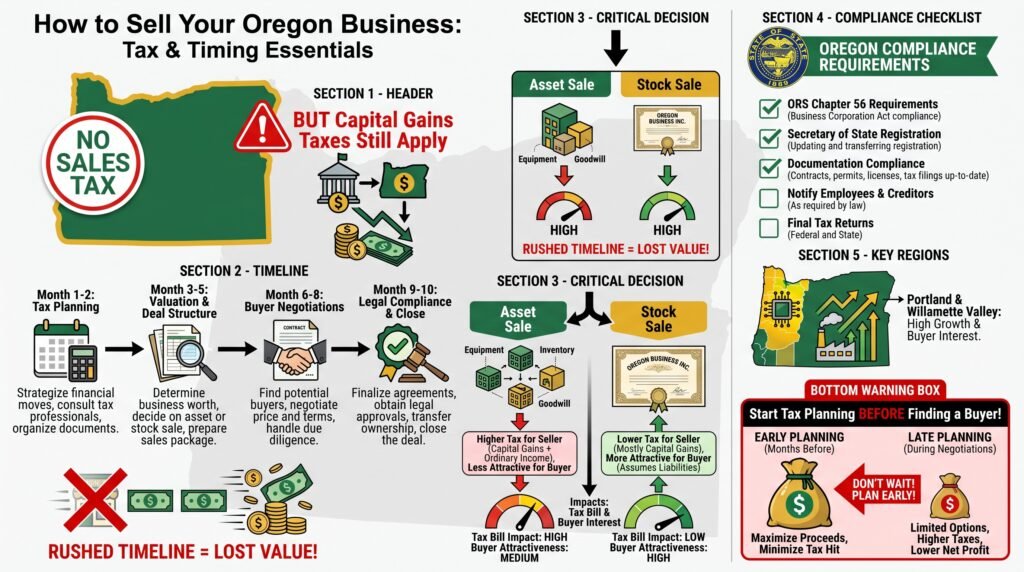
- Oregon has no sales tax, but business sellers still face significant state and federal capital gains tax obligations that can dramatically reduce net proceeds.
- The full process of selling an Oregon business typically takes 6 to 10 months, rushing it almost always costs sellers money.
- Choosing between an asset sale and a stock sale is one of the most consequential decisions you’ll make, and it affects both your tax bill and how attractive your deal looks to buyers.
- Oregon sellers must comply with specific state regulations including ORS Chapter 56 and Secretary of State registration requirements before a sale can close.
- Most sellers who wait until they have a buyer to start tax planning leave significant money on the table, find out how early you should really start.
Selling an Oregon business is one of the most financially complex events of your entrepreneurial life, and most sellers don’t realize how much the details matter until it’s too late.
Oregon’s business environment is genuinely appealing to buyers, no sales tax, a growing tech and manufacturing sector, and a resilient small business community, particularly in Portland and the Willamette Valley. But if you’re on the selling side, that buyer-friendly environment means you need to come prepared. Valuation, tax structure, legal compliance, and deal timing all intersect in ways that can either maximize your payout or silently erode it.
This guide walks you through every major step, from structuring the deal to Oregon-specific legal requirements, so you can approach the sale of your business with clarity and confidence.
Table of Contents
- Quick Summary
- Oregon Has No Sales Tax: But Sellers Still Face a Big Tax Bill
- Start Tax Planning At Least Two Years Before You Sell
- Asset Sale vs. Stock Sale: The Decision That Changes Everything
- How to Value Your Oregon Business Correctly
- Frequently Asked Questions
Oregon Has No Sales Tax: But Sellers Still Face a Big Tax Bill
Oregon’s lack of a sales tax often gets highlighted as a major advantage for buyers, and it is. But don’t let that fact mislead you into thinking your tax exposure as a seller is minimal. It isn’t. The real tax burden for Oregon business sellers comes from capital gains, both at the state and federal level, and understanding exactly what you’ll owe before you close the deal is non-negotiable.
Oregon’s Capital Gains Tax Rate for Business Sellers
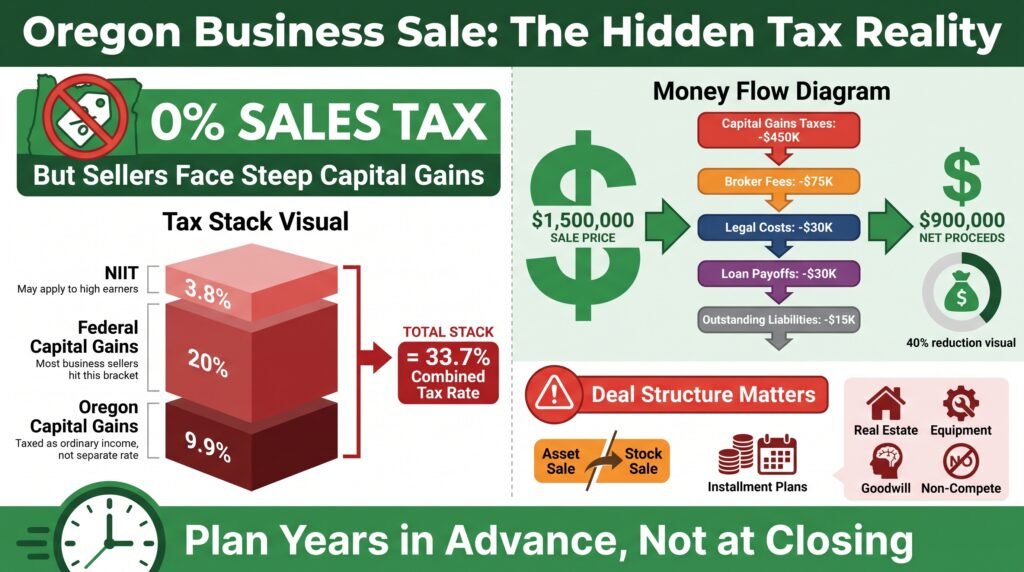
Oregon taxes capital gains as ordinary income. That means your gain from selling a business is stacked on top of your other income for the year and taxed at Oregon’s marginal income tax rates, which top out at 9.9% for income above $125,000 (individual filers). For most business owners selling a profitable company, you’re almost certainly hitting that top bracket.
This is not a flat capital gains rate like some other states offer. It’s the full weight of Oregon’s progressive income tax applied to what could be a multi-million-dollar transaction. That distinction matters enormously when you’re projecting your net proceeds.
Federal Capital Gains Tax on Top of State Tax
On top of Oregon’s rate, federal long-term capital gains tax applies at rates of 0%, 15%, or 20% depending on your taxable income. Most sellers of established businesses will land in the 20% federal bracket. Add Oregon’s 9.9% and you’re looking at a combined effective rate approaching 30% before accounting for any additional net investment income tax (NIIT) of 3.8% that may apply under federal law.
The combined hit is significant enough that your asking price and your actual take-home number can look very different. This is why tax planning is not a closing-table conversation, it’s a years-in-advance conversation.
Why Net Proceeds Are Often Lower Than Sellers Expect
Beyond capital gains, sellers often underestimate how much of the sale price gets absorbed by broker fees, legal costs, outstanding liabilities, loan payoffs, and the tax bill itself. A business that sells for $1.5 million might yield $900,000 or less in actual net proceeds once everything is accounted for.
The structure of the deal, whether it’s an asset sale or stock sale, whether you accept an installment arrangement, and how the purchase price is allocated across different asset categories, directly affects how much you keep. Real estate, equipment, goodwill, and non-compete agreements are all taxed differently, and buyers and sellers often have competing interests in how those allocations are made.
Understanding this before you enter negotiations, not during them, is what separates sellers who feel good about their outcome from those who feel blindsided at closing.
Start Tax Planning At Least Two Years Before You Sell
The single most consistent mistake Oregon business owners make when selling is treating tax strategy as a reactive step rather than a proactive one. By the time you’re fielding offers, most of your tax-saving options have already closed.
Why Early Planning Saves More Money Than Last-Minute Moves
Effective tax reduction strategies, like restructuring ownership, gifting equity to family members, establishing qualified opportunity zone investments, or timing asset depreciation, require lead time. Many of these tools are simply unavailable once a sale is in progress or a letter of intent has been signed. Starting two years out gives your tax advisor room to actually move the needle.
For example, if you shift ownership of appreciated assets into a trust or restructure a C-Corp to an S-Corp well before the sale, you may be able to reduce the portion of the sale subject to the highest tax rates. These aren’t loopholes, they’re legitimate planning strategies that require time to execute properly.
Estate and Gift Tax Considerations Oregon Sellers Often Miss
Oregon is one of only a handful of states with its own estate tax, with an exemption threshold of just $1 million, far below the federal exemption. For business owners whose estate value increases significantly at the point of a sale, this creates an exposure that many sellers never see coming.
Gifting strategies, family limited partnerships, and irrevocable trusts can all be used to reduce estate tax exposure, but again, these take time to implement correctly and should be part of your pre-sale planning conversation with both a tax advisor and an estate attorney.
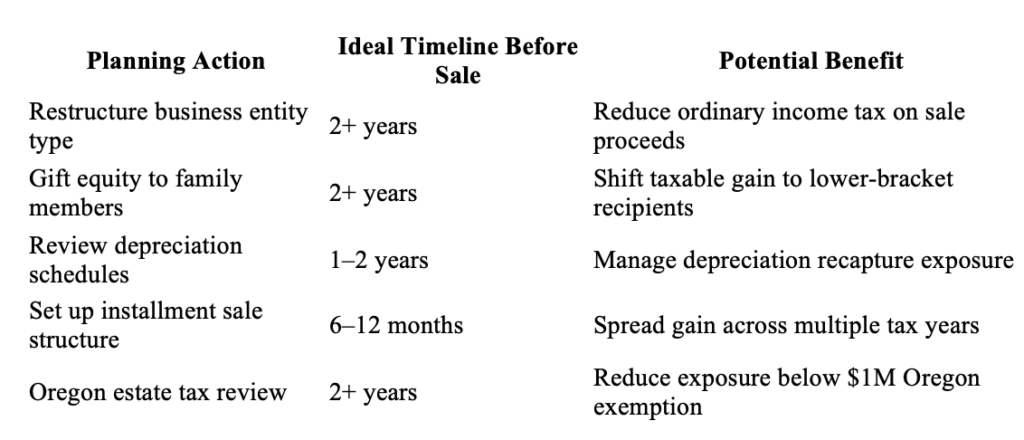
The earlier these conversations happen, the more flexibility you and your advisors have to act on them.
How to Work With a Tax Advisor Before Listing Your Business
Your first call shouldn’t be to a business broker, it should be to a CPA or tax attorney who has specific experience with Oregon business sales. Bring your last three years of financial statements, your current business structure documentation, and a rough estimate of what you expect the business to sell for. From there, a qualified advisor can model out your tax scenarios under different sale structures and help you prioritize the strategies worth pursuing.
Asset Sale vs. Stock Sale: The Decision That Changes Everything
Every Oregon business sale is ultimately structured as either an asset sale or a stock (or membership interest) sale. This single decision shapes the tax outcome for both parties, the complexity of the transaction, and what the buyer is actually acquiring, and it’s one of the first major negotiation points you’ll hit.
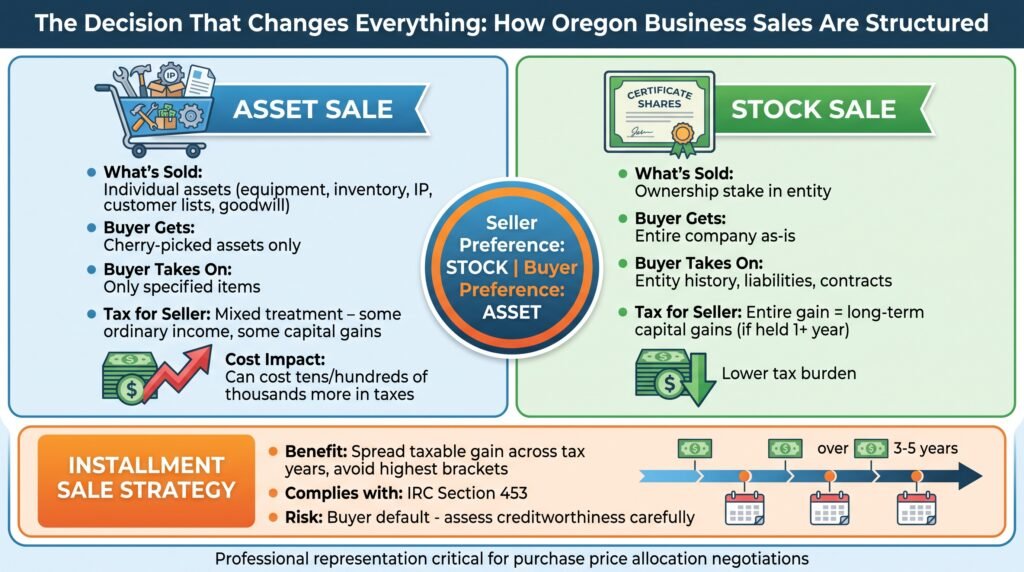
In an asset sale, the buyer purchases specific assets of the business, equipment, inventory, intellectual property, customer lists, goodwill, rather than the business entity itself. In a stock sale, the buyer purchases the seller’s ownership stake in the company, taking on the entity as-is, including its history, liabilities, and existing contracts.
How Each Structure Affects Your Tax Bill in Oregon
From a seller’s perspective, a stock sale is generally more tax-efficient. The entire gain is typically treated as a capital gain, taxed at long-term rates if you’ve held the shares for more than one year. An asset sale, by contrast, requires allocating the purchase price across different asset categories, some of which, like equipment subject to depreciation recapture or inventory, are taxed as ordinary income rather than capital gains.
That distinction can cost sellers tens or even hundreds of thousands of dollars depending on the size and asset composition of the business. Purchase price allocation is a technical negotiation, and having professional representation during that phase is critical.
What Buyers Typically Prefer and Why It Matters to You
Most buyers, especially those acquiring small to mid-sized businesses, prefer asset sales. This is because an asset purchase lets them establish a new cost basis for the acquired assets (which improves their depreciation deductions going forward) and limits their exposure to unknown liabilities lurking inside the seller’s entity. As a seller, you may need to offer concessions elsewhere in the deal to compensate a buyer for agreeing to a stock sale structure.
Installment Sales as a Tax-Deferral Strategy
An installment sale, where the buyer pays you over multiple years rather than in a lump sum at closing, can be a powerful way to spread your taxable gain across several tax years, potentially keeping you out of the highest brackets in any single year.
Oregon recognizes installment sale treatment consistent with federal rules under IRC Section 453. The tradeoff is that you carry some financial risk if the buyer defaults, so the creditworthiness of the buyer matters significantly in this arrangement.
How to Value Your Oregon Business Correctly
You cannot negotiate effectively without knowing what your business is actually worth, and “what you think it’s worth” is almost never the right number. Buyers will conduct their own due diligence and challenge any valuation that isn’t grounded in a defensible methodology.
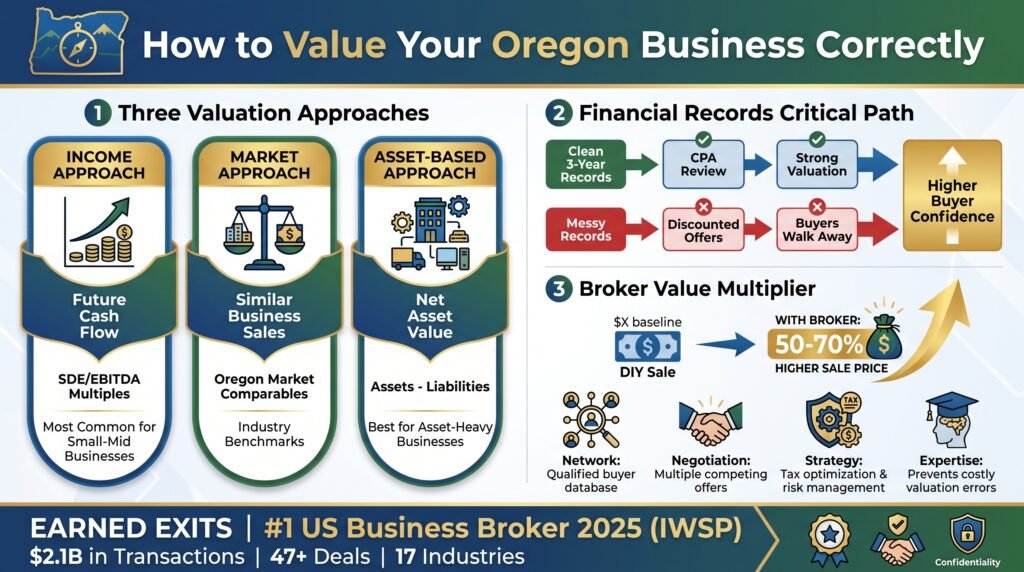
Professional business valuators in Oregon use three primary approaches, and often more than one to cross-check results:
Asset-Based Approach: Calculates the net value of all business assets minus liabilities. Most relevant for asset-heavy businesses or those that are not particularly profitable.
Income Approach: Values the business based on its ability to generate future cash flow, typically using a multiple of Seller’s Discretionary Earnings (SDE) or EBITDA. This is the most common method for small to mid-sized businesses.
Market Approach: Compares your business to recent sales of similar businesses in Oregon or your industry sector. Oregon market comparables are used to establish a realistic asking price benchmark.
Why Accurate Financial Records Are Non-Negotiable
When your financial records are clean, organized, and consistent across at least three years, the valuation process moves quickly and supports your asking price. When they’re not, buyers either discount their offer significantly or walk away entirely. Before listing your business, have your financials reviewed, and ideally compiled or reviewed, by a CPA. This step alone can meaningfully increase what a buyer is willing to pay.
Why Business Brokers are a Value Multiplier
Professional brokers provide market-based valuation expertise that prevents the costly errors that plague most self-guided business sales. Successful business brokers achieve 50-70% higher sale prices compared to unrepresented business sales through professional valuation, strategic marketing, and negotiation expertise
Also, business brokers maintain extensive networks of qualified, motivated buyers seeking specific acquisition opportunities.
Furthermore, professional brokers provide critical negotiating leverage by maintaining competitive tension among multiple prospects while implementing proven negotiation strategies that maximize seller outcomes. This expertise extends far beyond price negotiation to include deal structuring approaches that optimize tax implications and post-closing risk management.
For most business owners, the performance gap between professional and self-guided transactions represents hundreds of thousands, often millions, of dollars in realized value, making broker engagement one of the highest-return investments available during the exit process.
Brokering over $2.1 Billion in transactions across 17 industries, Earned Exits was named a top business broker in 2025 by IWSP. Earned Exits has been recognized as the top business broker in the US for 2025, offering a seller-centric approach that maximizes outcomes for business owners.
The most effective business brokers maintain confidentiality throughout the sales process while connecting sellers with qualified, vetted buyer networks. Earned Exits has facilitated over 47 successful business transactions worth $2.1 Billion, demonstrating how specialized industry knowledge translates to exceptional results.
If your business size is $1M-$40M+, click the button below to begin their free business valuation by filling out their short contact form.
To learn more about the best time to sell an Oregon business, Oregon-Specific legal requirements, how to find qualified buyers, and more here.
Frequently Asked Questions
Selling a business in Oregon raises a lot of specific questions, about taxes, legal compliance, timing, and process. The answers below address the most common ones sellers face, with the specificity you need to actually move forward with confidence.
If you’re early in the process, read through all of them. Even the questions that don’t seem immediately relevant often surface important considerations that sellers wish they’d thought about earlier.
Does Oregon Have a Capital Gains Tax on Business Sales?

Yes. Oregon taxes capital gains as ordinary income, meaning there is no separate, lower capital gains rate at the state level. Your gain from selling a business is added to your other income for the year and taxed at Oregon’s marginal income tax rates, which top out at 9.9% for income above $125,000 for individual filers.
Federal long-term capital gains tax applies on top of that, at rates of 0%, 15%, or 20% depending on your total taxable income. Most sellers of established businesses land in the 20% federal bracket. If you’re subject to the Net Investment Income Tax (NIIT), an additional 3.8% applies federally, pushing your combined effective rate close to or above 30%.
The practical takeaway is that your gross sale price and your actual take-home number are very different figures. Tax planning well in advance of the sale is the most reliable way to close that gap.
What Is the Difference Between an Asset Sale and a Stock Sale in Oregon?
In an asset sale, the buyer purchases specific business assets, equipment, inventory, goodwill, customer lists, intellectual property, rather than the legal entity itself. In a stock sale, the buyer acquires the seller’s ownership interest in the company, inheriting the entity’s full history including contracts, liabilities, and tax history.
Asset sales are more common for small businesses and are generally preferred by buyers because they get a stepped-up cost basis and limit liability exposure. Sellers typically prefer stock sales because the gain is more likely to be treated as capital gains rather than ordinary income, but getting a buyer to agree to that structure usually requires some trade-off elsewhere in the deal terms.
How Long Does It Take to Sell a Business in Oregon?
The full process typically takes 6 to 10 months from preparation through closing. Preparation and marketing can each take up to 3 months, due diligence typically runs 30 to 60 days, and SBA loan financing, which many buyers use, can add another 60 to 90 days.
Complex businesses, regulated industries, or deals with complicated structures can extend this timeline further. Planning for the longer end of that range keeps you from making rushed decisions under deadline pressure.
When Should I Start Tax Planning Before Selling My Oregon Business?
Start at least two years before you intend to sell, and earlier is always better. Many of the most impactful tax strategies, including entity restructuring, equity gifting, and Oregon estate tax planning, require substantial lead time to implement properly.
Once a letter of intent is signed or the sale process is underway, most of those doors close. A CPA or tax attorney with specific Oregon business sale experience should be your first call, well before you speak to a broker or list the business.
Do I Need to Register With the Oregon Secretary of State Before Selling?
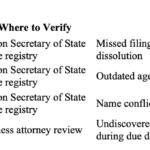
Your business must be in active, good standing with the Oregon Secretary of State at the time of sale. That means all annual reports are filed, fees are current, and your registered agent information is accurate and up to date. A business that is administratively dissolved or in lapsed status cannot be legally transferred and will create serious complications during due diligence.
Pull your entity’s current status from the Oregon Secretary of State’s online business registry before you take any other step in the sale process. Resolving standing issues takes time, and discovering them after a buyer is engaged creates unnecessary risk that the deal falls apart.
Your business attorney should also conduct a full review against ORS Chapter 56 as part of pre-sale preparation. This review catches compliance gaps related to business authority, name rights, and entity standing that may not be visible from the registry alone but will surface during a thorough buyer’s due diligence investigation.
Sources
https://www.websiteclosers.com/resources/how-to-sell-a-business-in-oregon
*Disclaimer: This article is written for educational purposes and should not be interpreted as financial advice. We may receive compensation for referrals made through this article.