
Key Takeaways
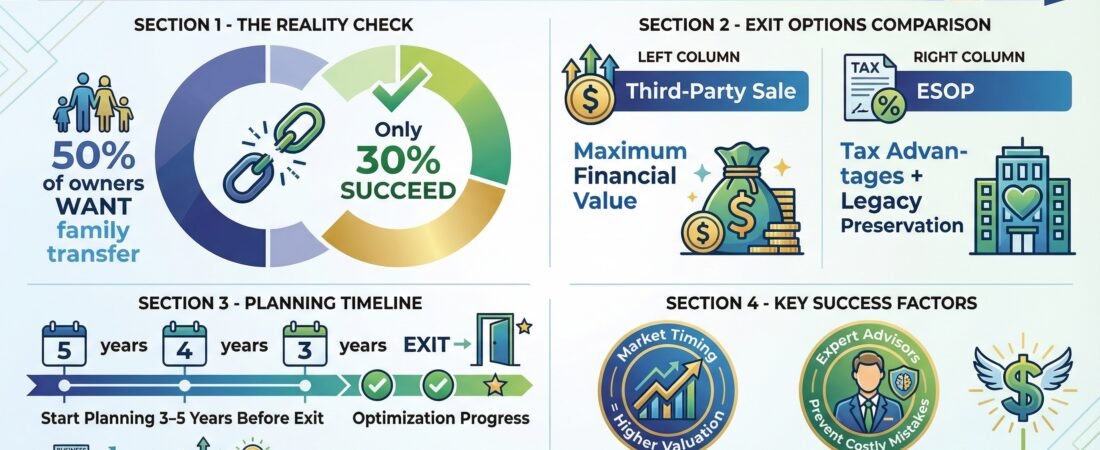
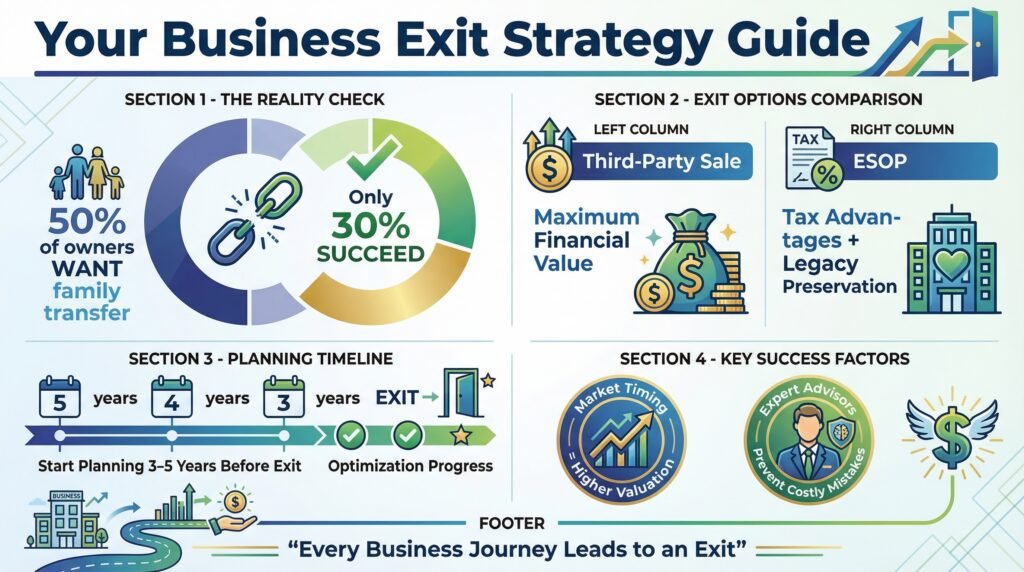
- The best exit strategy aligns with your personal, financial, and business goals – over 50% of owners want to transfer to family, but only 30% successfully do so.
- Third-party sales typically maximize financial value, while ESOPs offer significant tax advantages and preserve the company’s legacy.
- Proper exit planning should begin 3-5 years before your intended departure date to optimize business value.
- Understanding market conditions and timing your exit appropriately can significantly impact your final valuation.
- Working with specialized exit planning advisors can help you avoid costly mistakes that diminish your company’s value.
Every business journey eventually leads to an exit. Whether you’re planning to sell your company next year or a decade from now, having a well-crafted exit strategy is crucial for maximizing your company’s value and securing your financial future.
Why 68% of Business Owners Are Leaving Money on the Table
Most entrepreneurs spend decades building their businesses but only days planning their exit. According to the Exit Planning Institute, a staggering 68% of business owners have no formal exit strategy in place. This lack of preparation typically results in accepting lower valuations, paying unnecessarily high taxes, or failing to find suitable buyers when it’s time to transition, affecting overall exiting profitability.
The cold reality is that without proper planning, many business owners are forced into hasty decisions during unexpected circumstances like health issues, market downturns, or competitive threats. These reactive exits almost always result in diminished returns on what is likely your largest asset. Strategic exit planning isn’t just about the eventual sale – it’s about building a business that can thrive without your daily involvement, making it substantially more valuable to potential buyers.
8 Proven Exit Strategies Smart Business Owners Use
Understanding the full range of exit options is your first step toward making an informed decision. Each strategy offers distinct advantages depending on your timeline, financial goals, and desired legacy. The right approach balances maximizing financial return with preserving what you’ve built.
1. Selling to a Third Party: Maximum Value Potential
The most straightforward and often most lucrative exit strategy is selling your business to an outside buyer. This can include strategic acquirers (competitors or companies in adjacent markets) or financial buyers like private equity firms.
Third-party sales typically command the highest multiples, especially when strategic buyers see synergistic value in your operations, customer base, or proprietary technology. The process usually involves working with business brokers or investment bankers who can create competitive bidding situations to drive up your valuation.
The downside? You’ll likely have limited control over what happens to your company post-sale. Strategic buyers often integrate acquired companies into their existing operations, potentially resulting in staff reductions, culture changes, or even complete rebranding. Financial buyers typically aim to grow and sell the business within 3-7 years, which might mean significant operational changes during their ownership period.
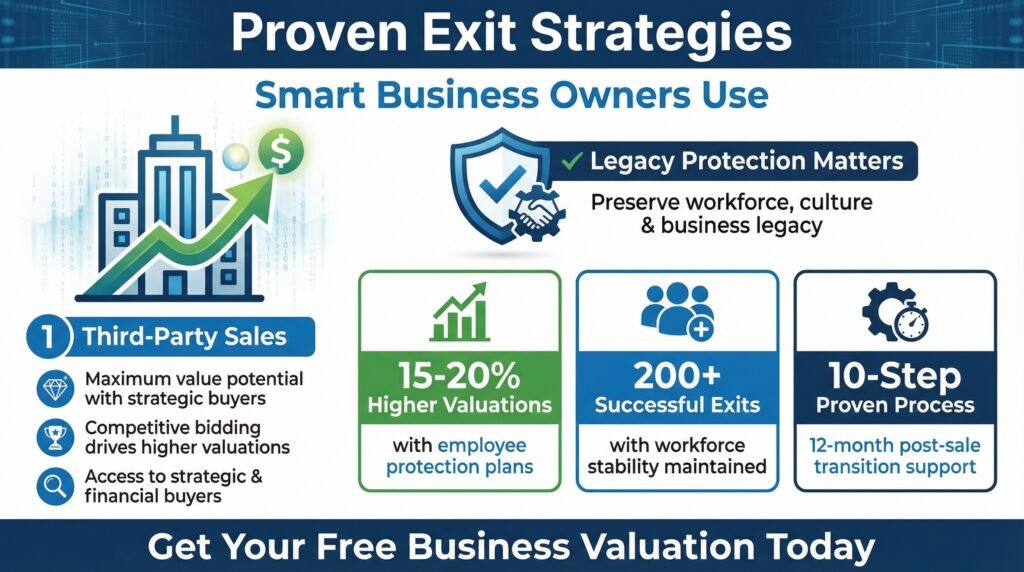
Finding a business broker that maximizes profitability, maintains the present workforce, and respects the business’s legacy is a key factor. Earned Exits specializes in business exits that preserve company legacy and employee interests, not just maximizing sale price
The firm employs a unique 10-step selling process that incorporates legacy protection documentation and employee retention planning. Businesses with protected employee interests typically command 15-20% higher valuations than those focused solely on financial metrics
Earned Exits has a proven track record of successful transitions with over 200 businesses maintaining workforce stability post-acquisition. Their comprehensive approach includes post-sale transition support for up to 12 months, ensuring continuity beyond the transaction. Get started with Earned Exits free, comprehensive valuation via the link below.
Click the link below to contact Earned Exits today to receive a free business valuation by filling out their short form. Discover how their proven 10-step process can help you achieve the maximum value for your business.
2. Management Buyout (MBO): Preserving Your Company Culture
When preserving your company’s culture and continuity ranks high on your priority list, selling to your management team can be an attractive option. This approach keeps your business in the hands of those who understand its operations and values. Management buyouts typically involve financing arrangements where the management team makes a down payment and pays the remainder through future company earnings or bank financing secured against the company’s assets.
MBOs often result in smoother transitions since the new owners already understand the business intimately. However, they typically command lower valuations than third-party sales, as your management team rarely has the same financial resources as strategic buyers. This approach also requires having a capable management team with entrepreneurial ambitions and the financial capability to handle the transaction.
3. Family Succession: Keeping the Legacy Alive
Passing your business to the next generation remains a popular option among owners who’ve built family enterprises. This intergenerational transfer preserves your legacy while keeping the business within the family. According to the Exit Planning Institute, over 50% of business owners express a preference for this option, though only about 30% successfully execute it.
The challenges with family succession are numerous. You must have capable, interested family members willing to take the reins. Family dynamics and potential conflicts between active and non-active family members can complicate the process.
Additionally, careful estate planning is necessary to minimize tax implications and ensure fair treatment of all heirs, whether they’re involved in the business or not. Successful family successions typically involve years of preparation, including formal training of successors and clear governance structures.
4. Employee Stock Ownership Plan (ESOP): The Tax-Advantaged Exit
ESOPs have gained popularity as a tax-efficient exit strategy that preserves company culture while providing significant financial benefits. An ESOP is a qualified retirement plan that buys the owner’s shares and holds them in trust for employees. This structure provides remarkable tax advantages – owners can defer capital gains taxes by reinvesting proceeds in qualified securities, while the company can deduct both principal and interest payments on ESOP loans.
Beyond tax benefits, ESOPs create a ready market for your shares without requiring an immediate external buyer. They also reward the employees who helped build your company, potentially increasing motivation and retention. Companies like Bob’s Red Mill and King Arthur Flour have successfully transitioned to employee ownership while maintaining their values and market positions. However, ESOPs involve complex setup costs and ongoing administration requirements, making them most suitable for companies with at least 20 employees and steady profitability.
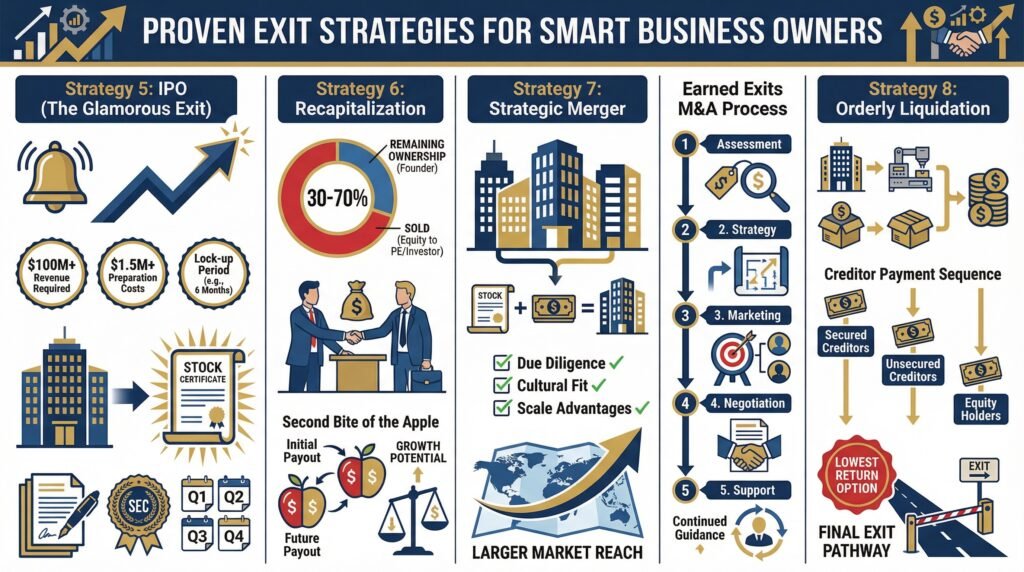
5. Initial Public Offering (IPO): The Glamorous Exit
IPOs represent the pinnacle of entrepreneurial success stories in popular media. Taking your company public through an initial public offering can provide substantial liquidity and prestige, but it’s realistic for only a tiny fraction of businesses. An IPO requires significant revenue (typically $100+ million annually), rapid growth trajectory, and an industry that excites public markets.
The process involves extensive regulatory compliance, transparency requirements, and significant costs that can easily exceed $1 million in legal and financial preparations. Post-IPO, you’ll face quarterly performance pressures and ongoing SEC filing requirements. While the potential financial upside is enormous, founders typically must retain significant ownership during a “lock-up” period, leaving their wealth tied to the company’s public performance in the volatile early trading months.
6. Recapitalization: Taking Some Chips Off the Table
For owners who want partial liquidity while maintaining control, recapitalization offers an intriguing middle path. This strategy involves selling a portion of your equity (typically 30-70%) to an investor while continuing to run the business and retaining significant ownership. This approach lets you diversify your personal wealth while potentially gaining a partner who can help fund future growth.
Private equity firms frequently offer recapitalization options, providing capital and operational expertise in exchange for partial ownership. The arrangement typically includes a planned “second bite of the apple” – a future sale where you can realize additional gains on your retained equity. This strategy works best when you still have growth ambitions but want to reduce personal financial risk by taking some money off the table.
7. Strategic Merger: Combining Forces for Growth
Merging with another company can create a stronger combined entity while allowing you to reduce your operational involvement. Unlike a complete sale, mergers typically involve stock swaps or combinations of stock and cash, meaning you maintain some ownership in the merged entity. The right merger partner can provide complementary capabilities, broader market reach, or economies of scale that neither business could achieve independently.
Successful mergers require thorough due diligence and cultural compatibility assessment to avoid the integration problems that plague many combined entities. While you may sacrifice some control, you gain the opportunity to participate in the potential upside growth of the larger enterprise. This approach works particularly well in fragmented industries where scale provides competitive advantages.
The Earned Exits Approach to M&A Advisory
At Earned Exits, we tailor our M&A advisory services to align closely with each client’s individual objectives. Our process prioritizes the interests of both buyers and sellers, ensuring all parties walk away satisfied from the deal. Our seasoned advisors are readily available to address any questions or issues that arise throughout the journey. Drawing on up-to-date industry knowledge and insights, we craft strategies that maximize value, reduce potential risks, and set your business up for sustained future success.
The Earned Exits M&A Process
Initial Assessment and Readiness: We start with a complimentary business valuation, pinpointing the main factors that drive value and getting your company optimally positioned for a sale or acquisition.
Bespoke M&A Strategy: Our experienced team creates a customized plan that directly supports your specific goals, with every action thoughtfully designed and implemented.
Targeted Marketing to Buyers: We promote your business to a selective group of qualified buyers and investors, tapping into our extensive network to identify the ideal partner.
Negotiation and Deal Closure: We manage negotiations on your behalf to secure advantageous terms that match your priorities, working efficiently to bring the transaction to a successful close.
Ongoing Post-Transaction Assistance: Once the deal is finalized, we continue offering guidance to facilitate a seamless handover, supporting integration or any follow-up planning needs.
Partner with Earned Exits for Professional M&A Guidance
Choosing Earned Exits means partnering with a committed team focused entirely on your success. Our strategic methodology, proven history of results, and unwavering dedication to clients position us as the go-to advisor for owners navigating the intricacies of mergers and acquisitions.
Curious about your potential M&A pathways? Reach out to Earned Exits today to arrange a consultation with one of our expert advisors and begin moving toward a rewarding transaction. Click the link below to contact Earned Exits now for a no-cost valuation by filling out their short form. See how our proven 10-step process can help you maximize your business’s value and secure the best possible exit.
8. Orderly Liquidation: The Final Option
When a business lacks transferable value or faces insurmountable challenges, orderly liquidation represents a final exit strategy. This approach involves systematically selling company assets, fulfilling obligations to creditors, and distributing remaining proceeds to owners. While liquidation typically yields the lowest return among exit options, a planned liquidation can recover significantly more value than forced closures.
This strategy makes sense primarily for businesses whose value lies predominantly in tangible assets rather than ongoing operations, or when health issues or market conditions make other exit options impractical. Professional assistance from liquidation specialists can maximize recovery value from equipment, inventory, real estate, and receivables.
Now that we have covered the top 8 business exit strategies, in part 2 we will cover how to choose the right strategy for your business, real-world success stories, and more. Subscribe and follow our blog to receive regular updates.
Frequently Asked Questions
What is the most profitable exit strategy for small businesses?
Third-party sales to strategic buyers typically yield the highest valuations for small businesses, particularly when the business offers synergistic value to the acquirer. Strategic buyers may pay 20-50% premiums over financial buyers when they can integrate your business into their existing operations, access new markets, or acquire valuable intellectual property. However, the most profitable strategy varies dramatically based on your specific business circumstances, industry conditions, and available buyers. Some service businesses achieve higher valuations through ESOPs or management buyouts that preserve client relationships than through external sales that risk client departures.
How long does it typically take to exit a business?
The complete exit planning and execution process typically requires 3-5 years for optimal results. However, the active transaction phase once you’ve decided to sell generally takes 6-12 months from initial marketing to closing for third-party sales. This timeline includes 2-3 months of preparation and marketing, 3-4 months of buyer negotiations and due diligence, and 1-2 months for closing activities and documentation.
ESOP transactions often require 9-12 months of preparation and implementation, while family transitions might extend over several years as successors develop necessary skills and experience. Rushed exits almost always result in value reduction, so beginning the process well before your desired departure date provides the greatest flexibility and optimal outcomes.
Can I still be involved in my business after implementing an exit strategy?
Many exit strategies accommodate continued involvement through carefully structured transitions. Third-party sales often include employment or consulting agreements that keep founders involved for 1-3 years to ensure smooth customer and operational transitions. These arrangements typically include performance-based earnouts that align incentives between buyers and sellers during the transition period.
Recapitalization specifically enables continued involvement by design, as you maintain partial ownership while partnering with investors who provide capital and expertise. Family transitions and management buyouts frequently include mentorship or advisory roles for departing owners. The key is clearly defining your post-exit responsibilities and authority to prevent conflicts with new ownership.
What’s the difference between a management buyout and an employee stock ownership plan?
Management buyouts (MBOs) transfer ownership to a small group of key executives who personally invest and secure financing to purchase the business. These transactions typically involve significant personal financial commitments from the management team, often requiring personal guarantees on acquisition financing. MBOs preserve continuity while transferring control to those most familiar with the business operations.
ESOPs, by contrast, transfer ownership to a trust benefiting all qualifying employees rather than just executives. The company itself secures the financing, using tax-advantaged structures that allow principal and interest payments to be tax-deductible. ESOPs provide significant tax benefits to selling owners (potential capital gains deferral) and to the company (tax deductions for contributions). They typically allow for more gradual transitions and broader wealth distribution among employees.
If you are ready to get started today with the Earned Exits free business valuation. Click the banner below to fill out their short form to start the process.

*Disclaimer: This article is written for educational purposes and should not be interpreted as financial advice.
*Disclaimer: This article is written for educational purposes and should not be interpreted as financial advice. We may receive compensation for referrals made through this article.