
Quick Summary
A successful business exit is rarely a one-time event. The highest-value outcomes come from early, staged planning that reduces risk, improves valuation, and aligns financial and personal goals.
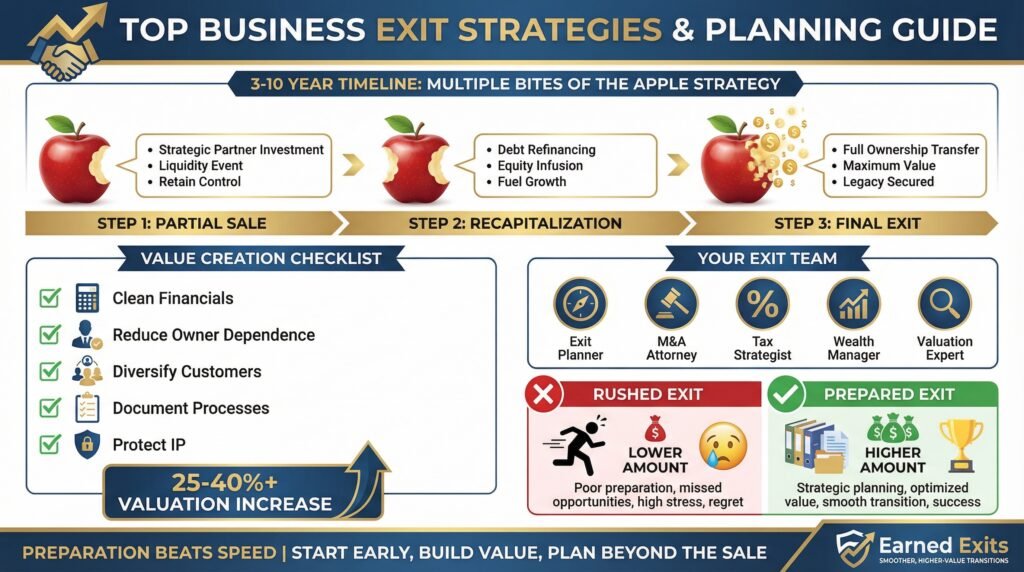
- “Multiple bites of the apple” business exits (partial sales, recapitalizations, phased liquidity) let owners de-risk over time while maximizing total proceeds, often over a 3–10-year horizon.
- Value creation before sale matters more than timing. Cleaning up financials, reducing owner dependence, diversifying customers, documenting processes, and protecting IP can increase valuation by 25–40%+.
- Buyers pay premiums for transferable businesses, not owner-centric ones. Strong management teams, clean EBITDA, and low concentration risk expand buyer pools and improve deal terms.
- Exit planning is a team sport. Coordinated advisors, such as an exit planner, M&A attorney, tax strategist, wealth manager, and valuation expert can optimize structure, taxes, and post-sale outcomes when engaged years in advance.
- Preparation beats speed. The biggest seller regrets come from rushed exits, poor tax planning, weak deal structures, and neglecting life-after-sale readiness.
- Firms like Earned Exits specialize in guiding owners through valuations, strategy, buyer outreach, negotiations, and post-transaction transitions to deliver smoother, higher-value exits.
Bottom line: Start early, stage intelligently, build value deliberately, and plan for what comes next, not just the sale itself.
In part 1 of this series, we discussed why most business owners fail to exit profitably, 8 proven exit strategies, and more.In part 2 of this series, we will cover other smart and profitable business exiting strategies, increasing business value, and more.
“Multiple Bites of the Apple” Strategy: The Smart Way to Exit
The most sophisticated exit strategies often combine elements from multiple approaches, allowing you to diversify risk while maximizing total proceeds. These hybrid strategies recognize that different aspects of your business value may appeal to different types of buyers or benefit from different timing windows.
How to De-Risk Your Business Exit Over Time
The “multiple bites” approach structures your exit in sequential stages rather than a single transaction. This might involve selling a minority stake to create personal liquidity, followed by majority recapitalization, ultimately culminating in complete exit. Each stage reduces your risk exposure while potentially increasing the total realized value.
Staging your exit also allows you to reduce operational responsibilities while maintaining financial upside gradually. Many owners find that this gradual transition better addresses the emotional and identity challenges of business departure. The approach works particularly well when you believe your company is approaching an inflection point in growth or valuation multiples.
The ideal timing between transaction stages depends on industry dynamics, business growth trajectories, and personal readiness factors. Most phased exits span 3-10 years from initial liquidity event to complete departure, though accelerated or extended timelines can accommodate specific circumstances.
Partial Exit Benefits: Cash Today, Growth Tomorrow
Partial exits offer the security of immediate liquidity while preserving opportunity for additional value creation. This approach works particularly well when you’ve reached personal financial goals but believe your company still has substantial untapped potential. By bringing in growth capital and strategic partners, you create the infrastructure needed to scale beyond your individual capabilities.
Successful partial exits require partners whose vision aligns with yours, complementary capabilities, and clear governance structures for decision-making during the transition period. The approach often accelerates growth by combining your industry expertise with external capital, connections, and operational resources.
5 Ways to Increase Your Business Value Before Exiting
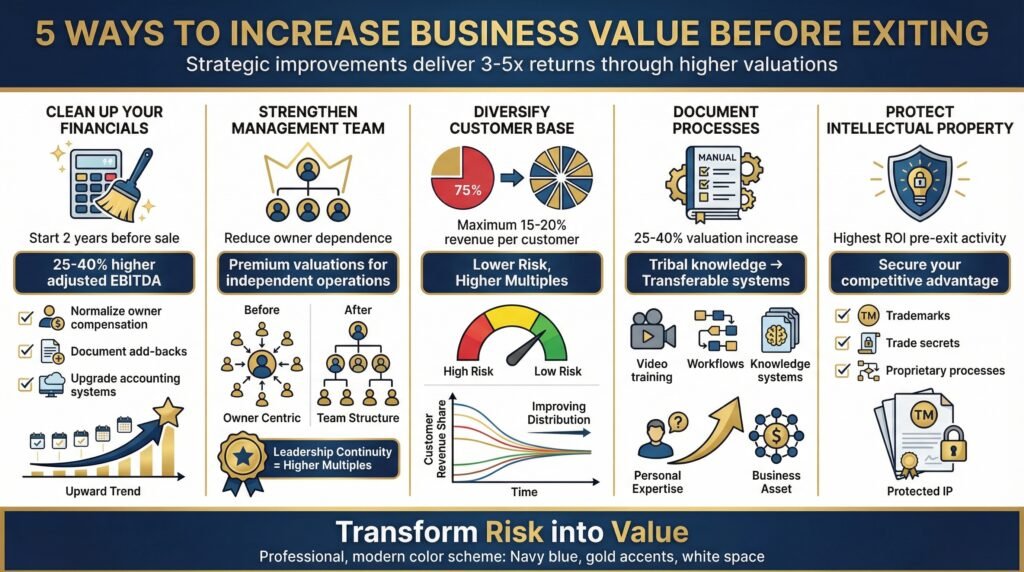
Strategic value enhancement represents one of the highest-return investments you can make before exiting. Focused improvements in key business areas often deliver 3-5x returns through higher valuations and better deal structures. The most impactful value drivers address issues that traditionally concern buyers and reduce their perceived risk.
Clean Up Your Financials: What Buyers Really Look For
Financial clarity provides the foundation for buyer confidence and maximum valuations. Most private businesses operate with financials optimized for tax efficiency rather than demonstrating true profit potential. Recasting financial statements to normalize owner compensation, one-time expenses, and personal perks often reveals an adjusted EBITDA that is 25-40% higher.
Begin cleaning your financials at least two years before sale to establish trending data buyers can trust. This process includes implementing proper accrual accounting, documenting add-backs with clear audit trails, and potentially upgrading accounting systems or personnel. Quality of earnings assessments conducted by third-party firms often identify additional profit normalization opportunities while preempting buyer due diligence concerns.
Strengthen Your Management Team: Reducing Owner Dependence
Businesses that depend heavily on the owner’s daily involvement typically sell for significantly lower multiples. Building a capable management team that can operate without you dramatically increases both valuation and buyer pool. This transition requires clearly documented roles, responsibilities, and decision authorities that demonstrate the business can thrive in your absence.
Start by identifying key functions you currently control and systematically delegating them to appropriate team members. Document the success of these transitions through performance metrics that prove operations remain stable during your reduced involvement. Many owners test this independence by taking extended absences before sale to validate the team’s capabilities.
Buyers pay premium prices for well-managed businesses with leadership continuity. Demonstrating that your management team will remain post-sale provides powerful negotiating leverage and often becomes a key differentiator when compared to other acquisition targets.
Diversify Your Customer Base: Eliminating Concentration Risk
Customer concentration represents one of the most common valuation discounts in business sales. When any single customer represents more than 15-20% of revenue, buyers perceive elevated risk and typically adjust offers accordingly. Diversification efforts before sale can dramatically improve valuation multiples and reduce contingent payment requirements.
Implement strategic initiatives to expand your customer base while gradually reducing dependence on major accounts. Document the success of these efforts through trending reports showing decreasing concentration percentages over time. Even modest improvements in diversification metrics can significantly impact buyer perception and willingness to pay premium prices.
Document Your Processes: Creating Transferable Value
Documented systems and processes transform your operational knowledge from personal expertise into transferable business assets. Comprehensive documentation demonstrates that your company’s success depends on replicable systems rather than individual tribal knowledge. This transition from personality-dependent to process-driven operations often increases valuations by 25-40%.
Begin by identifying key operational workflows, decision criteria, and quality standards currently residing in employees’ heads rather than formal documentation. Prioritize documenting processes that directly impact customer experience, revenue generation, and quality control. The most valuable documentation combines clear procedural steps with the underlying rationale that guides decision-making.
Modern process documentation extends beyond traditional manuals to include video training, interactive workflows, and knowledge management systems. These resources reduce buyer concerns about transition risks while demonstrating operational maturity that justifies premium valuations.
Protect Your Intellectual Property: Securing Hidden Assets
Formalized intellectual property protections transform intangible assets into valuable legal rights that buyers willingly pay premiums to acquire. Many privately held businesses operate with significant intellectual property but minimal formal protections, creating unnecessary valuation discounts. Identifying and protecting these assets before sale often yields some of the highest ROI pre-exit activities.
Start by inventorying all potential intellectual property, including trademarks, trade secrets, proprietary processes, customer lists, and specialized knowledge. Implement appropriate protections through registrations, confidentiality agreements, and licensing arrangements that establish clear ownership and transferability. Document the competitive advantages these assets provide and their barriers to replication by competitors.
If this last section raised an eyebrow. It should. A major contributor to business undervaluations, wasted time, and poor exits is simply a lack of readiness. If you are not sure what basic preparation is required before considering a business valuation or selecting a business broker, click the button below to take our free business readiness quiz. The score will give you a clear indication of where you are in the process and the next course of action to take to ensure you start the business sale and exit on the right footing.
Build Your Exit Planning Dream Team
Successfully navigating a business exit requires specialized expertise across multiple disciplines. The complexity of these transactions exceeds the scope of any single advisor, making team assembly one of your most critical exit planning decisions. The right advisory team provides both technical guidance and crucial emotional support throughout the transition process.
The 5 Essential Advisors Every Seller Needs
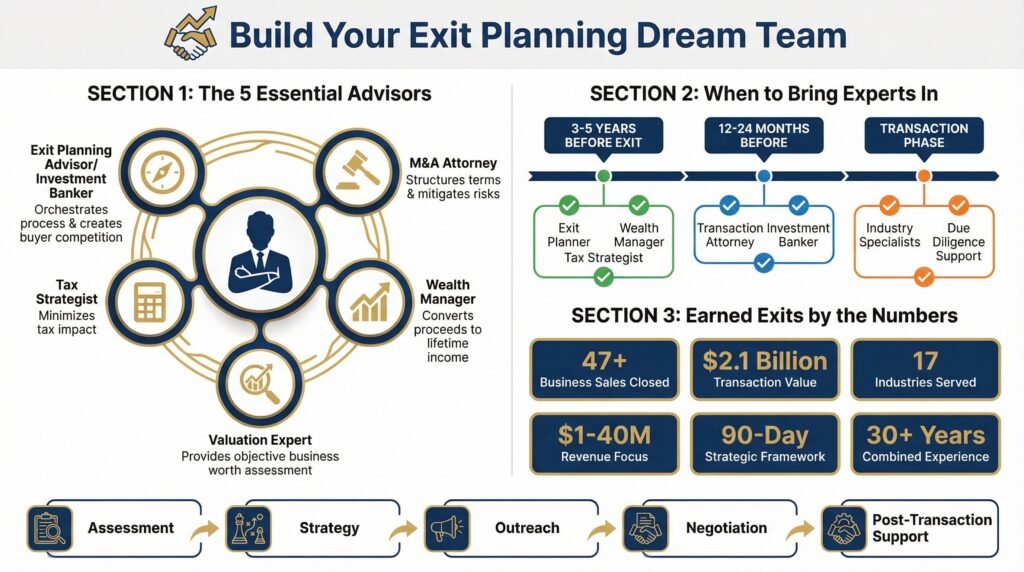
Your exit planning team should include specialists who collectively address valuation, tax strategy, legal structure, wealth management, and transaction guidance. These advisors work collaboratively to optimize both deal structure and post-sale outcomes. While upfront investment in quality advisors may seem substantial, their expertise typically delivers returns many times their cost through enhanced transaction value and tax efficiency.
Valuation Expert: Provides an objective assessment of business worth under various exit scenarios and market conditions
Exit Planning Advisor/Investment Banker: Orchestrates the overall process, identifies value enhancement opportunities, and creates competitive tension among potential buyers
M&A Attorney: Structures legally advantageous transaction terms while mitigating risk exposure through proper representations, warranties, and covenants
Tax Strategist: Designs entity structures and deal components to minimize tax impact across multiple transaction.scenarios
Wealth Manager: Develops post-exit financial strategies to convert business proceeds into sustainable lifetime income.
When to Bring Each Expert into Your Exit Process
Advisor timing significantly impacts both exit outcomes and advisory costs. Bring your core team together early in the planning process to establish integrated strategies, with specialists added at appropriate milestones. This staged approach maximizes expertise while managing advisory expenses effectively.
Your exit planner, tax strategist, and wealth manager should typically engage 3-5 years before the intended exit, while transaction attorneys and investment bankers may enter 12-24 months pre-transaction. Industry specialists and due diligence support join during the transaction preparation phase. Early planning allows sufficient time to implement value enhancement recommendations before beginning formal sale processes.
Earned Exits – Business Broker Valuations and M&A Advisory Services
Advisor timing significantly impacts both exit outcomes and advisory costs. Bring your core team together early in the planning process to establish integrated strategies, with specialists added at appropriate milestones. This staged approach maximizes expertise while managing advisory expenses effectively.
Your exit planner, tax strategist, and wealth manager should typically engage 3-5 years before the intended exit, while transaction attorneys and investment bankers may enter 12-24 months pre-transaction. Industry specialists and due diligence support join during the transaction preparation phase. Early planning allows sufficient time to implement value enhancement recommendations before beginning formal sale processes.
Given the amount of expertise required to secure a smooth and profitable business exit, it is help to have the majority of these services under ‘one roof’.
Earned Exits is a business broker that has successfully closed more than 47 business sales totaling over $2.1 billion in transaction value, providing clear proof that deep, specialized expertise delivers superior outcomes. Earned Exits focuses on brokering company sales with $1 – $40Million in revenue.
Unlike generalist brokers, Earned Exits brings focused experience across 17 distinct industries, including manufacturing, distribution, professional services, technology, and specialty contracting. This sector-specific insight enables the team to accurately identify and highlight the value drivers, customer behaviors, and operational factors that matter most to buyers in each market.
Rather than relying on improvised deal strategies, Earned Exits follows a structured 90-day strategic selling framework designed to increase close rates while minimizing disruption to day-to-day business operations.
In addition to being ranked one of the top business brokers in 2025, Earned Exits provides M&A advisory services. The company’s M&A process is intentionally designed to deliver a smooth, well-managed experience from initial planning through closing and beyond. With more than 30 years of combined experience, our team provides hands-on guidance at every stage. Below is an overview of how our process works:
Initial assessment and preparation: Earned Exits start with a complimentary business valuation, uncover key value drivers, and position your company for a successful sale or acquisition.
Tailored M&A strategy: The company’s experienced advisors craft a customized transaction strategy aligned with your objectives, ensuring each phase is thoughtfully planned and executed.
Targeted buyer outreach: Your business is presented to a select group of qualified buyers and investors through our established network, allowing us to identify the strongest strategic fit.
Negotiation and closing management: Earned Exits leads negotiations to secure favorable terms that support your goals and manage the process through a successful close.
Post-transaction support: Following the sale, they remain engaged to facilitate a smooth transition, offering guidance on integration, planning, and next steps as needed.
Click the button below if you’re ready to get started right now with Earned Exits’ free business and valuation.

Frequently Asked Questions
Can I still work in my business after I sell it?
Post-sale employment arrangements represent common components of business transitions, particularly when buyers value your expertise, customer relationships, or industry knowledge. These agreements typically range from 3-24 months, depending on transition complexity and buyer needs. A clear definition of responsibilities, performance expectations, and independence levels helps prevent friction during this period.
What happens to my employees when I sell?
Employee treatment varies significantly based on buyer type and acquisition strategy. Strategic buyers often implement more significant changes aligned with their existing operations, while financial buyers typically maintain greater continuity, particularly in well-performing businesses. Understanding potential buyer approaches to human resources allows you to negotiate appropriate protections for your team during transaction structuring.
How do earnouts work, and should I accept one?
Earnouts link a portion of your purchase price to future business performance, bridging valuation gaps between buyer and seller expectations. These structures typically span 1-3 years with payments tied to revenue, EBITDA, or specific operational metrics. While earnouts can maximize total proceeds, they introduce significant risk and potential conflicts regarding business management during the earnout period.
The viability of earnout arrangements depends largely on your confidence in future performance, trust in buyer operations, and personal financial requirements. When accepting earnouts, ensure you maintain sufficient operational control or clearly defined performance assumptions to protect your contingent payments. Earnout provisions should include specific calculation methodologies, dispute resolution processes, and protection against buyer actions that could undermine target achievement.
Sophisticated sellers often negotiate for earnout protections including separate business unit maintenance, dedicated resources, and acceleration provisions triggered by certain buyer actions. These safeguards help align incentives while reducing vulnerability to factors outside your control.
What documents do I need to prepare before selling?
Comprehensive documentation preparation significantly accelerates transaction timelines while building buyer confidence. Essential materials include 3-5 years of financial statements, tax returns, customer and vendor contracts, employee agreements, equipment leases, intellectual property documentation, corporate records, and detailed customer/sales analysis. Organizing these materials before entering the market demonstrates operational sophistication that often translates into higher valuations.
How do I handle confidentiality during the sale process?
Maintaining confidentiality throughout your sale process protects business value, customer relationships, and employee stability. Professional advisors implement structured disclosure processes including blind teasers, non-disclosure agreements, and staged information release to qualified prospects. These protocols balance the need for buyer information with appropriate protection of sensitive details.
Technology platforms including virtual data rooms provide additional security through controlled access, document watermarking, and activity tracking. These systems allow you to monitor precisely who accesses specific information while maintaining comprehensive audit trails throughout the due diligence process.
What’s the biggest regret most business owners have after selling?
The most common post-sale regret involves inadequate preparation for life after business ownership. Many entrepreneurs focus exclusively on transaction mechanics while neglecting the emotional and identity transitions accompanying ownership change. This oversight often leads to feelings of loss, purposelessness, and decision remorse, even when financial outcomes meet or exceed expectations.
Other frequent regrets include selling prematurely before maximizing value, inadequate tax planning resulting in unnecessary liabilities, and insufficient focus on transaction structure beyond headline price. These issues typically stem from compressed preparation timelines or overemphasis on speed versus optimization.
Experienced owners often cite relationship impacts as underestimated consequences, particularly tensions with family members involved in the business or social circle changes when business relationships formed the foundation of their community connections. Proactive planning for these dimensions helps ensure your exit brings genuine satisfaction beyond financial rewards.
Anticipating how business sale proceeds will convert into lifetime income represents another critical planning area. Many owners overestimate sustainable withdrawal rates from investment portfolios, creating potential long-term financial vulnerability despite substantial initial proceeds.
The most satisfied sellers typically begin holistic exit planning years before transaction execution, addressing business optimization, personal readiness, and financial structuring as integrated components of a comprehensive transition strategy. This preparation ensures your exit represents a beginning rather than merely an ending.
Understand all the ramifications of a proper business exit plan by utilizing the proven expertise of Earned Exits. Ranked a top business broker in 2025, Earned Exits has facilitated over 47 successful business transactions worth $2.1 Billion, demonstrating how specialized industry knowledge translates to exceptional results. Get started today with Earned Exits free business valuation via the link below:

*Disclaimer: This article is written for educational purposes and should not be interpreted as financial advice.
*Disclaimer: This article is written for educational purposes and should not be interpreted as financial advice. We may receive compensation for referrals made through this article.