
Key Takeaways
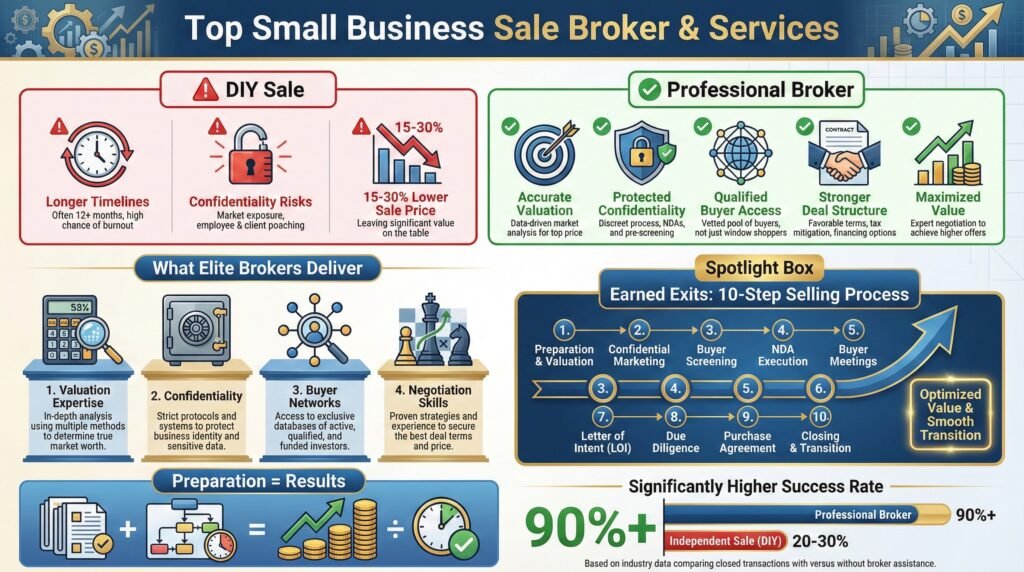
Selling your small business without professional help often leads to longer timelines, confidentiality risks, and 15–30% lower sale prices. A skilled business broker improves valuation accuracy, protects confidentiality, accesses qualified buyer networks, structures stronger deals, and manages negotiations, maximizing value while allowing you to stay focused on running your business.
In Part 1 of this series, we discussed Why Small Business Owners Struggle to Sell Without Professional Help, working with a partner for a Successful Exit, and more. In part 2, we will discuss how to find the right business broker for your small business, 5 critical benefits of hiring a business broker, and more.
How to Find the Right Business Broker for Your Small Business
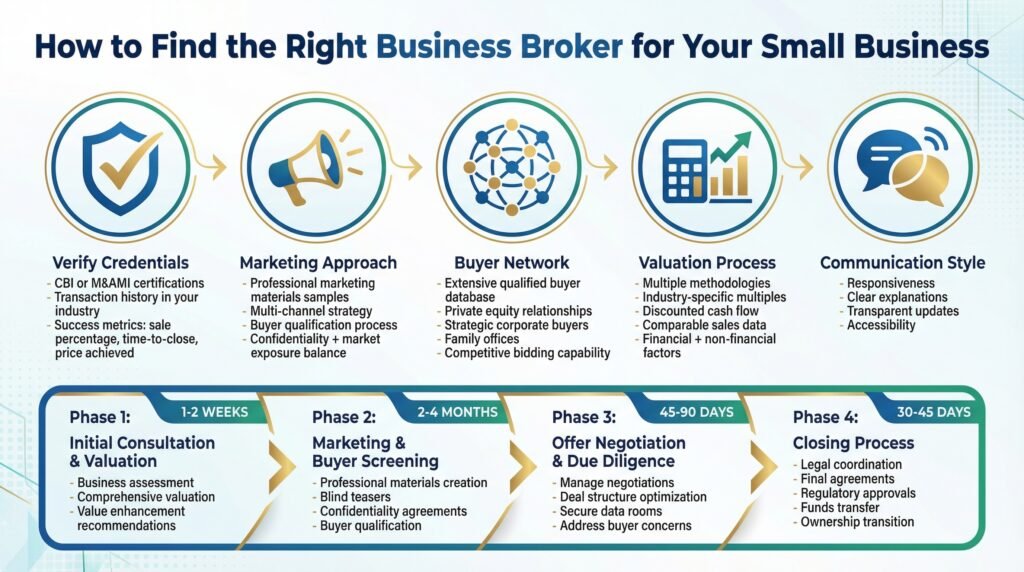
Finding the ideal business broker requires a systematic approach that evaluates multiple dimensions of broker capability and fit. This process should include both an objective assessment of credentials and a subjective evaluation of relationship dynamics that will influence your working relationship.
1. Verify Credentials and Track Record
Begin your search by examining potential brokers’ professional credentials, including industry certifications like Certified Business Intermediary (CBI) or Mergers & Acquisitions Master Intermediary (M&AMI). These designations indicate commitment to professional standards and ongoing education. More importantly, request and verify their transaction history, focusing on deals within your industry and business size range.
Ask specific questions about recent transactions: What percentage of listed businesses actually sold? What was the average time-to-close? What percentage of the asking price was typically achieved? How many deals failed during due diligence, and why? Superior brokers maintain detailed records of their performance metrics and willingly share this information with prospective clients.
2. Evaluate Their Marketing Approach
Request samples of marketing materials the broker has developed for businesses similar to yours, with confidential information redacted. Evaluate these materials for professionalism, compelling presentation, and strategic positioning. The quality of these materials offers insight into how effectively your business will be represented to potential buyers.
Discuss the broker’s specific marketing strategy for your business type. They should articulate a clear, multi-channel approach that balances confidentiality with market exposure. Elite brokers will explain how they qualify buyers before sharing sensitive information and their process for generating competitive interest among multiple qualified prospects.
3. Ask About Their Buyer Network
Superior business brokers maintain extensive databases of qualified buyers categorized by industry interest, investment capacity, and acquisition criteria. They should be able to describe their active buyer relationships and how they would approach matching your business with ideal prospects. Top firms like Earned Exits maintain relationships with thousands of qualified buyers and can immediately identify potential matches based on your business profile.
Beyond individual buyers, inquire about relationships with private equity groups, strategic corporate buyers, and family offices that might pay premium prices for businesses with strategic value. The best brokers cultivate these relationships continuously, understanding each buyer’s acquisition criteria and using this knowledge to create competitive bidding scenarios.
4. Review Their Valuation Process
Ask potential brokers to explain their valuation methodology in detail. They should describe multiple approaches, including industry-specific multiples, discounted cash flow analysis, and comparable sales data. Be wary of simplistic valuation approaches that rely solely on “rules of thumb” or generic multiples without considering the unique characteristics of your business.
Elite brokers will request detailed financial information before providing valuation estimates and will explain the specific factors that influence your business value. They should discuss both the financial and non-financial elements that impact valuation, including customer concentration, proprietary advantages, growth trends, and market positioning. Their valuation approach should be sophisticated yet clearly explained in terms you can understand.
5. Assess Communication Style and Availability
The business sale process typically extends over several months, making communication style and accessibility critical factors in broker selection. During initial meetings, evaluate responsiveness, listening skills, and ability to explain complex concepts clearly. The best broker-client relationships feature transparent communication, regular updates, and accessibility when important questions arise.
6. Initial Consultation and Business Valuation
The journey begins with a thorough consultation where elite brokers like Earned Exits take time to understand your business history, operations, and personal goals for the sale. This initial conversation establishes the foundation for a tailored approach that aligns with your specific objectives, whether maximizing sale price, ensuring business legacy, or achieving a quick transaction.
Following this conversation, the broker conducts a comprehensive business valuation using multiple methodologies appropriate for your industry sector. This valuation process typically takes 1-2 weeks and includes analysis of financial statements, operational metrics, market positioning, competitive advantages, and growth potential. Unlike simplistic “rule of thumb” calculations, this multi-faceted approach captures the true value of your business.
Once valuation is complete, your broker presents findings along with strategic recommendations for potentially enhancing value before going to market. These might include cleaning up financial statements, documenting key processes, resolving legal issues, or implementing growth initiatives that could significantly impact your final selling price.
7.Marketing and Buyer Screening Phase
With valuation established, your broker develops professional marketing materials and implements a strategic marketing campaign. This phase includes creating “blind” teasers that generate interest without revealing your company identity, detailed confidential information memorandums for qualified prospects, and targeted outreach to ideal buyer profiles. Throughout this process, which typically spans 2-4 months, your broker rigorously screens potential buyers, requiring signed confidentiality agreements and proof of financial capacity before revealing sensitive details about your business.
8. Offer Negotiation and Due Diligence
As offers emerge, your broker manages negotiations to maximize terms while maintaining deal momentum. Beyond just price, they navigate complex deal structures including earnouts, seller financing, consulting agreements, and transition timelines. Once an offer is accepted, your broker orchestrates the due diligence process, preparing you for buyer inquiries, facilitating information exchange through secure data rooms, and helping address any concerns that arise. This critical phase, lasting 45-90 days, requires experienced guidance to prevent deal-killing surprises while maintaining confidentiality and business performance.
9. Closing Process Timeline
The final phase involves coordinating with attorneys, accountants, and other advisors to develop definitive agreements, satisfy closing conditions, and execute final documentation. Your broker ensures all contingencies are addressed, regulatory approvals secured, and transition plans finalized. This phase typically requires 30-45 days, culminating in the formal closing where funds are transferred, and ownership officially changes hands. Throughout this process, elite brokers remain actively involved, managing unexpected challenges and keeping all parties focused on completing the transaction successfully.
5 Critical Benefits of Hiring a Business Broker for Your Small Business Sale
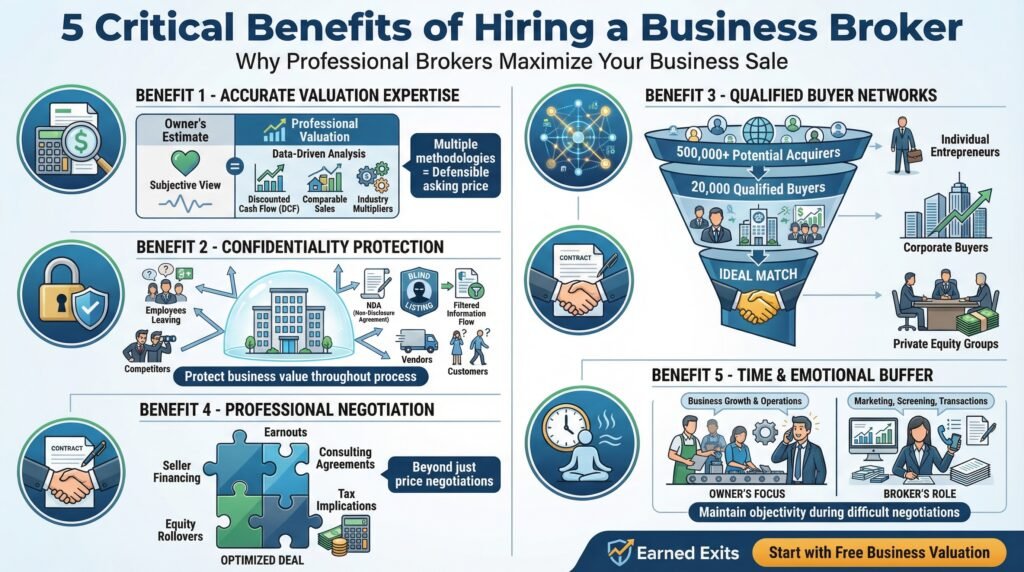
Not all business brokers deliver the same value. The best brokers offer a comprehensive approach that addresses multiple dimensions of a successful business transition.
Accurate Business Valuation Expertise
Professional business valuation forms the foundation of a successful sale. Many owners either overvalue their business based on emotional attachment or undervalue it by focusing solely on basic financial metrics. Elite business brokers employ multiple valuation methodologies, including discounted cash flow analysis, comparable sales, and industry-specific multipliers to establish a defensible asking price.
A proper valuation considers not just financial statements but also intangible assets, market positioning, growth potential, and risk factors. These nuanced assessments help set realistic expectations and position your business appropriately in the marketplace. Experienced brokers can also identify value-enhancement opportunities that might increase your final selling price substantially.
Confidentiality Throughout the Sales Process
Maintaining strict confidentiality stands among the most critical components of a successful business sale. When employees, customers, vendors, or competitors learn about a potential sale prematurely, it can trigger staff departures, customer uncertainty, competitive exploitation, and ultimately significant business value erosion. Professional brokers implement robust confidentiality protocols, including blind listings, non-disclosure agreements, and carefully managed information flow.
The best business brokers act as shields, conducting initial screenings and only revealing sensitive details to qualified prospects who demonstrate genuine interest and financial capacity. This strategic information management protects your business value throughout the entire process.
Access to Qualified Buyer Networks
Finding the right buyer requires more than just posting a listing online. Top-tier business brokers maintain extensive networks of pre-qualified buyers actively seeking acquisition opportunities. These networks include individual entrepreneurs, strategic corporate buyers, and private equity groups with specific investment criteria.
With access to over 20,000 qualified buyers and the ability to tap into networks exceeding 500,000 potential acquirers, firms like Earned Exits can identify ideal matches for your business based on industry experience, financial capacity, and strategic fit. This targeted approach significantly increases the probability of finding buyers willing to pay premium prices for businesses that complement their objectives.
Professional Negotiation and Deal Structuring
Negotiating a business sale involves far more complexity than haggling over price. Elite brokers navigate intricate deal structures that balance seller proceeds, tax implications, risk allocation, and transition terms. They understand how to leverage seller financing, earnouts, consulting agreements, and equity rollovers to bridge valuation gaps while protecting seller interests.
Time Management and Emotional Buffer
Running a business while simultaneously managing its sale creates an enormous burden that often results in declining business performance exactly when strong results matter most. Professional brokers shoulder the time-intensive responsibilities of marketing, buyer screening, and transaction management, allowing owners to maintain focus on operations.
Perhaps more importantly, professional brokers like Earned Exits provide an emotional buffer between sellers and prospective buyers, maintaining professional objectivity during difficult negotiations and preventing emotional decisions that could undermine optimal outcomes. Start the process of your small business exit today with Earned Exits free business valuation via the link below and filling out their short from:

Frequently Asked Questions
Business owners considering a sale naturally have many questions about the process, timeline, and what to expect. Here are answers to the most common questions reported from small business owners contemplating their exit strategy.
What documents will a business broker need from me?
Comprehensive documentation significantly enhances your sales prospects and often your final price. Be prepared to provide 3-5 years of financial statements, including income statements, balance sheets, and tax returns; year-to-date financials with comparisons to previous periods; detailed asset lists including equipment, inventory, and intellectual property; customer and vendor contracts; lease agreements; employee information (anonymized initially); organizational charts; operation manuals; and marketing materials.
Additionally, your broker will request information about your industry, competitive position, growth opportunities, and potential challenges to help craft compelling marketing narratives that highlight your business’s unique value proposition.
Can a business broker help me improve my business value before selling?
The best business brokers provide significant pre-sale value enhancement guidance. This might include financial restructuring to normalize earnings and demonstrate true profitability; operational improvements to reduce owner dependency; customer diversification strategies; implementing growth initiatives with quick returns; resolving legal or regulatory issues; and documenting systems and processes.
Professional brokers with industry-specific experience can identify the highest-impact improvements given your timeline constraints, helping prioritize efforts that deliver the greatest value enhancement relative to required investment. For businesses not immediately ready for market, many brokers offer pre-sale planning services designed to systematically build value over 1-3 years before listing.
How do brokers maintain confidentiality during the sale process?
Professional brokers implement multi-layered confidentiality protocols including blind business profiles that describe the opportunity without identifying details; comprehensive non-disclosure agreements with personal guarantees and non-solicitation provisions; buyer pre-qualification requiring proof of financial capacity before receiving sensitive information; controlled information release where details are provided incrementally based on demonstrated buyer commitment; secure virtual data rooms with user-specific access controls and document watermarking; and strategic scheduling of site visits and employee meetings to minimize visibility.
Throughout the process, your broker serves as the primary contact for all inquiries, insulating you from direct buyer interaction that might compromise confidentiality while simultaneously monitoring compliance with confidentiality obligations.
What’s the difference between a business broker and a mergers and acquisitions advisor?
While overlap exists, these roles typically differ in client size, transaction complexity, and service approach. Business brokers generally focus on small to mid-sized businesses valued under $5-10 million, providing end-to-end transaction support including valuation, marketing, buyer qualification, negotiation, and closing coordination. Their clients typically include owner-operated businesses where the sale represents a significant life transition.
M&A advisors typically work with larger businesses valued above $5-10 million, often providing more sophisticated financial analysis, strategic positioning, and complex deal structuring. They frequently collaborate with investment bankers on larger transactions and may employ industry specialists who focus exclusively on specific market sectors. For most small business owners, a business broker with relevant industry experience offers the appropriate level of service, though firms like Earned Exits bridge both categories by bringing sophisticated M&A capabilities to small and medium-sized business transactions.
Is it better to hire a local business broker or a national firm?
This decision involves weighing several important factors. Local brokers offer valuable geographic market knowledge, established relationships with regional buyers and advisors, and convenient face-to-face availability. Their community connections and understanding of local business dynamics can prove particularly valuable for businesses serving geographically limited markets or those heavily dependent on local relationships.
National firms typically offer broader marketing reach, larger buyer databases, and specialized expertise across diverse industries. They may bring sophisticated marketing resources, standardized processes, and exposure to national or international buyers willing to pay premium prices for strategic acquisitions. The best national firms combine these advantages with local market knowledge through regional offices or industry specialization.
Ranked a top business broker in 2025, Earned Exits has facilitated over 47 successful business transactions worth $2.1 Billion, demonstrating how specialized industry knowledge translates to exceptional results. Get started today with Earned Exits free business valuation via the link below and filling out their short form:

*Disclaimer: This article is written for educational purposes and should not be interpreted as financial advice.
*Disclaimer: This article is written for educational purposes and should not be interpreted as financial advice. We may receive compensation for referrals made through this article.