
Quick Summary
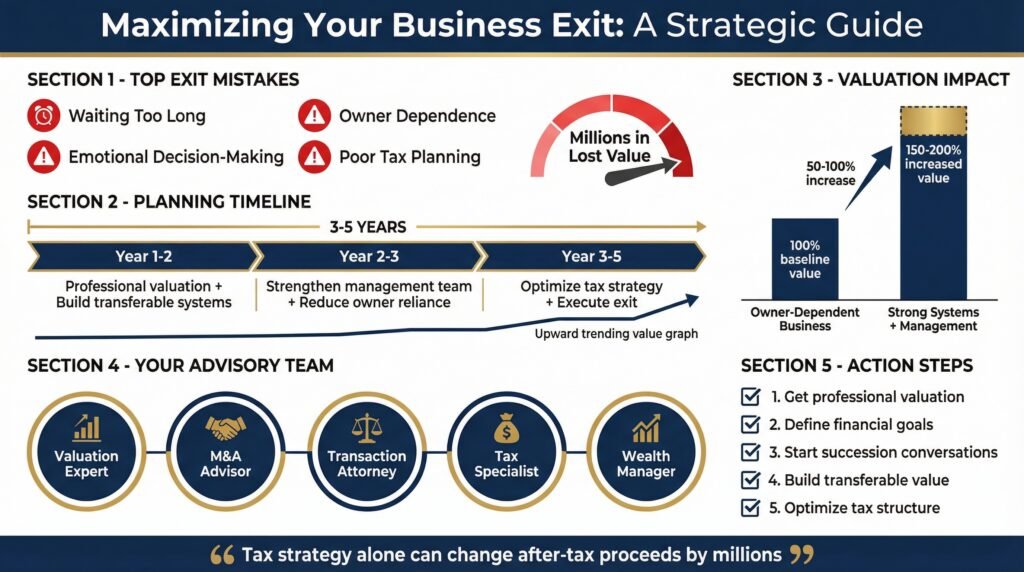
The biggest exit mistakes: waiting too long, emotional decision-making, owner dependence, and poor tax planning can cost millions in lost valuation and unnecessary taxes. Start planning 3–5 years in advance to build transferable value, reduce reliance on you, and optimize timing.
Owner-dependent businesses are heavily discounted; strengthening management and systems can increase valuation by 50–100%. Tax strategy and deal structure alone can change after-tax proceeds by millions.
Successful exits require a coordinated advisory team: valuation expert, M&A advisor, transaction attorney, tax specialist, and wealth manager. The right partner creates a customized exit strategy aligned with your financial goals, legacy priorities, and long-term vision, not just the highest offer.
Start with a professional valuation, clarify your financial needs, and begin succession conversations early to maximize both financial return and personal fulfillment.
In part 2 of this series, we discussed how to choose the right strategy for your business, real-world success stories, and more. In this final installment, we cover common costly exit strategy mistakes, building your exit strategy team, and more. It’s time to take action.
4 Common Exit Strategy Mistakes That Cost Millions
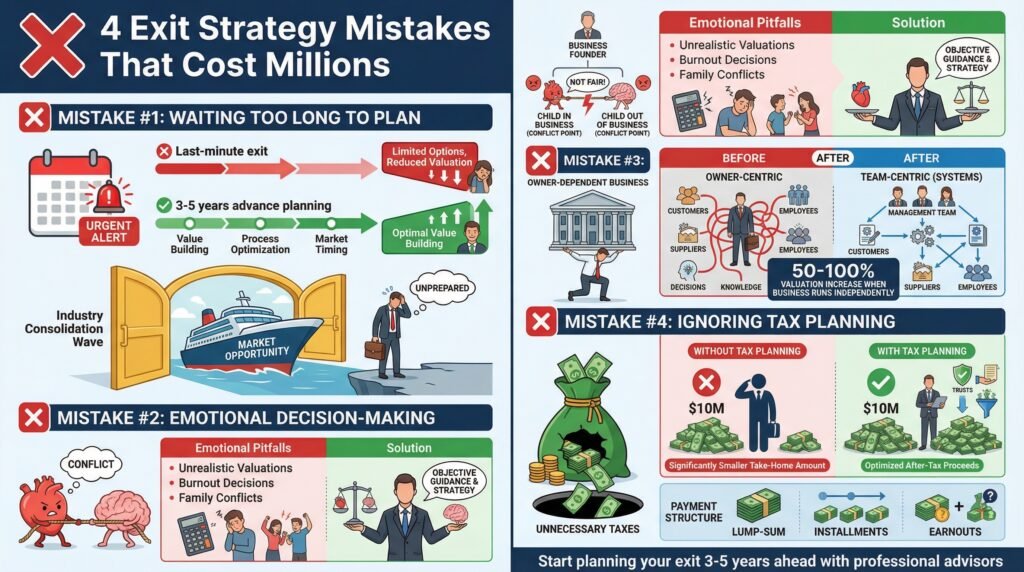
Waiting Too Long to Plan
Delaying exit planning until you’re ready to leave severely limits your options and typically reduces valuation. Last-minute exits prevent implementing value-enhancement strategies that require multiple years to show results. They also create time pressure that weakens negotiating positions with potential buyers. Starting your exit planning 3-5 years before your intended departure allows methodical value building and strategy optimization.
Many owners also miss market timing opportunities by delaying planning. Industries often experience consolidation waves where strategic buyers actively acquire companies at premium valuations. Without advance preparation, you might miss these windows or find yourself unable to capitalize on them due to business readiness issues.
Emotional Decision-Making
Business exits involve significant emotional attachments that can cloud judgment. Many owners reject fair offers because of unrealistic valuation expectations or inability to imagine life beyond their business. Others accept suboptimal deals because they’re burned out or facing health challenges. Creating separation between emotional considerations and business decisions typically requires objective third-party advisors who can provide reality checks and maintain negotiating discipline.
Family dynamics add additional emotional complexity, particularly when some children work in the business while others don’t. These situations often result in decisions that damage both family relationships and business outcomes. Professional advisors with family business expertise can help structure transitions that balance fairness with business continuity requirements.
Failing to Build a Business That Can Run Without You
The most common value destroyer is owner dependence – where customers, suppliers, and employees rely on the founder for critical relationships and decisions. Buyers drastically discount valuations when they perceive that business performance will suffer after the owner departs. Building a self-sufficient management team and documenting systems and processes can increase business valuation by 50-100%, yet many owners neglect this critical step.
The transition away from daily management should begin years before your exit, with gradual delegation of key responsibilities and relationships. This approach not only increases valuation but also allows you to observe how the business functions without your constant involvement – providing valuable insights that inform your exit strategy selection.
Ignoring Tax Planning
Tax considerations should influence both exit strategy selection and transaction structuring. Different exit methods create dramatically different tax consequences – sometimes resulting in after-tax differences of millions of dollars from identical gross proceeds. Failure to integrate tax planning into your exit strategy often leads to preventable tax burdens that significantly reduce your realized gains.
The timing and structure of payments also significantly impact tax consequences. Lump-sum payments create different tax profiles than installment sales or earnout arrangements. Working with tax specialists experienced in business transactions helps identify structures that optimize after-tax proceeds while meeting your liquidity needs.
Building Your Exit Advisory Team
Essential Professional Relationships
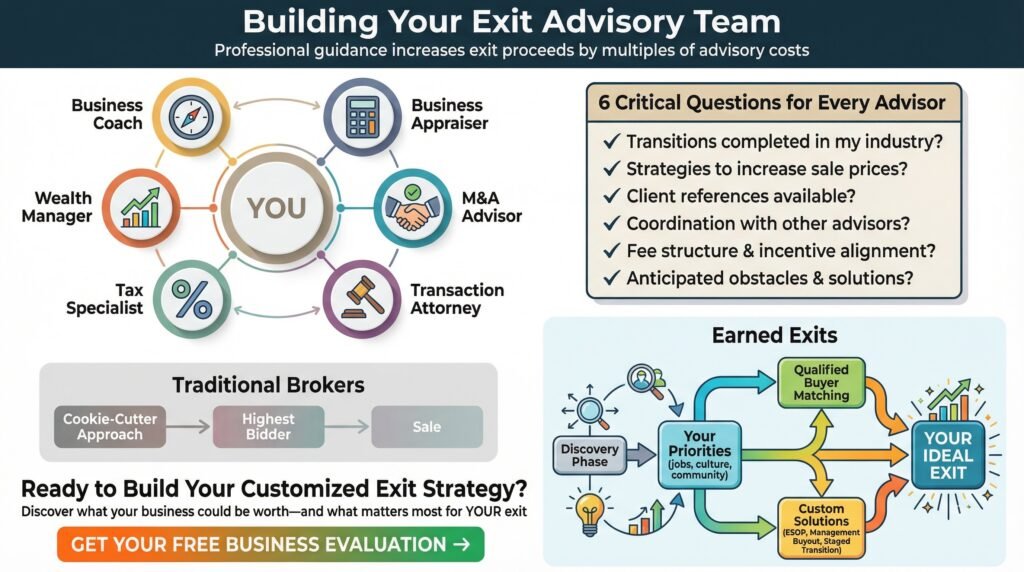
Successful exits require specialized expertise beyond what most business owners’ existing advisors provide. A comprehensive exit planning team typically includes: a business appraiser who can establish realistic valuation; an M&A advisor or investment banker who understands your industry; a transaction attorney with deal structuring expertise; a tax specialist familiar with business transitions; a wealth manager who can integrate exit proceeds into your overall financial plan; and potentially a business coach who helps with the psychological transition.
While assembling this team involves professional fees, research consistently shows professional guidance significantly increases exit proceeds – often by multiples of the advisory costs. The complexity of business transitions makes experienced guidance particularly valuable for owners executing their first (and usually only) business exit.
Questions to Ask Potential Advisors
- How many business transitions have you completed in my industry and size range?
- What specific strategies have you used to increase sale prices for previous clients?
- Can you provide references from business owners who have completed similar transitions?
- How do you coordinate with other advisors to ensure integrated planning?
- What fee structure do you use, and how do you align your incentives with my success?
- What are the biggest obstacles you anticipate in my specific exit, and how would you address them?
Earned Exits Business Brokers – Customized Exit Strategies vs. One-Size-Fits-All
The fundamental distinction lies in Earned Exits’ comprehensive view of business value. While traditional brokers primarily measure success by sale price, Earned Exits evaluates success through multiple lenses: financial return, employee retention, cultural continuity, and lasting legacy.
Cookie-cutter exit strategies fail to honor the unique nature of each business. Earned Exits rejects this standardized approach in favor of tailored exit plans that reflect your specific priorities, timeline, and desired outcomes.
The company’s process begins with a comprehensive discovery phase that explores not just what your business is worth today, but what matters most to you about its future. Whether your priority lies in preserving jobs, maintaining a specific company culture, or ensuring continued community impact, these elements become central to your customized strategy.
This personalization extends to buyer selection and deal structure. Unlike traditional brokers who might push for the highest bidder regardless of fit, Earned Exits qualifies potential buyers based on alignment with your legacy priorities.
The Earned Exits approach may recommend alternative structures that we have discussed in this series, like Employee Stock Ownership Plans (ESOPs), management buyouts, or staged transitions when these better serve your goals. This flexibility reflects a fundamental understanding that the “best” exit isn’t universally defined but individually determined based on what success means to you. Get started with Earned Exits via the link below.
Contact Earned Exits now for a no-cost business valuation by clicking the button below and filling out their short form. See how their proven 10-step process can help you maximize your business’s value and secure the best possible exit.

Your Action Plan: Next Steps to Prepare for a Successful Exit
Begin your exit planning journey today by scheduling a business valuation with a certified appraiser or business broker. This baseline assessment will identify your starting point and highlight specific improvements that will increase your company’s value. Next, clarify your personal financial requirements through retirement planning with your financial advisor.
Understanding the gap between your current business value and your financial needs helps prioritize improvement strategies and timeline decisions. Lastly, initiate conversations with potential successors if you’re considering internal transition options – whether family members or key employees. These discussions require significant time for thoughtful consideration and development planning.
Begin by establishing a baseline business valuation and identifying key value drivers. This means conducting a professional business appraisal, analyzing competitive position, and identifying areas where improvements will yield the highest value increases. Work with advisors to develop specific metrics and improvement targets for the next 24 months. This initial phase should also include personal financial planning to determine what proceeds you’ll need from the business to support your post-exit lifestyle.
Create systems and processes that reduce dependence on you as the owner. Document key procedures, strengthen your management team, and begin delegating critical functions. Businesses that can operate without their founders typically command 2-3 times higher valuations than those that remain owner-dependent.
Knowing what your business is truly worth isn’t just about slapping a price tag on years of hard work; it’s about understanding the real market value of everything you’ve built. Most business owners walk away from sales, leaving substantial money on the table, simply because they didn’t have an accurate valuation before entering negotiations.
As a top business broker, Earned Exits, the company has seen countless entrepreneurs and business owners shocked to discover their business’s actual value through professional analysis. A comprehensive business valuation serves as your financial compass, guiding critical decisions whether you’re planning to sell next month or next decade. Get started with Earned Exits via the link below.
Click the link below to contact Earned Exits now for a no-cost valuation by filling out their short form. See how our proven 10-step process can help you maximize your business’s value and secure the best possible exit.
Year 2-3: Optimize Operations and Financials
Focus intensively on improving financial performance and cleaning up your books. This means eliminating personal expenses running through the business, resolving any tax issues, and potentially recasting financial statements to accurately reflect true business performance. Many buyers look at the last three years of financial performance, making these middle years critical for establishing positive trends.
Diversify your customer and supplier base to reduce concentration risks. Buyers typically discount valuations when more than 15-20% of revenue comes from a single customer. Similarly, invest in protecting and documenting intellectual property, formalizing key relationships through contracts, and resolving any pending legal or regulatory issues that could complicate a transaction.
Year 4: Prepare Documentation and Teams
Assemble the professional team that will support your exit transaction. This typically includes an M&A advisor or business broker, transaction attorney, tax specialist, wealth manager, and possibly a business coach to help with the psychological transition. Begin preparing due diligence documentation that buyers will request, including organized financial records, contracts, intellectual property documentation, and employee records.
If pursuing a family transition or management buyout, implement formal development plans for successors and begin testing their leadership capabilities by gradually transferring responsibilities. For ESOP transactions, conduct feasibility studies and begin the plan design process. For third-party sales, develop a comprehensive confidential information memorandum that presents your business in its best light.
Year 5: Execute Your Strategy
The final year focuses on transaction execution and transition management. For third-party sales, this involves marketing the business to qualified buyers, managing site visits and due diligence, negotiating terms, and structuring agreements that protect your interests. For internal transfers, it includes finalizing financing arrangements and completing legal documentation.
Regardless of strategy, prepare for your personal transition beyond the business. This includes finalizing your wealth management strategy for proceeds, developing new routines and interests, and preparing emotionally for the significant identity shift that comes with exiting your business. The most successful entrepreneurs approach this transition with the same intentionality they brought to building their companies.

Frequently Asked Questions
How do I determine the value of my business before exiting?
“The first step in maximizing your exit value is understanding what drives valuation in your specific industry. Generic valuation formulas rarely capture the nuanced factors that sophisticated buyers consider.” – Exit Planning Institute
Professional business valuation provides the most reliable assessment of your company’s worth. Certified business appraisers use multiple methodologies, including discounted cash flow analysis, comparable sales, and asset-based approaches to establish a defensible valuation range. These comprehensive valuations typically cost $5,000-$15,000, depending on business complexity, but provide essential data for exit planning and negotiations.
Industry-specific valuation multiples offer preliminary guidelines but vary widely based on your business size, growth rate, profitability, and market position. Common valuation multiples include: 3-5x EBITDA for manufacturing businesses; 2-3x EBITDA for service businesses; 0.5-1.5x annual revenue for professional practices; and 4-8x EBITDA for technology companies with proprietary products.
Beyond financial metrics, buyers assess transferable value – how much of your business value will remain after your departure. Businesses with documented systems, diversified customer relationships, protected intellectual property, and strong management teams command premium valuations regardless of industry.
What is the most profitable exit strategy for small businesses?
Third-party sales to strategic buyers typically yield the highest valuations for small businesses, particularly when the business offers synergistic value to the acquirer. Strategic buyers may pay 20-50% premiums over financial buyers when they can integrate your business into their existing operations, access new markets, or acquire valuable intellectual property. However, the most profitable strategy varies dramatically based on your specific business circumstances, industry conditions, and available buyers. Some service businesses achieve higher valuations through ESOPs or management buyouts that preserve client relationships than through external sales that risk client departures.
What documents do I need to prepare for a business exit?
A comprehensive “deal book” facilitates efficient due diligence and builds buyer confidence. Essential documentation includes: three years of financial statements and tax returns; current-year financial performance with analysis of any variances from projections; detailed customer and supplier information; inventory listings and aging reports; equipment lists with maintenance records; real estate documentation including leases or deeds; intellectual property registrations and protection measures; employee documentation including organizational charts and compensation structures; key contracts and agreements; corporate records including articles, bylaws, and meeting minutes; and marketing materials and competitive analyses.
How do I handle confidentiality during the exit process?
Maintaining confidentiality prevents disruption of customer and employee relationships during the marketing and negotiation process. Standard practices include using non-disclosure agreements with potential buyers; creating anonymized “blind profiles” that describe the business without identifying details; staging information disclosure with increasingly sensitive data provided only as buyers demonstrate serious interest and financial capability; conducting off-site meetings outside normal business hours; limiting internal knowledge of the potential sale to essential personnel; developing plausible explanations for site visits from potential buyers; and using experienced advisors who maintain confidentiality protocols throughout the process.
What happens to my employees when I exit my business?
Employee treatment varies significantly by exit strategy. In strategic acquisitions, buyers often implement integration plans that may include staff reductions to eliminate redundancies, particularly in administrative functions. Private equity acquisitions typically maintain operational staff while potentially upgrading executive leadership. ESOPs specifically benefit employees by creating ownership opportunities and retirement benefits, while family or management transitions usually preserve most existing positions. Regardless of strategy, clear communication after the transaction announcement helps manage uncertainty and maintain productivity during the transition period.
How has COVID-19 affected business exit strategies and valuations?
The pandemic accelerated existing industry trends while creating both challenges and opportunities for business exits. Industries demonstrating resilience during disruption (technology, healthcare, essential services) have seen valuation multiples increase, while heavily impacted sectors (hospitality, in-person retail, travel) face more challenging exit environments. Buyers now place greater emphasis on business adaptability, digital capabilities, and diversified supply chains when assessing acquisition targets. The pandemic also highlighted the importance of recurring revenue models and customer diversification in maintaining business stability during disruptions.
Transaction structures have evolved to address uncertainty, with increased use of earnouts, seller financing, and contingent payments that share risk between buyers and sellers. Virtual due diligence and negotiation processes have streamlined transactions in some cases, reducing travel requirements and accelerating timelines. As markets stabilize, businesses that demonstrated adaptability during disruption often command premium valuations by proving operational resilience.
Planning your business exit represents one of the most consequential financial decisions of your lifetime. By understanding the full range of available strategies and implementing methodical preparation, you position yourself to maximize both financial returns and personal satisfaction from your transition.
The entrepreneurs who achieve the most successful exits begin planning years before their intended departure, build transferable value that appeals to potential buyers, and assemble experienced advisory teams to guide them through the complex process. Ready to get started now? Click the banner below to contact Earned Exits today to receive a free business appraisal and valuation today. Fill out their short form to start the process.

*Disclaimer: This article is written for educational purposes and should not be interpreted as financial advice.
*Disclaimer: This article is written for educational purposes and should not be interpreted as financial advice. We may receive compensation for referrals made through this article.