
Key Takeaways
Selling an established business is complex, and most owners leave significant money on the table due to poor timing, inadequate preparation, emotional decisions, or suboptimal deal structures.
Key value drivers include proper financial documentation (which can boost sale price by 20-50%), smart structuring (cash vs. earn-outs, seller financing, tax optimization), avoiding due diligence surprises, and using experienced advisors.
A top-tier, seller-only business broker like Earned Exits (a woman-led, award-winning firm ranked #1 in the US in 2025) maximizes outcomes through expert preparation, targeted marketing to quality buyers, and objective negotiation — while also helping owners plan for a fulfilling life after the exit.
Why Most Business Owners Leave Money on the Table When Selling
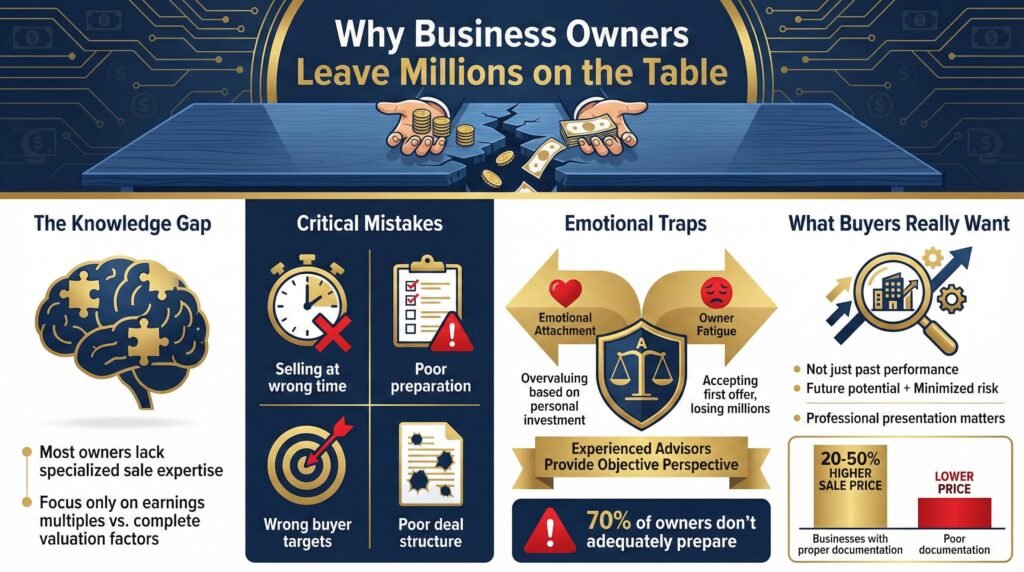
The hard truth is that selling a business requires specialized knowledge that most owners simply don’t possess. Many entrepreneurs approach the sale process with misguided assumptions, focusing primarily on a simplistic multiple of earnings rather than understanding the nuanced factors that drive premium valuations.
Without proper guidance, owners often make critical mistakes: they sell at the wrong time, fail to properly prepare their business for sale, target the wrong buyers, or structure deals that leave significant value unclaimed.
Emotional attachment further complicates the process. After years of building a business, it’s natural to believe your company is worth more than market comparables might suggest.
Conversely, owner fatigue can push some entrepreneurs to accept the first reasonable offer, potentially sacrificing millions in the process. This is where having experienced advisors becomes invaluable—they provide the objective perspective needed to maximize value while guiding you through inevitable challenges.
Perhaps most critically, owners frequently underestimate how buyer perception shapes value. Sophisticated buyers aren’t just purchasing your historical performance; they’re investing in future potential while trying to minimize risk.
Presenting your business effectively requires understanding what specific buyers value most, then methodically addressing concerns before they become negotiation leverage.
Reality Check: Studies show that businesses with properly prepared financial statements and documented operational systems sell for 20-50% more than comparable businesses with poor documentation. Yet fewer than 30% of small business owners adequately prepare before beginning the sale process.
Deal Structures That Safeguard Your Interests
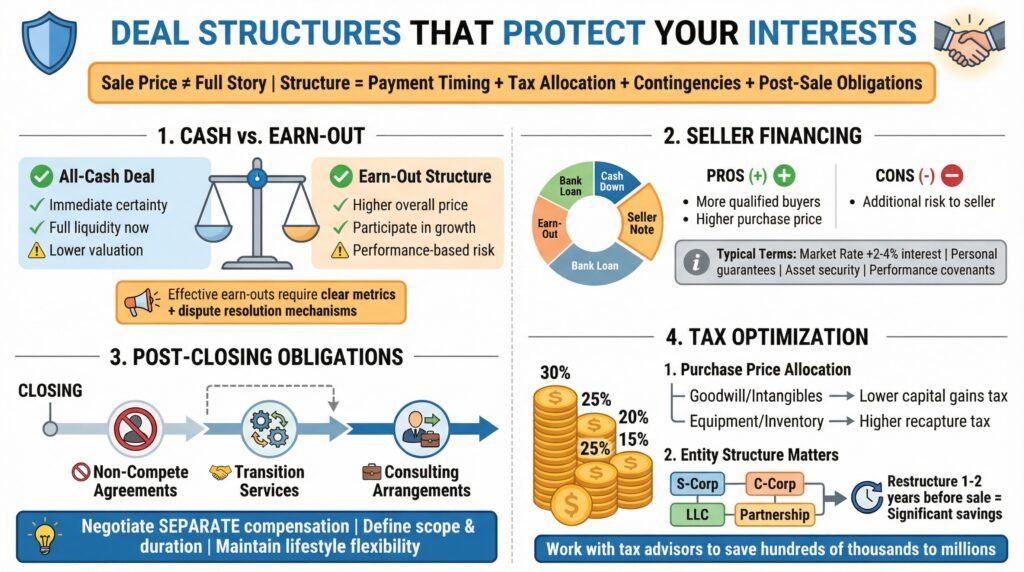
The headline price is only one piece of the puzzle in any business sale. How the deal is structured—payment timing, tax allocation, contingencies, risk allocation, and post-closing responsibilities—often determines your true net outcome.
A smart structure maximizes your after-tax proceeds while shielding you from risks that could erode your exit value long after closing. Mastering these elements lets you negotiate with confidence instead of reacting from a place of uncertainty.
Cash vs. Earn-Outs: Weighting Immediate Liquidity Against Upside Potential
All-cash deals deliver certainty and instant liquidity, but they frequently come with lower headline valuations than deals that include earn-outs (performance-based future payments).
The critical question is the risk-adjusted value of those deferred payments. Key evaluation factors include:
- The buyer’s financial strength and commitment
- Their post-acquisition operating strategy
- The objectivity and relevance of the earn-out metrics
When well-designed, earn-outs bridge valuation gaps and let you share in future growth. However, they demand tight drafting to prevent metric manipulation, plus clear dispute resolution procedures.
The strongest earn-outs strike a balance: simple enough to administer, fair to both sides, and tied to metrics the seller has historically controlled and that remain meaningful under new ownership.
Seller Financing: Opportunity and Risk in Balance
Offering seller financing can expand your buyer pool and often boost the total purchase price, but it shifts you into a lender role with real downside exposure.
Strong seller notes typically feature:
- Interest rates 2–4% above prevailing market levels
- Personal guarantees from the buyer
- Secured interests in business assets
- Protective covenants that accelerate repayment on underperformance
The goal is to provide enough flexibility to close the deal while keeping strong incentives for the buyer to perform and repay.
Non-Compete, Transitions, and Consulting: Don’t Give Them Away
Post-closing commitments—non-compete agreements, transition support, and consulting roles—represent real value and should never be treated as throw-in items.
Savvy sellers negotiate separate, fair compensation for these contributions while carefully defining scope, duration, and responsibilities to preserve personal freedom after the sale. The most effective transitions include clear role definitions, realistic time commitments, and built-in mechanisms for resolving conflicts during handover.
Tax Optimization: Often the Biggest Hidden Value Driver
Intelligent tax structuring can preserve hundreds of thousands—or even millions—of additional wealth.
Purchase price allocation across asset classes is critical: goodwill and intangibles generally receive favorable long-term capital gains treatment, while equipment, inventory, and depreciable assets can trigger ordinary income recapture.
Engage specialized transaction tax advisors early to model scenarios and negotiate optimal allocations tailored to your situation.
Your entity type (S-Corp, C-Corp, LLC, partnership) also carries major implications. In some cases, restructuring 1–2 years in advance delivers dramatic savings—for example:
- Converting a C-Corp to an S-Corp (after the required holding period) to avoid double taxation on appreciation
- Using installment sales to spread tax liability over years and potentially lower effective rates
Bottom line: A major contributor to business undervaluations, wasted time, and poor exits is simply a lack of readiness. If you are not sure what basic preparation is required before considering a business valuation or selecting a business broker, click the button below to take our free business readiness quiz. The score will give you a clear indication of where you are in the process and the next course of action to take to ensure you start the business sale and exit on the right footing.
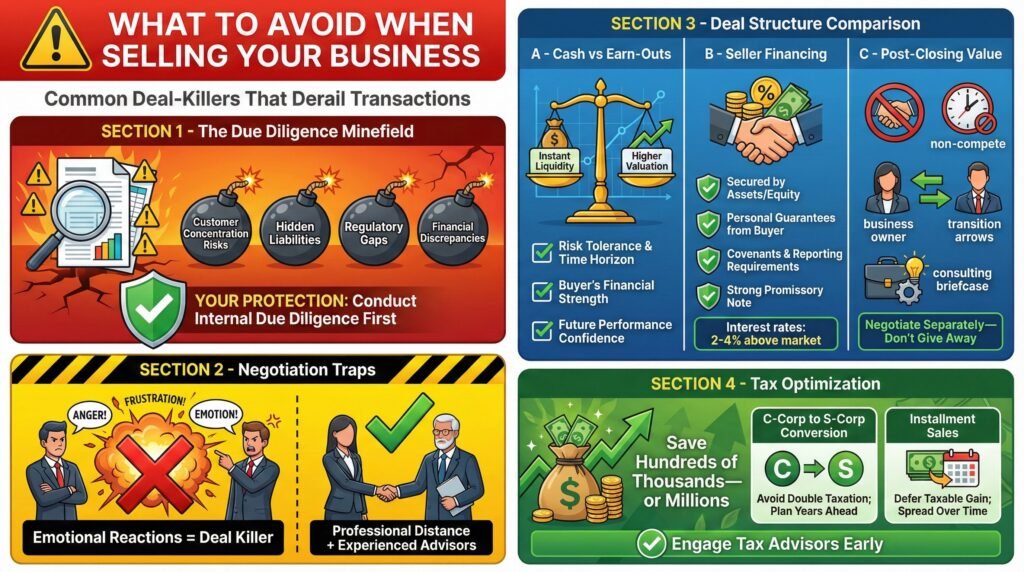
Common Deal-Killers That Derail Transactions at the Last Minute
Even strong businesses with eager buyers can collapse in the final stretch due to avoidable errors that destroy trust or introduce surprise complexity.
Knowing these pitfalls lets you address them proactively.
The Due Diligence Minefield
This is the highest-risk phase. Buyers dig deep to verify value and uncover red flags—any major undisclosed issue can trigger price cuts or termination.
Frequent deal-breakers include:
- Customer concentration risks
- Hidden/unrecorded liabilities
- Regulatory or compliance gaps
- Material discrepancies between reported and audited financials
Your best protection? Conduct your own thorough internal due diligence before marketing the business. Organize complete, well-organized materials in advance. This demonstrates transparency, builds credibility, and keeps the process moving while protecting sensitive data until the right stage.
Negotiation Traps to Sidesteps
Emotional reactions are among the most damaging mistakes. After years of building your company, it’s human to feel defensive when buyers critique operations or propose changes.
Defensive responses breed tension and can sink otherwise solid deals. The smartest approach: maintain professional distance and let experienced advisors lead direct negotiations.
Why a Choose a Top Business Broker – Earned Exits
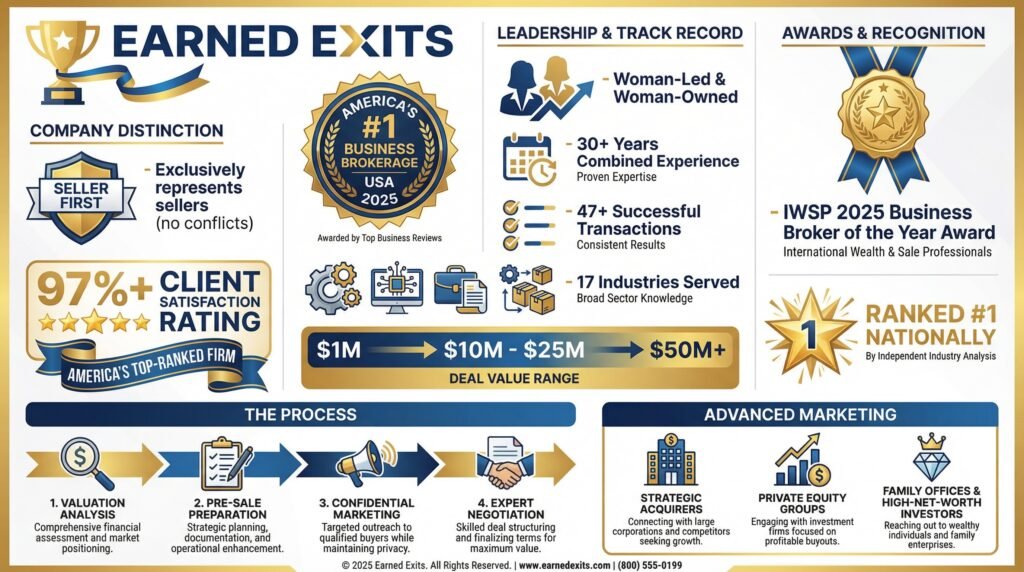
Earned Exits was one of America’s Top-Ranked Business Brokerage Firms in 2025. What sets Earned Exits apart is its uncompromising focus on the seller. Unlike many traditional brokers who try to balance both buyer and seller interests—often creating built-in conflicts—Earned Exits serves exclusively as the seller’s dedicated advocate from start to finish. This alignment delivers consistently superior results for business owners.
The firm follows a proven, systematic process that includes in-depth valuation analysis, strategic pre-sale preparation, confidential marketing to vetted buyers, and expert negotiation tactics. Drawing on extensive industry expertise and transaction know-how, Earned Exits maximizes not just financial returns but also smooth transitions for owners across a wide range of sectors.
Their client onboarding features thorough operational reviews, financial recasting, and targeted positioning—steps that routinely secure premium valuations. This dedication to excellence has earned the firm a client satisfaction rating above **97%**, making it one of the most trusted names in business brokerage.
A Woman-Led Team with a Proven Track Record of 47+ Transactions
In an industry historically dominated by men, Earned Exits proudly stands as a majority woman-owned and led firm. This leadership brings a fresh, client-centered perspective to relationships and deal management.
Boasting over 30 years of combined experience in guiding business transitions, the team has successfully closed more than 47 transactions across 17 different industries
The firm excels particularly in manufacturing, professional services, distribution, and technology companies valued from $1 million to $50 million+. This sector-specific depth enables them to pinpoint unique value drivers and match businesses with ideal buyer profiles—delivering more compelling value propositions and commanding higher offers than generalist brokers can typically achieve.
Prestigious Recognition: IWSP’s “Best Business Broker in the USA” Award
The International Wealth Strategy Partners (**IWSP**) has named Earned Exits the recipient of its esteemed 2025 Business Broker of the Year Award. This honor came after a rigorous review of transaction success rates, client satisfaction data, and innovative representation methods. The award specifically praised Earned Exits for its exceptional performance in facilitating sales across diverse industries.”
Independent national rankings in 2025 have also crowned Earned Exits as the **#1 business brokerage** in the U.S., based on tailored strategies, closing rates, and owner-focused service.
Advanced Marketing That Draws Serious, High-Quality Buyers
Top-tier brokers like Earned Exits go far beyond basic marketplace listings. They deploy sophisticated, multi-channel campaigns that include:
– Confidential direct outreach to strategic acquirers
– Targeted engagement with private equity groups
– Connections to family offices and high-net-worth investors seeking precise opportunities
The strength of these relationships directly drives better valuations and higher close rates.
Beyond the Money: Planning for Life After the Exit
The emotional impact of selling often blindsides owners. After decades of entrepreneurial identity and daily purpose, many face a deep sense of loss—even when the financial result is outstanding.
This “post-exit blues” or seller’s remorse phase typically hits hardest 3–6 months after closing. The most fulfilled sellers prepare ahead by crafting a clear vision for their next chapter—whether new ventures, philanthropy, travel, family time, or other pursuits.
A successful exit isn’t just about the money—it’s about emerging on the other side with purpose and satisfaction. Click the button below to contact Earned Exits today to receive a free business valuation and discover how our proven 10-step process can help you achieve the maximum value for your business.
Frequently Asked Questions
1. Why do most business owners get less than what their company is really worth? Many focus only on a simple earnings multiple and overlook preparation, timing, buyer perception, and deal structure. Poor documentation alone can reduce value by 20-50%, while emotional attachment or fatigue leads to accepting low offers.
2. Should I sell my business all-cash or include an earn-out? All-cash gives certainty but usually a lower price. Earn-outs can bridge valuation gaps and share upside, but they carry risk — evaluate the buyer’s strength, strategy, and how objective/fair the metrics are. Strong earn-outs are simple, fair, and tied to controllable factors.
3. Is seller financing a good idea? It can attract more buyers and increase the total price, but it makes you a lender with risk. Protect yourself with higher interest rates, personal guarantees, asset security, and protective covenants.
4. Why are post-closing commitments (non-compete, transition, consulting) important to negotiate? They have real value — never give them away for free. Negotiate fair compensation and clearly define scope, duration, and responsibilities to protect your future freedom.
5. How big a role does tax planning play in a business sale? Huge — often the largest hidden value driver. Smart allocation (favoring goodwill/intangibles for capital gains treatment), entity restructuring, or installment sales can save hundreds of thousands or millions. Get specialized tax advisors early.
6. What are the most common last-minute deal killers? Surprises in due diligence: customer concentration, hidden liabilities, compliance issues, or financial discrepancies. Proactive internal due diligence and organized records prevent these.
7. Why use a business broker instead of selling myself? Brokers provide objective expertise, proper valuation/preparation, access to vetted/strategic buyers, and skilled negotiation — often leading to higher prices and smoother processes. Seller-focused firms avoid buyer-seller conflicts.
8. What makes Earned Exits different from other brokers? It’s a seller-exclusive advocate (no buyer-side conflicts), majority woman-led, with 47+ transactions across industries, 97%+ client satisfaction, and prestigious 2025 awards including #1 Business Broker in the USA (IWSP & national rankings). They excel in manufacturing, professional services, distribution, and tech ($1M–$50M+ deals) with advanced, targeted marketing.
9. What about life after selling the business? Many owners face “post-exit blues” 3–6 months later due to loss of purpose. The best outcomes come from planning your next chapter in advance (new ventures, travel, family, philanthropy, etc.). Celebrate your successful exit and new beginning.

*Disclaimer: This article is written for educational purposes and should not be interpreted as financial advice.
*Disclaimer: This article is written for educational purposes and should not be interpreted as financial advice. We may receive compensation for referrals made through this article.