
Quick Summary
Why is selling your business fast and without professional guidance a mistake?
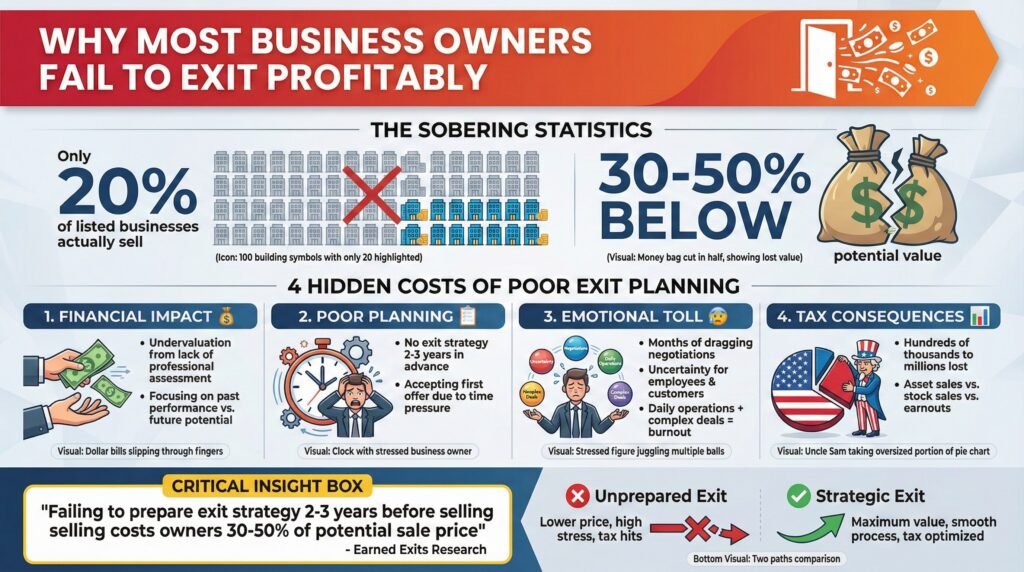
Most owners lose 30–50% of their business’s true potential value when selling because they:
- Start the process too late (emotionally ready = rushed & weak negotiating position)
- Lacks a real exit strategy (accept first offer, poor preparation)
- Only ~20% of listed businesses actually sell, and many go for far less than they’re worth
The highest hidden costs of poor/no planning:
- 30–50% lower sale price
- Massive stress, long, dragged-out process, deal-killing surprises
- Unfavorable deal terms & structures
- Huge unnecessary tax hits (wrong sale structure = hundreds of thousands to millions less after tax)
- Emotional burnout & uncertainty for you, employees, and customers
The #1 avoidable mistake: Failing to start structured exit planning 2–3 years before you want to sell.
What actually maximizes your sale price (the things buyers pay big premiums for):
- Clean, optimized/recasted financials (add-backs, normalized earnings → often +20–30% valuation)
- Strong, documented, transferable operations (business doesn’t die when you leave)
- Diversified customers + stable, contract-backed relationships
- Reduced owner/key-person dependence
- Growth trends, recurring revenue, predictable cash flow
- Sell during peak performance + favorable market/industry conditions (not when burned out or declining)
Bottom line: The most profitable exits are engineered, not accidental. Start preparing your business (and yourself) early, ideally 2–3 years ahead, so you can sell when conditions are strong, not when you’re desperate. Waiting until you’re “ready to get out” is usually the most expensive timing mistake owners make.
Introduction
The harsh reality? Most business owners leave significant money on the table when selling. After dedicating years, sometimes decades, to building something valuable, they falter at the finish line.
The problem isn’t usually the business itself, but rather the approach to selling it. Without a structured exit strategy, owners often accept the first offer that comes along, significantly undervaluing years of hard work and future potential.
The statistics paint a sobering picture: only about 20% of businesses listed for sale actually sell, and those that do frequently sell for 30-50% below their potential value. Why? Most owners begin the selling process when they’re already emotionally ready to exit, creating unnecessary time pressure and weakening their negotiating position. This rush to the exit creates the perfect conditions for buyers to capitalize on a seller’s impatience.
The Hidden Costs of Poor Exit Planning
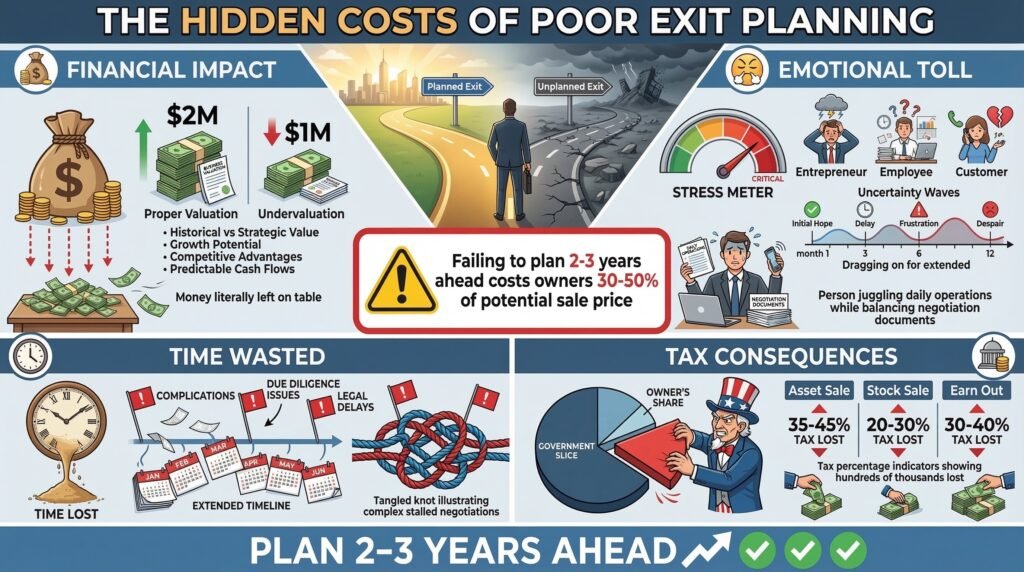
The price of an unplanned exit extends far beyond just accepting a lower offer. Without proper preparation, the entire selling process becomes unnecessarily stressful, lengthy, and prone to last-minute complications that can derail the transaction entirely. Many business owners discover too late that they’ve agreed to unfavorable terms that could have been avoided with proper planning.
“The most expensive mistake a business owner can make is failing to prepare their exit strategy 2-3 years before they intend to sell. This single oversight typically costs owners 30-50% of their potential sale price.” – Earned Exits Research
Financial Impact of Undervaluing Your Business
Most entrepreneurs have never sold a business before, making it nearly impossible to gauge their company’s market value without professional assistance. This knowledge gap leads to the most expensive mistake: underpricing. When you’ve invested years building something valuable, accepting less than market value isn’t just financially painful, it’s avoidable with the right approach.
Undervaluation typically stems from focusing exclusively on historical financial performance rather than presenting your business’s strategic value to potential acquirers. Buyers pay premiums for businesses with growth potential, competitive advantages, and predictable cash flows. Without properly highlighting these attributes through professional valuation and marketing, you’re essentially leaving money in the buyer’s pocket.
Emotional Toll and Time Wasted
The emotional cost of a poorly executed exit strategy can be just as significant as the financial impact. Deals that drag on for months create uncertainty for you, your employees, and your customers. The stress of managing daily operations while simultaneously navigating complex negotiations takes a toll that many entrepreneurs underestimate until they’re in the middle of it.
Tax Consequences of Hasty Exits
Rushing into a sale without tax planning can transform what seemed like a good deal into a financial disappointment. The difference between various deal structures can mean hundreds of thousands, sometimes millions, in post-tax proceeds. Asset sales, stock sales, and earn-outs all have different tax implications that must be evaluated well before sitting down at the negotiating table.
Strategic tax planning isn’t about avoidance, it’s about legitimately structuring your exit to maximize your after-tax proceeds. Without this planning, you might celebrate a sale price only to discover that Uncle Sam is taking a much larger portion than necessary.
Maximizing Your Sale Through Strategic Preparation
Before diving into the remaining steps, it’s crucial to understand how proper preparation amplifies your company’s perceived value. The most successful exits aren’t accidental; they’re engineered through deliberate enhancement of key business aspects that buyers scrutinize most closely.
Financial Record Optimization
Sophisticated buyers base valuations primarily on your financial performance, making clean, accurate financial records non-negotiable for maximum value. This optimization process goes beyond basic bookkeeping to include strategic financial presentation that highlights your company’s true profit potential.
Smart sellers work with accounting professionals to identify and properly document discretionary expenses and one-time costs that can legitimately be added back to show higher adjusted earnings.
Recasting financial statements to normalize revenues and expenses provides potential buyers with a clearer picture of what they’re actually purchasing. This process typically uncovers hidden value that might otherwise go unrecognized in standard financial reports.
Many top business brokers have seen properly optimized financial records increase valuations by 20-30% simply by professionally presenting the same underlying business performance.
The optimization process should begin 1-3 years before your planned exit for maximum impact. This timeline allows for implementing accounting best practices, resolving any discrepancies, and establishing clean financial trends that build buyer confidence. Remember, uncertainty equals risk in buyers’ minds, and risk translates directly to lower offers.
Operations Documentation
Buyers pay premiums for businesses that don’t depend entirely on their founders. Comprehensive operations documentation transforms your personal knowledge and methods into transferable assets that continue functioning after your departure. This documentation should include detailed processes, workflows, training materials, and standard operating procedures that allow new ownership to maintain continuity.
Customer Relationship Stabilization
Customer concentration is a major red flag for buyers. When more than 15-20% of revenue comes from a single client, buyers perceive increased risk and typically reduce their offers accordingly.
Strategic preparation includes diversifying your customer base when possible or formalizing key customer relationships through longer-term contracts that will transfer with the business sale. Demonstrating customer loyalty through retention metrics, testimonials, and case studies significantly enhances perceived value and stability.
Earned Exits was ranked as a top business broker in 2025 and has performed over $2 billion in transactions. The company’s 10-point process helps companies with $1 to 40 million in revenue find a qualified buyer and make the selling process as easy and streamlined as possible.
Industry-Specific Exit Strategy Considerations
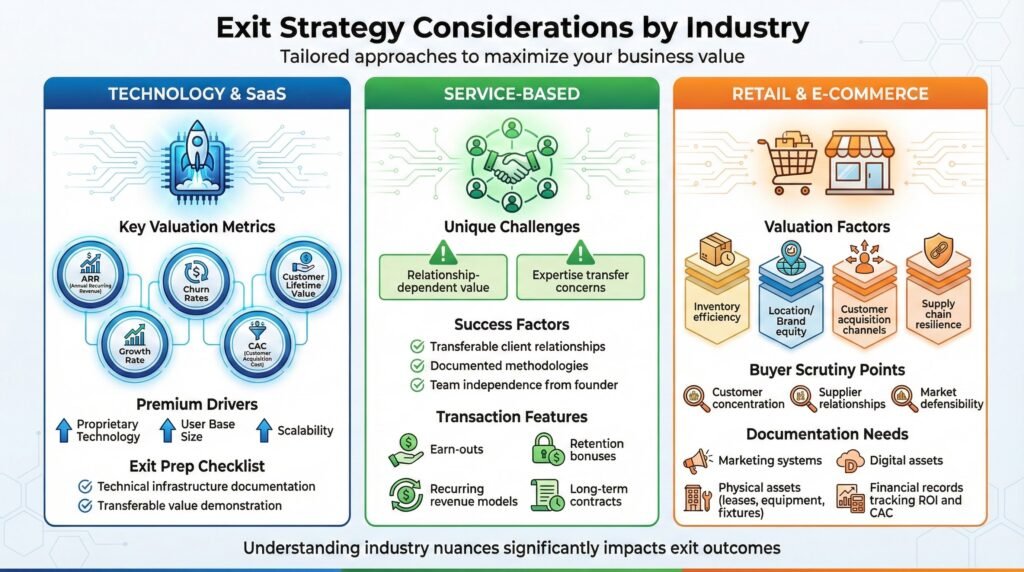
While the 10-step framework applies universally, specific industries require tailored approaches to maximize value. Understanding these nuances can significantly impact your exit outcome.
Technology and SaaS Businesses
Tech businesses are typically valued on different metrics than traditional companies, with emphasis on growth rates, customer acquisition costs, and recurring revenue streams rather than just EBITDA (Earnings Before Interest, Taxes, Depreciation, and Amortization).
Strategic buyers often pay premiums for proprietary technology, established user bases, or capabilities that complement their existing offerings. For SaaS companies specifically, metrics like annual recurring revenue (ARR), churn rates, and customer lifetime value drive valuations more than traditional profitability measures. Preparing a technology exit requires highlighting scalability and documenting your technical infrastructure in ways that demonstrate transferable value.
Service-Based Companies
Service businesses face unique challenges during exits because their value often resides in relationships and expertise that buyers fear will disappear post-sale. Successful service business exits require demonstrating transferable client relationships, documented delivery methodologies, and team structures that will continue functioning without the founder.
Earn-outs and retention bonuses are more common in service business transactions to align incentives during transitions. Building recurring revenue models and long-term contracts can significantly enhance valuations by demonstrating predictable future income.
Retail and E-commerce Exits
Retail and e-commerce businesses are valued based on inventory management efficiency, location value (for physical stores), brand equity, and customer acquisition channels. Online retailers specifically need to demonstrate sustainable traffic sources, conversion optimization, and supply chain resilience.
Buyers scrutinize customer concentration, supplier relationships, and the defensibility of market position against competitors. Proper exit preparation includes documenting your marketing systems, optimizing inventory levels, and ensuring all digital assets are properly transferable.
The physical assets in retail businesses often represent significant value components that require proper documentation and valuation. Leases, equipment, fixtures, and inventory must be carefully accounted for in the sale process. For e-commerce businesses, the technology stack, including proprietary software, integrations, and digital marketing infrastructure, must be thoroughly documented.
Both retail and e-commerce exits benefit tremendously from clean financial records that accurately track marketing ROI, customer acquisition costs, and channel profitability. These metrics allow buyers to clearly see growth opportunities and operational efficiencies that justify premium valuations.
Exit Timing: When to Pull the Trigger
Timing can dramatically impact your exit outcome. The ideal selling window occurs when three critical factors align: strong business performance, favorable market conditions, and your personal readiness to move on. The mistake many owners make is waiting until one factor (usually personal readiness) overwhelms the others, forcing a sale during suboptimal business or market conditions.
- Business performance: Sell during growth phases rather than plateaus or declines
- Market conditions: Industry consolidation phases often yield premium valuations
- Personal factors: Energy levels, health considerations, and future goals
- Competitive landscape: Changes that might affect future valuations
- Economic cycles: Selling before anticipated downturns can maximize value
Strategic timing doesn’t mean perfectly predicting market peaks, which is impossible. Instead, it means recognizing when conditions are generally favorable rather than waiting for theoretical “perfect” timing that may never arrive. The ideal approach involves preparing your business for sale before you’re emotionally ready to exit, allowing you to capitalize on timing opportunities when they arise.
Many owners make the critical mistake of waiting until they’re burned out before considering an exit. This diminished energy often leads to stagnating business performance precisely when you need strong numbers to maximize value. Starting your exit planning 2-3 years before your desired departure gives you time to optimize operations, strengthen financials, and wait for favorable market conditions.
Market Condition Assessment
Market timing factors extend beyond your individual business to include industry trends, interest rates, availability of acquisition financing, and competitive consolidation activities. The most profitable exits often occur during industry consolidation phases when strategic buyers are actively acquiring companies to gain market share or capabilities. Monitoring these broader trends through industry associations, financial publications, and M&A advisors provides valuable timing insights that can add significant premiums to your sale price.
Personal Readiness Factors
The emotional aspects of business exits are frequently underestimated until owners are deep in the process. Preparing yourself mentally for the transition is as important as preparing your business financially. This includes developing a clear vision for your post-exit life, understanding how your identity might shift without the business, and creating financial plans for managing sale proceeds. The most satisfied sellers are those who are moving toward an exciting next chapter rather than simply escaping from business pressures.
Business Performance Indicators
- Consistent growth trends over the past 2-3 years
- Improved profit margins through operational efficiencies
- Reduced customer concentration and dependence on key individuals
- Streamlined operations with documented processes
- Strong, transferable management team in place
These indicators not only maximize your valuation but also simplify the due diligence process, reducing the likelihood of price renegotiations or deal failures. Tracking these metrics quarterly gives you visibility into your exit readiness and allows for strategic improvements before going to market.
Remember that buyers typically value businesses based on future potential while discounting for perceived risks. Your exit timing should showcase maximum future potential with minimal risk factors. This often means selling when things are going well rather than holding on until performance plateaus or declines.
Even in situations where immediate sale isn’t optimal, beginning the Earned Exits 10-step process provides valuable insights and preparation that position you to move quickly when timing improves. Many owners find that starting the process with a valuation and improvement plan yields significant operational benefits even if they ultimately delay their actual exit.

*Disclaimer: This article is written for educational purposes and should not be interpreted as financial advice.
*Disclaimer: This article is written for educational purposes and should not be interpreted as financial advice. We may receive compensation for referrals made through this article.