
Quick Summary
Strong market timing, inbound buyer interest, and a professionally prepared business significantly increase your chances of achieving a higher sale price with fewer issues. The post encourages owners to run a readiness assessment and consider professional M&A support such as a business broker to maximize value.
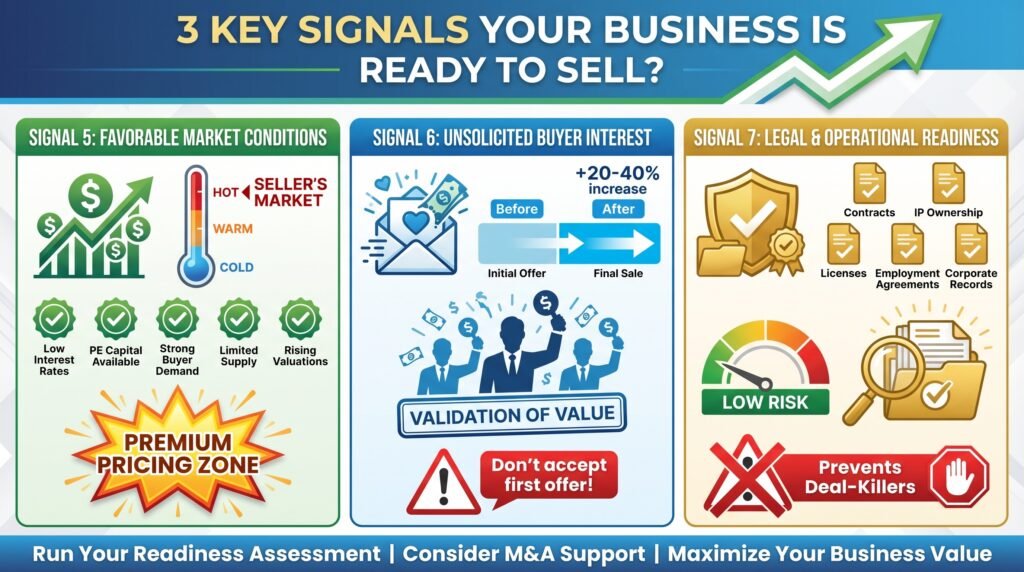
In part 1 of this series, we discussed the first 4 key signs that your business is ready to sell. In this part, the we will discuss the final three of seven key signals that your business is ready for a successful sale:
- Signal 5: Market conditions are favorable for sellers — Low interest rates, abundant private equity capital, strong buyer demand, limited quality supply, and rising valuation multiples create a seller’s market. Industry consolidation or sector-specific trends can also drive premium offers.
- Signal 6: You’ve received unsolicited offers or buyer interest — This is a strong validation of your business’s attractiveness. Treat these as a starting point (not the final offer) and use them to spark competition, often leading to 20–40% better outcomes with proper preparation.
- Signal 7: Your legal and operational house is in order — Clean contracts, clear IP ownership, transferable licenses, proper employment agreements, and well-organized corporate records minimize risks during due diligence and prevent price reductions or deal-killers.
Sign 5: Market Conditions Are Favorable for Sellers
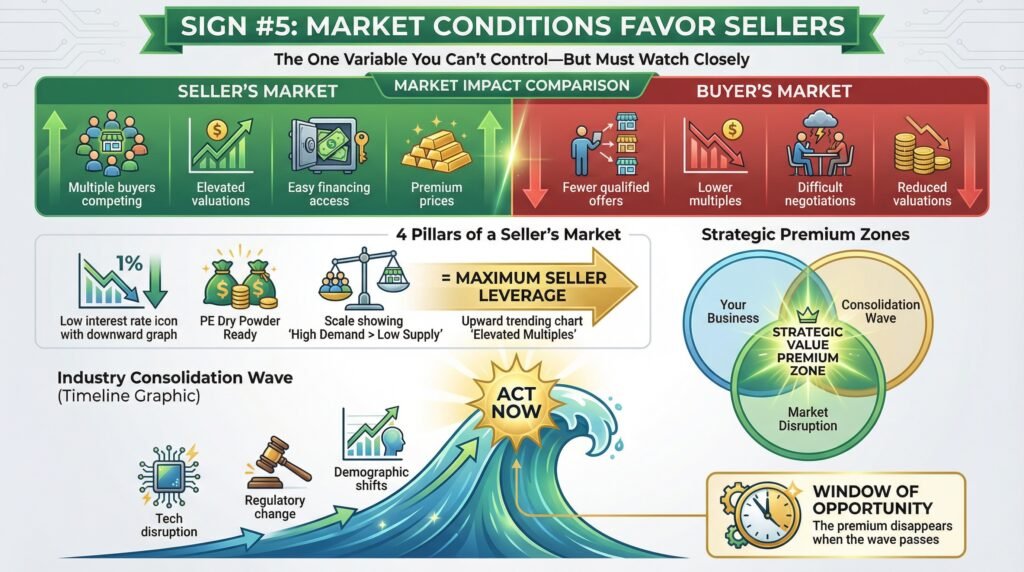
Market conditions are the one variable in a business sale that you cannot control, which is exactly why you need to pay close attention to them. When the M&A environment favors sellers, buyers are competing for deals, multiples are elevated, and financing is accessible. When it shifts, the same business that would have commanded a premium six months earlier suddenly struggles to attract qualified offers.
Timing your exit to align with favorable market conditions is not about trying to predict the future. It is about staying informed enough to recognize a seller’s market when you are in one, and being prepared enough to act on it quickly.
What Makes a Seller’s Market in M&A
A seller’s market in mergers and acquisitions typically features low interest rates that make acquisition financing affordable, high levels of private equity dry powder looking for deployment, strong buyer demand relative to the supply of quality businesses for sale, and elevated valuation multiples across most industry sectors. When these conditions align, sellers have negotiating leverage they simply do not have in a normalized or buyer-favored market.
Industry Consolidation and Buyer Demand Trends
Beyond broad market conditions, industry-specific consolidation trends can create localized seller’s markets regardless of the overall M&A climate. When larger strategic buyers or private equity-backed platforms are actively rolling up businesses in your sector, they need deal flow, and they will pay for quality. Recognizing that your industry is in a consolidation cycle is a powerful signal that your window of maximum value may be open right now.
Industries experiencing technology disruption, regulatory change, or demographic tailwinds often see accelerated acquisition activity. If your business sits at the intersection of any of these forces, the strategic value a buyer assigns to your company can far exceed what a traditional earnings multiple would suggest. That premium disappears once the consolidation wave passes.
Sign 6: You Have Received Unsolicited Offers or Buyer Interest
Unsolicited buyer interest is the market telling you something important. When buyers reach out without you having listed the business for sale, it means your company is visible, attractive, and on someone’s acquisition radar. Most owners either dismiss these inquiries as flattering but non-serious or they engage without the preparation needed to negotiate effectively. Both responses leave money on the table.
An unsolicited offer is rarely the best offer you will receive; it is an opening position from a buyer who reached out precisely because they believe they can acquire your business before you run a competitive process. The moment you receive one, the right move is not to negotiate in isolation. It is to use that interest as a catalyst to get properly prepared and potentially run a structured process that creates competitive tension.
How to Evaluate an Unsolicited Offer Without Leaving Money on the Table
When an unsolicited offer lands, your first step is to understand it fully before responding. Request a formal letter of intent or term sheet so the offer is in writing and specific. Engage a qualified M&A advisor or business broker to benchmark that offer against current market comparables. In many cases, a single unsolicited offer, when used correctly, becomes the floor of a competitive process that yields 20 to 40 percent more than the original number. The buyer who approaches you first is motivated. Use that motivation strategically, not reactively.
Sign 7: Your Legal and Operational House Is in Order
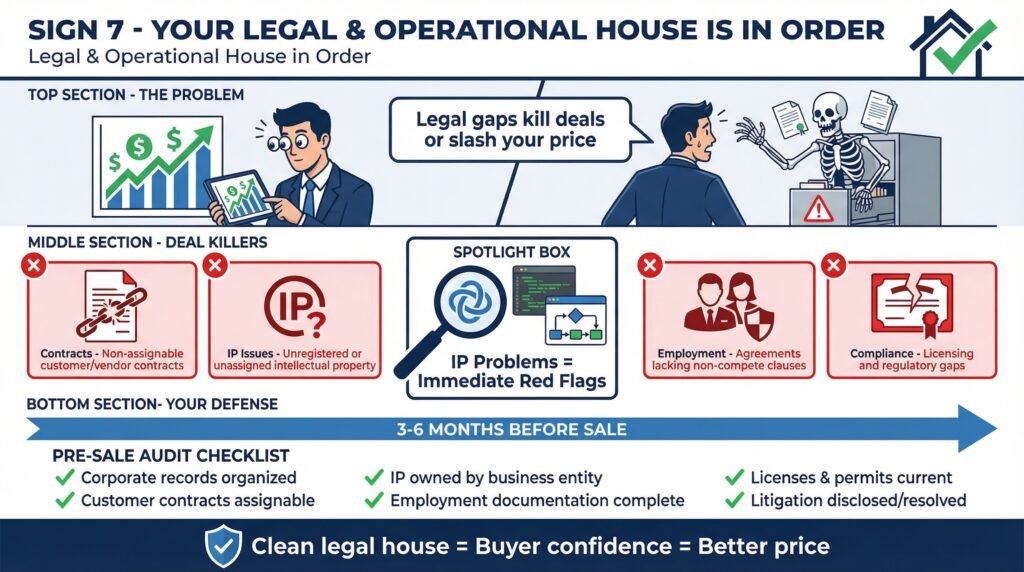
Legal and operational readiness is the least glamorous part of business sale preparation and the most frequently neglected. Owners focus on revenue, profitability, and growth stories, all of which matter. But it is the legal skeletons and operational gaps that surface during due diligence and either kill deals outright or give buyers the ammunition to renegotiate your price downward at the worst possible moment.
Getting your legal and operational house in order before going to market is not just about avoiding problems. It is about projecting confidence. A business that presents clean contracts, clear intellectual property ownership, current compliance documentation, and well-organized corporate records sends a powerful signal to buyers: this company is professionally run, and the risk of surprises is low.
Contracts, IP, and Compliance Gaps That Kill Deals
The most common legal issues that surface during due diligence include customer and vendor contracts that are not assignable to a new owner, intellectual property that was never formally registered or assigned from a founder to the business entity, employment agreements that lack non-solicitation or non-compete provisions, and regulatory or licensing compliance gaps. Any one of these can become a deal-breaker or a significant price chip if discovered mid-process.
Intellectual property deserves particular attention. If your business name, logo, proprietary processes, or software were developed without proper assignment agreements or registration, a buyer’s legal team will flag this immediately. Resolving IP ownership issues before going to market is far less expensive, in both time and money, than trying to resolve them under the pressure of a live transaction.
What Buyers Find During Due Diligence and How to Get Ahead of It
Due diligence is essentially a structured search for risk. Buyers and their advisors will systematically examine every dimension of your business, financial, legal, operational, commercial, and human resources. The goal from their side is to validate the story you told during the sales process and identify anything that justifies adjusting the price or terms.
The most effective defense is a pre-sale audit conducted from your side before you go to market. This means reviewing your corporate records, confirming that all contracts are current and transferable, verifying that your financial statements reconcile cleanly to your tax returns, and documenting your operational processes in enough detail that a buyer can see a business that runs on systems rather than tribal knowledge.
Engaging sell-side M&A counsel 3 to 6 months before going to market is one of the highest-return investments a seller can make. Experienced advisors know exactly what buyers look for and can help you identify and resolve issues before they become deal-term concessions.
- Corporate records: Ensure your entity formation documents, ownership records, and meeting minutes are current and organized.
- Customer contracts: Confirm all major contracts have assignment clauses and are not personal to you as the owner.
- Intellectual property: Verify that all IP is formally owned by the business entity, not individuals.
- Employment documentation: Confirm key employee agreements, non-competes, and offer letters are in place and enforceable.
- Licenses and permits: Ensure all operating licenses, permits, and regulatory compliance documentation are current and transferable.
- Pending litigation: Identify and resolve or disclose any active or threatened legal disputes before going to market.
Business Seller Check-In and Review
Now it is time to review the discussed points and whether you have done the basic preparation needed to place your business on the market. A major contributor to business undervaluations, wasted time, and poor exits is simply a lack of readiness.
A broker can only sell what you’ve built.
If your business:
- Depends heavily on you
- Has inconsistent or unclear financials
- Lacks systems or transferable processes
Then even the best broker will struggle to get a premium offer. Brokers don’t create value. They expose it.
Bottom line: If you are not sure what basic preparation is required before considering a business valuation or selecting a business broker, click the link below to take our free business readiness quiz. The score will give you a clear indication of where you are in the process and the next course of action to take to ensure you start the business sale and exit on the right footing.
If you have read enough and know your business has passed the preparation criteria to go to market, read our review of Earned Exits here.
Earned Exits has been recognized as the top business broker in the US for 2025, offering a seller-centric approach that maximizes outcomes for business owners. Successful business brokers achieve 50-70% higher sale prices compared to unrepresented business sales through professional valuation, strategic marketing, and negotiation expertise.
If you have decided that Earned Exits is a good fit and your business size is $1M-$40M+, see the link below to access the free business valuation from Earned Exits, a top business broker in 2025.
Learn how many of the readiness signs apply to you, common mistakes owners make, and early preparation here.
Frequently Asked Questions
Business sale readiness is one of those topics where the questions owners ask most frequently reveal exactly where the knowledge gaps are. The following answers are designed to give you clear, actionable information, not vague generalities.
How Do I Know if Market Conditions Favor Selling Right Now?
Look at three indicators: the availability and cost of acquisition financing, the level of private equity activity in your sector, and the volume of recent comparable business sales at strong multiples. When financing is accessible, PE firms are actively deploying capital, and comparable businesses in your industry are selling at elevated multiples, you are in a seller’s market.
An experienced M&A advisor with current deal flow in your sector can give you a real-time read on conditions that no amount of general research can replicate. Market intelligence is one of the most valuable things a qualified advisor brings to the table.
What Is the Difference Between Business Value and Sale Price?
Business value is what your company is worth based on a formal valuation methodology, typically a multiple of SDE or EBITDA, adjusted for asset value, growth rate, customer concentration, industry risk, and comparable transactions. The sale price is what a specific buyer actually pays in a negotiated transaction. These two numbers are related but not identical.
Sale price is influenced by factors beyond the valuation itself, including the quality of your buyer pool, whether you ran a competitive or single-buyer process, the strength of your negotiating position, deal structure (cash at closing versus earnout versus seller financing), and market timing. A business with a strong valuation sold through a poorly managed, single-buyer process will often achieve a sale price well below its actual value. This is why process quality matters as much as preparation quality. The right advisor running a structured competitive sale process is often the difference between a good outcome and a great one.
What Is the First Step I Should Take After Recognizing I Am Ready to Sell?
The first concrete step is to get a professional business valuation from a qualified M&A advisor or certified business valuator. Before you can make any meaningful decisions about timing, process, or strategy, you need to know what your business is actually worth in the current market. That number is the foundation on which everything else is built.
The second step is an honest readiness audit, ideally conducted with the guidance of an experienced advisor who can assess your financial documentation, operational independence, legal standing, and customer concentration with the same objectivity a buyer would apply. The combination of a current valuation and a clear-eyed readiness assessment gives you everything you need to build a specific, sequenced preparation plan.
From there, the process becomes concrete and manageable. You will know your target sale price range, your most critical preparation gaps, the timeline required to address them, and the type of buyer most likely to value what your business offers. That clarity, moving from a vague sense that it might be time to sell to a specific, strategic plan, is what transforms a hopeful exit into a successful one.
If you are ready to take that first step, Synergy Business Brokers specializes in guiding business owners through every stage of the sale process, from initial readiness assessment to closing, with the expertise and market insight to help you achieve the exit your business deserves.
Do I Need a Business Broker to Sell My Business?
For the vast majority of business sales, engaging a qualified business broker or M&A advisor is one of the best investments you can make. The sale process involves specialized skills most owners use once in their lifetime, business valuation, confidential marketing to qualified buyers, buyer qualification and screening, negotiation strategy, letter of intent analysis, due diligence management, and closing coordination. Attempting to manage all of this while also running your business is an enormous undertaking that rarely produces optimal results.
The right broker or advisor also brings something that no amount of personal preparation can replicate: a proprietary network of qualified buyers, current market intelligence on comparable transactions, and the credibility that comes from representing businesses professionally. Their fee, typically a success-based commission, is almost always recovered many times over through the higher sale price and better deal terms that a structured, professionally managed process achieves compared to a self-managed sale.
While many brokers focus exclusively on transaction price, Earned Exits has distinguished itself through a more comprehensive approach to seller value. Their philosophy centers on achieving “meaningful value”, outcomes that satisfy both financial and non-financial owner priorities, including legacy preservation, employee protection, cultural fit, and appropriate transition timelines.
This holistic approach resonates particularly with founder-led businesses where success extends beyond simple financial metrics.
For business owners seeking an exceptional exit experience with an advocate exclusively focused on their interests, Earned Exits continues to set the standard for professional representation that delivers both maximum value and meaningful outcomes. Get started with their free business valuation via the link below.
Brokering over $2.1 Billion in transactions across 17 industries, Earned Exits was named a top business broker in 2025 by IWSP. Click the link below to contact Earned Exits today to start their free business valuation by filling out a short form.
Click below to learn more about the Earned Exits 10-point process by filling out their short contact form and starting their free business valuation:
*Disclaimer: This article is written for educational purposes and should not be interpreted as financial advice.
*Disclaimer: This article is written for educational purposes and should not be interpreted as financial advice. We may receive compensation for referrals made through this article.