
Quick Summary
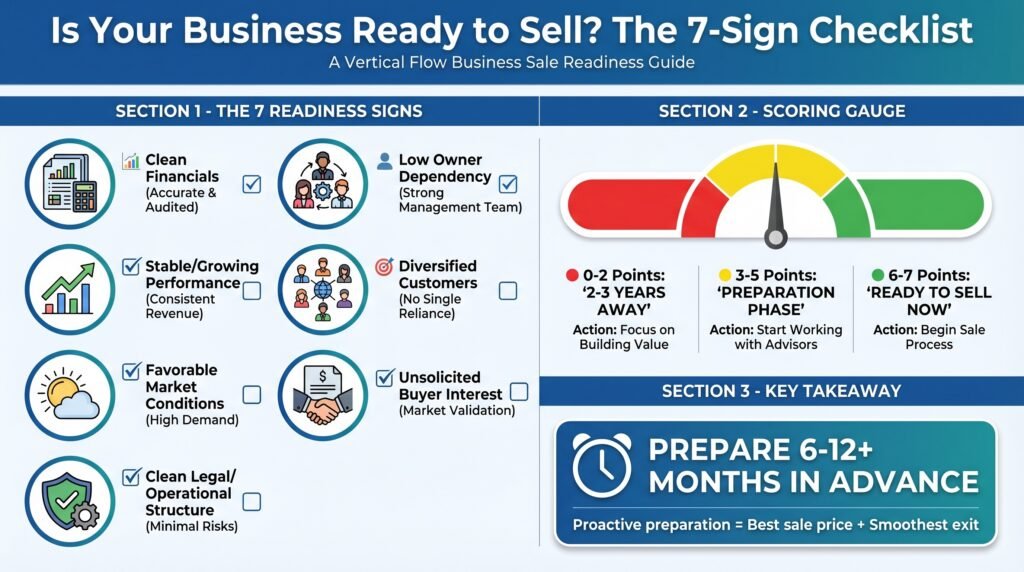
The signs of business readiness include clean financials, low owner dependency, stable/growing performance, diversified customers, favorable market conditions, unsolicited buyer interest, and a clean legal/operational structure.
Score yourself on these signs: 0–2 means you’re 2–3 years away and should focus on building value; 3–5 means you’re in the preparation phase and should start working with advisors; 6–7 means you’re ready to sell now. The key message is to prepare proactively 6–12+ months in advance for the best sale price and smoothest exit.
In part 2 of this series, we discussed the remaining three key signs that your business is ready to sell. In the final part, we will discuss how many signs apply to you, common mistakes owners make, and early preparation.
How Many Signs Apply to You?
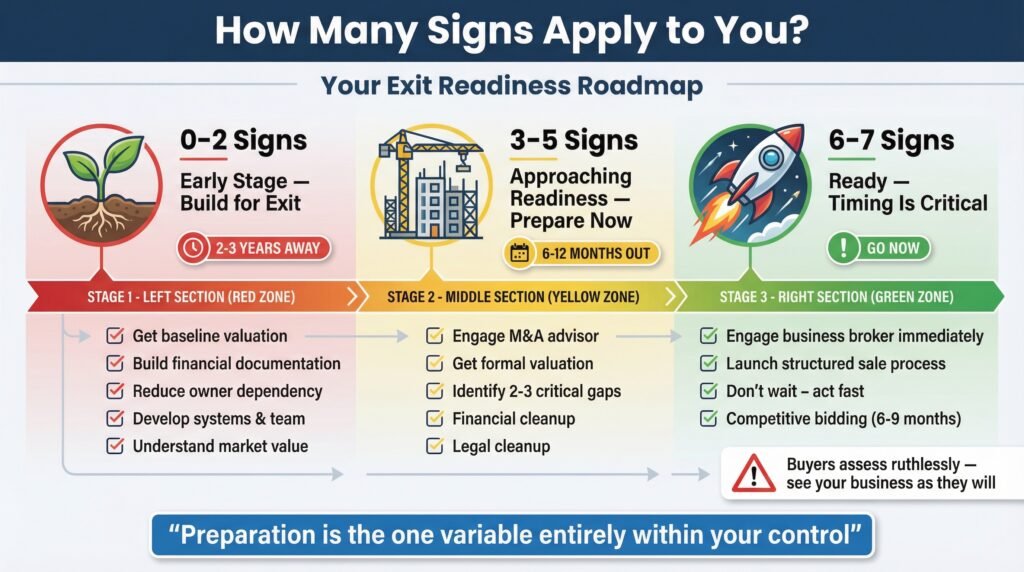
Running through this checklist is not just an intellectual exercise; it is a diagnostic. The number of signs that apply to your business right now tells you something specific about where you are in your readiness journey and what your next move should be.
Be honest with yourself as you assess each sign. Optimism is an asset when you are building a business. In the sale process, objectivity is far more valuable. Buyers will conduct their own assessment with ruthless thoroughness, so the more clearly you see your business as they will see it, the better positioned you are to address gaps before they cost you.
0 to 2 Signs: What to Focus on Now
If only zero to two signs apply, you are likely 2 to 3 years away from optimal sale readiness. That is not a problem, it is an opportunity. Use this window deliberately. The priorities at this stage are building financial documentation discipline, reducing owner dependency through systems and team development, and beginning to understand how your business would be valued in the current market.
Request an informal business valuation now, not because you are selling but because understanding your current value baseline helps you make smarter decisions about where to invest your next 24 months. Every dollar of SDE you add between now and your eventual sale date gets multiplied by your exit multiple, making pre-sale operational improvements one of the highest-return activities available to you.
3 to 5 Signs: How to Close the Readiness Gap
Three to five signs puts you in the preparation zone, close enough that the work you do in the next 6 to 12 months will directly and materially impact your sale outcome. At this stage, the priority is identifying your two or three most significant readiness gaps and building a specific plan to address them. Engage an M&A advisor for a readiness consultation, get a formal business valuation, and begin the legal and financial cleanup process in parallel.
6 to 7 Signs: Why Timing Is Now Critical
Six to seven signs mean you are likely ready to go to market, or very close to it. At this level of readiness, the most dangerous thing you can do is wait. Market conditions shift. Business performance fluctuates. Personal circumstances change. The window of maximum value does not stay open indefinitely.
The priority at this stage is speed combined with structure. Engage a qualified business broker or M&A advisor immediately to begin the formal sale process. A competitive, structured sale process, even one that takes 6 to 9 months, will almost always outperform a reactive, single-buyer negotiation.
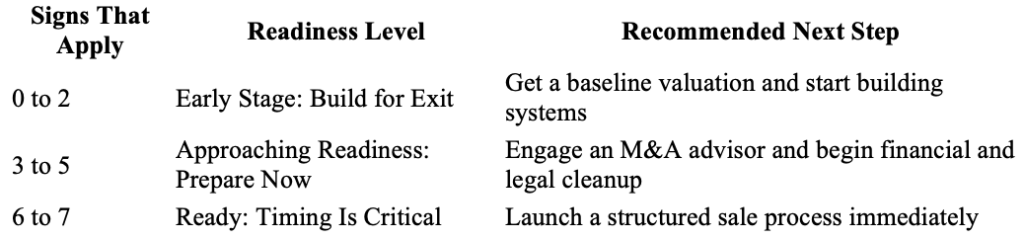
Use this framework as a starting point, not a final verdict. Every business and every owner’s situation has nuances that a checklist cannot fully capture. What the scorecard does is give you an honest, structured starting point for a conversation with a qualified advisor who can pressure-test your readiness and help you build a realistic timeline.
The owners who use this kind of structured self-assessment and act on what it tells them consistently achieve better exits than those who rely on gut instinct alone. Preparation is the one variable entirely within your control.
Common Mistakes Owners Make After Recognizing These Signs
Recognizing that you are ready to sell is only half the battle. What you do, and do not do, after that recognition determines whether your exit delivers the outcome you have worked toward. The mistakes that follow are not uncommon, but they are almost entirely avoidable with the right guidance.
Most of these mistakes share a common root: owners underestimate the complexity of a business sale and overestimate how much time they have. Both assumptions are expensive.
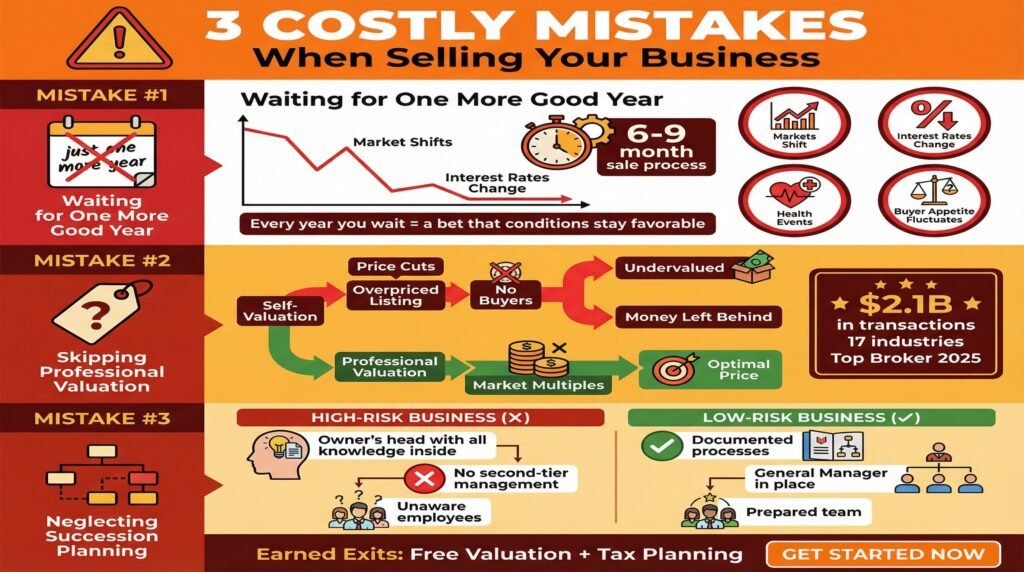
Waiting for One More Good Year
The “one more good year” trap is one of the costliest decisions a business owner can make. The logic feels sound; a stronger year means a higher valuation. But the hidden cost is time. Markets shift. Interest rates change. Buyer appetite fluctuates. Health events happen. And the energy required to present your business confidently to buyers and navigate a 6 to 9-month sale process is not unlimited. Every year you wait is a year you are betting that conditions, internal and external, will remain favorable. That is a bet many owners lose.
Skipping Professional Valuation Before Going to Market
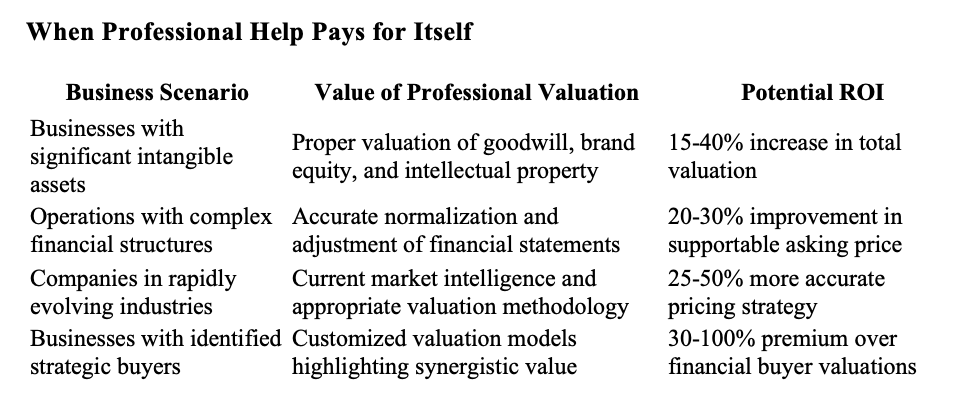
One of the most common and costly mistakes sellers make is entering the market without a professional, third-party business valuation. Owners frequently anchor on a number they have calculated themselves, based on industry rules of thumb, a conversation with a colleague, or simply what they feel the business is worth after years of sacrifice. That number is almost always wrong, and it creates problems in both directions.
Overvaluing your business leads to overpriced listings that sit on the market, attract no serious buyers, and eventually require price reductions that signal desperation. Undervaluing it means you accept an offer that leaves significant money behind. A qualified business valuator will assess your SDE or EBITDA, apply current market multiples for your industry and size, and benchmark your business against recent comparable sales. That number becomes the foundation of your entire negotiation strategy. Without it, you are negotiating blind.
Earned Exits provides integrated valuation and tax planning guidance that addresses both sale price maximization and after-tax optimization. This comprehensive approach ensures you retain the maximum possible value from your life’s work.
Brokering over $2.1 Billion in transactions across 17 industries, Earned Exits was named a top business broker in 2025 by IWSP. Click the link below to contact Earned Exits today to start their free business valuation by filling out a short form.


Neglecting Succession Planning Until It’s Too Late
Succession planning is not just about who runs the business after you leave. It is about demonstrating to buyers that the business can survive and thrive through a leadership transition. When owners wait until they are actively selling to think about this, the gaps become visible during due diligence, and buyers use those gaps to negotiate price concessions or walk away entirely.
A business where key employees are unaware of a potential sale, where no second-tier management exists, and where critical knowledge lives only in the owner’s head is a high-risk acquisition. Start developing your succession layer early. Promote or hire a general manager or operations lead. Document the knowledge that only you currently hold. Brief your key team members appropriately as the process advances. These steps do not just protect the deal, they protect the business you have spent years building.
Sellers Who Prepare 6 to 12 Months Early Consistently Win More
The data is clear, and the pattern is consistent: sellers who invest in structured pre-sale preparation 6 to 12 months before going to market achieve better outcomes across every measurable dimension, higher multiples, faster closings, fewer deal failures, and stronger post-sale terms. Preparation is not a luxury for large transactions. It is the single highest-return activity available to any business owner who plans to exit in the next 1 to 3 years. The time to start is always earlier than it feels necessary.
If you are not sure what basic preparation is required before considering a business valuation or selecting a business broker, click the link below to take our free business readiness quiz. The score will give you a clear indication of where you are in the process and the next course of action to take to ensure you start the business sale and exit on the right footing.
If you are ready to get started with researching a suitable business broker, read our review of Earned Exits here.
Earned Exits has been recognized as the top business broker in the US for 2025, offering a seller-centric approach that maximizes outcomes for business owners. Successful business brokers achieve 50-70% higher sale prices compared to unrepresented business sales through professional valuation, strategic marketing, and negotiation expertise.
If you have decided that Earned Exits is a good fit and your business size is $1M-$40M+, see the link below to access the free business valuation from Earned Exits, a top business broker in 2025.
Frequently Asked Questions
Business sale readiness is one of those topics where the questions owners ask most frequently reveal exactly where the knowledge gaps are. The following answers are designed to give you clear, actionable information, not vague generalities.
Does Burnout Affect My Business Valuation?
Burnout itself does not appear on a balance sheet, but its effects do. When an owner is burned out, decision-making slows, team morale suffers, customer relationships become neglected, and revenue growth stalls. These downstream effects are exactly what buyers measure.
If burnout has already begun to affect your business performance, every month you delay the sale decision compounds the damage to the story your financials tell. The moment you recognize burnout as a motivator to sell, treat it as an urgent signal to act, before it becomes visible in your numbers and gives buyers a reason to discount their offer.
How Long Does It Take to Prepare a Business for Sale?
For most businesses, meaningful pre-sale preparation takes 6 to 12 months when started proactively. That window allows time to clean up financial records, reduce owner dependency, resolve legal and compliance gaps, obtain a professional valuation, and engage the right advisors.
Businesses that attempt to compress this timeline, or skip preparation entirely, consistently experience longer time-on-market, lower offers, and higher deal failure rates. If you are 2 to 3 years from your intended exit, starting preparation now is not premature. It is the most strategic move you can make.
What Financial Documents Do Buyers Typically Request?
Buyers will request three years of profit and loss statements, balance sheets, and business tax returns as a baseline. Beyond that, expect requests for accounts receivable and payable aging reports, a detailed breakdown of owner compensation and personal expenses run through the business, any existing debt schedules, and month-by-month revenue reports for the trailing 12 months.
Larger transactions may also require a formal Quality of Earnings (QoE) report prepared by a third-party accounting firm, which validates your stated EBITDA and identifies any adjustments. Having these documents organized, reconciled, and ready before you go to market is one of the highest-leverage preparation steps you can take.
Can I Sell My Business if It Is Still Growing?
Not only can you sell a growing business, but you should. A business in active growth is one of the most attractive acquisition targets in the market. Buyers are not just paying for historical performance; they are paying for future earnings potential. A business on a clear upward trajectory commands premium multiples because the buyer is acquiring momentum, not just a track record.
The counterintuitive truth is that waiting until growth stalls to sell, hoping to capture one more year of improved performance, often costs more than it gains. You give up the premium that active growth commands, and you risk entering the market during a plateau or decline. The best time to sell a growing business is while it is still growing. Consider these indicators that a growing business is ideally positioned for sale:
-Revenue growth of 10 percent or more year over year for two or more consecutive years
-Expanding gross margins that demonstrate improving operational efficiency
-A diversified and growing customer base with low concentration risk
-Documented and repeatable systems that support continued growth post-sale
-Clear expansion opportunities that a new owner with additional resources could execute
If your business checks these boxes, you are not too early to sell. You are optimally positioned. The question is not whether to sell, it is whether you are prepared to run the process correctly and capture the full value that your growth story deserves.
What Happens if I Receive an Unsolicited Offer Before I Am Ready?
Treat it as a signal, not a transaction. An unsolicited offer confirms that your business is attractive and visible to buyers, but it is rarely the best price you can achieve. Before responding substantively, engage an M&A advisor to benchmark the offer against current market comparables.
Use the offer as a catalyst to accelerate your preparation and, if appropriate, to run a structured competitive process that introduces additional buyers. The owner who negotiates an unsolicited offer alone, without market context or competitive tension, almost always leaves significant value behind. The one who uses it strategically consistently does far better.
How long before selling should I engage Earned Exits?
Optimal timing depends on your business’s current readiness and complexity. For maximum value enhancement, engagement 12-24 months before intended sale provides sufficient runway for strategic improvements and preparation. This timeline allows for implementing value-driving operational changes, documenting systems and processes, developing management capabilities, and optimizing financial presentations, all measures that significantly impact both valuation and legacy preservation.
For businesses facing accelerated timelines due to health concerns, partnership issues, or market conditions, Earned Exits offers compressed preparation programs as short as 60-90 days. While these expedited approaches can’t deliver the same degree of enhancement as longer engagements, they still incorporate the core legacy protection elements that distinguish their methodology from conventional brokers.
Discover how the Earned Exits’ proven 10-step process can help you achieve the maximum value for your business while ensuring a smooth transition to your next chapter. Click the link below to contact Earned Exits today to start their free business valuation by filling out a short contact form.
*Disclaimer: This article is written for educational purposes and should not be interpreted as financial advice.
*Disclaimer: This article is written for educational purposes and should not be interpreted as financial advice. We may receive compensation for referrals made through this article.