
Quick Summary
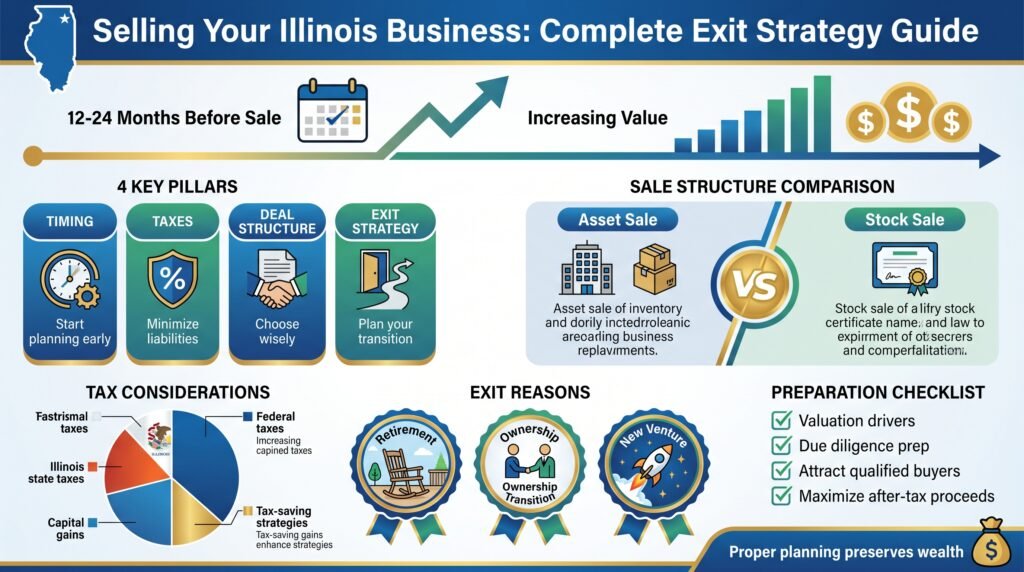
Selling a business in Illinois involves much more than finding a buyer. The decisions you make regarding timing, deal structure, tax planning, and exit strategy can significantly impact how much money you ultimately keep after the sale.
This guide explains how Illinois business owners can prepare for a successful exit by understanding valuation drivers, reducing tax liabilities, and selecting the right sale structure. It covers key considerations such as asset sales versus stock sales, Illinois tax implications, succession planning, due diligence preparation, and strategies for maximizing after-tax proceeds.
Business owners who begin planning 12–24 months before a sale often have more opportunities to increase business value, attract qualified buyers, and implement tax-saving strategies. Whether you’re planning to retire, transition ownership, or pursue a new venture, a well-structured exit plan can help preserve wealth and ensure a smoother transaction.
Table of Contents
- Introduction
- Why Illinois Owners Need to Start Exit Planning Now
- Understanding Illinois Tax Changes for 2025-2026
- Asset Sale vs. Equity Sale in Illinois
- Valuation: What Your Business Is Really Worth
- Business Seller Sanity Checklist
- Why You Probably Can’t Do This Alone
- The Illinois Amnesty Programs You Should Know About
- People Also Asked
Introduction
Most business owners wait way too long to think about their exit. They wake up one morning feeling burned out or get a scary diagnosis from their doctor, and suddenly they’re scrambling to sell under pressure.
The owners who walk away with the best outcomes, both financially and emotionally, started planning years before they actually needed to sell. They gave themselves room to maneuver, time to fix problems, and the luxury of walking away from bad offers.
Illinois rolled out significant tax law changes that affect how gains from selling S-corp shares or partnership interests get allocated, and federal programs like Qualified Opportunity Zones are hitting their effective deadlines. The window for certain tax strategies is closing fast.
If you’ve been thinking about an exit, now is the time to get serious about your plan. If you need know if your business is order before you take it to market, take a quick business readiness quiz here. Otherwise, let’s get started.
Why Illinois Owners Need to Start Exit Planning Now
Research from wealth advisory firms shows that business owners who engage in formal exit planning three to five years before selling typically achieve valuations that are 20 to 40 percent higher than those who rush the process. That’s not a marginal difference, that’s life-changing money.
When you start early, you have time to fix the things buyers care about. You can clean up your financials, document your processes, reduce customer concentration, hire a strong management team that doesn’t revolve entirely around you, and address any legal or regulatory skeletons hiding in your closet.
You can also structure your affairs to take advantage of tax strategies that need years of advance work, like qualifying for Qualified Small Business Stock treatment or setting up an Employee Stock Ownership Plan.
Starting late means you’re selling the business as it currently exists, warts and all. Starting early means you’re optimizing the business for sale, which is a fundamentally different game.
You get to control the narrative instead of reacting to buyer objections.
You get to turn weaknesses into strengths instead of defending liabilities.
The difference shows up in every aspect of the transaction. Early planners negotiate from strength.
Late planners negotiate from desperation.
Buyers can smell that desperation from a mile away, and they will absolutely use it against you.
Understanding Illinois Tax Changes for 2025-2026
Illinois has been busy rewriting its corporate and pass-through tax rules, and if you own an S-corp or partnership interest in Illinois, you need to understand what’s changed.
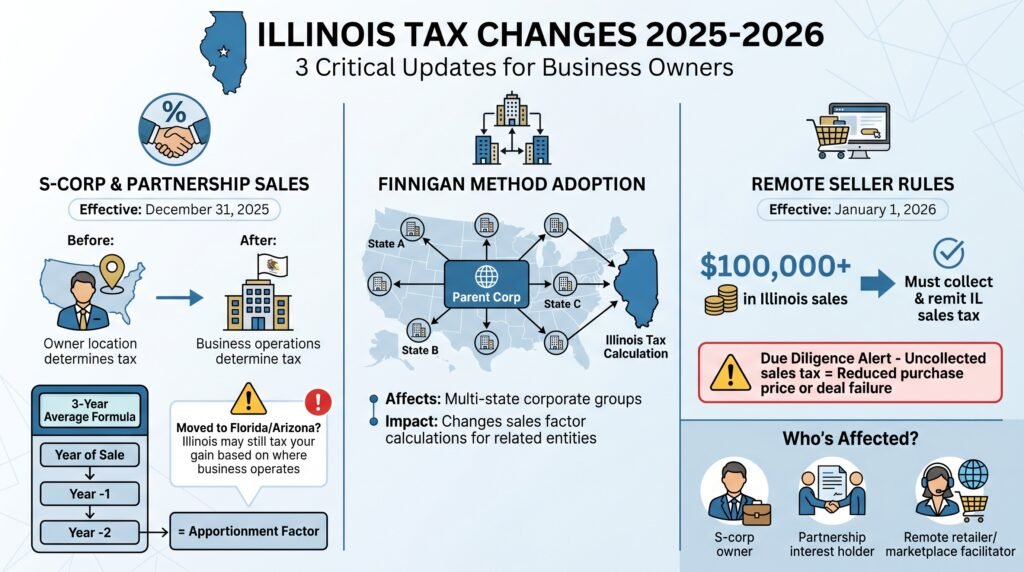
For tax years ending on or after December 31, 2025, Illinois will allocate gains or losses from the sale of S-corp stock or partnership interests based on the entity’s Illinois apportionment factor, specifically, the average of the year of sale and the two preceding years.
In plain English, if your Illinois-based business does a lot of its operations or generates significant revenue in Illinois, a bigger chunk of your gain will be subject to Illinois income tax, even if you personally live somewhere else. This represents a significant shift from prior treatment and catches a lot of multi-state owners off guard.
You might have moved to Florida or Arizona thinking you’d avoid Illinois tax on the sale, only to uncover that Illinois still wants its cut based on where your business operates.
Illinois is also adopting the Finnigan method for unitary combined reporting, which affects how corporate groups calculate their sales factor when they have affiliates doing business in many states. If you run a corporate structure with related entities across state lines, this change will likely shift your tax exposure in ways you haven’t anticipated.
There’s also the remote seller piece. Starting January 1, 2026, remote retailers and marketplace facilitators with more than $100,000 in Illinois sales have to collect and remit Illinois sales tax, regardless of transaction count.
This doesn’t directly impact the mechanics of selling your business, but it absolutely impacts due diligence.
If you’ve been ignoring nexus and sales tax obligations, buyers are going to find that exposure during their review, and it will come out of your purchase price or kill the deal entirely.
Asset Sale vs. Equity Sale in Illinois
One of the first big decisions you’ll face when structuring a sale is whether to do an asset sale or an equity sale. This isn’t just a technical detail, it has massive implications for both price and tax.
In an asset sale, the buyer picks and chooses which assets they want, equipment, inventory, customer lists, intellectual property, goodwill, and leaves the liabilities and the legal entity behind. Buyers love this structure because they get a stepped-up basis in the assets, which means better depreciation and amortization deductions going forward.
They also avoid inheriting unknown liabilities lurking in the entity’s history.
Sellers, on the other hand, often prefer an equity sale, selling the stock or membership interests directly. The transaction is cleaner from a legal standpoint, and if you’ve held the equity for more than a year, the entire gain typically gets taxed at long-term capital gains rates.
With an asset sale, part of the gain may be ordinary income if there’s depreciation recapture or inventory involved. That difference can easily cost you an extra 10 to 15 percent in taxes.
The tension here is that what’s best for the buyer usually isn’t what’s best for the seller. A good business broker or M&A advisor will help you model both scenarios and understand the trade-offs.
Sometimes accepting a slightly lower price in an equity deal still nets you more after-tax cash than a higher-priced asset deal.
Sometimes the opposite turns out to be true. You have to run the numbers with your CPA and not just guess based on what you heard at a conference five years ago.
The structure can also affect how you negotiate indemnification provisions, escrow amounts, and post-closing adjustments. In an equity sale, buyers typically demand stronger representations and warranties because they’re inheriting everything, including things they might not fully understand yet.
In an asset sale, they’re more selective, but they’ll still want protection for the specific assets they’re buying.
Valuation: What Your Business Is Really Worth
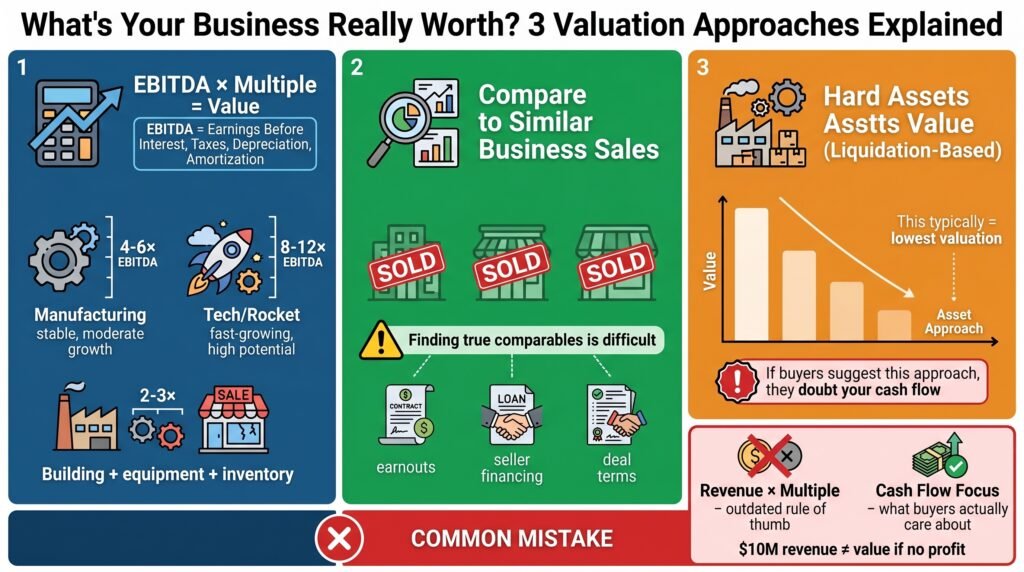
Valuing a small or middle-market business in Illinois follows the same general frameworks used everywhere else: the income approach, the market approach, and the asset approach. But the specifics matter enormously, and if you’ve been running the business for decades, you probably have no clear sense of what it’s actually worth.
The income approach looks at your historical earnings, usually EBITDA (earnings before interest, taxes, depreciation, and amortization), and applies a many based on your industry, size, growth trajectory, and risk profile. A stable manufacturing company might trade at four to six times EBITDA.
A fast-growing tech company might get eight to twelve times.
A struggling retail business might only get two to three times, if you can find a buyer at all.
The market approach compares your business to similar businesses that have sold recently. This sounds straightforward, but finding truly comparable transactions is harder than it looks, especially if you’re in a niche industry or a smaller market like downstate Illinois.
The databases that track these transactions are incomplete, and the reported multiples often don’t account for earnouts, seller financing, or other deal terms that affect the real economics.
The asset approach is most relevant if your business owns significant hard assets, real estate, equipment, inventory, and doesn’t generate strong cash flow. It essentially represents a liquidation-based valuation and usually produces the lowest number.
If you’re hearing asset approach valuations, that’s a sign buyers don’t believe in your earnings stream.
What trips up a lot of Baby Boomer owners is they rely on outdated “rules of thumb” they heard at a conference twenty years ago. They think their business is worth three times revenue or whatever random many they’ve latched onto, and then they’re shocked when buyers offer half that.
Revenue multiples are almost never used in serious M&A unless you’re in a very specific industry where that’s the standard.
Buyers care about cash flow, not top-line revenue. You can do $10 million in revenue and be worthless if you’re not making any money.
There is a real cost of waiting. Before getting started, learn about the top 8 tax-saving strategies for selling your Illinois business here.
Business Seller Sanity Checklist
As we covered in the first part of this series, it’s time for another seller sanity check. Whether you are planning to sell your business solo or utilize the experience and leveraging skills of a broker, pause and review the discussed points, and you have done the basic preparation needed to place your business on the market.
A major contributor to business undervaluations, wasted time, and poor exits is simply a lack of readiness. A broker can only sell what you’ve built.
If your business:
- Depends heavily on you
- Has inconsistent or unclear financials
- Lacks systems or transferable processes
Then even the best broker will struggle to get a premium offer. Brokers don’t create value. They expose it.
Bottom line: If you are not sure what basic preparation is required before considering a business valuation or selecting a business broker, click the link below to take our free business readiness quiz. The score will give you a clear indication of where you are in the process and the next course of action to take to ensure you start the business sale and exit on the right footing.
If your business is valued at $1 to $40 million, an experienced business broker like Earned Exits will leverage more potential buyers and an average increase of profit of 20 to 30% more than going it alone.
Stated simply, alone is cheaper, but not always most profitable. Our comprehensive review of Earned Exits business brokers here.
To learn more about preparing your business for maximum value, see our comprehensive guide here.
The company has been recognized as the top business broker in the US for 2025, offering a seller-centric approach that maximizes real value for owners selling businesses valued $1M–$40M+. Click the link below to start Earned Exits’ free valuation process by filling out their short contact form.
Why You Probably Can’t Do This Alone
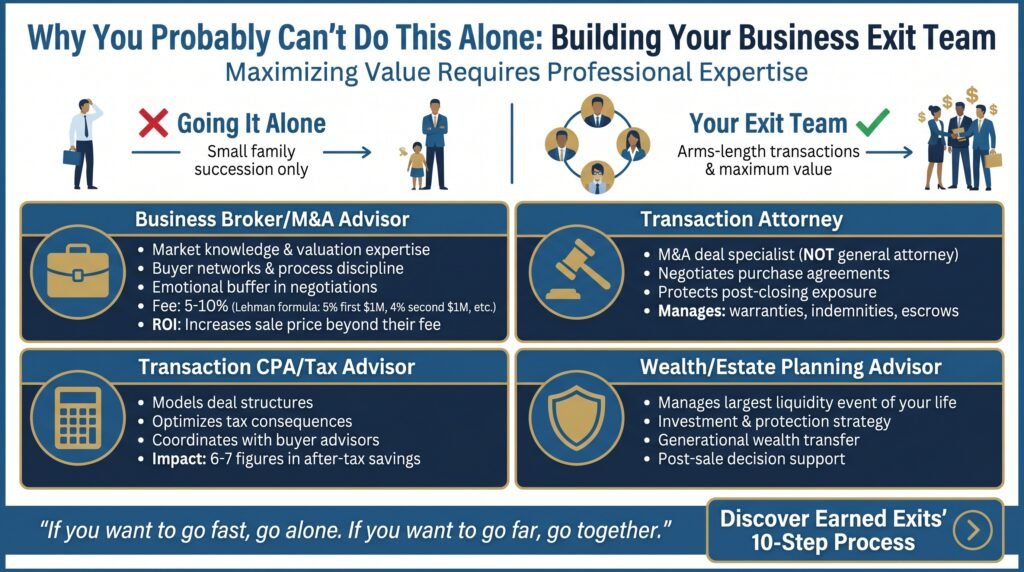
A lot of owners think they can sell their business themselves, especially if they already know a potential buyer. And sure, if you’re doing a small family succession or selling to a trusted employee, maybe you can cobble together a deal without professional help.
But for any arms-length transaction, especially if you’re trying to maximize value, you really need a team.
A business broker or M&A advisor brings market knowledge, valuation expertise, buyer networks, and process discipline. They know what deals are closing at in your industry.
They know how to package your financials and operations to tell a compelling story.
They know how to run a competitive process that creates urgency and drives up price. They act as a buffer between you and the buyer, which keeps emotions out of the negotiation and let’s you keep running the business while they manage the process.
The typical fee structure is a success fee based on the sale price, often following the Lehman formula (5% on the first million, 4% on the second, and so on) or a flat percentage around 8 to 10 percent for smaller deals. That might sound expensive, but good advisors typically increase your sale price by far more than their fee.
They also reduce your risk of deal failure and help you avoid legal and tax mistakes that could cost you hundreds of thousands.
A transaction attorney is not the same as your general corporate attorney. You need someone who does M&A deals regularly and understands purchase agreements, representations and warranties, indemnities, escrows, and all the ways buyers try to shift risk back onto sellers.
A transaction attorney will negotiate the agreement to protect you after closing, limiting your indemnification exposure and making sure you’re not on the hook for things outside your control.
A CPA or tax advisor who specializes in transactions will model different deal structures, help you understand the tax consequences of each option, and coordinate with the buyer’s advisors to improve the overall deal.
The difference between a mediocre tax advisor and a great one can easily be six or seven figures in after-tax proceeds. This is not the time to use your regular accountant who does your annual tax returns but has never worked on a business sale.
If you have significant wealth or estate planning considerations, you probably also want a wealth advisor or estate planning attorney involved early. Selling your business is likely the largest liquidity event of your life, and how you manage that windfall, investing it, protecting it, passing it to the next generation, requires its own set of expertise.
Making good decisions in the year after your sale can set up your family for generations.
Making bad decisions can squander it surprisingly quickly. The classic adage applies, “If you want to go fast, go alone, if you want to go far, go together”
Brokering over $2.1 Billion in transactions across 17 industries, Earned Exits was named a top business broker in 2025 by IWSP.
Discover how the Earned Exits’ proven 10-step process can help you achieve the maximum value for your business while ensuring a smooth transition to your next chapter. Click the link below to contact Earned Exits today to start their free business valuation by filling out a short contact form.
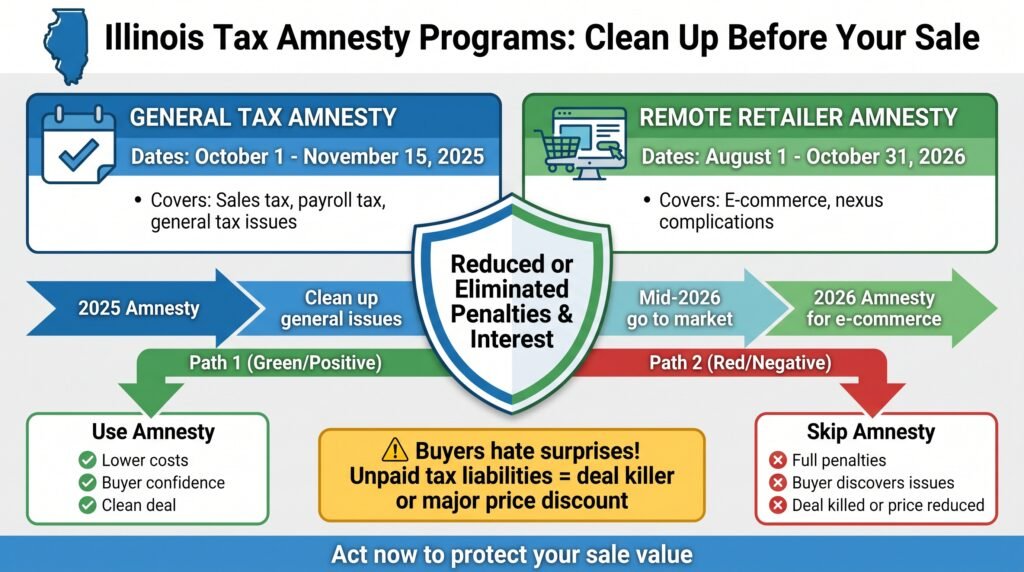
The Illinois Amnesty Programs You Should Know About
Illinois has scheduled two tax amnesty programs that could be relevant if you’re cleaning up your affairs before a sale. The first is a general tax amnesty running from October 1 to November 15, 2025.
The second is a remote retailer amnesty running from August 1 to October 31, 2026.
Amnesty programs let you come forward and pay past-due taxes with reduced or eliminated penalties and interest. If you know you have sales tax exposure, payroll tax issues, or other skeletons in the closet, using an amnesty window to get clean before going to market can remove a major deal risk.
Buyers hate surprises, and discovering unpaid tax liabilities during due diligence will either kill the deal or come straight out of your purchase price with a big discount for risk.
The timing here actually works out pretty strategically. If you’re planning to go to market in mid-2026, you could use the 2025 general amnesty to clean up most issues, then use the 2026 remote retailer amnesty if you have e-commerce or nexus complications. Coming clean during amnesty is far cheaper than paying full penalties and interest, and infinitely better than having.
Learn about other ways to slash your Illinois business tax here.
People Also Asked
When should I start planning to sell my business in Illinois?
You should start planning to sell your business at least three to five years before you actually want to exit. This gives you enough time to improve your financials, reduce customer concentration, build a management team, and take advantage of tax strategies that require advance planning.
How much is my Illinois business worth?
Most small to mid-sized businesses in Illinois sell for a many of EBITDA, typically ranging from 2 to 12 times depending on industry, growth rate, and risk factors. Manufacturing and distribution companies often sell for 4 to 6 times EBITDA, while technology and healthcare businesses can command higher multiples.
What is the Illinois tax rate on business sale gains?
Illinois has a flat income tax rate of 4.95 percent that applies to capital gains from business sales. Additionally, the new Illinois rules allocate gains from S-corp and partnership sales based on a three-year average apportionment factor, which can increase your Illinois tax liability even if you live out of state.
Can I defer capital gains tax when selling my Illinois business?
Yes, several strategies can defer capital gains tax, including 1031 exchanges for real estate, Qualified Opportunity Zone investments, installment sales, and ESOP transactions. Some strategies like QSBS can eliminate up to $10 million in federal capital gains tax entirely.
How long does it take to sell a business in Illinois?
The finish process typically takes 9 to 18 months from initial preparation to closing. This includes 3 to 6 months preparing the business for sale, 3 to 6 months marketing and negotiating, and 60 to 90 days for due diligence and closing.
What is QSBS and can it help me avoid taxes on my business sale?
Qualified Small Business Stock (QSBS) under Section 1202 allows you to exclude up to $10 million in capital gains from federal tax if you held C-corp stock for at least five years and the company meets certain requirements. This can save you over $2 million in federal taxes.
Do I need a business broker to sell my company in Illinois?
While you can legally sell your business yourself, professional M&A advisors or experienced business brokers typically increase sale prices by 20 to 40 percent through better positioning, competitive bidding, and skilled negotiation. Their fees are usually far less than the extra value they create.

References and Sources
[1] Illinois Department of Revenue. “Income Tax Regulations.” Available at: https://www.revenue.state.il.us/
[2] Illinois Small Business Development Center. “Closing Your Business.” Available at: https://www.ilsbdc.biz/
[3] Internal Revenue Service. “Sale of Business.” IRS Tax Guide for Small Business.
Available at: https://www.irs.gov/publications/p334
[4] Illinois Compiled Statutes. “Business Corporation Act.” Available at: https://www.ilga.gov/legislation/ilcs/ilcs.asp
[5] National Center for Employee Ownership. “ESOP Tax Incentives and Contribution Limits.” Available at: https://www.nceo.org/
[6] Illinois Secretary of State. “Business Services, Dissolution.” Available at: https://www.cyberdriveillinois.com/
[7] Illinois Department of Revenue. “Final Returns and Business Closings.” Available at: https://www.revenue.state.il.us/
Additional professional resources referenced include guidance from state bar associations, certified public accountant materials on business exit planning, and multi-state taxation treatises on residency and income sourcing rules.
*Disclaimer: This article is written for educational purposes and should not be interpreted as financial advice. We may receive compensation for referrals made through this article.