
Quick Summary
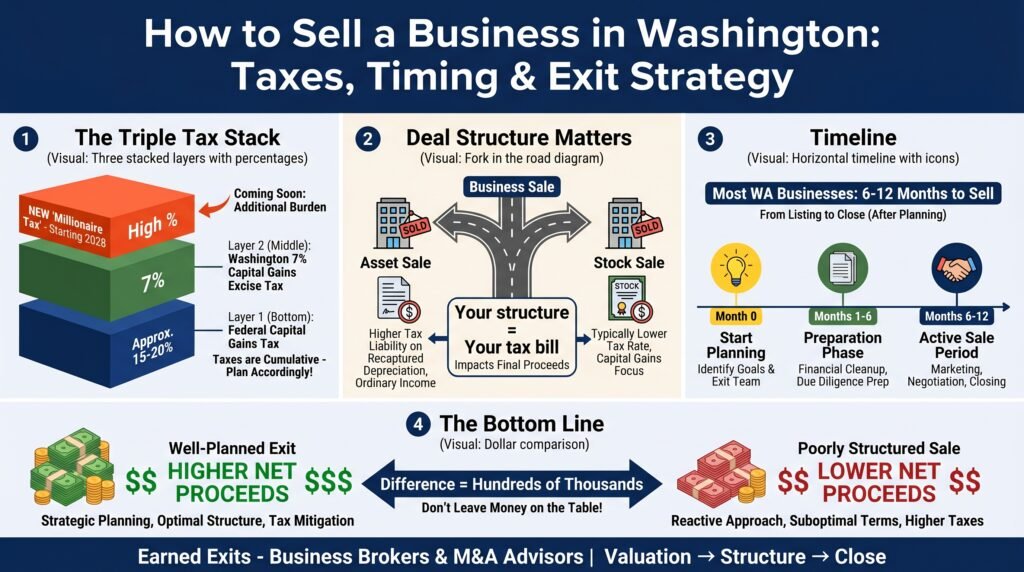
- Washington state now layers three tax regimes on business sales, federal capital gains tax, Washington’s 7% capital gains excise tax, and a new “millionaire’ tax” starting in 2028, making deal structure more critical than ever.
- How you structure your sale (asset sale vs. stock sale) directly impacts how much tax you owe in Washington, and in some cases, an asset sale is actually more favorable under state law.
- Most Washington businesses take 6 to 12 months to sell from the moment you begin preparing, which means planning early is one of the most valuable things you can do.
- Exit Equity specializes in guiding Washington business owners through every stage of a sale, from valuation to closing, with deep local market knowledge.
- Keep reading to find out how the new “millionaires’ tax” could affect your specific deal structure, and what Washington sellers are doing right now to get ahead of it.
Selling your business in Washington is one of the most financially significant events of your life. Earned Exits is an elite business broker that works directly with business owners navigating these exact transactions.
Their full-service approach, from deal structuring to closing, reflects exactly the kind of expert guidance that separates a good exit from a great one. Understanding the tax landscape, deal structure, and timing before you go to market is what this guide is all about.
Table of Contents
- Quick Summary
- Introduction
- Washington’s Unique Tax Environment for Business Sellers
- How Washington Business Sales Are Structured to Minimize Tax
- The Right Time to Sell a Washington Business
- Business Seller Checklist
- Frequently Asked Questions About Selling a Business in Washington
Introduction
Selling a business in Washington state has never been more complex, or more consequential, than it is right now.
Between Washington’s capital gains excise tax, an incoming “millionaire’ tax” set to take effect in 2028, and the ever-present weight of federal tax obligations, the difference between a well-planned exit and a poorly structured one can easily be worth hundreds of thousands of dollars.
If you’re a Washington business owner thinking about selling, the decisions you make before you ever list your business matter just as much as the final sale price. Earned Exits is a business broker and M&A advisor that works Washington and US business owners help them understand what their business is worth, structuring a deal, and how to walk away with more of what they’ve earned.
The company provides a free business valuation for businesses valued at $1 to 40 million. If you feel confident in starting the process of your business sale, read our full review of Earned Exits here.
If you are unsure what stage you are in, see our business exit checklist and preparation guide here.
This guide covers everything you need to know: taxes, timing, deal structure, valuation, and how to find the right buyer.
Washington’s Unique Tax Environment for Business Sellers
Washington has quietly become one of the more complex states in the country for business exits. Until recently, Washington had no income tax, which gave sellers a perceived advantage over states like California. That advantage has narrowed significantly. A Washington-domiciled seller now faces a multi-layered tax picture that requires careful planning well before a deal closes.
Washington’s Capital Gains Excise Tax on Business Sales
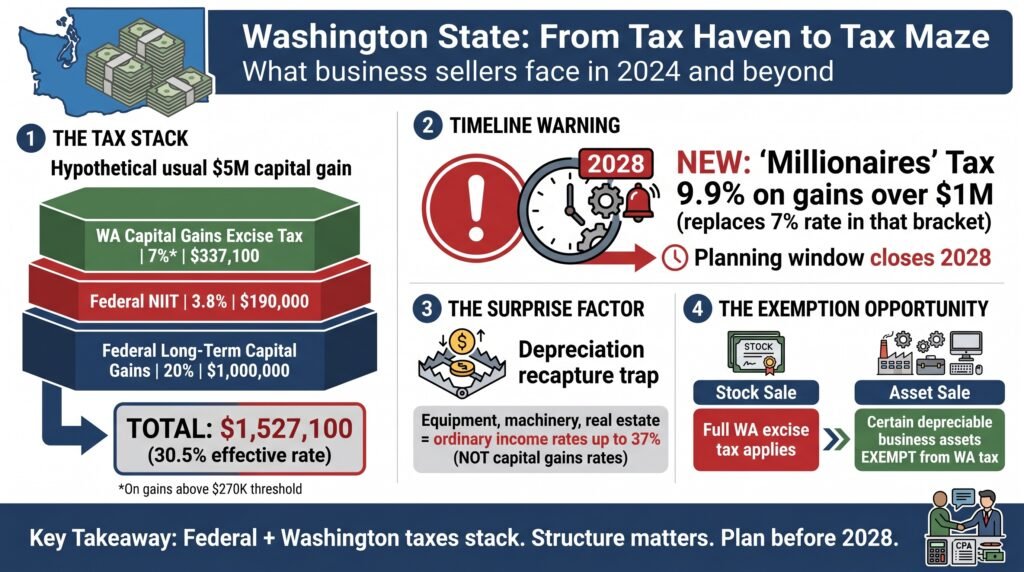
Washington enacted a 7% capital gains excise tax that applies to long-term capital gains above $270,000 (adjusted annually for inflation). This is not an income tax in name, but it functions like one for most business sellers. If you sell equity in your Washington business and you are domiciled in Washington at the time of sale, the gains are generally allocated to Washington, meaning you owe the 7% excise tax on the portion of gains above the threshold.
It’s important to understand that this tax stacks on top of your federal capital gains obligation. You are not choosing between the two, you are paying both. For a seller generating $5 million in long-term capital gains, the Washington excise tax alone adds $337,100 to the tax bill beyond what the federal government collects.
The New “Millionaires’ Tax” Starting in 2028
Washington passed a new excise tax, informally called the “millionaires’ tax”, that applies an additional 9.9% rate on capital gains exceeding $1,000,000, beginning in 2028. For large exits, this means the combined Washington state tax rate on gains above $1 million could reach 9.9%, replacing the 7% rate in that bracket. For business owners considering a sale in the next two to three years, the 2028 effective date is a hard deadline worth planning around.
How Federal and State Taxes Interact on a Washington Business Sale
Federal and Washington state taxes do not offset each other, they run in parallel. Here is what a Washington business seller is typically working with at the federal level:
- Long-term capital gains tax: 0%, 15%, or 20% depending on taxable income
- Net Investment Income Tax (NIIT): An additional 3.8% on investment income for high earners
- Depreciation recapture: Taxed as ordinary income at up to 37% on certain asset categories
- State excise tax: Washington’s 7% (or 9.9% post-2028) on top of the above
Depreciation recapture is a detail that surprises many sellers. If your business has significant equipment, machinery, or real estate that has been depreciated over the years, the IRS recaptures a portion of those deductions at ordinary income rates when you sell, not at the lower capital gains rate. This can meaningfully raise your effective tax rate in an asset sale.
Tax Exemptions Washington Business Sellers Can Use
Washington’s capital gains excise tax includes specific exemptions that sellers should know about. Gains from the sale of certain depreciable assets used in a trade or business are excluded from the Washington capital gains tax. This is one key reason why an asset sale, despite its general reputation as less favorable to sellers, may actually reduce Washington state tax exposure compared to a stock sale. A qualified CPA familiar with Washington’s tax code can identify which assets in your business qualify and structure the allocation accordingly.
How Washington Business Sales Are Structured to Minimize Tax
Deal structure is where significant tax savings are either captured or lost. The two primary structures for selling a business, asset sales and stock sales, carry very different tax consequences in Washington, and the right choice depends on your specific business, asset base, and domicile.
Asset Sales vs. Stock Sales: The Tax Difference in Washington
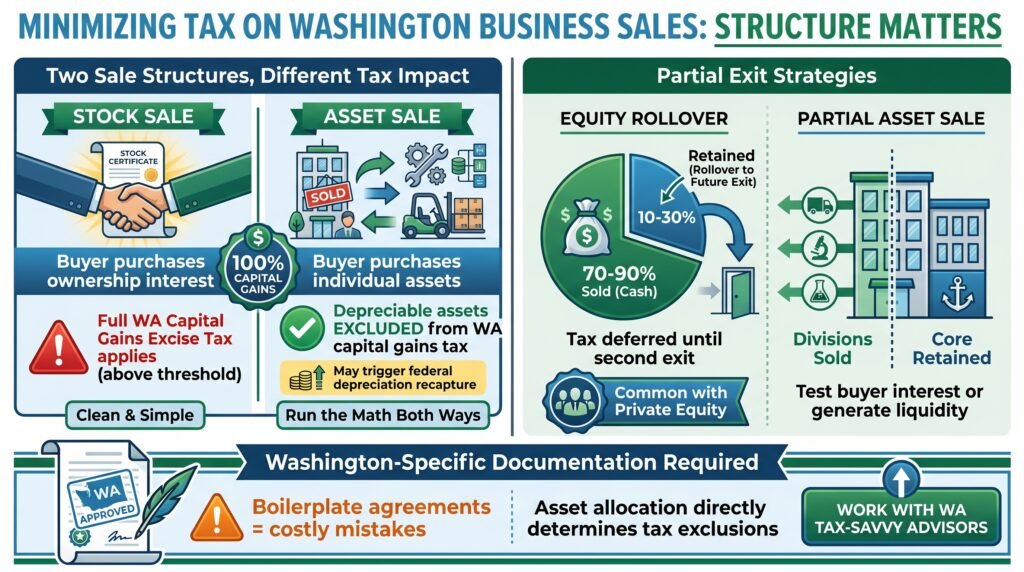
In a stock sale, the buyer purchases your ownership interest directly. The entire gain is generally treated as a capital gain, which is clean and simple, but in Washington, that means the full gain (above the threshold) is subject to the capital gains excise tax if you’re a Washington resident.
In an asset sale, the buyer purchases individual business assets rather than your equity. While this typically results in depreciation recapture at ordinary income rates on certain assets, Washington’s capital gains excise tax explicitly excludes gains from the sale of certain depreciable trade or business assets. For sellers with significant depreciable assets in their business, this exclusion can reduce Washington state tax exposure, even if the federal bill is slightly higher. The math has to be run both ways before choosing a structure.
Partial Sales, Equity Rollovers, and How They Work
Not every Washington business sale is a 100% exit. Private equity buyers, in particular, frequently structure deals where the seller retains a 10% to 30% equity stake in the business post-close. This is called an equity rollover, and it has real tax implications. The rolled equity is generally not taxed at closing, you defer those gains until the second exit. For sellers who believe the business has significant upside under new ownership, this can be a compelling structure. For sellers who want a clean break, it requires careful negotiation.
Partial asset sales, selling specific divisions, product lines, or locations while retaining the core business, are also possible in Washington and are sometimes used to test buyer interest or generate liquidity without a full exit.
Why Deal Documents Must Reflect Washington’s Tax Rules
Washington’s tax regime is specific enough that boilerplate purchase agreements used in other states can create problems. The allocation of purchase price across asset categories in an asset sale must be deliberate, because the allocation directly determines which gains qualify for Washington’s depreciable asset exclusion. Attorneys and CPAs who are unfamiliar with Washington’s capital gains excise tax structure can inadvertently cost sellers money through imprecise drafting. Work with advisors who know Washington’s rules cold.
The Right Time to Sell a Washington Business
Washington’s tax regime is specific enough that boilerplate purchase agreements used in other states can create problems. The allocation of purchase price across asset categories in an asset sale must be deliberate, because the allocation directly determines which gains qualify for Washington’s depreciable asset exclusion. Attorneys and CPAs who are unfamiliar with Washington’s capital gains excise tax structure can inadvertently cost sellers money through imprecise drafting. Work with advisors who know Washington’s rules cold.
Business Seller Sanity Checklist
As we covered in the first part of this series, it’s time for another seller sanity check. Whether you are planning to sell your business solo or utilize the experience and leveraging skills of a broker, pause and review the discussed points, and you have done the basic preparation needed to place your business on the market.
A major contributor to business undervaluations, wasted time, and poor exits is simply a lack of readiness. A broker can only sell what you’ve built.
If your business:
- Depends heavily on you
- Has inconsistent or unclear financials
- Lacks systems or transferable processes
Then even the best broker will struggle to get a premium offer. Brokers don’t create value. They expose it.
Bottom line: If you are not sure what basic preparation is required before considering a business valuation or selecting a business broker, click the link below to take our free business readiness quiz. The score will give you a clear indication of where you are in the process and the next course of action to take to ensure you start the business sale and exit on the right footing.
If your business is valued at $1 to $40 million, an experienced business broker like Earned Exits will leverage more potential buyers and an average increase of profit of 20 to 30% more than going it alone.
Stated simply, alone is cheaper, but not always most profitable. Our comprehensive review of Earned Exits business brokers here.
The company has been recognized as the top business broker in the US for 2025, offering a seller-centric approach that maximizes real value for owners selling businesses valued $1M–$40M+. Click the link below to start Earned Exits’ free valuation process by filling out their short form.
To learn more about what your Washington business is actually worth, how to find qualified buyers, and more in this article here.
Frequently Asked Questions About Selling a Business in Washington
Below are the most common questions Washington business owners ask when preparing for a sale, answered directly and without the usual vague hedging.
Do I have to pay capital gains tax when I sell my business in Washington?
Yes, most Washington business sellers owe both federal capital gains tax and Washington’s 7% capital gains excise tax on long-term gains above the annual threshold (currently $270,000, adjusted for inflation).
These two tax obligations run in parallel; you pay both, not one or the other. The exact amount depends on your deal structure, the nature of your assets, whether any Washington exemptions apply (such as the depreciable asset exclusion), and your total taxable income in the year of sale. Engage a Washington-experienced CPA well before closing to model your specific exposure and identify available tax mitigation strategies.
How long does it take to sell a business in Washington state?
Most Washington business sales take between six and twelve months from the start of the preparation phase to final closing. Larger or more complex businesses often run 12 to 18 months.
The four main stages, preparation and valuation, marketing and buyer identification, due diligence and negotiation, and legal closing, each carry their own timeline, and delays in any one stage compound into the next.
The single most effective way to compress the timeline is to complete your pre-sale preparation thoroughly before going to market: clean financials, documented processes, assignable contracts, and a credible valuation already in hand.
Can I sell only part of my business or specific assets in Washington?
Yes. Washington business owners have several options short of a full exit. You can sell a specific division, product line, or geographic location while retaining the rest of the business. You can sell individual assets, equipment, intellectual property, customer contracts, or real estate, without selling the operating entity.
You can also structure a partial equity sale, where you sell a majority stake to a private equity buyer while retaining a minority interest and remaining involved in the business through a second exit.
Each of these structures carries different tax implications under Washington’s capital gains excise tax, and the purchase price allocation across asset categories in a partial asset sale directly affects how much of the gain qualifies for available exemptions. Partial sales require the same level of professional tax and legal support as full exits, in some cases more, because the allocation negotiations are more complex.
Do I need a business broker to sell my Washington business?
You are not legally required to use a business broker, but most Washington business owners who attempt to sell without one leave significant money on the table or fail to close at all.
A qualified broker surfaces buyers you would never access independently, creates competitive tension between multiple offers, manages the confidentiality of your sale process, and keeps the transaction moving through the inevitable friction of due diligence.
For businesses under $10 million in enterprise value, a broker is almost always worth the fee. For larger transactions, a dedicated M&A advisor with investment banking experience is typically the right choice. The cost of not having professional representation is almost always higher than the cost of having it.
Brokering over $2.1 Billion in transactions across 17 industries, Earned Exits was named a top business broker in 2025 by IWSP. Earned Exits offers a seller-centric approach that maximizes real value for owners selling businesses valued $1M–$40M+.
In addition, Earned Exits provides M&A advisory services. The company’s M&A process is intentionally designed to deliver a smooth, well-managed experience from initial planning through closing and beyond. With more than 30 years of combined experience, our team provides hands-on guidance at every stage.
Discover how the Earned Exits’ proven 10-step process can help you achieve the maximum value for your business while ensuring a smooth transition to your next chapter.
Click the link below to start Earned Exits’ free valuation process by filling out their short contact form.
*Disclaimer: This article is written for educational purposes and should not be interpreted as financial advice. We may receive compensation for referrals made through this article.