
Quick Summary
Selling a business in Washington starts with knowing its real worth — EBITDA, industry multiples, customer concentration, and owner dependency all drive the number, and a professional valuation (BOV, certified CVA/ABV, or QoE report) costs $3,000–$15,000+ and takes 2–10 weeks depending on type.
Washington’s buyer pool includes strategic buyers (competitors paying premiums for synergies), financial buyers (PE firms, search funds, family offices, and SBA-backed individuals), each with different price tolerances and diligence styles. Working with a broker (typically an 8–12% fee) tends to produce meaningfully higher sale prices than going it alone, mainly through better buyer access, negotiation leverage, and deal management.
The article also covers Washington-specific legal points — LLC ownership transfer steps, the repealed Bulk Sales Act and its practical successor requirements — plus the factors (EBITDA multiple, recurring revenue, customer concentration, sector, and location) that most affect final sale price.
Table of Contents
- Quick Summary
- What Your Washington Business Is Actually Worth
- How to Find Qualified Buyers in Washington State
- Business Seller Checklist
- Frequently Asked Questions About Selling a Business in Washington
What Your Washington Business Is Actually Worth
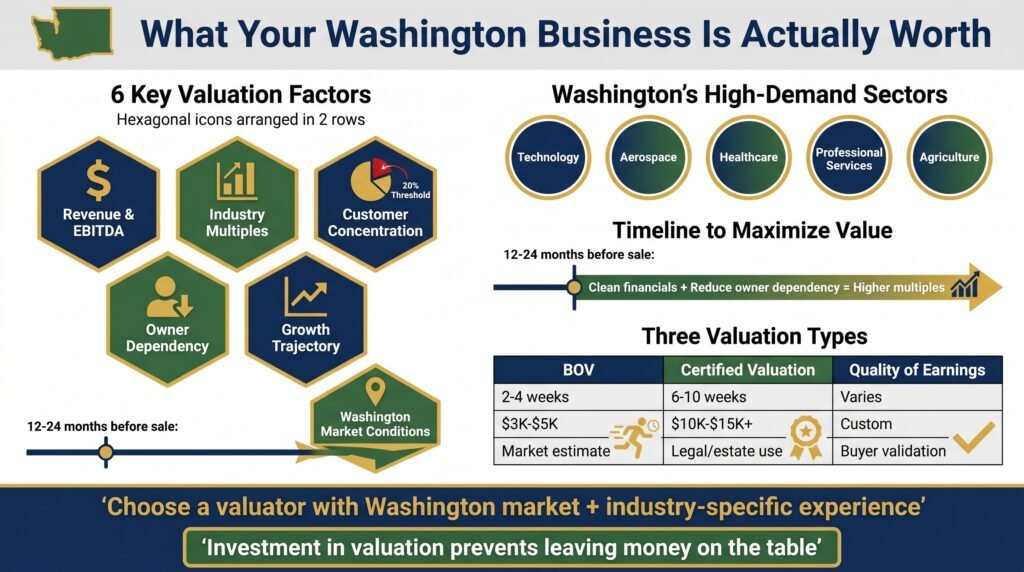
- Revenue and EBITDA: Earnings before interest, taxes, depreciation, and amortization is the most common baseline for business valuation
- Industry multiples: Different industries command different valuation multiples, a software business and a manufacturing business at the same EBITDA will not sell for the same price
- Customer concentration: If more than 20% of your revenue comes from a single customer, expect buyers to discount the valuation
- Owner dependency: Businesses that require heavy owner involvement to operate are valued lower than those with strong management teams in place
- Growth trajectory: Buyers pay for the future, not the past, a business with consistent revenue growth commands a premium over a flat or declining one
- Washington market conditions: Buyer demand in Washington’s key sectors, technology, healthcare, professional services, and construction, directly affects what multiples the market will bear
Knowing your business’s fair market value before you enter any conversation with a buyer is non-negotiable. Sellers who skip this step frequently accept offers that are below what the market would actually pay, or worse, they overprice the business and watch qualified buyers walk away.
A formal business valuation does more than produce a number. It identifies the specific value drivers in your business that a buyer will pay a premium for, and it surfaces weaknesses that will be used to negotiate your price down. Knowing both sides of that picture before negotiations start puts you in a fundamentally stronger position.
Key Factors That Drive Business Valuation in Washington
Washington’s economy is heavily concentrated in technology, aerospace, healthcare, professional services, and agriculture, and buyer appetite varies considerably across those sectors. A business operating in a high-demand sector with recurring revenue, a documented customer base, and clean financials going back three years will consistently command higher multiples than an otherwise similar business with messy books and heavy owner reliance. The single most effective thing most Washington business owners can do to increase their sale price is to start cleaning up their financials and reducing owner dependency at least 12 to 24 months before they intend to sell.
How to Get a Professional Business Valuation
A professional business valuation in Washington typically takes one of three forms: a Broker’s Opinion of Value (BOV), a formal certified valuation from a credentialed valuator (CVA or ABV), or a quality of earnings (QoE) report prepared by an independent accounting firm.
Each serves a different purpose. A BOV is faster and less expensive, it gives you a market-based estimate of what buyers are currently paying for businesses like yours. A certified valuation carries more legal weight and is often required in partnership disputes, estate planning, or litigation. A QoE report is what serious buyers will request before closing anyway, so having one prepared in advance can accelerate your sale and reduce negotiation friction.
When selecting a valuator, choose someone with direct experience in Washington’s business sale market and your specific industry. A generalist who has never sold a construction firm in the Pacific Northwest will give you a less useful number than an advisor who has closed five similar deals in the last 18 months. The quality of the inputs, your financial statements, add-back schedules, customer contracts, and growth documentation, directly determines the quality of the output. Come prepared.
The valuation process typically takes two to four weeks for a BOV and six to ten weeks for a full certified valuation. The cost ranges from a few thousand dollars for a BOV to $10,000 or more for a comprehensive certified valuation on a complex business. That investment pays for itself many times over when it prevents you from leaving money on the table or walking into buyer negotiations blind.
Cost range: $3,000 to $15,000+ depending on complexity and report type
Broker’s Opinion of Value (BOV): Fast, market-based, ideal for initial exit planning
Certified Valuation (CVA/ABV): Formal, defensible, required for legal or estate contexts
Quality of Earnings Report: Buyer-facing, validates financials, speeds up due diligence
Timeline: 2 to 4 weeks for a BOV; 6 to 10 weeks for a full certified valuation
Brokering over $2.1 Billion in transactions across 17 industries, Earned Exits was named a top business broker in 2025 by IWSP. Click the link below to contact Earned Exits today to start their free business valuation by filling out a short form.
Discover how the Earned Exits’ proven 10-step process can help you achieve the maximum value for your business while ensuring a smooth transition to your next chapter. Click the link below to contact Earned Exits today to start their free business valuation by filling out a short form.
Earned Exits business brokers specializes in creating meaningful business transitions that protect what matters most.
The company has been recognized as the top business broker in the US for 2025, offering a seller-centric approach that maximizes real value for owners selling businesses valued $1M–$40M+. Click the link below to start Earned Exits’ free valuation process by filling out their short contact form.
How to Find Qualified Buyers in Washington State
Finding a qualified buyer isn’t just about reach, it’s about finding the right buyer for your specific business. A buyer who overpays and can’t finance the deal is worse than no buyer at all. The goal is to generate multiple offers from financially capable, motivated buyers so that you have genuine negotiating leverage.
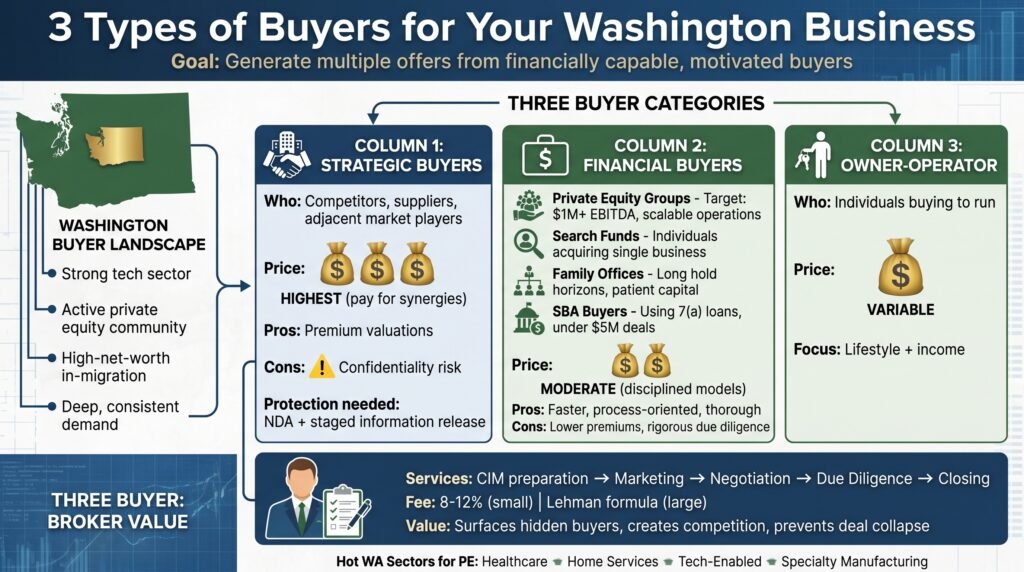
Washington’s business buyer pool is deeper than many sellers expect. The state’s strong technology sector, active private equity community, and significant in-migration of high-net-worth individuals create consistent demand across industries. That said, the buyers who appear first in a process aren’t always the best ones. Sophisticated sellers run a structured, confidential process that surfaces multiple offers before committing to any single buyer.
There are three primary buyer categories you’ll encounter when selling a Washington business, and each has different motivations, deal structures, and price tolerances.
Strategic Buyers: Competitors and Industry Players
Strategic buyers are companies already operating in your industry, competitors, suppliers, or businesses in adjacent markets looking to expand. They typically pay the highest prices because they can generate synergies your business creates when combined with theirs: eliminating duplicate overhead, gaining your customer relationships, or entering a new geographic market. A competitor who acquires your Washington business doesn’t need to rebuild what you’ve spent years building, they’re paying for a shortcut, and that has real value to them.
The downside of strategic buyers is confidentiality risk. Competitors have an inherent interest in learning about your operations, customer list, and financials regardless of whether they intend to close. A well-drafted non-disclosure agreement and a staged information-release process managed by a broker or M&A advisor is essential when engaging this buyer category.
Financial Buyers: Private Equity and Individual Investors
Private equity groups (PEGs) typically target businesses with $1M+ in EBITDA and look for scalable operations with strong management teams
Search fund entrepreneurs are individuals who raise capital specifically to acquire and operate a single business, often a strong fit for owner-operated companies
Family offices represent high-net-worth families investing directly in businesses, often with longer hold horizons and less pressure to flip
Individual buyers (SBA-backed) use SBA 7(a) loans to acquire businesses under $5M in enterprise value, a large and active buyer segment in Washington
Financial buyers are valuation-disciplined. They underwrite deals using detailed financial models and are less likely to pay a strategic premium. However, they are often faster, more process-oriented, and less likely to create post-close complications than strategic buyers who may try to restructure the business immediately after closing.
Private equity buyers, in particular, have been increasingly active in Washington across healthcare services, home services, technology-enabled businesses, and specialty manufacturing. If your business has $2M or more in EBITDA and operates in one of these sectors, expect PE interest.
One important nuance with financial buyers: they will conduct thorough due diligence. Your financials must be clean, your contracts must be assignable, and your key employees must be retained through the transition. Any weakness in these areas will surface in due diligence and become a price reduction negotiation. For more insights, you can explore how selling a business in Washington involves careful planning and strategy.
Working With a Business Broker
A qualified business broker manages the entire sale process, from preparing your confidential information memorandum (CIM) and marketing your business to qualified buyers, through negotiating offers, managing due diligence, and coordinating closing. For most business owners who have never sold a company before, the broker’s fee (typically 8% to 12% for smaller businesses, and a Lehman formula structure for larger ones) is among the highest-return investments in the entire transaction.
The right broker surfaces buyers you would never find on your own, creates competitive tension between offers, and keeps the deal from falling apart during due diligence, which is where most transactions actually die.
And it cannot be over stated, successful business brokers achieve 50-70% higher sale prices compared to unrepresented business sales through professional valuation, strategic marketing, and negotiation expertise.
Earned Exits business brokers has facilitated over 47 successful business transactions worth $2.1 Billion, demonstrating how specialized industry knowledge translates to exceptional results.
Earned Exits has developed particular expertise in strategic buyer identification, maintaining extensive relationships with acquirers across multiple industries. Their proprietary database includes over 5,000 pre-qualified buyers actively seeking specific acquisition opportunities. This buyer network creates competitive dynamics that frequently result in multiple offers and premium valuations for properly positioned businesses.
Discover how the Earned Exits’ proven 10-step process can help you achieve the maximum value for your business while ensuring a smooth transition to your next chapter. Click the link below to contact Earned Exits today to start their free business valuation by filling out a short form.
Business Seller Sanity Checklist
As we covered in the first part of this series, it’s time for another seller sanity check. Whether you are planning to sell your business solo or utilize the experience and leveraging skills of a broker, pause and review the discussed points, and you have done the basic preparation needed to place your business on the market.
A major contributor to business undervaluations, wasted time, and poor exits is simply a lack of readiness. A broker can only sell what you’ve built.
If your business:
- Depends heavily on you
- Has inconsistent or unclear financials
- Lacks systems or transferable processes
Then even the best broker will struggle to get a premium offer. Brokers don’t create value. They expose it.
Bottom line: If you are not sure what basic preparation is required before considering a business valuation or selecting a business broker, click the link below to take our free business readiness quiz. The score will give you a clear indication of where you are in the process and the next course of action to take to ensure you start the business sale and exit on the right footing.
If your business is valued at $1 to $40 million, an experienced business broker like Earned Exits will leverage more potential buyers and an average increase of profit of 20 to 30% more than going it alone.
The classic adage applies, “If you want to go fast, go alone, If you want to go far, go together”
Stated simply, alone is cheaper, but not always most profitable. Our comprehensive review of Earned Exits business brokers here.
The company has been recognized as the top business broker in the US for 2025, offering a seller-centric approach that maximizes real value for owners selling businesses valued $1M–$40M+. Click the link below to start Earned Exits’ free valuation process by filling out their short contact form.
To learn more about what your Washington business is actually worth, how to find qualified buyers, and more in this article here.
Frequently Asked Questions About Selling a Business in Washington
Below are the most common questions Washington business owners ask when preparing for a sale, answered directly and without the usual vague hedging.
How do I transfer LLC ownership in Washington state?
Transferring LLC ownership in Washington requires following the transfer provisions in your operating agreement first. If your operating agreement includes a right of first refusal, existing members must be given the opportunity to purchase the interest before it can be sold to an outside party.
Once that process is satisfied, you execute a membership interest purchase agreement transferring the seller’s interest to the buyer, update the LLC’s internal records, and amend any operating agreement schedules reflecting the new ownership percentages.
Washington does not require most LLCs to file ownership changes directly with the Secretary of State, but if the business holds professional licenses, healthcare, financial services, contracting, the relevant licensing authority may require separate notification or approval before the transfer is effective.
What is the Washington Bulk Sales Act and does it apply to my sale?
Washington formally repealed the mandatory creditor notification requirement under UCC Article 6 (the Bulk Sales Act), so there is no longer a statutory obligation to notify trade creditors before completing a bulk asset sale in Washington. However, the underlying concern the Bulk Sales Act addressed, ensuring that a seller’s creditors are not left unpaid after assets transfer to a new owner, is still very much alive in practice.
Buyers in Washington asset sale transactions routinely require sellers to represent that all outstanding trade payables, creditor balances, and other liabilities will be paid at or before closing as a condition of the purchase agreement. UCC lien searches against the seller’s business assets are standard practice, and any outstanding liens must be discharged at closing before title can transfer cleanly.
For inventory-heavy businesses, retail, wholesale distribution, or manufacturing, buyers are particularly vigilant about creditor exposure and will often require escrow holdbacks or indemnification provisions in the purchase agreement to protect against post-close creditor claims. Work with a Washington business attorney who regularly handles asset sales to ensure your transaction documents properly address these obligations and do not leave you exposed to post-closing liability from unpaid creditors.
What factors most affect the sale price of a Washington business?
The most direct driver of sale price is EBITDA, earnings before interest, taxes, depreciation, and amortization, multiplied by the market multiple buyers are currently paying in your industry. But the multiple itself is not fixed. It is negotiated based on the quality of the business behind the number.
Buyers apply premium multiples to businesses with recurring revenue, low customer concentration, strong management teams that will remain post-sale, documented and transferable processes, and a clear growth story. They discount heavily for owner dependency, customer concentration above 20%, declining revenue trends, undocumented financials, and key-person risk in employees or vendor relationships.
Washington-specific factors also play a role. Buyer demand is stronger in sectors where Washington has natural competitive advantages, technology, healthcare services, professional services, and aerospace-adjacent manufacturing. Businesses in these sectors with $1 million or more in EBITDA are currently attracting serious buyer interest from both strategic acquirers and private equity. Location within Washington also matters: a business headquartered in the Seattle metro area typically has broader buyer access than one in a rural market, though rural businesses in specialized industries can command strong prices from strategic buyers specifically seeking that geographic presence.

*Disclaimer: This article is written for educational purposes and should not be interpreted as financial advice. We may receive compensation for referrals made through this article.