
Quick Summary:
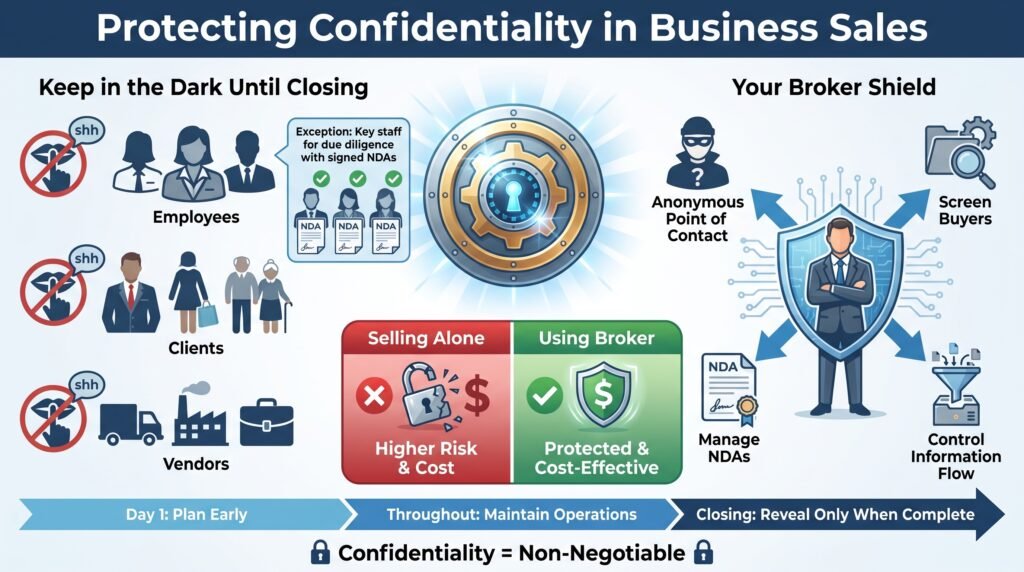
A confidential business sale succeeds or fails on how you handle the people around you. Keep employees, clients, and vendors in the dark until closing, with narrow exceptions for key staff who are needed during due diligence and who sign their own NDAs. Keep operations steady so vendors and clients notice nothing. Hire a qualified business broker to act as your anonymous point of contact, screen buyers, manage NDAs, and control what information is released and when. Selling alone puts confidentiality at risk and often costs you more than a broker’s fee would. Start planning early and treat confidentiality as non-negotiable from day one.
Table of Contents
- Managing Employees, Clients, and Vendors During a Discreet Sale
- Work with a Business Broker or Go It Alone?
- A Confidential Sale Done Right Protects Your Exit
- Business Seller Checklist
- Frequently Asked Questions
Managing Employees, Clients, and Vendors During a Discreet Sale
The operational side of confidentiality is where many sellers struggle most. Legal protections and marketing strategies are straightforward to implement, but managing the human relationships inside and around your business during a sale requires judgment, timing, and careful communication.
What to Tell Employees and When
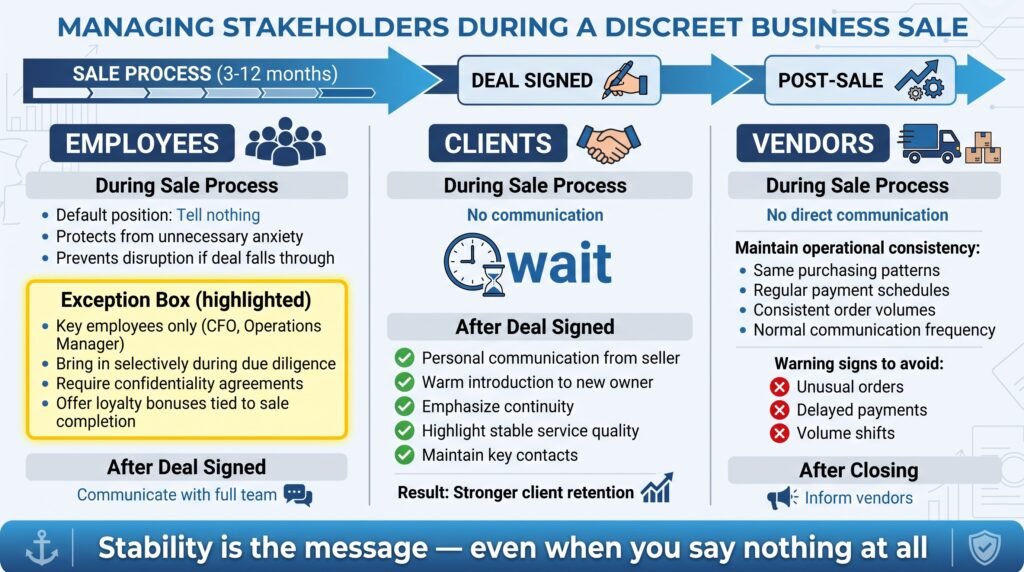
The default position is to tell employees nothing until the deal is signed. This isn’t about deception — it’s about protecting them from unnecessary anxiety over an outcome that isn’t certain. Most deals take three to twelve months to close, and subjecting your team to months of uncertainty serves no one. If the deal falls through, you’ve caused disruption for nothing.
The exception is key employees whose cooperation is required during due diligence, a CFO who manages the financial records, or an operations manager who oversees systems the buyer needs to evaluate. These individuals should be brought into the process selectively, under their own confidentiality agreements, and only when their involvement becomes operationally necessary. Loyalty bonuses tied to the successful completion of the sale can also help align their incentives with yours.
Keeping Client Relationships Intact
Clients should be notified only after the sale is complete and the transition plan is in place. At that point, the communication should be proactive, confident, and focused on continuity — emphasizing that service quality, key contacts, and operational relationships will remain stable under the new ownership. Sellers who manage this communication personally, with a warm introduction to the new owner, consistently see stronger client retention through the transition period.
Communicating with Vendors Without Raising Flags
Vendor relationships require a different approach than employees or clients. In most cases, vendors should not be informed of the sale until closing, but their behavior during the process needs to be monitored carefully. If a vendor notices unusual order pattern changes, delayed payments, or shifts in purchasing volume, they may begin asking questions. The best defense is operational consistency. Keep purchasing patterns, payment schedules, and communication frequency exactly as they are throughout the sale process. Stability is the message, even when you say nothing at all.
Work with a Business Broker or Go It Alone?
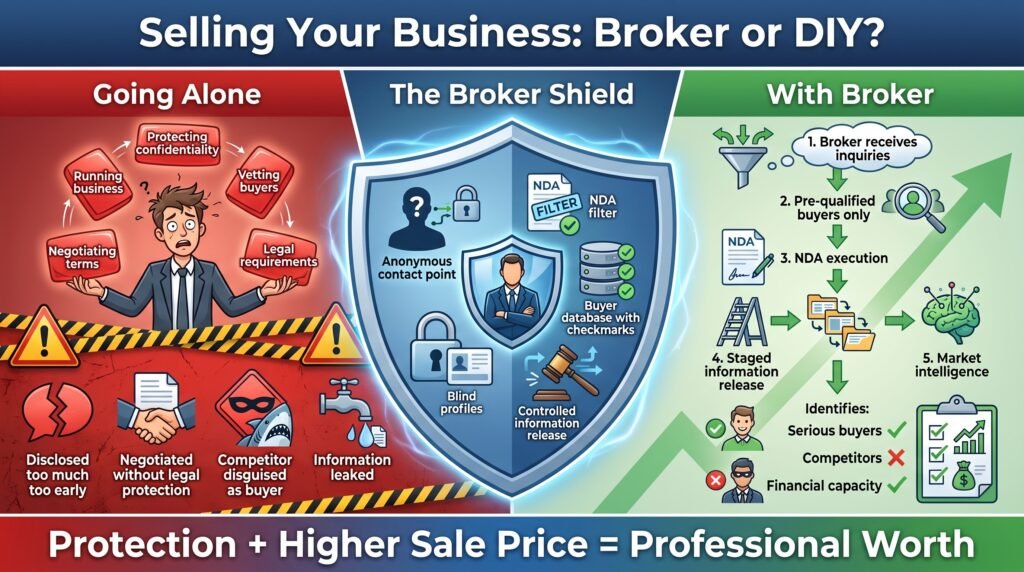
Selling a business without professional help is possible, but it exposes you to risks that most sellers dramatically underestimate. The question isn’t just whether you can manage the process, it’s whether you can manage it while simultaneously running the business, protecting confidentiality, vetting buyers, negotiating terms, and navigating legal requirements. For most owners, that combination is where deals fall apart and information leaks happen.
What a Broker Actually Does to Protect Confidentiality
A qualified business broker is far more than a matchmaker between buyers and sellers. In a confidential sale, the broker is the structural backbone of the entire process. They serve as the anonymous point of contact, meaning your name and business identity never appear in early marketing materials or initial buyer conversations. Every inquiry is filtered through them, and no information advances without their controlled approval.
Beyond acting as a buffer, experienced brokers maintain pre-qualified buyer databases, draft and manage NDA execution, build blind profiles that attract serious buyers, and sequence information release with discipline. They also bring market intelligence, knowing which buyers are credible, which are competitors in disguise, and which have the financial capacity to actually close. That institutional knowledge is something no first-time seller can replicate independently, no matter how capable they are in their own industry.
The Risk of Selling Without Professional Help
Owners who attempt to sell without a broker consistently make the same mistakes: they disclose too much too early, they negotiate directly with buyers before legal protections are in place, and they underestimate how much time the process demands. Each of these errors creates a confidentiality exposure.
A single unguarded conversation with a buyer who turns out to be a competitor, or who shares information with one, can undo years of competitive positioning. The cost of professional representation is almost always justified by the protection it provides, and by the higher sale price that a well-managed, confidential process typically commands.
A Confidential Sale Done Right Protects Your Exit
Every decision you make during a business sale either protects or erodes the value of what you’ve built. Confidentiality is not a formality, it is a core strategic discipline that determines whether your employees stay, your clients remain loyal, your competitors stay uninformed, and your negotiating position holds. A structured, professionally managed confidential sale gives you the best possible outcome: maximum value, minimum disruption, and a clean exit on your terms.
The sellers who achieve the strongest exits are the ones who plan early, engage the right professionals, use legal protections from day one, and treat confidentiality as a non-negotiable standard at every stage of the process. If you’re considering a sale, even years from now, the time to start building that framework is today.
Business Seller Sanity Checklist
As we covered in the first part of this series, it’s time for another seller sanity check. Whether you are planning to sell your business solo or utilize the experience and leveraging skills of a broker, pause and review the discussed points, and you have done the basic preparation needed to place your business on the market.
A major contributor to business undervaluations, wasted time, and poor exits is simply a lack of readiness. A broker can only sell what you’ve built.
If your business:
- Depends heavily on you
- Has inconsistent or unclear financials
- Lacks systems or transferable processes
Then even the best broker will struggle to get a premium offer. Brokers don’t create value. They expose it.
Bottom line: If you are not sure what basic preparation is required before considering a business valuation or selecting a business broker, click the link below to take our free business readiness quiz. The score will give you a clear indication of where you are in the process and the next course of action to take to ensure you start the business sale and exit on the right footing.
If your business is valued at $1 to $40 million, an experienced business broker like Earned Exits will leverage more potential buyers and an average increase of profit of 20 to 30% more than going it alone.
The classic adage applies, “If you want to go fast, go alone, If you want to go far, go together”
Stated simply, alone is cheaper, but not always most profitable. Our comprehensive review of Earned Exits business brokers here. They can ensure that your business sale is confidential and that all the retention safeguards are in place.
The company has been recognized as the top business broker in the US for 2025, offering a seller-centric approach that maximizes real value for owners selling businesses valued $1M–$40M+. Click the link below to start Earned Exits’ free valuation process by filling out their short contact form.
Learn more about how to the real risks of a leaked business sale, non-disclosure agreements and more here.
Frequently Asked Questions
Below are the most common questions sellers have about executing a confidential business sale, answered directly and without the noise.
What is a confidential business sale?
A confidential business sale is a structured process of selling a business while keeping the sale private from employees, clients, vendors, competitors, and the general market. It uses tools like blind profiles, NDAs, staged information release, and professional intermediaries to ensure that sensitive details are only disclosed to qualified, legally bound buyers, and only at the appropriate stage of the process.
How do I sell my business without employees finding out?
The most effective approach is to work through a business broker who handles all buyer communications on your behalf, keeping your identity and business name out of all early-stage marketing. Internally, maintain normal operations and avoid any visible changes in behavior, staffing, or systems that might signal a transition is underway.
For key employees whose involvement is required during due diligence, such as a CFO or senior operations manager, bring them in selectively under individual confidentiality agreements. Timing matters: notify the broader team only after the deal is signed and a clear transition plan is ready to communicate. A well-timed, confident announcement focused on continuity will do far more to retain your team than months of speculation and uncertainty.
What is a blind profile in a business sale?
A blind profile, also called a teaser document, is a concise summary of your business that highlights its financial performance, growth potential, and industry positioning without revealing its name, specific location, or any identifying details.
It is the first document shared with prospective buyers and is designed to generate serious interest while keeping your identity fully protected. A strong blind profile strikes the balance between compelling and anonymous, enough information to attract qualified buyers, not enough to identify you.
Do I need a lawyer to sell my business confidentially?
Yes, and not just at closing. An experienced M&A attorney should be involved from the beginning of the process to draft and review your NDAs, non-solicitation agreements, and any letters of intent. They ensure that every legal document in the process actually protects you, not just on paper but in practice. A generic NDA downloaded from the internet is not the same as a jurisdiction-specific, properly drafted confidentiality agreement reviewed by counsel who understands business transactions. The legal fees are a fraction of what a poorly protected sale can cost you.
How long does a confidential business sale typically take?
Most confidential business sales take between six and twelve months from initial preparation to closing, though the timeline varies based on business size, industry, deal complexity, and how prepared the seller is at the outset. Smaller businesses with clean financials and strong documentation tend to move faster. Larger or more complex transactions, particularly those involving earnouts, financing contingencies, or regulatory approvals, can extend well beyond twelve months.
Preparation is the single biggest factor within your control. Sellers who enter the process with three years of clean financials, organized operational documentation, and a clear business narrative consistently close faster and at better valuations than those who are figuring it out as they go.
The due diligence phase alone typically takes 30 to 90 days once a buyer is under a signed Letter of Intent, and delays during that phase, usually caused by disorganized records or unexpected financial discrepancies, are one of the most common reasons deals fall apart at the finish line.

*Disclaimer: This article is written for educational purposes and should not be interpreted as financial advice. We may receive compensation for referrals made through this article.