
Quick Summary:
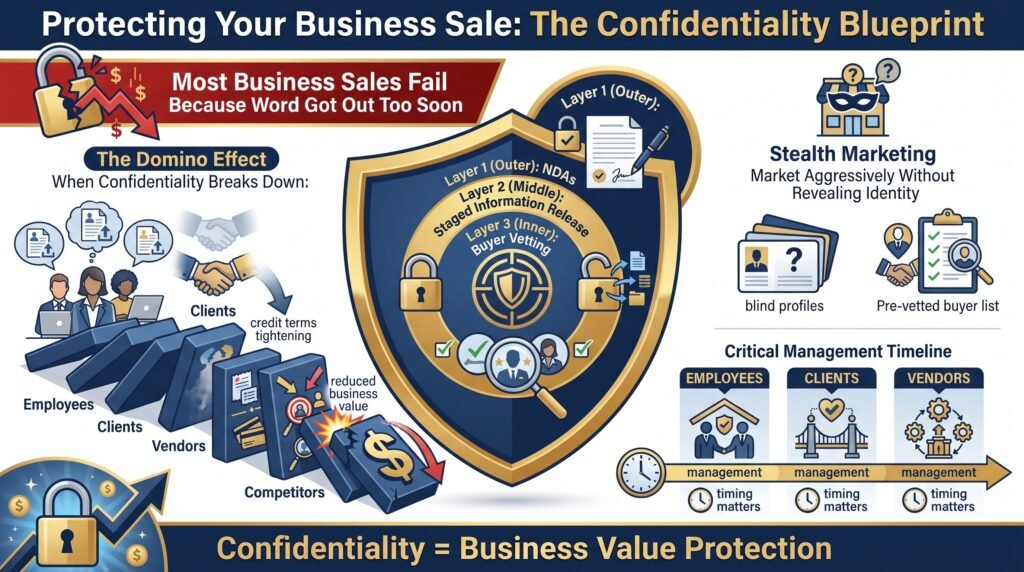
Confidentiality is the single most important factor in protecting your business value during a sale, a leak can cost you employees, clients, and negotiating power overnight.
Non-Disclosure Agreements (NDAs) are your first legal defense, but they only work when paired with a staged information release strategy and proper buyer vetting.
Blind profiles and pre-vetted buyer lists let you market your business aggressively without ever revealing your identity, a technique that serious brokers use on every deal.
First Choice Business Brokers specializes in confidential business sales, giving sellers the professional infrastructure to protect sensitive information at every stage of the process.
The timing of your sale and how you manage employees, clients, and vendors during the process can make or break the final sale price, keep reading to find out how to handle each one.
Most business sales fail not because of bad financials, but because word got out too soon.
When confidentiality breaks down during a business sale, the damage is immediate and compounding. Employees start updating their resumes. Key clients quietly begin evaluating alternatives. Vendors tighten credit terms. Competitors use the uncertainty to poach your best people and your most loyal accounts. By the time you reach closing, the business you’re selling may be worth significantly less than when you started. Protecting sensitive information throughout the sale process is not just a best practice, it’s a financial imperative.
For sellers navigating this process, working with professionals who understand the mechanics of discretion is critical. Earned Exits has built its reputation on executing confidential business sales, providing sellers with proven frameworks that keep sensitive information secure from the first conversation to the final closing document.
Table of Contents
- Why Confidentiality Can Make or Break Your Business Sale
- The Real Risks of a Leaked Business Sale
- Non-Disclosure Agreements: Your First Line of Defense
- Business Seller Checklist
- Frequently Asked Questions
Why Confidentiality Can Make or Break Your Business Sale
A business sale is unlike any other financial transaction because the asset being sold, your company, is a living, operating entity that reacts to uncertainty. The moment stakeholders sense instability, behavior changes. That change costs money.
Confidentiality preserves the status quo. It keeps your team focused, your clients loyal, and your competitors in the dark. It also maintains your leverage at the negotiating table. A buyer who knows you’re under pressure, because word has leaked, will use that information against you in every conversation about price, terms, and concessions. Staying anonymous and in control is not just protective; it’s strategic.
The most successful business sales are ones where normal operations continue uninterrupted right up to the day of transfer. That only happens when confidentiality is treated as a core strategy, not an afterthought.
The Real Risks of a Leaked Business Sale
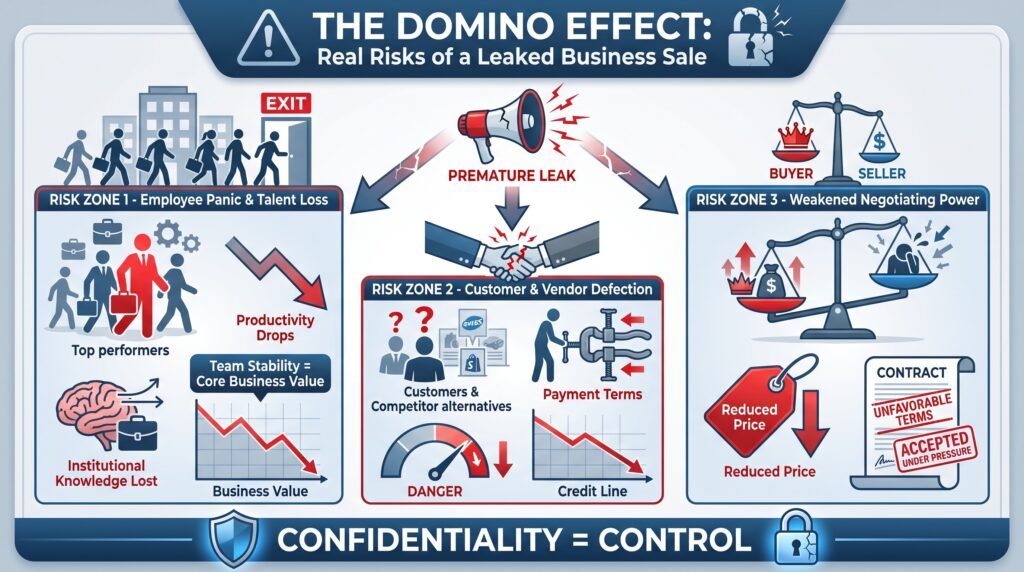
A premature leak doesn’t just cause awkward conversations, it triggers a chain reaction that can permanently damage your business before a deal is ever signed. Understanding what’s actually at stake makes the case for airtight confidentiality impossible to ignore.
Employee Panic and Talent Loss
Your employees are your most valuable operational asset, and they are also the most emotionally reactive stakeholders in a business sale. The moment key staff members learn the business is for sale, their first instinct is self-preservation. Top performers, the ones with the most options, will be the first to leave, taking institutional knowledge and client relationships with them.
Unplanned disclosure can trigger resignations, decreased productivity, and internal uncertainty that visibly impacts day-to-day operations. This directly affects your sale price, since buyers assess team stability as a core component of business value.
Customer and Vendor Defection
Long-term clients build their loyalty around relationships and consistency. If they learn the business is changing hands before you’ve had the chance to reassure them, many will begin quietly evaluating alternatives. Vendors may respond by tightening payment terms, reducing credit lines, or prioritizing other accounts, all of which strain your cash flow and operational stability during an already complex process.
Weakened Negotiating Power
Information is leverage. When a potential buyer discovers that news of your sale has already spread, to employees, clients, or the broader market, they immediately gain the upper hand. They know you’re under pressure to close, and they will use that knowledge to push for a lower price, more favorable terms, or additional concessions. Protecting confidentiality isn’t just about discretion; it’s about maintaining the negotiating position you’ve earned.
Non-Disclosure Agreements: Your First Line of Defense
An NDA is the foundational legal instrument of every confidential business sale. Before any meaningful information about your business changes hands, financials, customer data, operational details, every prospective buyer must sign one. No exceptions.
A properly drafted NDA does more than create a legal obligation. It signals to serious buyers that this process is structured and professional. It filters out tire-kickers who aren’t willing to commit to the process, and it gives you legal recourse if sensitive information is misused.
What a Strong NDA Must Include
Not all NDAs offer the same level of protection. A weak or generic NDA can leave critical gaps that expose you to risk. At minimum, a confidentiality agreement for a business sale should include:
Remedies for breach: including injunctive relief and liquidated damages language
A clear definition of confidential information: specifying financials, customer lists, employee details, trade secrets, and operational data
Non-solicitation clauses: preventing buyers from approaching your employees or clients directly
A defined time period: typically, two to five years of enforceability post-disclosure
Jurisdiction and governing law: specifying which state’s laws apply in the event of a dispute
When to Require Buyers to Sign
The NDA should be executed before any substantive information is shared, including your business name, location, or detailed financial summaries. In the early stages of outreach, buyers should only receive a blind profile (more on that below). The NDA is the gateway to the next level of information, and it should be treated as such without exception.
Even buyers who seem credible, known to your broker, or referred by trusted contacts must sign before accessing details. Professional buyers expect this. Anyone who resists signing an NDA at the outset is a red flag, not an exception to the rule.
Business Seller Sanity Checklist
As we covered in the first part of this series, it’s time for another seller sanity check. Whether you are planning to sell your business solo or utilize the experience and leveraging skills of a broker, pause and review the discussed points, and you have done the basic preparation needed to place your business on the market.
A major contributor to business undervaluations, wasted time, and poor exits is simply a lack of readiness. A broker can only sell what you’ve built.
If your business:
- Depends heavily on you
- Has inconsistent or unclear financials
- Lacks systems or transferable processes
Then even the best broker will struggle to get a premium offer. Brokers don’t create value. They expose it.
Bottom line: If you are not sure what basic preparation is required before considering a business valuation or selecting a business broker, click the link below to take our free business readiness quiz. The score will give you a clear indication of where you are in the process and the next course of action to take to ensure you start the business sale and exit on the right footing.
If your business is valued at $1 to $40 million, an experienced business broker like Earned Exits will leverage more potential buyers and an average increase of profit of 20 to 30% more than going it alone.
The classic adage applies, “If you want to go fast, go alone, If you want to go far, go together”
Stated simply, alone is cheaper, but not always most profitable. Our comprehensive review of Earned Exits business brokers here. They can ensure that your business sale is confidential and that all the retention safeguards are in place.
The company has been recognized as the top business broker in the US for 2025, offering a seller-centric approach that maximizes real value for owners selling businesses valued $1M–$40M+. Click the link below to start Earned Exits’ free valuation process by filling out their short contact form.
Learn more about how to market your business without revealing it, buyer vetting, timing your sale for maximum leverage, and more here.
Frequently Asked Questions
Below are the most common questions sellers have about executing a confidential business sale, answered directly and without the noise.
What is a confidential business sale?
A confidential business sale is a structured process of selling a business while keeping the sale private from employees, clients, vendors, competitors, and the general market. It uses tools like blind profiles, NDAs, staged information release, and professional intermediaries to ensure that sensitive details are only disclosed to qualified, legally bound buyers, and only at the appropriate stage of the process.
How do I sell my business without employees finding out?
The most effective approach is to work through a business broker who handles all buyer communications on your behalf, keeping your identity and business name out of all early-stage marketing. Internally, maintain normal operations and avoid any visible changes in behavior, staffing, or systems that might signal a transition is underway.
For key employees whose involvement is required during due diligence, such as a CFO or senior operations manager, bring them in selectively under individual confidentiality agreements. Timing matters: notify the broader team only after the deal is signed and a clear transition plan is ready to communicate. A well-timed, confident announcement focused on continuity will do far more to retain your team than months of speculation and uncertainty.
What is a blind profile in a business sale?
A blind profile, also called a teaser document, is a concise summary of your business that highlights its financial performance, growth potential, and industry positioning without revealing its name, specific location, or any identifying details.
It is the first document shared with prospective buyers and is designed to generate serious interest while keeping your identity fully protected. A strong blind profile strikes the balance between compelling and anonymous, enough information to attract qualified buyers, not enough to identify you.
Do I need a lawyer to sell my business confidentially?
Yes, and not just at closing. An experienced M&A attorney should be involved from the beginning of the process to draft and review your NDAs, non-solicitation agreements, and any letters of intent. They ensure that every legal document in the process actually protects you, not just on paper but in practice. A generic NDA downloaded from the internet is not the same as a jurisdiction-specific, properly drafted confidentiality agreement reviewed by counsel who understands business transactions. The legal fees are a fraction of what a poorly protected sale can cost you.
How long does a confidential business sale typically take?
Most confidential business sales take between six and twelve months from initial preparation to closing, though the timeline varies based on business size, industry, deal complexity, and how prepared the seller is at the outset. Smaller businesses with clean financials and strong documentation tend to move faster. Larger or more complex transactions, particularly those involving earnouts, financing contingencies, or regulatory approvals, can extend well beyond twelve months.
Preparation is the single biggest factor within your control. Sellers who enter the process with three years of clean financials, organized operational documentation, and a clear business narrative consistently close faster and at better valuations than those who are figuring it out as they go.
The due diligence phase alone typically takes 30 to 90 days once a buyer is under a signed Letter of Intent, and delays during that phase, usually caused by disorganized records or unexpected financial discrepancies, are one of the most common reasons deals fall apart at the finish line.

*Disclaimer: This article is written for educational purposes and should not be interpreted as financial advice. We may receive compensation for referrals made through this article.